Now I have read all the images. The document consists of pages 1–8 as the primary letter, followed by an "Other Copies" divider and duplicate copies. I will transcribe the primary document only.
[Cover, docket notation written sideways:]
[from # Secy. [undecipherable] War
Pitts[undecipherable] 1798]
[undecipherable]
[Seal]
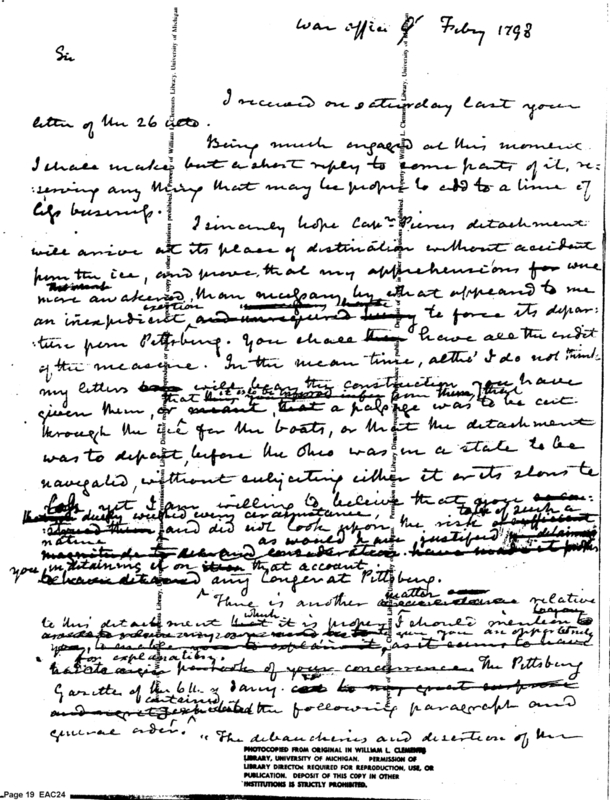
War Office 4 February 1798
Sir,
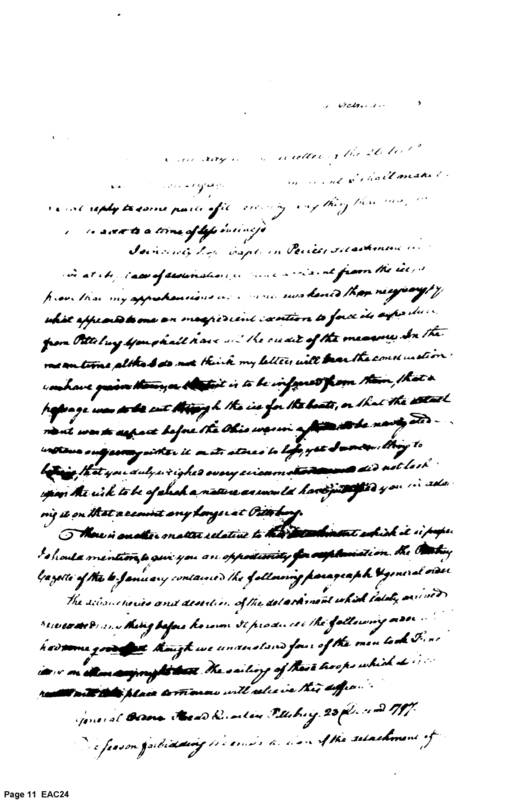
I received on Saturday last your letter of the 26 Ulto.
Being much engaged at this moment I shall make but a short reply to some parts of it, reserving any thing that may be proper to add to a time of less business.
I sincerely hope Captain Pierce's detachment will arrive at its place of destination, without accident from the ice, and prove that my apprehensions were more awakened than necessary, by what appeared to me an inexpedient exertion to force its departure from Pittsburg. You shall have all the credit of the measure. In the mean time, altho I do not think my letters will bear the construction you have given them, or that it is to be inferred from them, that a passage was to be cut through the ice for the boats, or that the detachment was to depart before the Ohio was in a state to be navigated without subjecting either it or its stores to [undecipherable] I am [undecipherable] believe that you duly weighed every circumstance, and did not look upon the risk to be of such a nature as would have justified you in detaining it on that account any longer at Pittsburg.
There is another matter relative to this detachment which it is proper I should mention to give you an opportunity for explanation. the Pittsburg Gazette of the 16 January contained the following paragraph, & general order.
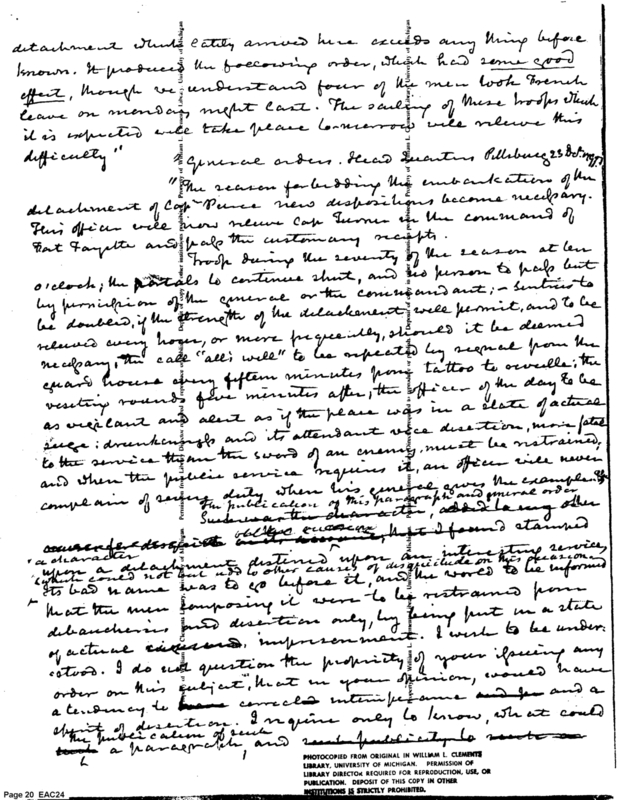
"The debaucheries and desertion of the detachment which lately arrived here, exceeded any thing before known. It produced the following order, which had some good effect, though we understand four of the men took French leave on Monday night last. The sailing of these troops which is expected will take place tomorrow will relieve this difficulty."
"General Orders. Head Quarters Pittsburg. 23 Decemd 1797.
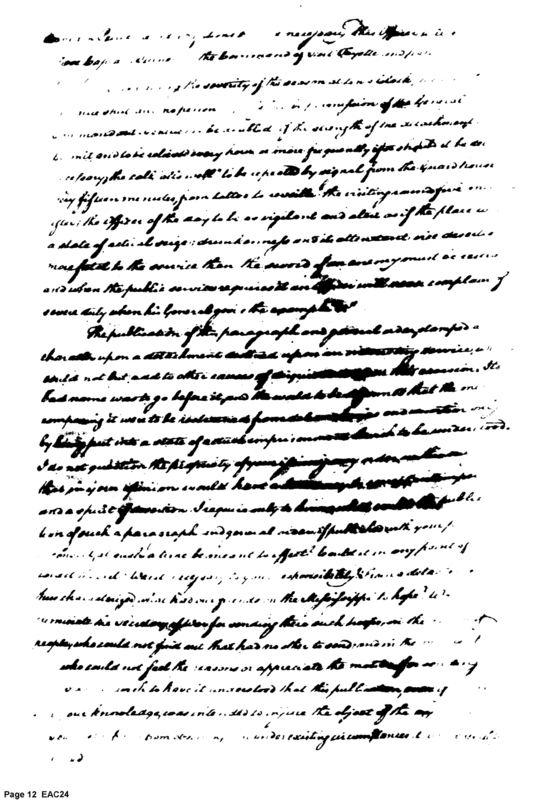
"The reason for forbidding the embarkation of the detachment of Capt Pierce, new dispositions become necessary. This Officer will now relieve Captain Turner in the Command of Fort Fayette, and pass the customary receipts.
"Troop, during the severity of the season at ten o'clock, the portals to continue shut, and no person to pass but by permission of the General or the Commandant. Sentries to be doubled, if the strength of the detachment will permit, and to be relieved every hour, or more frequently, if it should be deemed necessary; the call 'all is well' to be expected by signal from the Guard House every fifteen minutes from tattoo to reveille. the visiting [undecipherable] and five minutes after; the Officer of the day to be as vigilant and alert as if the place was in a state of actual seige; drunkenness and its attendant vice desertion, are more fatal to the service than the sword of an enemy, must be restrained; and when the public service requires it an Officer will never complain of severe duty, when his General gives the example &c."
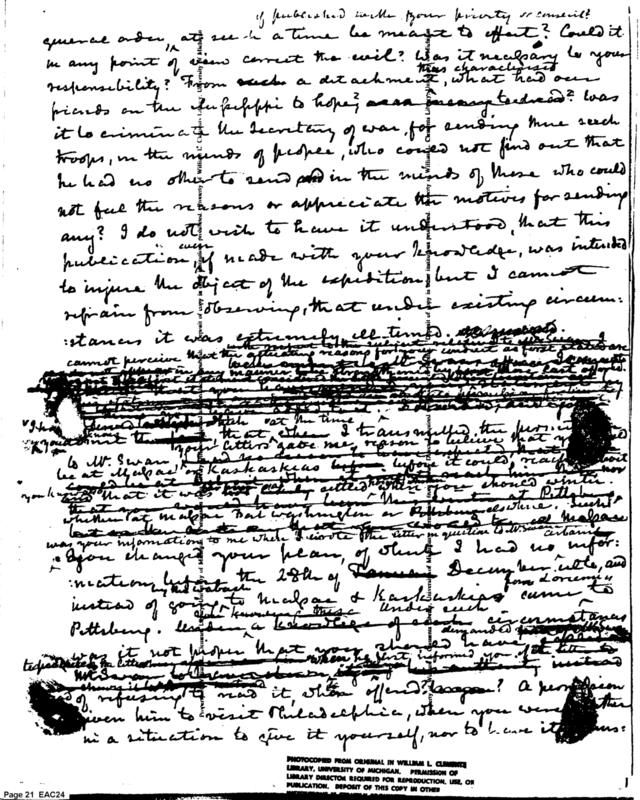
The publication of this paragraph and general order, stamped a character upon a detachment destined upon an interesting service, which could not but add to other causes of disquietude upon this occasion. Its bad name was to go before it, and the world is to be informed that the men composing it were to be restrained from debaucheries and desertion only by being put into a state of actual imprisonment. I wish to be convinced. I do not question the propriety of your issuing any order on this subject that in your opinion would have a tendency to correct intemperance and a spirit of desertion. I require only to know what could the publication of such a paragraph and general order, if published with your privity or consent, at such a time be meant to effect? Could it in any point of view correct the evil? Was it necessary to your responsibility? [undecipherable] a detachment thus characterized, what had our friends on the Mississippi to hope? Was it to criminalize the Secretary of War for sending there such troops, in the minds of people, who could not find out that he had no other to send; and in the minds of those who could not feel the reasons or appreciate the motives for sending any? I do not wish to have it understood that this publication, even if made with your knowledge, was intended to injure the object of the expedition, but I cannot refrain from observing that under existing circumstances it was exceedingly ill timed.
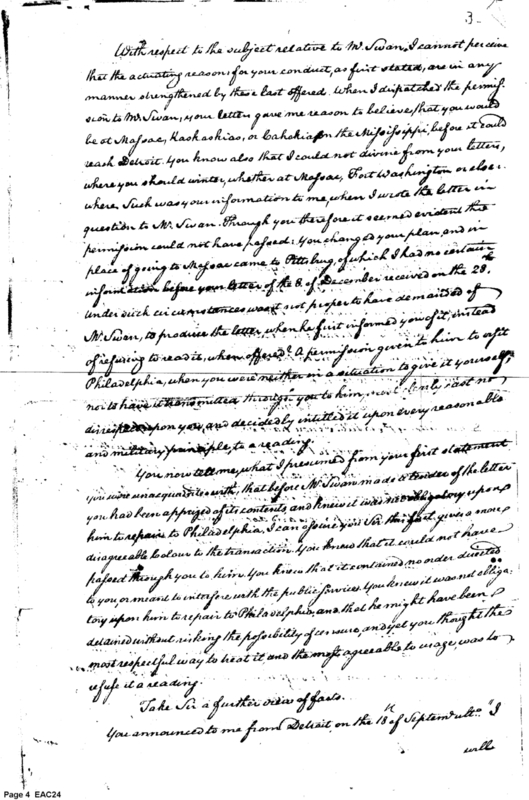
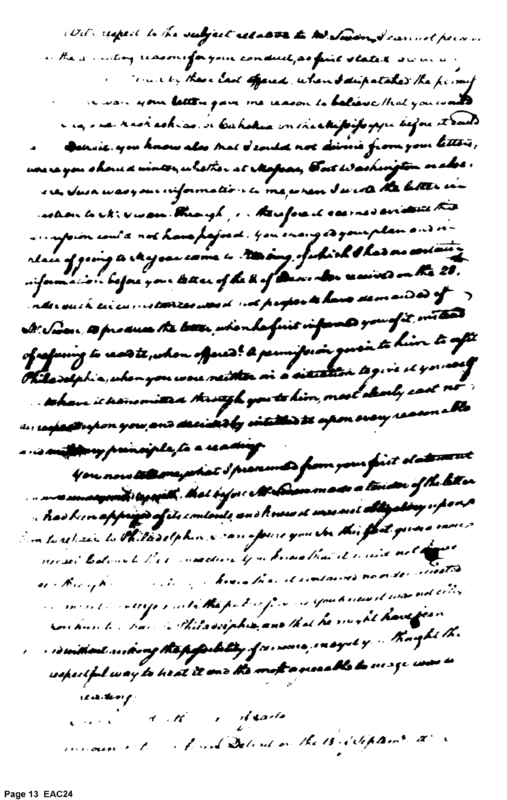
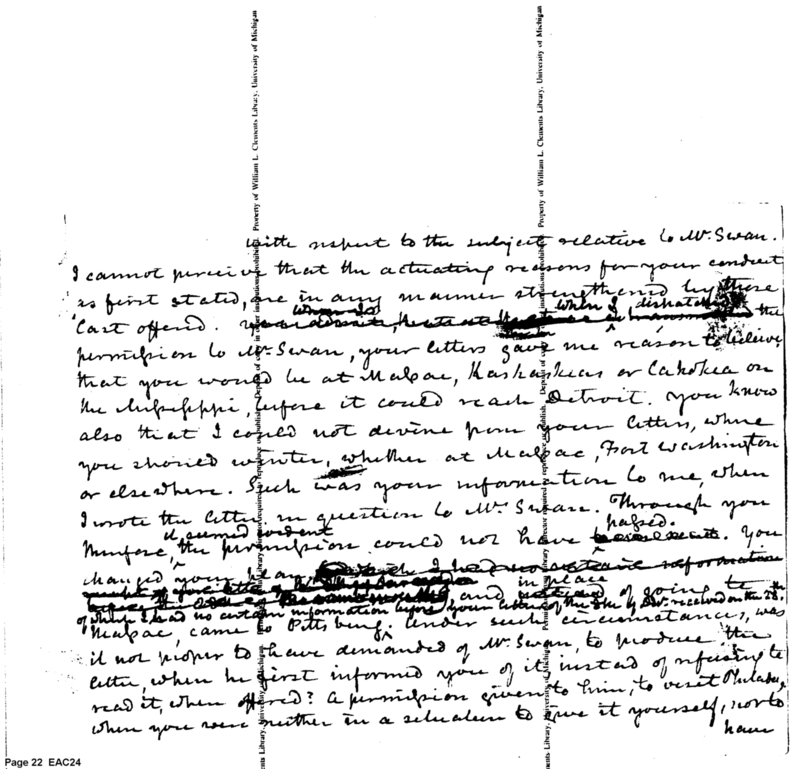
With respect to the subject relative to Mr Swan, I cannot perceive that the actuating reasons for your conduct, as first stated, are in any manner strengthened by those last offered. When I dispatched the permission to Mr Swan, your letters gave me reason to believe, that you would be at Mafosac, Kaskaskias, or [undecipherable] on the Mississippi, before it could reach Detroit. You know also that I could not divine from your letters, where you should winter, whether at Mafosac, Fort Washington or elsewhere. Such was your information to me when I wrote the letter in question to Mr Swan. Through you therefore it seemed evident the permission could not have passed. You changed your plan and in place of going to Mafosac came to Pittsburg, of which I had no certain information before your letter of the 8 of December received on the 28. Under such circumstances was it not proper to have demanded of Mr Swan, to produce the letter, when he first informed you of it, instead of refusing to read it, when offered? A permission given to him to visit Philadelphia, when you were neither in a situation to give it yourself, nor to have it transmitted through you to him, could not [undecipherable] directly upon you, and decidedly entitled it upon every reasonable and military principles, to a reading.
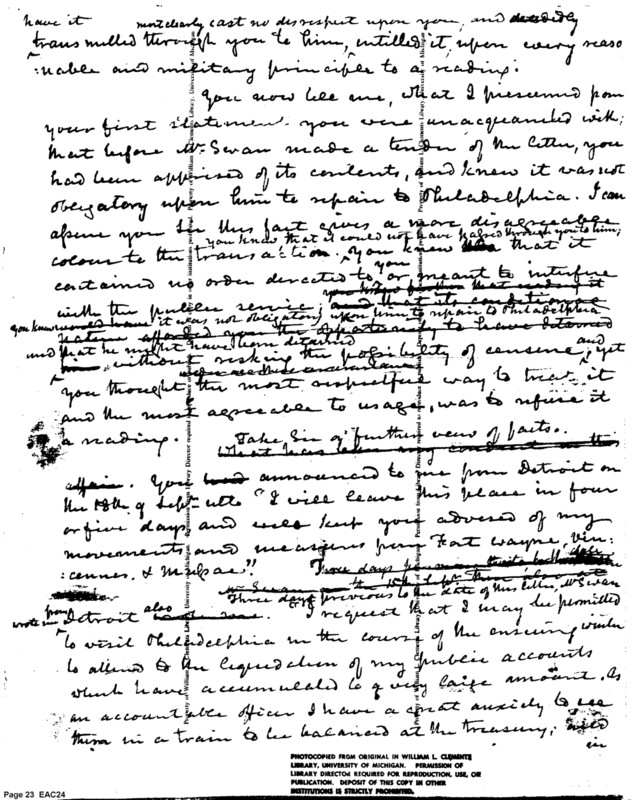
You now tell me, what I presumed from your first statement you were unacquainted with, that before Mr Swan made a trustee of the letter you had been apprised of its contents, and knew it was not obligatory upon him to repair to Philadelphia. I can assure you Sir, this fact gives a more disagreeable colour to the transaction. You know that it could not have passed through you to him; that it contains no order directed to you, or meant to interfere with the public service. You knew it was not obligatory upon him to repair to Philadelphia, and that he might have been detained without risking the possibility of censure, and yet you thought the most respectful way to treat it and the most agreeable to usage, was to refuse it a reading.
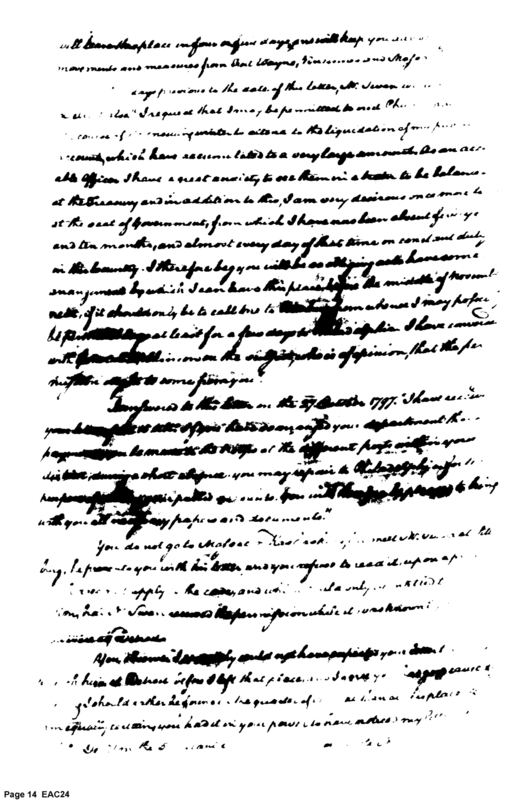
Take Sir a further view of facts.
You announced to me from Detroit on the 13 of September— I
will leave this place in four or a few days, and will keep you advised of my movements and measures from Fort Wayne, Vincennes and Mafosac.
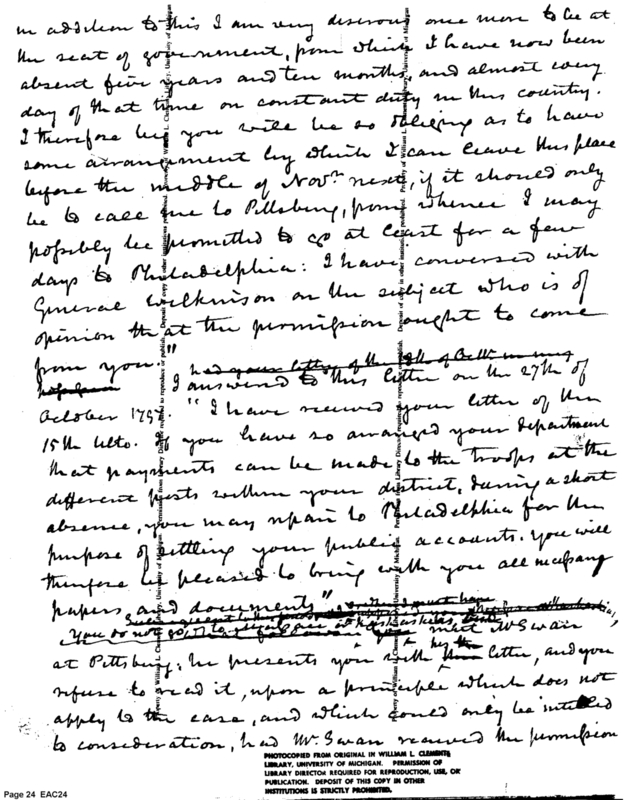
Three days previous to the date of this letter, Mr Swan wrote me from Detroit also. "I request that I may be permitted to visit Philadelphia in the course of the ensuing winter, to attend to the liquidation of my public accounts, which have accumulated to a very large amount. As an accountable Officer I have a great anxiety to see them in a train to be balanced at the Treasury, and in addition to this, I am very desirous once more to be at the seat of Government, from which I have now been absent five years and ten months, and almost every day of that time on constant duty in this Country. I therefore beg you will be so obliging as to have some arrangement by which I can leave this place before the middle of November next, if it should only be to call me to Pittsburg from whence I may possibly be permitted to go at least for a few days to Philadelphia. I have conversed with General Wilkinson on the subject, who is of opinion, that the permission ought to come from you."
I answered to this letter on the 27 October 1797. "I have received your letter of the 15 Ulto. If you have so arranged your department that payments can be made to the troops at the different posts within your district, during a short absence, you may repair to Philadelphia for the purpose of settling your public accounts. You will therefore be pleased to bring with you all necessary papers and documents."
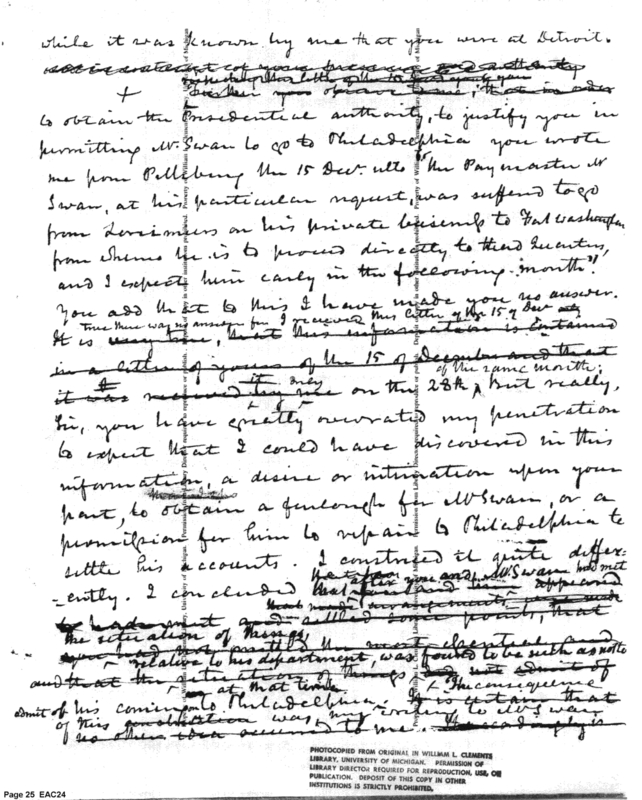
You do not go to Mafosac or Kaskaskias, but meet Mr Swan at Pittsburg; he presents you with his letter, and you refuse to receive it, upon a principle which does not apply to the case, and which could only be entitled to consideration, had Mr Swan received the permission while it was known by me, that you were at Detroit.
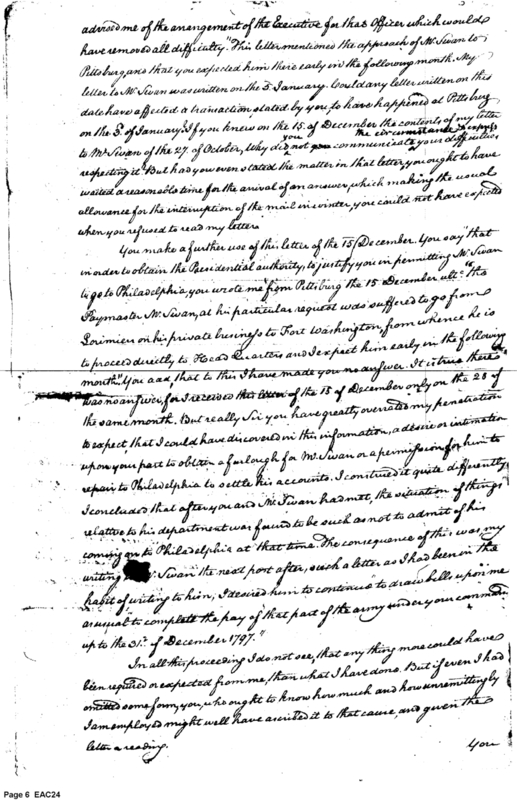
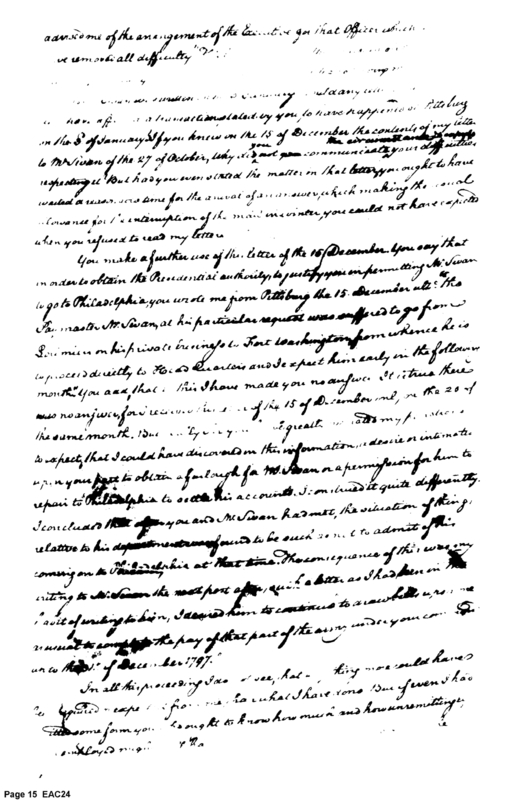
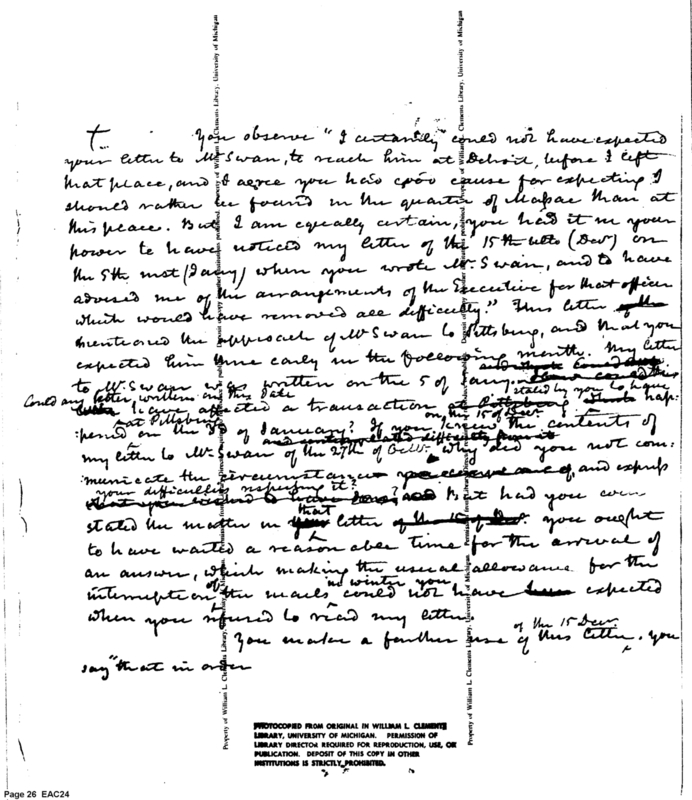
You observe, I certainly could not have expected your letter to Mr Swan to reach him at Detroit, before I left that place, and I am very sure you had good cause for expecting I should rather be found in the quarters of Mafosac than at this place. But I am equally certain, you had it in your power to have noticed my letter of the 15 Ulto (Decr) on the 5 instant (January) when you wrote Mr Swan, and to have advised me of the arrangement of the Executive for that Officer which would have removed all difficulty. This letter mentions the approach of Mr Swan to Pittsburg, and that you expected him there early on the following month. My letter to Mr Swan was written on the 5 January. Could any letter written on this date have effected a transaction stated by you to have happened at Pittsburg on the 8 of January? If you knew on the 15 of December the contents of my letter to Mr Swan of the 27 of October, why did not you communicate your difficulties respecting it? But had you even stated the matter in that letter, you ought to have waited a reasonable time for the arrival of an answer, which making the usual allowance for the interruption of the mail in winter, you could not have expected when you refused to read my letter.
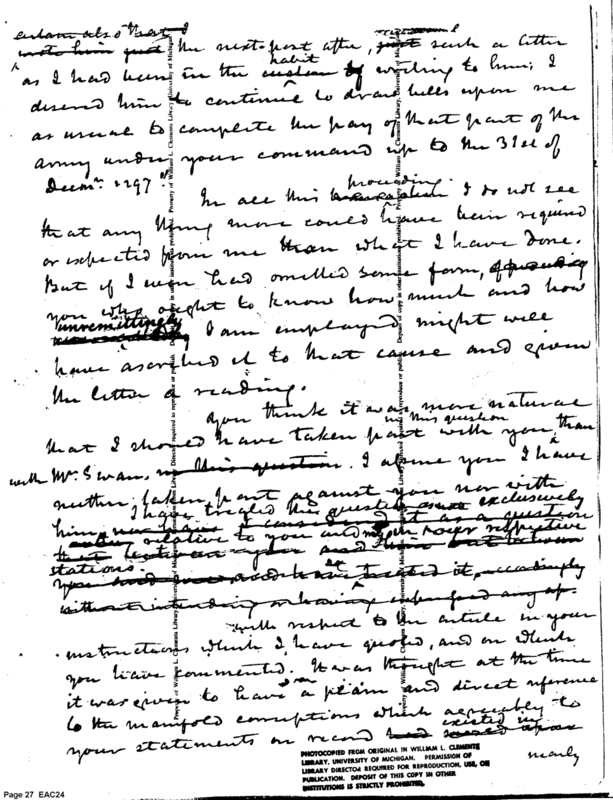
You make a further use of the letter of the 15 December. You say that in order to obtain the Presidential authority, to justify you in permitting Mr Swan to go to Philadelphia, you wrote me from Pittsburg the 15 December Ulto. "The Paymaster Mr Swan, at his particular request, was suffered to go from [undecipherable] on his private business to Fort Washington, from whence he is to proceed directly to Head Quarters, and I expect him early in the following month." You add that to this I have made you no answer. It is true there was no answer, for I received this letter of the 15 of December only on the 28 of the same month. But really Sir you have greatly overrated my penetration to expect that I could have discovered in this information, a desire or intimation upon your part, to obtain a furlough for Mr Swan, or a permission for him to repair to Philadelphia to settle his accounts. I construed it quite differently. I concluded that after you and Mr Swan had met, the situation of things relative to his department was found to be such as not to admit of his coming to Philadelphia at that time. The consequence of this was, my writing Mr Swan the next port after, such a letter as I had been in the habit of writing to him, I desired him to continue to draw bills upon me as usual to complete the pay of that part of the army under your command up to the 31st of December 1797."
In all this proceeding I do not see, that any thing more could have been required or expected from me, than what I have done. But if even I had omitted some form, you ought to know how much and how unremittingly [I] am employed might well have ascribed it to that cause, and given the letter a reading.
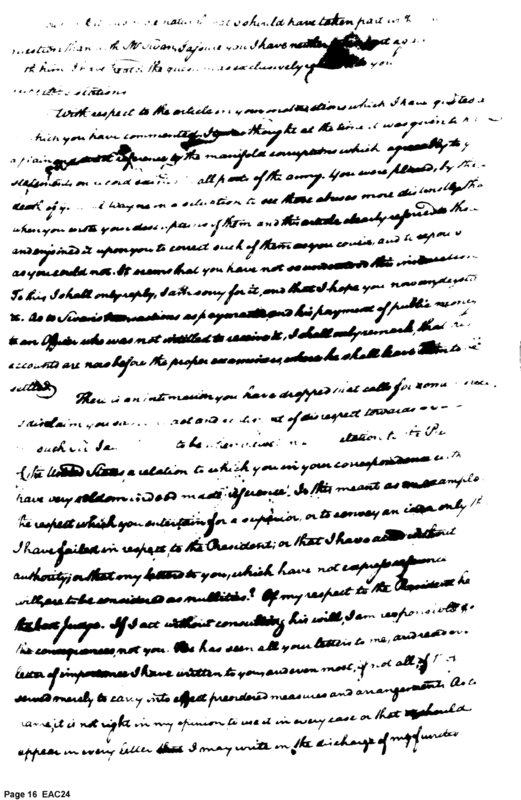
You think it was more natural that I should have taken part with you in this question than with Mr Swan. I assure you I have neither taken part against you nor with him. I have treated the question as exclusively relative to you and me in our respective stations.
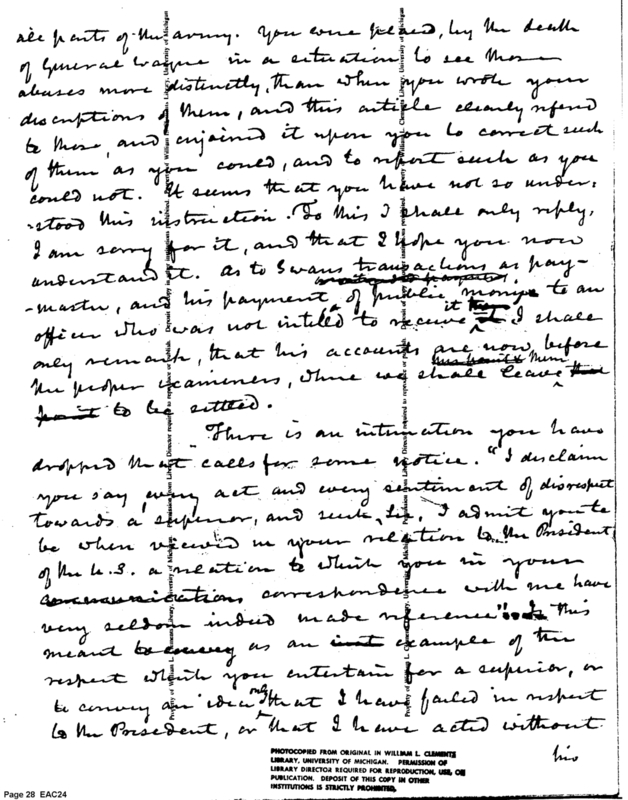
With respect to the article in your instructions which I have quoted and on which you have commented. It was thought he as the time it was going to have a plain and direct reference to the manifold corruptions which, agreeably to your statements on record existed in all parts of the army. You were placed, by the death of General Wayne, in a situation to see those abuses more distinctly, than when you wrote your descriptions of them, and this article clearly referred to those, and enjoined it upon you to correct such of them as you could, and to report such as you could not. It seems that you have not so understood this instruction. To this I shall only reply, I am sorry for it, and that I hope you now understand it. As to Swan's transactions as paymaster, and his payment of public money to an Officer who was not entitled to receive it, I shall only remark, that his accounts are now before the proper examiners, where he shall have them to be [strikethrough: settled].
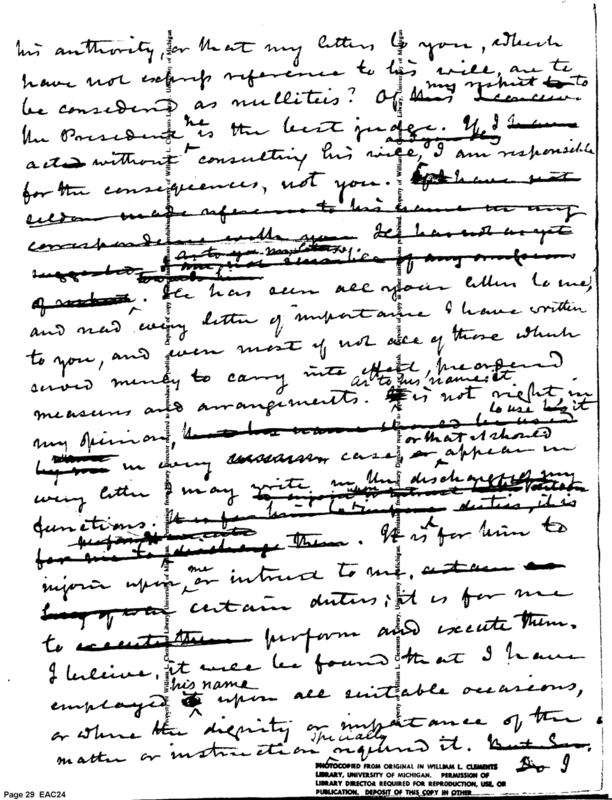
There is an intimation you have dropped that calls for some notice. "I disclaim you say, every act and [strikethrough: statement] of disrespect [strikethrough: towards a superior, and such, Sir, I admit you to be when viewed in your relation to the President] and such, Sir, I admit you to be when viewed in your relation to the President of the United States, a relation to which you in your correspondence with one of the [undecipherable] have very seldom indeed made reference". Is this meant as an example of the respect which you entertain for a superior, or to convey an idea only, that I have failed in respect to the President; or that I have acted without his authority; or that my letters to you, which have not express reference to his will, are to be considered as nullities? Of my respect [to the] President he is the best judge. If I act without consulting his will, I am responsible for the consequences, not you. He has seen all your letters to me, and read every letter of importance I have written to you, and even most, if not all, of those which served merely to carry into effect preordered measures and arrangements. As to his name, it is not right in my opinion to use it in every case, or that it should appear in every letter that I may write, in the discharge of my functions.
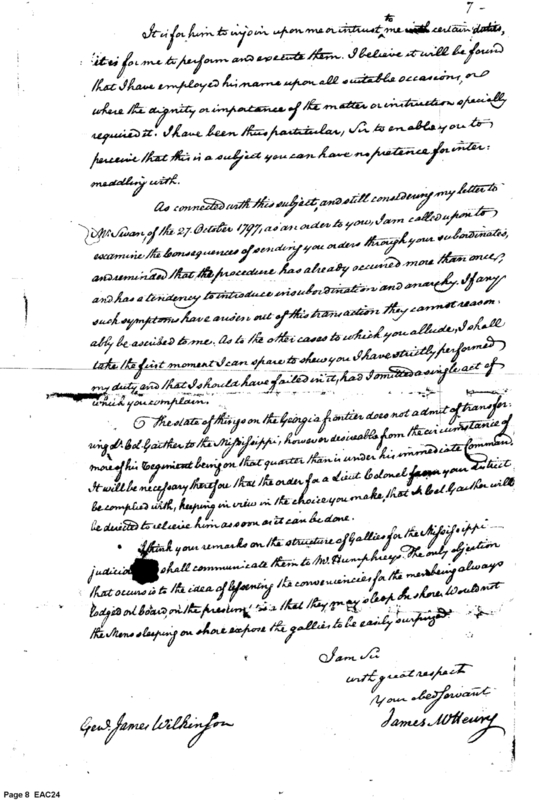
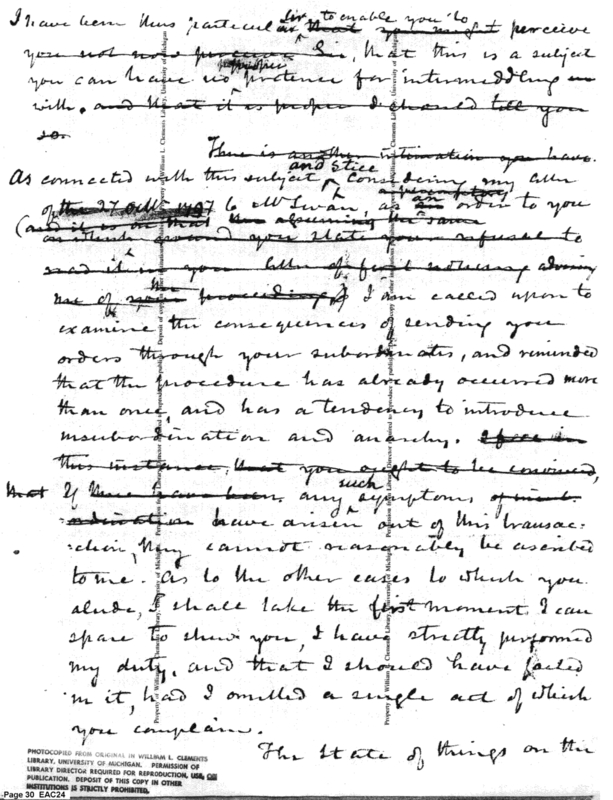
It is for him to enjoin upon me or intrust me with certain duties, it is for me to perform and execute them. I believe it will be found that I have employed his name upon all suitable occasions, or where the dignity or importance of the matter or instruction specially required it. I have been thus particular, Sir, to enable you to perceive that this is a subject you can have no pretence for intermeddling with.
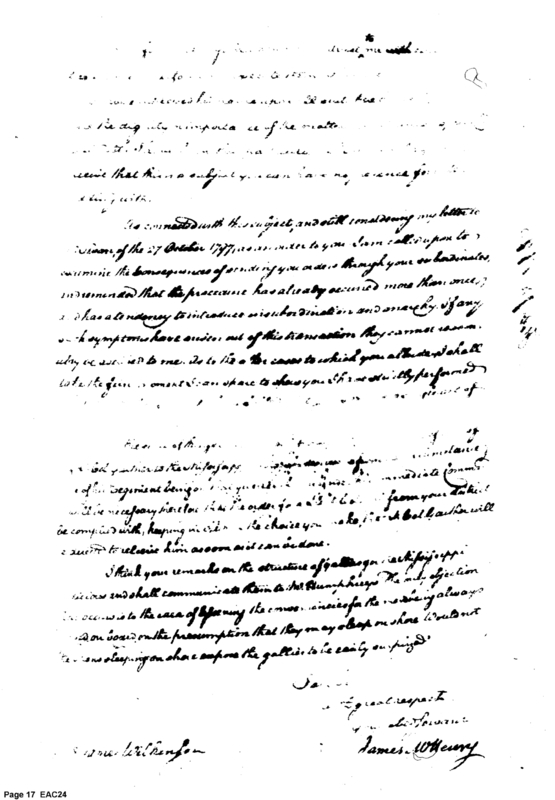
As connected with this subject, and still considering my letter to Mr Swan, of the 27 October 1797, as an order to you, I am called upon to examine the consequences of sending you orders through your subordinates, and reminded that the procedure has already occurred more than once, and has a tendency to introduce insubordination and anarchy. If any such symptoms have arisen out of this transaction they cannot reasonably be ascribed to me. As to the other cases to which you allude, I shall take the first moment I can spare to shew you I have strictly performed my duty, and that I should have failed in it, had I omitted a single act of which you complain.
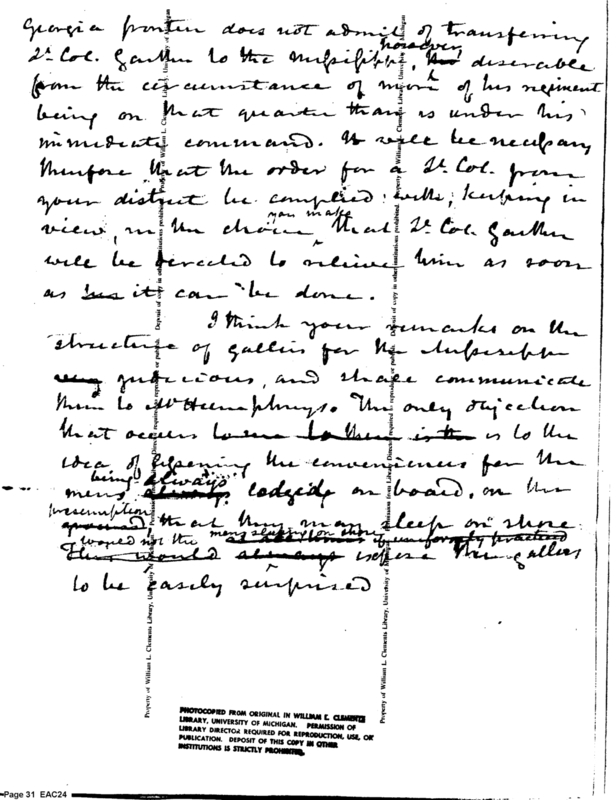
The state of things on the Georgia frontier does not admit of transferring [Lt.] Col. Gaither to the Mississippi; however desireable from the circumstances of more of his Regiment being on that quarter than is under his immediate command. It will be necessary therefore that the order for a Lt Colonel [from] your district will be complied with, keeping in view in the choice you make, that Lt Col Gaither will be directed to relieve him as soon as it can be done.
I think your remarks on the structure of gallies for the Mississippi are judicious, and shall communicate them to Mr Humphreys. The only objection that occurs to me is the idea of [undecipherable] the conveniences for the men, by always lodging on board, on the presumption that they may sleep on shore. I would not [undecipherable] the men sleeping on shore exposes the gallies to be easily surprised.
I am Sir
with great respect
Your obed Servant
James McHenry
Gend James Wilkinson