

Suggested Changes to Regulations
Document 1798Hamtramck returns changes he made in the regulations sent by McHenry.



No human transcription currently available for this document.
This transcription was generated by machine using Anthropic's Claude Code (model sonnet 4.6). It may contain errors or inaccuracies. Please verify against the document image. Learn more about our generative AI methodology.
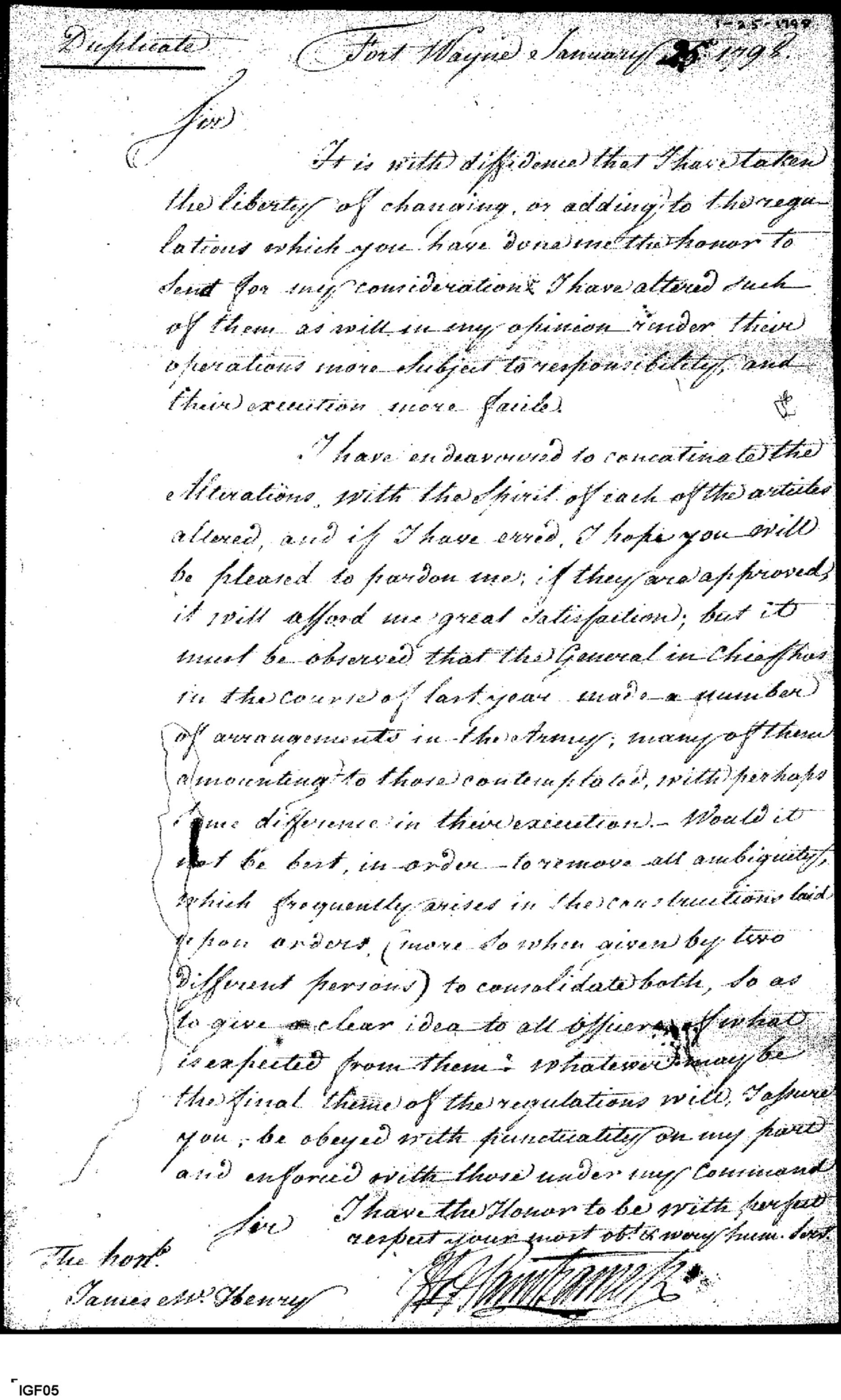
[Duplicate]
Fort Wayne January [undecipherable] 1798
Sir
It is with diffidence that I have taken the liberty of chaning, or adding to the regulations which you have done me the honor to send for my consideration. I have altered such of them as will in my opinion render their operations more Subject to responsibility, and their execution more failible.
I have endeavoured to concatinate the Alterations, with the Spirit of each of the articles altered, and if I have erred, I hope you will be pleased to pardon me; if they are approved, it will afford me great Satisfaction; but it must be observed that the General in Chief has in the course of last year made a number of arrangements in the Army; many of them amounting to those contemplated, with perhaps some difference in their execution. Would it not be best, in order to remove all ambiguity, which frequently arises in the constructions laid upon orders (more so when given by two different persons) to consolidate both, so as to give a clear idea to all officers of what is expected from them? whatever may be the final theme of the regulations will, I assure you, be obeyed with punctuality on my part and enforced with those under my Command.
Sir I have the Honor to be with perfect respect your most obt & very hum. Svt.
[signature]
The honb.
James McHenry
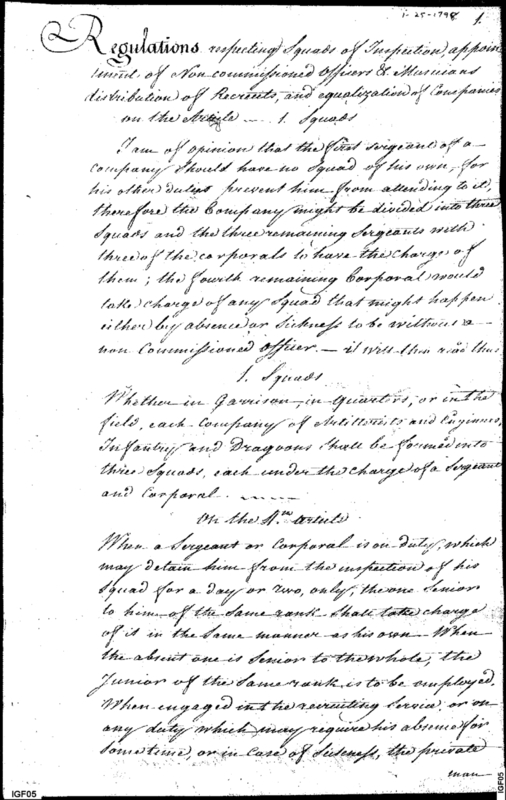
Regulations respecting Squads of Inspection, appointment of Non-commissioned Officers & Musicians, distribution of Recruits, and equalization of Companies on the Article — 1 Squads
I am of opinion that the first Sergeant of a company Should have no Squad of his own, for his other duties prevent him from attending to it; therefore the Company might be divided into three Squads and the three remaining Sergeants with three of the corporals to have the charge of them; the fourth remaining Corporal would take charge of any Squad that might happen either by absence or Sickness to be without a non Commissioned officer — it will then read thus
1. Squads
Whether in Garrison, in Quarters, or in the field, each Company of Artillerists and Engineers, Infantry and Dragoons Shall be formed into three Squads, each under the charge of a Sergeant and Corporal. ——
On the 4th Article
When a Sergeant or Corporal is on duty, which may detain him from the inspection of his Squad for a day or two, only, the one Senior to him of the same rank Shall take charge of it in the Same manner as his own — When the absent one is Senior to the whole, the Junior of the same rank is to be employed. When engaged in the recruiting Service, or on any duty which may require his absence for Some time, or in case of Sickness, the private man—
man who is appointed to act as lance Corporal Shall have the Same power and authority over the Squad, and the Same responsibility, as the non Commissioned officer which he represents ———
yet it might read thus
When both the non Commissioned Officers of a Squad happen to be absent at One time the fourth Corporal is always to take charge of that Squad and if more than one Squad is without its non Commissioned officer — The Officer commanding the Company will Select and appoint a private to take Charge of it untill the return of the non commissioned officer ——
Regulations respecting the Sick and Hospital
On Article the 2nd
The non commissioned officers of the Hospital might be paid on the number of the Sick, and at the requisition of the Surgeon — a Selection of a non Commissioned officer might perhaps be better than by turn; for this reason that, as those non Commissioned officers would have frequently in their hands the refreshments for the Sick a Drunkard or a dishonest man might make a bad use of them to the great prejudice of the Sick)
The 2d Article might therein thus
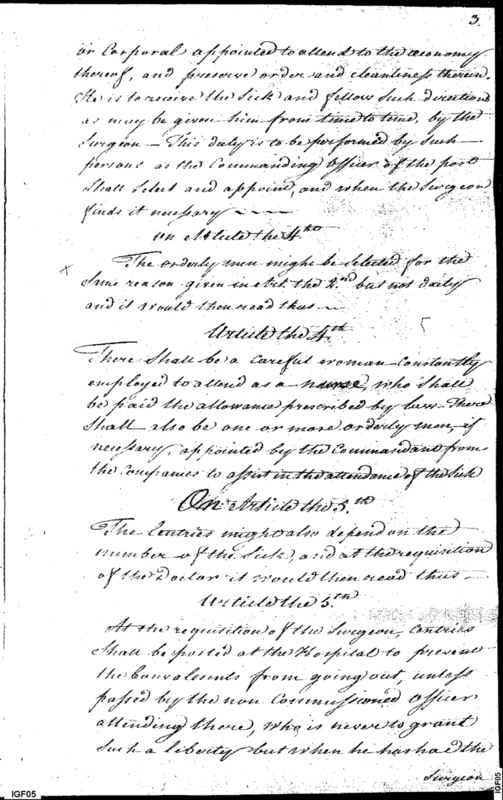
To every hospital there Shall be a Sergeant—
or
or Corporal appointed to attend to the economy thereof, and preserve order and cleanliness therein. He is to receive the Sick and follow Such Directions as may be given him from time to time, by the Surgeon — This duty is to be performed by Such persons as the Commanding Officer of the post Shall Select and appoint, and when the Surgeon finds it necessary ——
On Article the 4to
The orderly men might be Selected for the Same reason given in Art. the 4th but not daily and it would then read thus —
Article the 4th
There Shall be a careful woman constantly employed to attend as a nurse, who Shall be paid the allowance prescribed by law. There Shall also be one or more orderly men, if necessary, appointed by the Commandant from the Companies to assist in the attendance of the Sick
On Article the 5th
The Sentries might also depend on the number of the Sick, and at the requisition of the Doctor it would then read thus —
Article the 5th
At the requisition of the Surgeon, Sentries Shall be posted at the Hospital to prevent the Convalescents from going out, unless passed by the non Commissioned Officer attending there, Who is never to grant Such a liberty but when he has had the Surgeon
Surgeon particular leave for so doing —
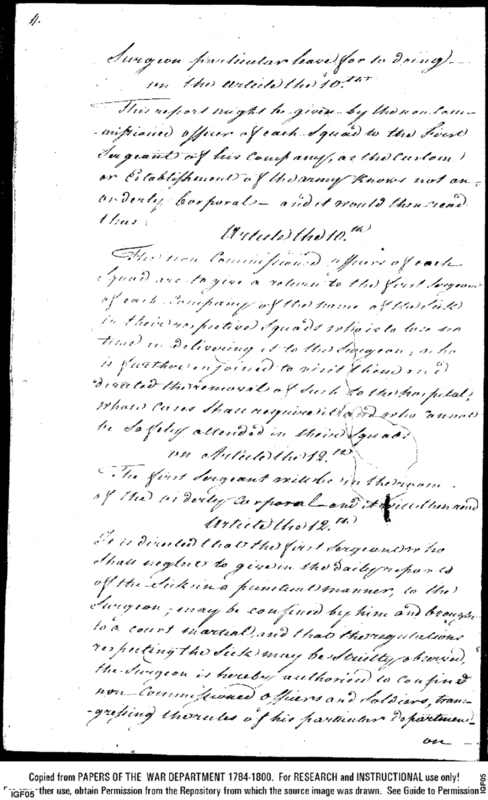
On the Article the 10th
This report might be given by the non Commissioned officer of each Squad to the first Sergeant of his Company, as the Custom or Establishment of the Army knows not an orderly Corporal — and it would then read thus
Article the 10th
The non Commissioned officers of each Squad are to give a return to the first Sergeant of each Company of the name of the Sick in their respective Squads who is to lose no time in delivering it to the Surgeon, who is further enjoined to visit them and directed the removals of Such to the hospital, whose cases Shall require it and who cannot be Safely attended in their Squads.
On Article the 12th
The first Sergeant will be on the return of the orderly Corporal and it will then read
Article the 12th
It is directed that the first Sergeant who Shall neglect to give in the daily reports of the Sick in a punctual manner, to the Surgeon; may be confined by him and brought to a court martial, and that the regulations respecting the Sick may be Strictly observed, the Surgeon is hereby authorised to confine non Commissioned Officers and Soldiers, transgressing the rules of his particular Department.
on —
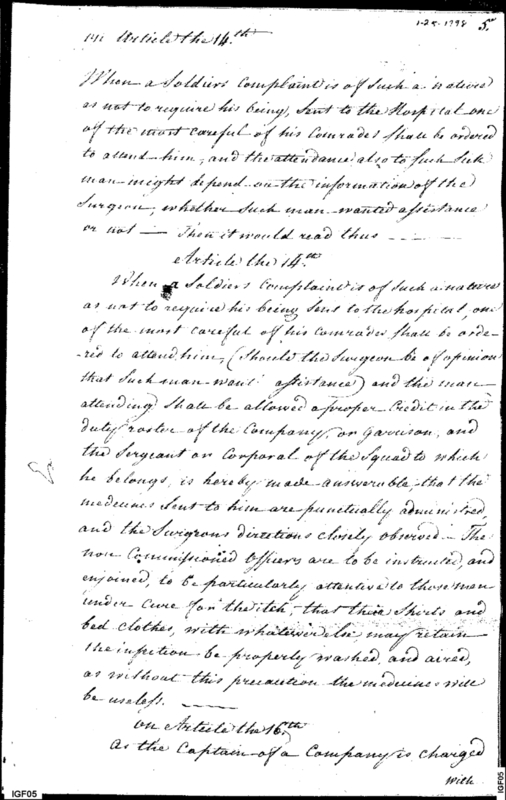
On Article the 14th
When a Soldiers Complaint is of Such a nature as not to require his being Sent to the Hospital, one of the most careful of his Comrades Shall be ordered to attend him, and the attendance also to Such Sick man might depend on the information of the Surgeon, whether Such man wanted assistance or not — Then it would read thus —
Article the 14th
When a Soldiers Complaint is of Such a nature as not to require his being Sent to the hospital, one of the most careful of his Comrades Shall be ordered to attend him, (Should the Surgeon be of opinion that Such man want assistance) and the man attending Shall be allowed a proper Credit in the duty roster of the Company, or garrison, and the Sergeant or Corporal of the Squad to which he belongs, is hereby made answerable, that the medicines Sent to him are punctually administered, and the Surgeons directions closely observed — The non Commissioned Officers are to be instructed, and enjoined, to be particularly attentive to those men under Cure for the Sick, that their Shirts and bed Clothes, with whatever else may retain the infection be properly washed, and aired, as without this precaution the medicines will be useless. ——
On Article the 16th
As the Captain of a Company is charged
With
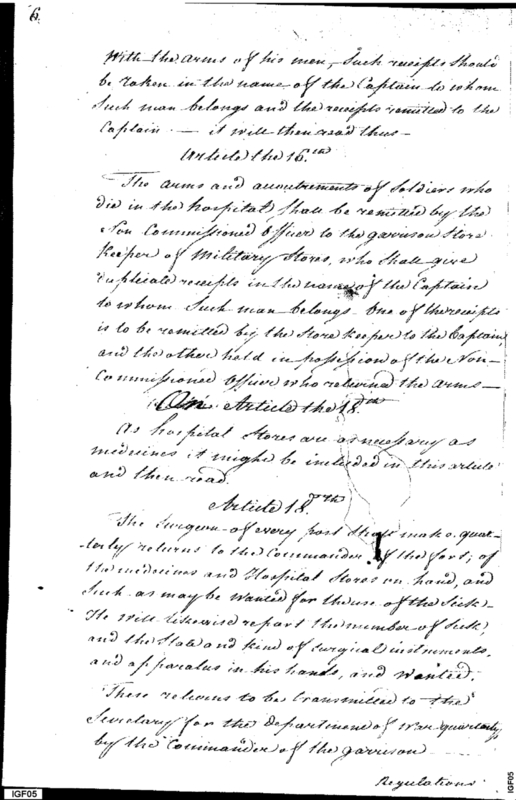
With the arms of his men, Such receipts Should be taken in the name of the Captain to whom Such man belongs and the receipts remitted to the Captain — it will then read thus —
Article the 16th
The arms and accoutrements of Soldiers who die in the hospital Shall be remitted by the Non Commissioned Officer to the garrison Store Keeper of Military Stores, who Shall give Duplicate receipts in the name of the Captain to whom Such man belongs. One of the receipts is to be remitted by the Store Keeper to the Captain, and the other held in possession of the Non Commissioned Officer who returned the arms —
On Article the 18th
As hospital Stores are as necessary as medicines it might be included in this Article and then read
Article 18th
The Surgeon of every post Shall make quarterly returns to the Commander of the fort; of the medicines and Hospital Stores on hand, and Such as may be wanted for the use of the Sick — He will likewise report the number of Sick, and the State and Kind of Surgical instruments, and apparatus in his hands, and wanted.
These returns to be transmitted to the Secretary for the Department of War quarterly by the Commander of the garrison ——
Regulations:
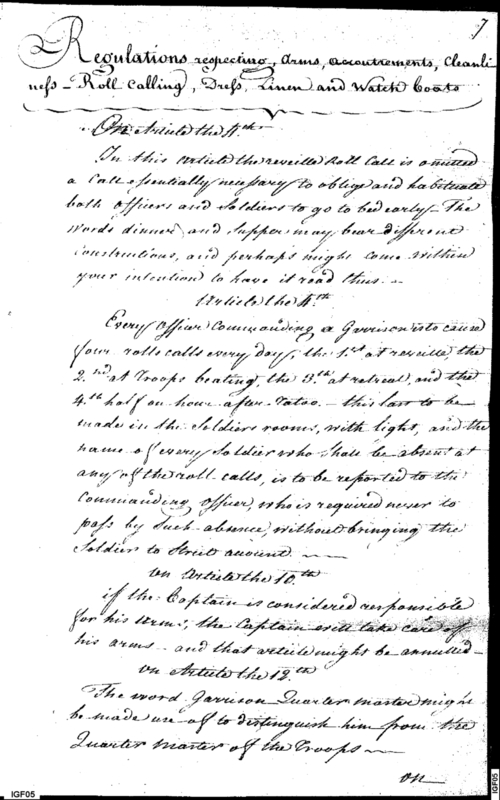
Regulations respecting Arms, accoutrements, Cleanliness — Roll calling, Dress, Linen and Watch Coats
On Article the 11th
On this Article the reveille Roll Call is omitted a Call essentially necessary to oblige and habituate both Officers and Soldiers to go to bed early — The words dinner and Supper may bear different constructions, and perhaps might come within your intention to have it read thus —
Article the 11th
Every Officer Commanding a Garrison is to cause four rolls calls every day; the 1st at reveille, the 2nd at Troops beating, the 3d at retreat, and the 4th half an hour after Tatoo — this last to be made in the Soldiers rooms, with lights, and the name of every Soldier who Shall be absent at any of the roll calls, is to be reported to the Commanding Officer, who is required never to pass by Such absence, without bringing the Soldier to Strict account. ——
On Article the 10th
If the Captain is considered responsible for his arms, the Captain will take care of his arms — and that Article might be annulled —
On Article the 12th
The word Garrison Quarter master might be made use of to distinguish him from the Quarter master of the Troops —
on
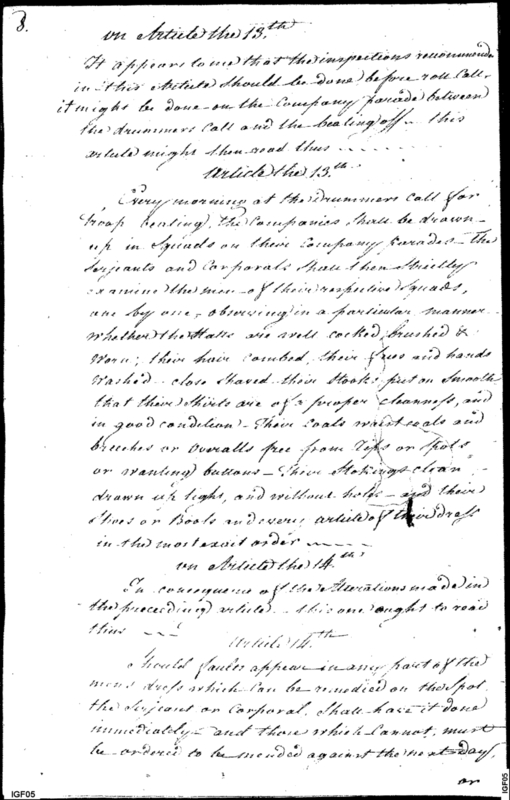
On Article the 13th
It appears to me that the inspections recommended in this Article should be done before roll Call — it might be done on the Company parade between the Drummers Call and the Beating off — this Article might then read thus ——
Article the 13th
Every morning at the Drummers Call for Troop beating, the Companies Shall be drawn up in Squads on their Company Parades — The Sergeants and Corporals Shall then Strictly examine the men of their respective Squads, one by one, observing in a particular manner whether their Hatts are well cocked, brushed & worn; their hair combed, their faces and hands washed — close Shaved — their Stocks put on Smooth — that their Shirts are of a proper Cleanness, and in good condition — Their Coats waistcoats and breeches or Overalls free from Rips or Spots, or wanting buttons — Their Stockings clean — drawn up tight, and without holes — and their Shoes or Boots and every article of their dress in the most exact order ———
On Article the 14th
In consequence of the Alterations made in the preceding Article — this one ought to read thus ——
Article 14th
Should faults appear in any part of the men's dress which can be remedied on the Spot, the Sergeant or Corporal, Shall have it done immediately — and those which Cannot, must be ordered to be mended against the next Day,
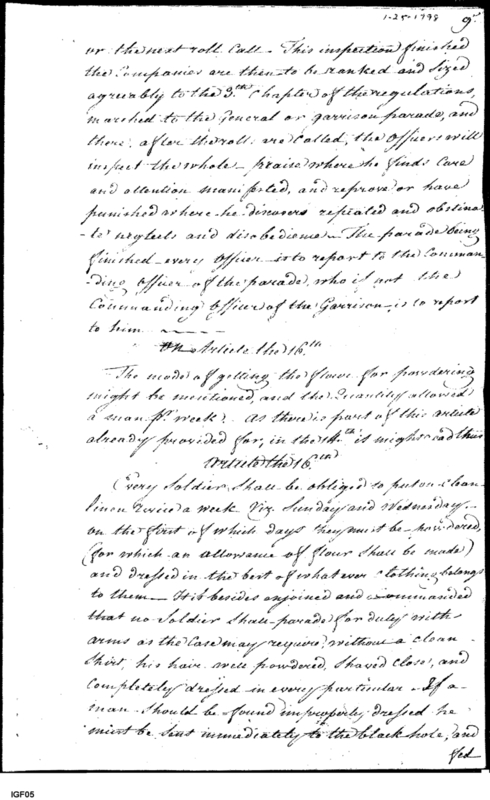
or the next roll Call — This inspection finished the Companies are then to be ranked and Sized agreeably to the 3d Chapter of the regulations, marched to the general or garrison parade, and there, after the roll are called, the Officers will inspect the whole — praise where he finds Care and attention manifested, and reprove or have punished where he discovers repeated and obstinate neglects and disobedience — The parade being finished — every Officer is to report to the Commanding Officer of the parade, who if not the Commanding Officer of the Garrison, is to report to him. ———
On Article the 16th
The mode of getting the flour for powdering might be mentioned, and the Quantity allowed a man Pr week) As there is part of this Article already provided for; in the 4th it might read thus
Article the 16th
Every Soldier Shall be obliged to put on clean linen twice a week Viz. Sunday and Wednesday — on the first of which days they must be powdered, (for which an allowance of flour Shall be made) and dressed in the best of whatever clothing belongs to them — It is besides enjoined and commanded that no Soldier Shall parade for duty with arms as the Case may require, without a clean Shirt, his hair well powdered, Shaved close, and Completely dressed in every particular — If a man Should be found improperly dressed he must be Sent immediately to the black hole, and fed—
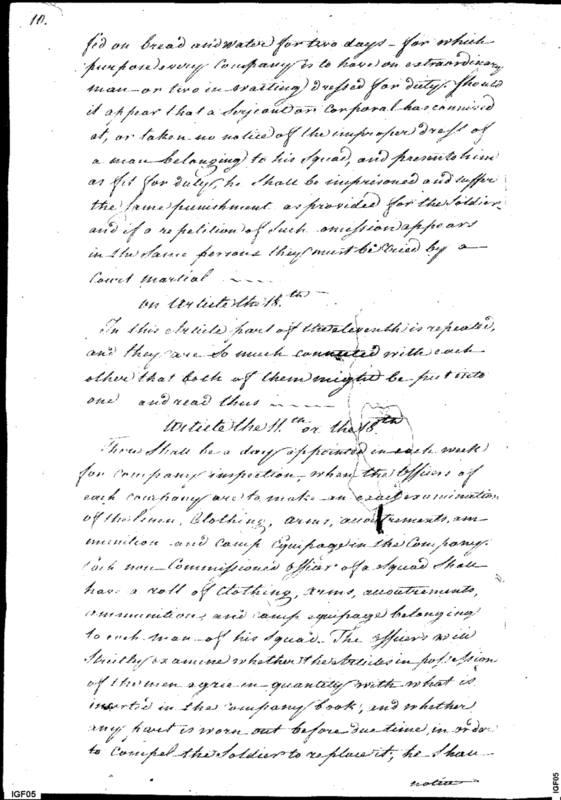
fed on bread and water for two days — for which purpose every Company is to have an extraordinary man or two in waiting Dressed for duty. Should it appear that a Sergeant or Corporal has connived at, or taken no notice of the improper Dress of a man belonging to his Squad, and presents him as fit for duty, he Shall be imprisoned and Suffer the Same punishment as provided for the Soldier and if a repetition of Such omission appears in the Same persons they must be tried by a Court Martial ——
On Article the 18th
In this Article part of the Seventeenth is repeated, and they are So much connected with each other that both of them might be put into one and read thus ——
Article the 11th or the 18th
There Shall be a day appointed in each week for Company inspection — when the Officers of each Company are to make an exact examination of the linen, Clothing, arms, accoutrements, ammunition and Camp Equipage in the Company. Each non Commissioned officer of a Squad Shall have a roll of Clothing, arms, accoutrements, ammunition and Camp equipage belonging to each man of his Squad. The Officers will Strictly examine whether the articles in possession of the men agree in quantity with what is inserted in the Company book, and whether any part is worn out before due time, in order to compel the Soldier to replace it; he Shall —
notice—
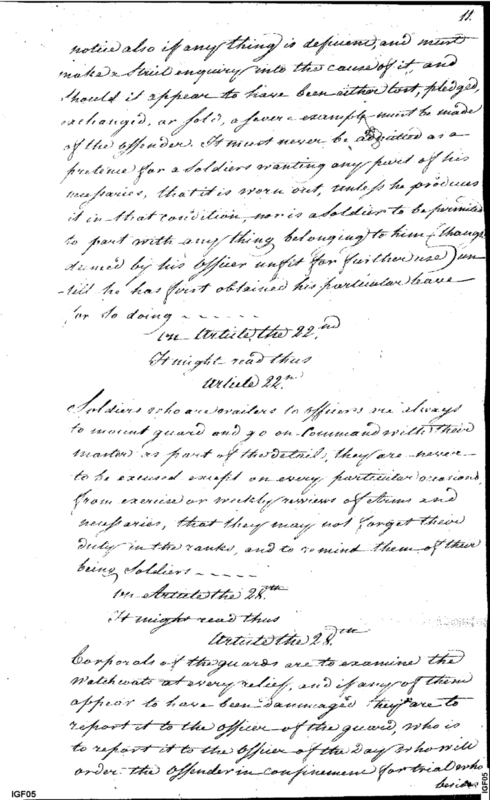
notice also if any thing is deficient, and must make a Strict enquiry into the cause of it, and Should it appear to have been either lost, pledged, exchanged, or Sold, a Severe example must be made of the offender. It must never be admitted as a pretence for a Soldiers wanting any part of his necessaries, that it is worn out, unless he produces it in that condition, nor is a Soldier to be permitted to part with any thing belonging to him (though deemed by his Officer unfit for further use) untill he has first obtained his particular leave for So doing ——
On Article the 22d
It might read thus
Article 22d
Soldiers who are orderlies to Officers are always to mount guard and go on Command with their Masters as part of the Detail, they are never to be excused except on every particular occasions, from exercise or weekly reviews of arms and necessaries, that they may not forget their Duty in the ranks, and to remind them of their being Soldiers ——
On Article the 28th
It might read thus
Article the 28th
Corporals of the guards are to examine the Watchcoats at every relief, and if any of them appear to have been Damaged they are to report it to the Officer of the guard, who is to report it to the Officer of the Day who will order the Offender in Confinement for trial who besides
besides being punished (if found guilty) Shall also be obliged to make it good. ——
On Article the 29th
It might read thus
Article 29th
At every guard mounting the Corporal or Some non Commissioned Officer of the new guard Shall examine the State of all the Watch Coats, and if any of them are damaged, or lost, report is to be made to the new Officer of the day, who will immediately in conjunction with the relieved Officer, ascertain by whom the damage has been done in order that the offender may be brought to trial, (who if found Guilty) Shall besides being punished, be obliged to make the damage or loss good — And as the Safety and condition of the Watch Coats will depend on a close attention, the Officer of the Day will in visiting the Sentries inspect into their condition, and report their State, to the Commandant and relieving Officer in the report of his guard ——
Regulations respecting ammunition exercise
On Article the 2nd
The powder to be kept in a room and in a leathern bag will be very much exposed to be Stolen — There is nothing that a Soldier would rather Steal than ammunition; for he always finds a good market either with the inhabitants or Indians. The making of Cartridges Cannot be—
be done well by Infantry Soldiers, very few of them understanding the business, besides the inconvenience of handling loose powder in a room always full of Soldiers — This Article might read thus
Article 2nd
The Troops in garrison will be allowed at all times a quantity of blank cartridges for exercise, to be drawn out of the Stores, or to be made by them as most convenient. ——
On Article the 4th
For the reason given in the Second Article it might read thus ——
Article 4th
When there is no blank Cartridges in Store, or When there is no Artillery men, Powder, paper &c are to be drawn out of the magazine, and cartridges made by the Infantry in Such number, and in Such manner as the Commanding Officer Shall direct, and it is further directed that the Troops are to drawn no more cartridges at one time, than are to be consumed at one exercise.
On Article the 5th
It might read thus
Article the 5th
After the exercise is over, the Officer Commanding Companies or platoons, Shall in their presence Cause all the Spare cartridges to be collected and lodged in the magazine for the next exercise —
On Article the 6th
It might read thus
Article the 6th
As ball Cartridges must always be in possession of the men on actual Service, they must be — punished
punished for losing any part of them through neglect, besides being made to pay for them; and the greatest Care taken to prevent their being broken or damaged — but as accidents will happen notwithstanding the utmost Care, every Officer of a Company Shall at every morning roll Call examine minutely into the State of the Cartridges and Flints of his Company, if there are any damaged he will return them; if any are wanted he will make the usual return to Supply the deficiency.
On Article the 7th
The orderly Corporal Should be changed for first Sergeant — and read thus
Article 7th
No firelocks in Garrison are ever to be loaded, but by orders; and whenever a Soldier returns into Garrison from Command or detachment with his firelock loaded, the first Sergeant is made answerable that it is unloaded [a before] it is deposited in its place; he is also responsible for the balls drawn, which are to be returned to the Officer charged with the ammunition and garrison Stores, taking a receipt for the Same in the name of the Officer from whom Such Soldier may have drawn his ammunition, which receipt is to be remitted to Such officer.
Exercise of the Soldiers
On Article the 13th
It is recommended in this Article to manœuvre the Troops applicably only to real war fare; I must observe that all Officers do not agree in the mode of fighting
fighting Indians, would it not be better to have Some established manœuvres
Regulations respecting Absentees From Command and Furloughs
On Article the 9th
In order to adhere to the Principles that I have adopted, I would have this Article to read thus
Article the 9th
Before a Soldier receives his furlough he is to deliver up his arms and accoutrements to his Officer who is always accountable for the arms of his Company.
Resignation of Commission
On Article the first — It might read thus
Article 1st
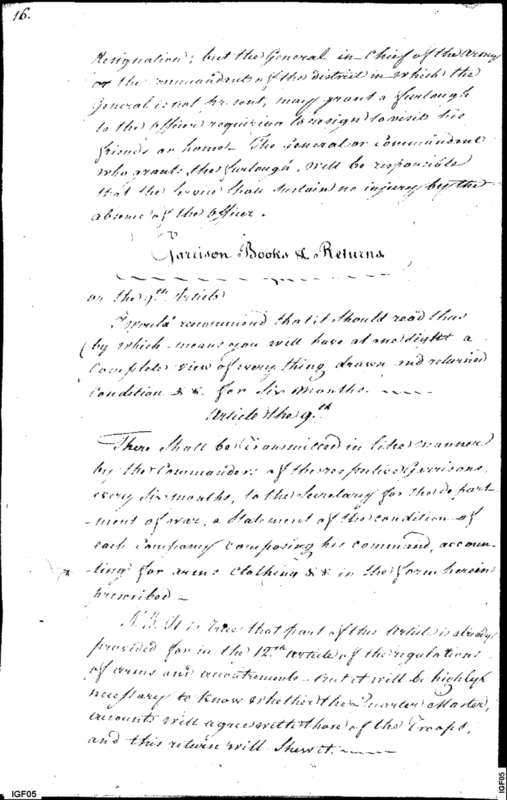
When Officers want to resign, they must obtain in the first place, a Certificate, from both the Commanding Officer of their Regiment, and Paymaster, as also from the Commanding Officer of the garrison in which they then Serve, that there is no demand against them of a public nature; and then their requisition for permission to resign their Commissions Shall be first presented to the Commandant of the District, who Shall forward the Same to the Secretary for the Department of War, to the end they may be Laid before the President — No Officer to be Considered out of Service till the President has accepted his — resignation
Resignation; but the General in Chief of the Army or the Commandant of the District in which the General is not present, may grant a furlough to the Officer requiring to resign to visit his friends at home. The General or Commandant who grants the furlough, will be responsible that the Service Shall Sustain no injury by the absence of the Officer.
Garrison Books & Returns
On the 9th Article
I would recommend that it Should read thus (by which means you will have at one Sight a Complete view of every thing drawn and returned Condition &c for Six Months. ——
Article the 9th
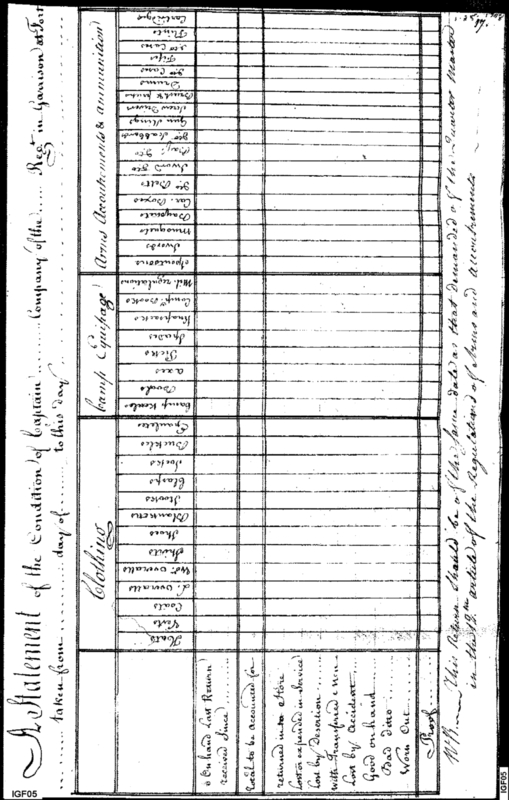
There Shall be transmitted in like manner by the Commanders of the respective Garrisons, every Six months, to the Secretary for the Department of War, a Statement of the condition of each Company composing his Command, accounting for mens Clothing &c in the form herein prescribed —
N.B. It is true that part of this Article is already provided for in the 12th Article of the regulations of arms and accoutrements — but it will be highly necessary to know whether the Quarter Master's accounts will agree with those of the Troops, and this return will Shew it. ——
[illustration of a blank tabular form: "A Statement of the Condition of Captain ........ Company of the ...... Regt in Garrison at Fort ...... taken from ...... day of ...... to this day" with columns for Clothing, Camp Equipage, and Arms Accoutrements & Ammunition, and rows for On hand last Return, Received Since, Total to be accounted for, Returned into Store, Lost by Desertion, Lost by Transfer'd to new, Lost by Accident, Good on hand, Bad Ditto, Worn Out, Proof]
N.B. This Return Should be of the Same date as that Demanded of the Quarter Master in the 12th Article of the Regulations of Arms and Accoutrements
Regulations respecting Fortified Places
On Article the 6th
There Will be a great deal of Writing for the Commanding Officer of a district, I would therefore recommend this Article to read thus —
Article the 6th
The Commanding Officers of Districts are expressly enjoined to reside where the wants of the Service Stands most need of their presence, and to visit at least one in every year, the totality of the posts within their district; they are at liberty to employ a platoon Officer of their District to assist them if they find it necessary. It also permitted to Commandants of districts to change the original or partition of the Troops in his district; but he must instantaneously Communicate the Same and the reason which induced it to the Secretary for the Department of War. ——
On Article the 11th — It might read thus
Article the 11th
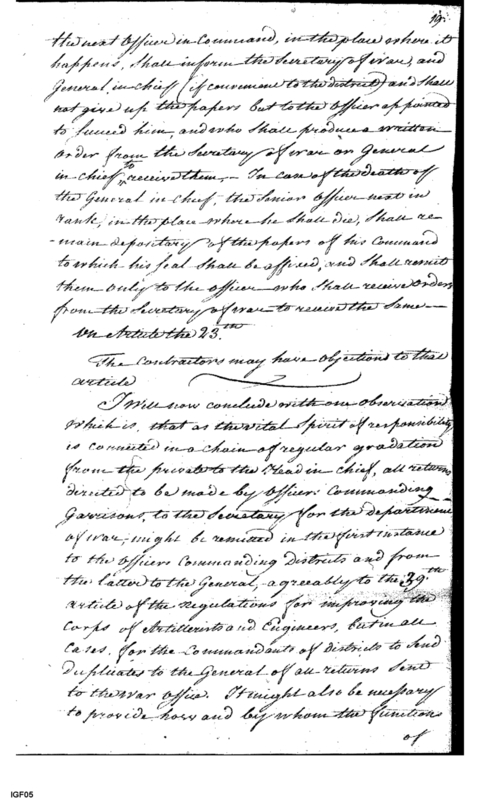
In Case of the death of the Commander of a fortified place, all maps, papers, and plans respecting the fortification thereof Shall be put into the hands of the next Officer in Command, who Shall give instant information to the district Commandant and put the Said papers into his hands as Soon as he Shall present himself to receive them, which papers Shall be delivered to the Officer next appointed to the Command of the place — he Shall also immediately on the death of the Said Officer, Seal the papers, plans &c and remove the Seal only in the presence of the District Commandant or Some Officer provided with a written order from him to that purpose — In Case of the death of the District Commandant,
the next Officer in Command, in the place where it happens, Shall inform the Secretary of War, and General in Chief (if convenient to the district) and Shall not give up the papers but to the Officer appointed to Succeed him, and who Shall produce a written order from the Secretary of War or General in Chief to receive them — In Case of the death of the General in Chief, the Senior Officer next in rank, in the place where he Shall die, Shall remain depositary of the papers of his Command to which his Seal Shall be affixed, and Shall remit them only to the Officer who Shall receive Orders from the Secretary of War to receive the Same ——
On Article the 23th
The Contractors may have Objections to that Article
I Will now conclude with one observation which is, that as the vital Spirit of responsibility is connected in a chain of regular gradation from the private to the Head in Chief, all returns directed to be made by Officers Commanding Garrisons, to the Secretary for the Department of War, might be remitted in the first instance to the Officers Commanding Districts and from the latter to the General, agreeably to the 39th Article of the Regulations for improving the Corps of Artillerists and Engineers, but in all Cases, for the Commandants of districts to Send Duplicates to the General of all returns Sent to the War office. It might also be necessary to provide how and by whom the functions of
of Officers Commanding districts Should be discharged in Case of Sickness or Some other Causes —
Type
Contemporary Copy of Letter Signed
Description
Hamtramck returns changes he made in the regulations sent by McHenry.
Date
01/25/1798
Author
Recipient
Sent from
Fort Wayne
Repository
Collection
Document number
1798012540001
Page start
1
Notable persons
James McHenry
John Francis Hamtramck
invalids
dragoons
nurses
surgeons
drunkards
General in Chief
Army
Notable locations
Fort Wayne
Notable items
regulations
sick
medicine
inspection
punishment
arms
trial
ammunition
furlough
resignation
operations