

Remarks on the third article of the Jay Treaty
Document 1798Contemplates various interpretation the third article of the Jay Treaty, particularly in relation to free commerce and the imposition of duties. Concludes with his own final interpretation on the article.


No human transcription currently available for this document.
This transcription was generated by machine using Anthropic's Claude Code (model sonnet 4.6). It may contain errors or inaccuracies. Please verify against the document image. Learn more about our generative AI methodology.
[Remarks on the 3d
Articles of the Treaty
Treaty — Jany 5 1798]
[Vol. 23 No 71 all]
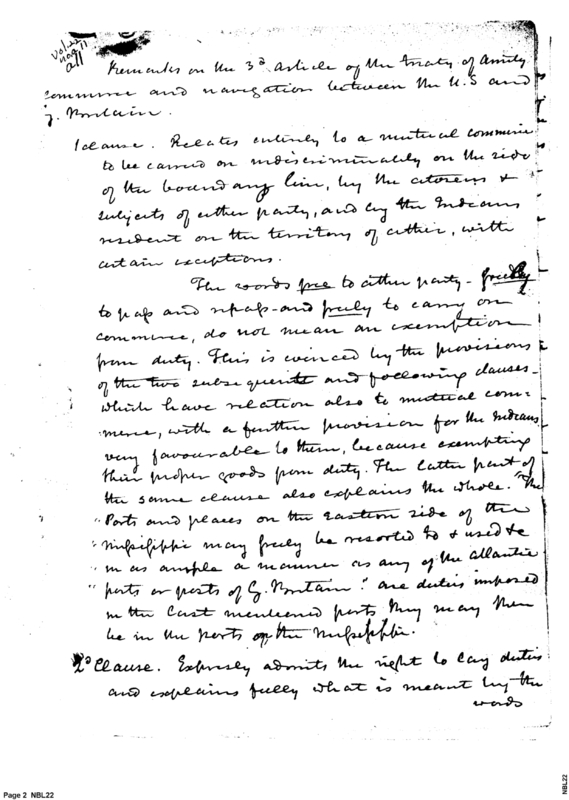
Remarks on the 3d. Article of the Treaty of Amity Commerce and Navigation between the U. S. and G. Britain.
1 Clause. Relates entirely to a mutual commerce to be carried on indiscriminately on the side of the boundary line, by the citizens & subjects of either party, and by the Indians resident on the territory of either, with certain exceptions.
The words free to either party - [strikethrough: freely] to pass and repass - and freely to carry on commerce, do not mean an exemption from duty. This is evinced by the provisions of the two subsequent and following clauses which have relation also to mutual commerce, with a further provision for the Indians very favourable to them, because exempting their proper goods from duty. The latter part of the same clause also explains the whole. The "Ports and places on the eastern side of the Mississippi may freely be resorted to & used to in as ample a manner as any of the Atlantic "ports or ports of G. Britain." Are duties imposed in the last mentioned ports they may then be in the ports of the Mississippi.
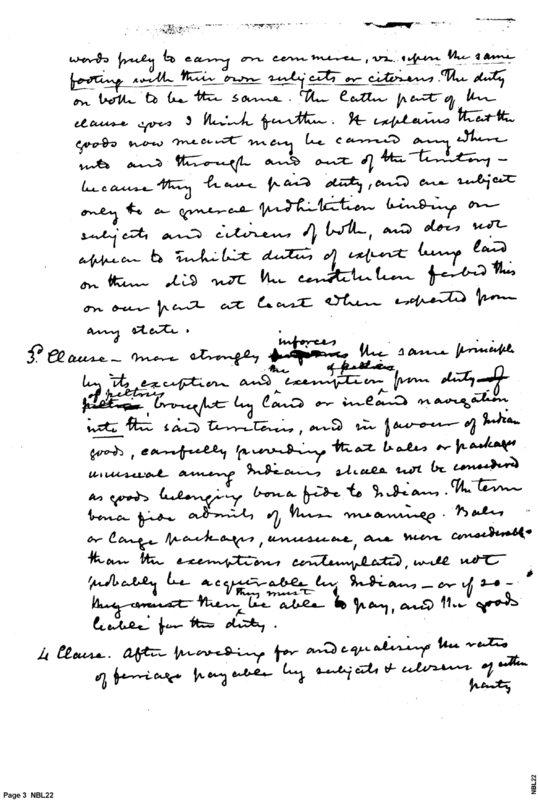
2d Clause. Expressly admits the right to levy duties and explains fully what is meant by the words freely to carry on commerce, viz upon the same [underline: footing with their own subjects or citizens]. The duty on both to be the same. The latter part of the clause goes I think further. It explains that the goods now meant may be carried any where into and through and out of the territory — because they have paid duty, and are subject only to a general prohibition binding on subjects and citizens of both, and does not appear to inhibit duties of export being laid on them did not the constitution forbid this on our part at least when exported from any state.
3 Clause — more strongly [strikethrough: inforces] [undecipherable: interlinear insertion] [strikethrough: the same principle]
by its exception and exemption from duty [strikethrough: of]
[strikethrough: of [undecipherable]] brought by land or inland navigation into the said territories, and in favour of Indian goods, carefully providing that bales or packages unusual among Indians shall not be considered as goods belonging bona fide to Indians. The term bona fide admits of this meaning. Bales or Large packages, unusual, are more considerable than the exemptions contemplated, will not probably be acquirable by Indians — or if so — [strikethrough: they must] they must be able to pay, and the goods liable for the duty.
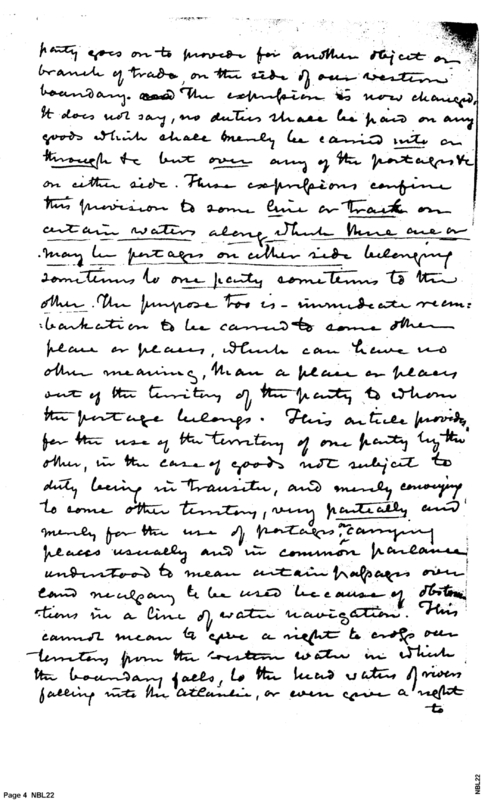
4 Clause. After providing for and equalising the rates of tonnage payable by subjects & citizens of either party goes on to provide for another object or branch of trade on the side of our western boundary. [strikethrough: and] The expression is now changed. It does not say, no duties shall be paid on any goods which shall merely be carried into or through &c but [underline: over] any of the portages on either side. These expressions confine this provision to some line or [underline: Tract] on certain [underline: waters] along which there are or may be portages on either side belonging sometimes to one party sometimes to the other. The purpose too is — immediate reembarkation to be carried to some other place or places, which can have no other meaning, than a place or places out of the territory of the party to whom the portage belongs. This article provides for the use of the territory of one party by the other, in the case of goods not subject to duty being in transitu, and merely conveying to some other territory, very particularly and merely for the use of portages; carrying places usually and in common parlance understood to mean certain passages over land necessary to be used because of obstructions in a line of water navigation. This cannot mean to give a right to cross over territory from the western water in which the boundary falls, to the head waters of rivers falling into the Atlantic, or even give a right to use in the transportation of dutiable goods, any of our waters. The waters alone to be used are those on the boundary common to both and requiring no stipulation for the use of, in this place, and there is no mention of other waters or other parts of territory to be used in this transportation than the portages, consequently cannot.
Again. The strong provision of the usual direct road [underline: across] the portage, which is [underline: declared] only to be meant, can apply only to a portage and the shortest, by land, and implies a direction or agreement, that in the case of dutiable goods, the transportation shall rest as short a time as possible on the lands or territory of the other party. Further. "regulations may be established to prevent the [underline: probability of fraud in this respect]. Probability of fraud is a very strong expression and of extended meaning.
A free view of the whole 3d article results in this conclusion. That the 4 clause is to provide for something different and [strikethrough: contradistinct] contradistinguished from what was contemplated by the former clauses. The former contemplated mutual commerce within the respective territories, the articles of which to be dutiable, and paying the duty, transportable any where by land or water into, through and out of the territory of the other. The 4th contemplates commerce with other nations by means of a [underline: common water] flowing over or [strikethrough: and] constituting a common boundary line, [strikethrough: to] connected perhaps with the [underline: waters] of the Mississippi, in the use of which water for transportation of goods it might be necessary by reason of falls or rapids, for either party to use a portage on the territory of the other. It provides that goods thus in transitu, shall not pay any duty, and anxiously provides, for as short a route as possible, for as short of space of time to be employed, and for a manner of conducting, which shall be subject to the operation of regulations capable of preventing the [underline: probability of fraud].
War Office 19 Jany 1798 James McHenry
Type
Draft Document
Description
Contemplates various interpretation the third article of the Jay Treaty, particularly in relation to free commerce and the imposition of duties. Concludes with his own final interpretation on the article.
Date
01/19/1798
Author
Sent from
War Office
Repository
Collection
Document number
1798011900001
Page start
1
Notable persons
James McHenry
British
Indians
Notable locations
War Office
Canada
Britain
Mississippi
ports
waters
territory
rivers
Atlantic
Notable items
Duty
tariff
import
posts
trade
goods
bales
packages
tolls
road