

Memorandum regarding neutral vessels
Document 1797Discusses rules of engagement between a neutral vessel and a belligerent power. Questions whether or not a neutral vessel has a right resist - by force - a search of their ship, or if a belligerent power has a right to search a neutral ship and carry the vessel back to their country for a trial. McHenry adds that the United States has no obligation to return deserters from British vessels, and fully condemns impressment.


No human transcription currently available for this document.
This transcription was generated by machine using Anthropic's Claude Code (model sonnet 4.6). It may contain errors or inaccuracies. Please verify against the document image. Learn more about our generative AI methodology.
[Illegible Text: Some or all of the pages of this file are wholly or in part illegible. We have not been able either to locate a better copy of the document, or to enhance its legibility electronically.]
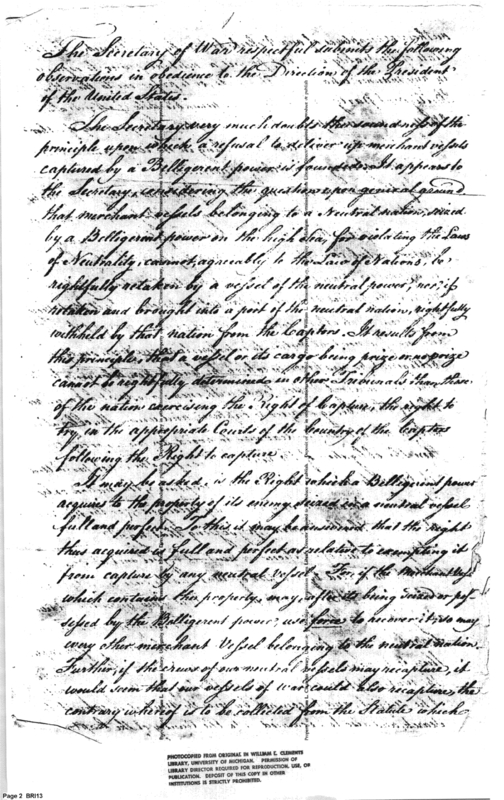
The Secretary of War respectfully submits the following observations in obedience to the Directions of the President of the United States.
The Secretary very much doubts the reasonableness of the principle upon which a refusal to deliver up merchant vessels captured by a Belligerent power is founded. It appears to the Secretary, considering this question upon general ground that merchant vessels belonging to a neutral nation, seized by a Belligerent power on the high seas, for violating the laws of Neutrality, cannot, agreeably to the law of Nations, be rightfully retained by a vessel of the neutral power; and if retaken and brought into a port of the neutral nation, rightfully withheld by that nation from the captor. It results from this principle that a vessel or its cargo being prize once [undecipherable] cannot be rightfully determined in other Tribunals than those of the nation exercising the right of capture; the right to try, in the appropriate Courts of the Country of the Captor, following the Right to capture.
It may be asked, is the Right which a Belligerent power acquires to the property of its enemy seized as a neutral vessel, full and perfect? To this it may be answered that the right thus acquired is full and perfect as relates to compelling it from capture of any neutral vessel. For if the merchants which contains the property, may, after it being seized as prize by the Belligerent power, with [undecipherable] to answer it in every other merchant vessel belonging to the neutral nations. Further, if the crew of a neutral vessel may recapture it, it would seem that our vessels of war could also recapture the contrary [undecipherable] from the States which
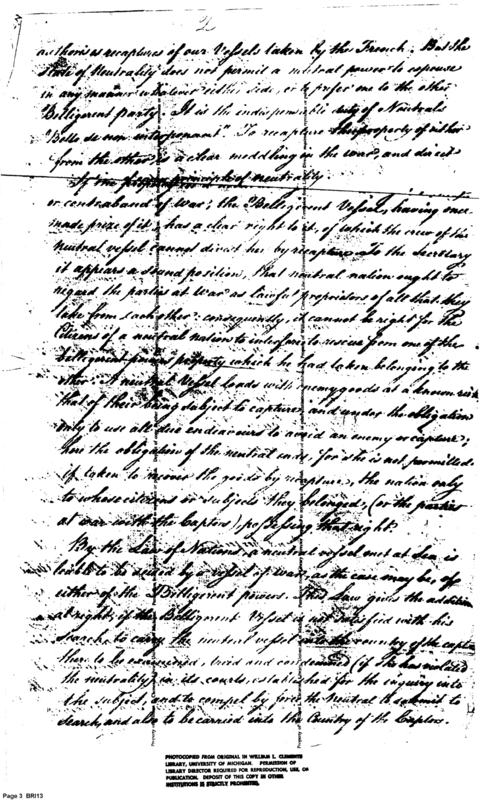
authorises recapture of our Vessels taken by the French. But the State of Neutrality does not permit a neutral power to espouse in any manner whatever either side, or to prefer one to the other Belligerent party. It is the indispensable duty of a Neutral [undecipherable] to [undecipherable] the property of the other, from the other, as neither meddling in the war, and directed by [undecipherable] preserving neutrality.
[undecipherable] or contraband of war; the Party, and Vessels having once made prize of it, has a clear right to it; of which the crew of the neutral vessel cannot divest him by recapture. As to the Secretary it appears a sound position, That neutral nations ought to regard the parties at war as lawful [undecipherable] of all they take from each other; consequently, it cannot be right for the [undecipherable] a neutral nation to interpose to receive from one of the Belligerent parties property which he had taken belonging to the other. A neutral Vessel loaded with [undecipherable] goods at a known risk of [undecipherable] being subjected to capture, and under the obligation only to use all due conduct and to avoid an enemy or captor; thus the obligation of the neutral ends. For this cause, it is permitted of them to receive the goods by recapture; the nation only to whose citizens as subjects they belong, (or the parties at war with the captor) possibly being that right.
By the law of Nations, a neutral vessel out at sea is liable to be seized by a vessel of war, as the case may be, of either of the Belligerent powers. This law gives the additional right of the Belligerent vessel to [undecipherable] for the vessel with his papers; to carry the neutral vessel into the country of the captor, there to be examined, tried and condemned if the law entitled the neutrality; in its courts established for inquiring into the subject, and to compel by force the Neutral to submit to search, and also to be carried into the Country of the Captor.
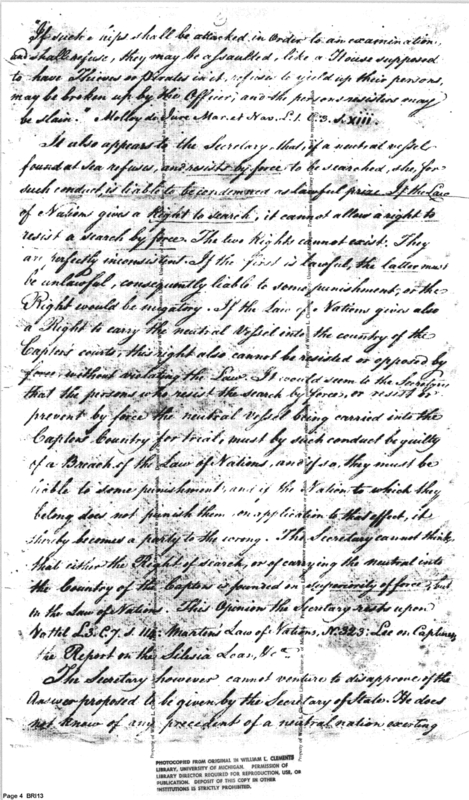
If such a vessel shall be attacked in order to examine it and shall resist, they may be [undecipherable] as a Vessel supposed to have [undecipherable] or Pirates in it. [undecipherable] to yield up those persons, may be taken up by the Officers, and the persons resisting may be slain." Molloy [undecipherable] Art. 1 Nov. 5t [undecipherable] XLIII.
It also appears to the Secretary, that if a neutral vessel found at sea refuses, and resist by force to be searched, she, for such conduct, is liable to [undecipherable] as unlawful prize. [undecipherable] of a Nation gives a Right to search, it cannot allow a right to resist a search by force. The two Rights cannot exist. They are entirely inconsistent; if the first is lawful, the latter must be unlawful, consequently liable to some punishment, or the Right would be nugatory. By the law of Nations give also a Right to carry the neutral Vessel into the country of the Captors courts; this right also cannot be resisted or opposed by force without violating the Laws. It would seem to the Secretary that the freedom to resist the search by force, or resist to prevent by force the neutral vessel being carried into the Captors Country for trial, must by such conduct be guilty of a Breach of the law of Nations, and [undecipherable] they must be liable to some punishment, and if the Nation to which they belong does not punish them, on application to that effect, the shortly becomes a party to the enemy. The Secretary cannot think that either the right of search, or of carrying the neutral into the Country of the Captor, is founded in express authority of [undecipherable] to the law of Nations. This Opinion the Secretary rests upon No. 114. [undecipherable] of the Maritime Laws of Nations, No. 223: Lee on Captures in Report on the Silesia Loan, No. [undecipherable].
The Secretary however cannot venture to disapprove of the Answer proposed to be given by the Secretary of State. We do not know of any precedent of a neutral nation exerting
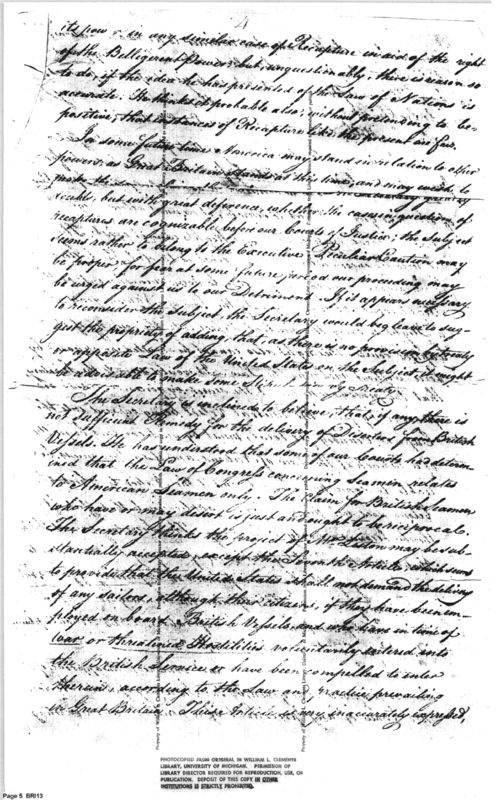
the law in any case, but this appears to be in aid of the right of the Belligerent power, which, by [undecipherable], this is seen as [undecipherable]. But the distinct provisions of the law of Nations is positive that instances of Recapture like the present are [undecipherable].
In some situations, America may stand in relation to other powers in [undecipherable] of the times, one may make it credible, but with great differences; whether the exact question of recaptures are determinable before our Courts of Justice; the subject [undecipherable] rather to belong to the Executive. The Administration may be referred for final determination [undecipherable] appearing may be urged against it to our Detriment. If it appears sufficient to remember the subject, the Secretary would be [undecipherable] to suggest that [undecipherable] that, as there are [undecipherable] [undecipherable] of the United States on the [undecipherable] might [undecipherable] under [undecipherable].
The Secretary also desires to observe, that if anything is Different [undecipherable] for the defense of [undecipherable] from British [undecipherable] the Administration [undecipherable] of our vessels has shown that the law of Congress concerning [undecipherable] American Seamen only. The claim for British [undecipherable] who have or may [undecipherable] is just and [undecipherable]. The Secretary thinks the [undecipherable] of [undecipherable] may be [undecipherable]. It is entirely accepted, that [undecipherable] States [undecipherable] to provide that the United States shall not demand the taking of any [undecipherable], though [undecipherable] if they have been employed on board British Vessels, and who have in time of war, or threatened Hostilities, voluntarily entered into the British Service or have been compelled to enter therein; according to the law and practice prevailing in Great Britain. [undecipherable]
Type
Document
Description
Discusses rules of engagement between a neutral vessel and a belligerent power. Questions whether or not a neutral vessel has a right resist - by force - a search of their ship, or if a belligerent power has a right to search a neutral ship and carry the vessel back to their country for a trial. McHenry adds that the United States has no obligation to return deserters from British vessels, and fully condemns impressment.
Date
1797
Author
Recipient
Repository
Collection
Document number
1797999900901
Page start
1
Notable persons
James McHenry
President
merchants
French
Timothy Pickering
British
deserters
seaman
Congress
Liston
Oliver Wolcott, Jr.
sailors
Notable locations
France
courts
Britain
Notable items
Vessels
trial
laws
examination
cargo
statute
treaty