

Memorandum regarding neutral vessels
Document 1797Discusses rules of engagement between a neutral vessel and a belligerent power. Questions whether or not a neutral vessel has a right resist - by force - a search of their ship, or if a belligerent power has a right to search a neutral ship and carry the vessel back to their country for a trial. McHenry adds that the United States has no obligation to return deserters from British vessels, and fully condemns impressment.


No human transcription currently available for this document.
This transcription was generated by machine using Anthropic's Claude Code (model sonnet 4.6). It may contain errors or inaccuracies. Please verify against the document image. Learn more about our generative AI methodology.
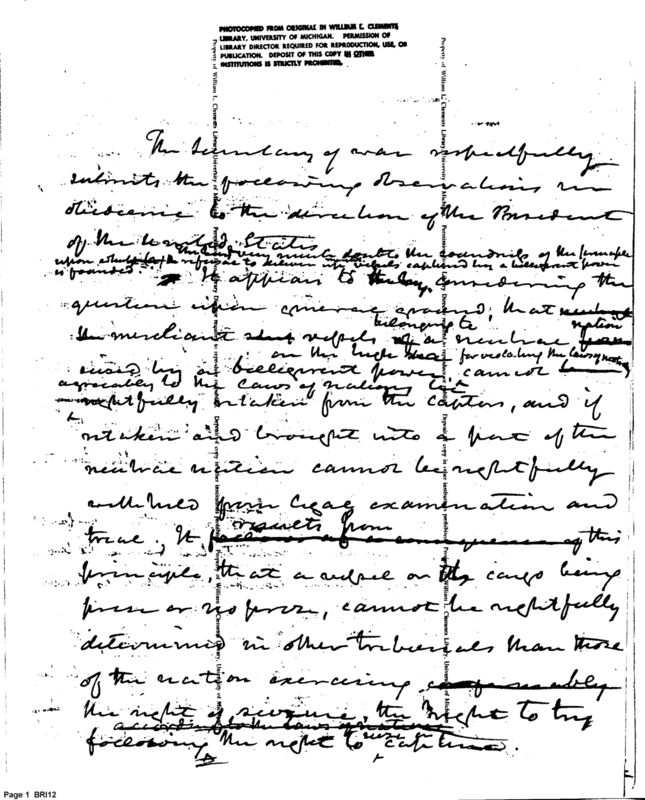
The Secretary of war respectfully submits the following observations in obedience to the direction of the President of the United States.
[strikethrough: upon studying in reference to determine the councils of the principle ... captured has a [undecipherable] is founded]
It appears to [him?], considering the questions which [arise] around, that vessels belonging to [a] nation [undecipherable]
The merchant ship[s] vessels of [the] neutral [undecipherable] on the high seas for violating the [laws] [undecipherable] by a belligerent power, cannot be [undecipherable] according to the laws of nations [undecipherable: unlawfully] retaken from the captors, and if retaken and brought into a port of the neutral nation cannot be rightfully withdrawn from legal examination and trial. It [results] from [undecipherable] of this principle, that a vessel or the cargo being proven or not proven, cannot be rightfully determined in other tribunals than those of the nation exercising [presumably] the right of seizure, the right to try [undecipherable] following the right to [determine].
[strikethrough: 2.] That by the laws of nations a neutral vessel met at sea, is liable to be seized by a vessel of war of either of the belligerent powers, and that this law gives the [additional] right, if the belligerent vessel is not satisfied with his search, to carry the neutral vessel into the country of the captor, there to be further examined tried and condemned (if she has violated the neutrality) in its courts established for the enquiring into the subject, and [undecipherable] compel by force the neutral to submit to search, and also to be carried into the country of the captor.
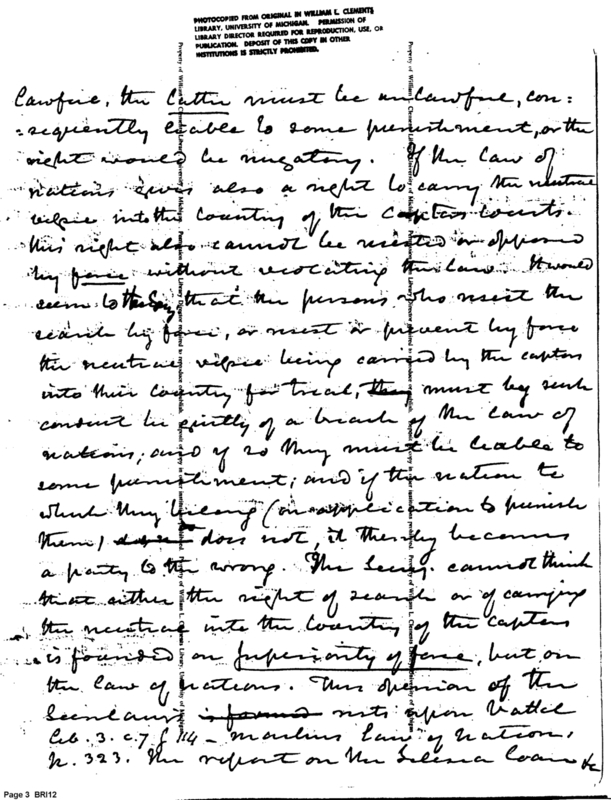
It also seems to [him] if a neutral vessel found at sea, refuses & resists by force to be searched, that for such conduct she is liable to be condemned as lawful prize. If the law of nations gives a right of search, it cannot allow a right to resist a search by force. The two rights cannot exist. They are perfectly inconsistent. If the first is
lawful, the latter must be unlawful, consequently liable to some punishment, or the right would be nugatory. If the law of nations gives also a right to carry the neutral vessel into the country of the captor's courts. This right also cannot be resisted or opposed by force without violating the law. It would seem to [the Secy.] that the persons who resist the search by force, or resist or prevent by force the neutral vessel being carried by the captor into their country for trial, they must by such conduct be guilty of a breach of the law of nations, and if so they must be liable to some punishment; and if the nation to which they belong (on application to punish them) does not, it thereby becomes a party to the wrong. The Secy. cannot think that either the right of search or of carrying the neutral into the country of the captors is founded on superiority of force, but on the law of nations. This opinion of the Secretary is founded not, upon Vattel Lib. 3. c.7. § 114 — Martins Law of Nations p. 323. The report on the [Selena?] case [undecipherable]
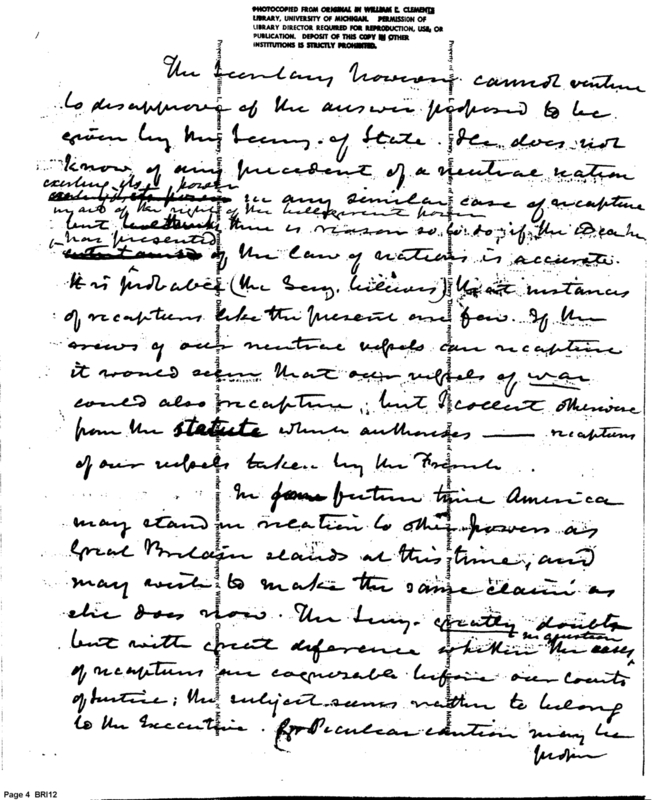
The Secretary however cannot venture to disapprove of the answer proposed to be given by the Secretary of State. He does not know of any precedent of a neutral nation exerting [her] force [undecipherable] in any similar case of recapture [undecipherable] by act of the right of the belligerent power [undecipherable] but [he thinks] there is reason so to do, if the [assertion] of the law of nations is accurate.
It is probable (the Secy. believes) that at instances of recaptures like the present are few. If the crews of our neutral vessels can recapture it would seem that our vessels of war could also recapture; but I recollect otherwise from the [statute] which authorizes [undecipherable] recaptures of our vessels taken by the French.
In some future time America may stand in relation to other powers as Great Britain stands at this time, and may wish to make the same claims as she does now. The Secy. greatly doubts but with great deference [undecipherable] the cases of recaptures are cognizable before our courts of justice; the subject seems rather to belong to the Executive. [undecipherable] Peculiar caution may be [proper?]
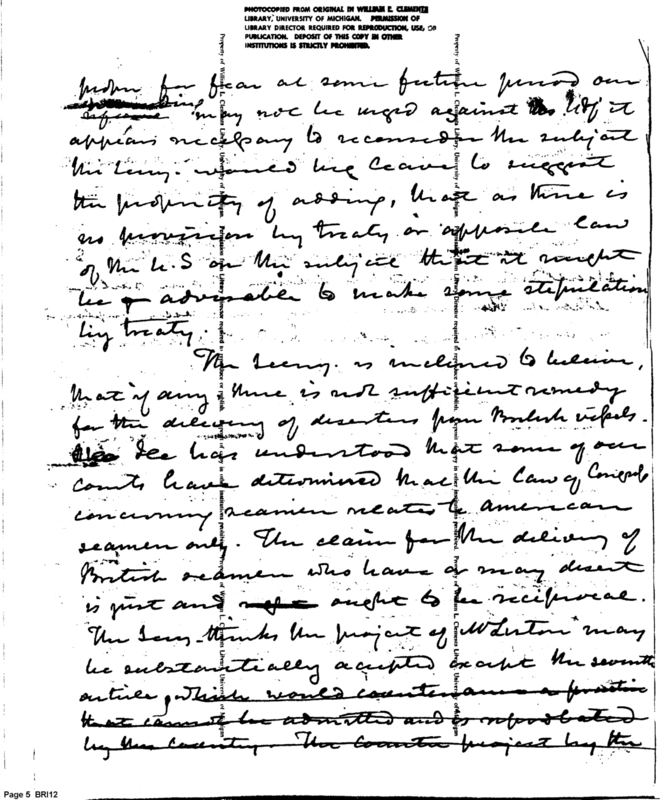
proper for fear at some future period our [undecipherable] may not be urged against [us?]. If it appears necessary to reconsider the subject the Secy. wished his leave to suggest the propriety of adding, that as there is no provision by treaty or applicable law of the U.S. on the subject that it might be advisable to make some stipulation by treaty.
The Secy. is inclined to believe, that if any, there is not sufficient remedy for the delivery of deserters from British vessels. [strikethrough: He] He has understood that some of our courts have determined that the Law of Congress concerning seamen relates to American seamen only. The claim for the delivery of British seamen who have or may desert is just and [strikethrough: of] ought to be reciprocal. The Secy. thinks the project of Mr [Liston?] may be substantially accepted except the seventh article which would countenance a practice that cannot be admitted and is reprobated by this country. The counter project by the +
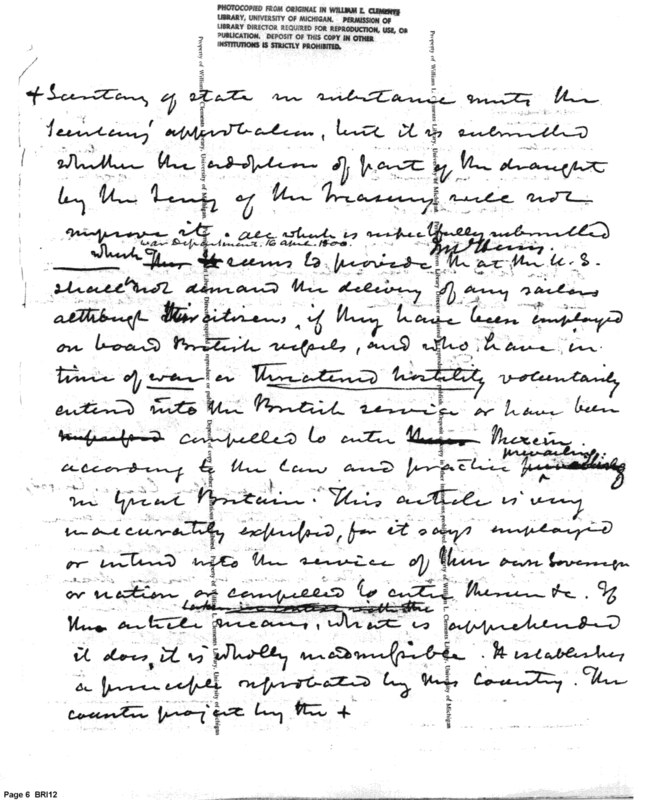
+ Secretary of State in substance suits the Secretary's approbation, but it is submitted whether the adoption of part of the draught by the [Secy.] of the Treasury will not improve it. All which is respectfully submitted
War Department [undecipherable] April 1800 McHenry
[undecipherable: There/That] seems to provide that the U.S. shall not demand the delivery of any sailors although [its?] citizens, if they have been employed on board British vessels, and who have in time of war or threatened hostility voluntarily entered into the British service or have been [strikethrough: impressed] compelled to enter [strikethrough: the] therein according to the law and practice [undecipherable] in Great Britain. This article is very inaccurately expressed, for it says employed or entered into the service of [their] own sovereign or nation or compelled to enter therein &c. If this article means what is apprehended it does, it is wholly inadmissible. It establishes a principle reprobated by this country. The counter project by the +
Type
Draft Document
Description
Discusses rules of engagement between a neutral vessel and a belligerent power. Questions whether or not a neutral vessel has a right resist - by force - a search of their ship, or if a belligerent power has a right to search a neutral ship and carry the vessel back to their country for a trial. McHenry adds that the United States has no obligation to return deserters from British vessels, and fully condemns impressment.
Date
1797
Author
Recipient
Repository
Collection
Document number
1797999900801
Page start
1
Note
Draft; final document is 1797999900901 (img BRI13)
Notable persons
James McHenry
President
merchants
French
Timothy Pickering
British
deserters
seaman
Congress
Liston
Oliver Wolcott, Jr.
sailors
Notable locations
France
courts
Britain
Notable items
Vessels
trial
laws
examination
cargo
statute
treaty