[Report of the heads of departments / Tench Coxe]
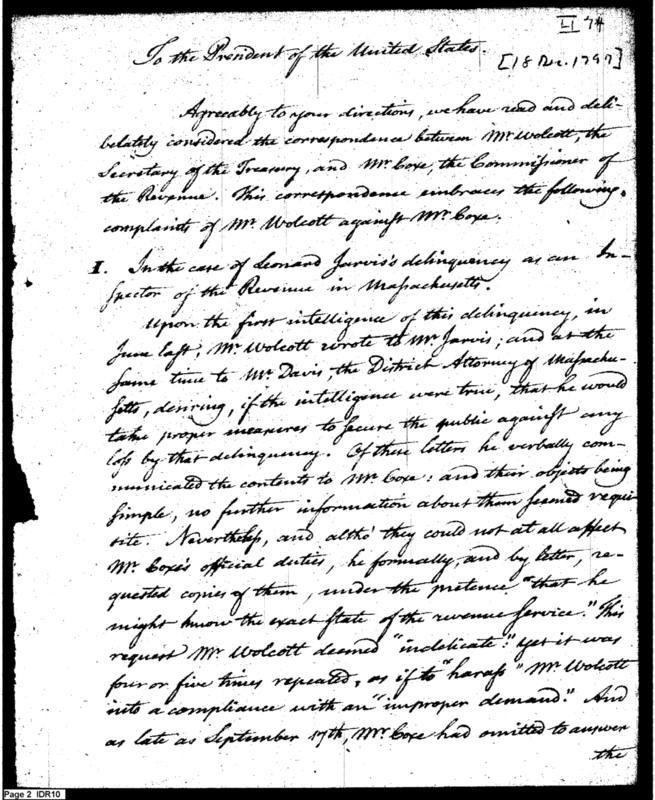
To the President of the United States. [18 Dec. 1797]
Agreeably to your directions, we have read and deliberately considered the correspondence between Mr Wolcott, the Secretary of the Treasury, and Mr Coxe, the Commissioner of the Revenue. This correspondence embraces the following complaints of Mr Wolcott against Mr Coxe:
**I.** In the case of demand Jarvis's delinquency as an Inspector of the Revenue in Massachusetts.
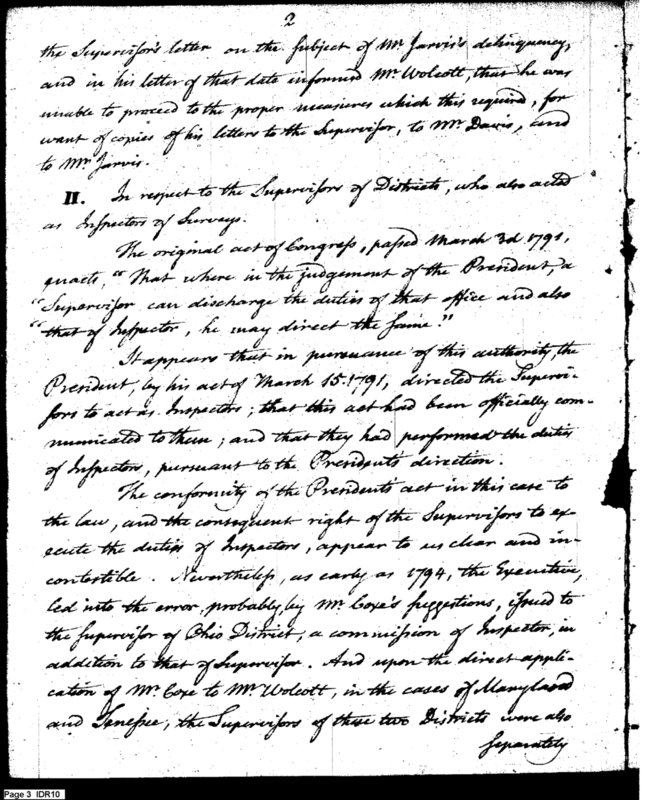
Upon the first intelligence of this delinquency, in June last, Mr Wolcott wrote to Mr Jarvis; and at the same time to Mr Davis, the District Attorney of Massachusetts, desiring, if the intelligence were true, that he would take proper measures to secure the public against any loss by that delinquency. Of these letters he verbally communicated the contents to Mr Coxe: and their objects being simple, no further information about them seemed requisite. Nevertheless, and altho' they could not at all affect Mr Coxe's official duties, he formally, and by letter, requested copies of them, under the pretence "that he might know the exact state of the revenue service." This request Mr Wolcott deemed "indelicate;" yet it was four or five times repeated, as if to "haras" Mr Wolcott into a compliance with an "improper demand." And as late as September 17th, Mr Coxe had omitted to answer the Supervisor's letter on the subject of Mr Jarvis's delinquency, and in his letter of that date informed Mr Wolcott, that he was unable to proceed to the proper measures which this required, for want of copies of his letters to the Supervisor, to Mr Davis, and to Mr Jarvis.
**II.** In respect to the Supervisors of Districts, who also acted as Inspectors of Surveys.
The original act of Congress, passed March 3d 1791, enacts, "That where in the judgement of the President, a "Supervisor can discharge the duties of that office and also "that of Inspector, he may direct the same."
It appears that in pursuance of this authority, the President, by his act of March 15. 1791, directed the Supervisors to act as Inspectors; that this act had been officially communicated to them; and that they had performed the duties of Inspectors, pursuant to the Presidents direction.
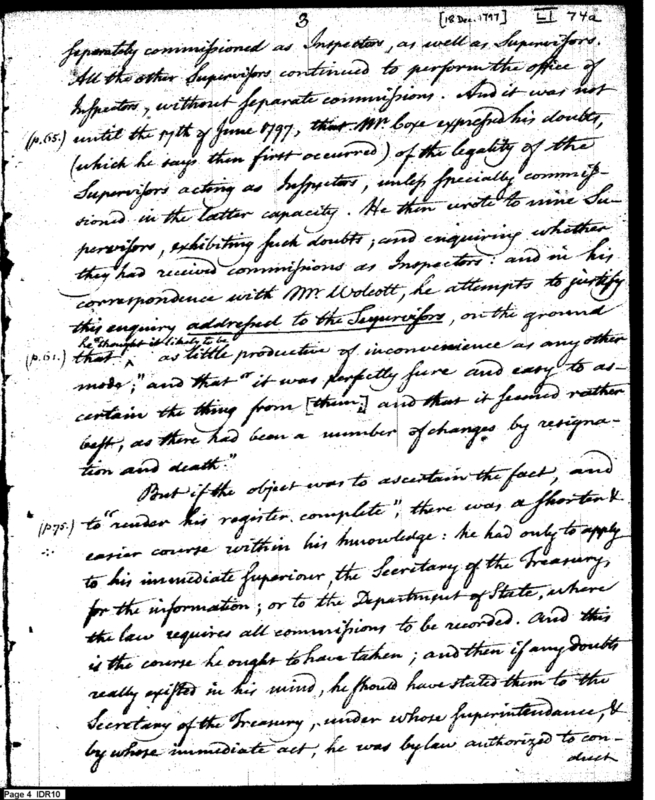
The conformity of the Presidents act in this case to the law, and the consequent right of the Supervisors to execute the duties of Inspectors, appear to us clear and incontestible. Nevertheless, as early as 1794, the Executive, led into the error, probably by Mr Coxe's suggestions, issued to the Supervisor of Ohio District, a commission of Inspector, in addition to that of Supervisor. And upon the direct application of Mr Coxe to Mr Wolcott, in the cases of Maryland and Genesee, the Supervisors of those two Districts were also separately commissioned as Inspector, as well as Supervisors. All the other Supervisors continued to perform the office of Inspector, without separate commissions. And it was not
(p.65.) until the 17th of June 1797, that Mr Coxe expressed his doubts, (which he says then first occurred) of the legality of the Supervisors acting as Inspectors, unless specially commissioned in the latter capacity. He then wrote to nine Supervisors, exhibiting such doubts, and enquiring whether they had received commissions as Inspectors; and in his correspondence with Mr Wolcott, he attempts to justify this enquiry addressed to the Supervisors, on the ground
(p.61.) that — "as little productive of inconvenience as any other mode;" and that "it was perfectly sure and easy to ascertain the thing from [them]; and that it seemed rather best, as there had been a number of changes by resignation and death."
But if the object was to ascertain the fact, and
(p.72.) to "render his register complete," there was a shorter & easier course within his knowledge: he had only to apply to his immediate Superior, the Secretary of the Treasury, for the information; or to the Department of State, where the law requires all commissions to be recorded. And this is the course he ought to have taken; and then if any doubts really existed in his mind, he should have stated them to the Secretary of the Treasury, under whose Superintendance, & by whose immediate act, he was by law authorized to conduct this branch of Treasury business. But instead of this prudent mode of proceeding, which was so obvious, & which any man sincerely aiming to promote the public Service would not have overlooked; and instead of confining his enquiries to the fact; — at the same time that he made the enquiry, he scattered his mischievous doubts.
(p.77.) And in his subsequent letter to one of the Supervisors [Mr Chinn of Connecticut] he says explicitly, That "the doings "of a person [meaning a Supervisor] acting as Inspector, "without a distinct commission, would be of no legal effect, and might produce consequences injurious to such "person, or to the United States." and, in effect, that frauds & perjuries might be committed with impunity. Yet, notwithstanding these peremptory declarations of the illegality of the acts of such a Supervisor, performing the duties of an Inspector, — in his justificatory correspondence with Mr Wolcott, he says [with astonishing inconsistency] that
(p.55.) "no doubt has been raised of the sufficiency of these acts "of the President [those which directed Supervisors to perform the duties of Inspectors] to all the ends for which "the President designed them. It was an evidence only "of his acts that was represented as necessary."!
**III.** The third complaint is grounded on Mr Coxe's communications to Mr Wolcott respecting the act imposing Stamp duties.
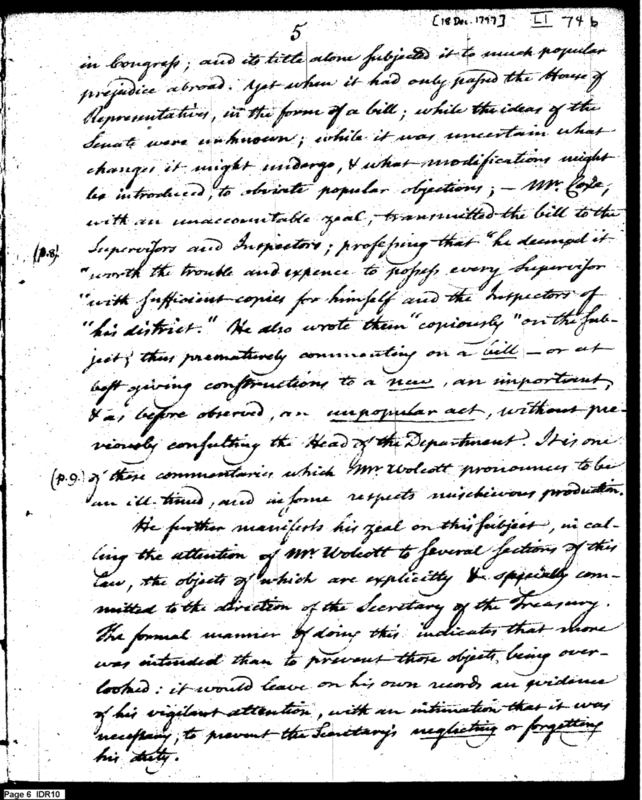
This act had to encounter not a little opposition in Congress; and its title alone subjected it to much popular prejudice abroad. Yet when it had only passed the House of Representatives, in the form of a bill; while the ideas of the Senate were unknown; while it was uncertain what changes it might undergo, & what modifications might be introduced, to obviate popular objections; — Mr Coxe, with an unaccountable zeal, transmitted the bill to the Supervisors and Inspectors; professing that "he deemed it worth the trouble and expence to propse every Supervisor "with sufficient copies for himself and the Inspectors of "his district." He also wrote them "copiously" on the subject; thus prematurely commenting on a bill — or at least giving constructions to a new, an important, & as before observed, an unpopular act, without previously consulting the Head of the Department. It is one
(p.9.) of those commentaries which Mr Wolcott pronounces to be "an ill-timed, and in some respects mischievous production."
He further manifests his zeal on this subject, in calling the attention of Mr Wolcott to several sections of this law, the objects of which are explicitly & specially committed to the direction of the Secretary of the Treasury. The formal manner of doing this indicates that there was intended than to prevent those objects being overlooked: it would leave on his own record, an evidence of his vigilant attention, with an intimation that it was necessary to prevent the Secretary's neglecting or forgetting his duty.
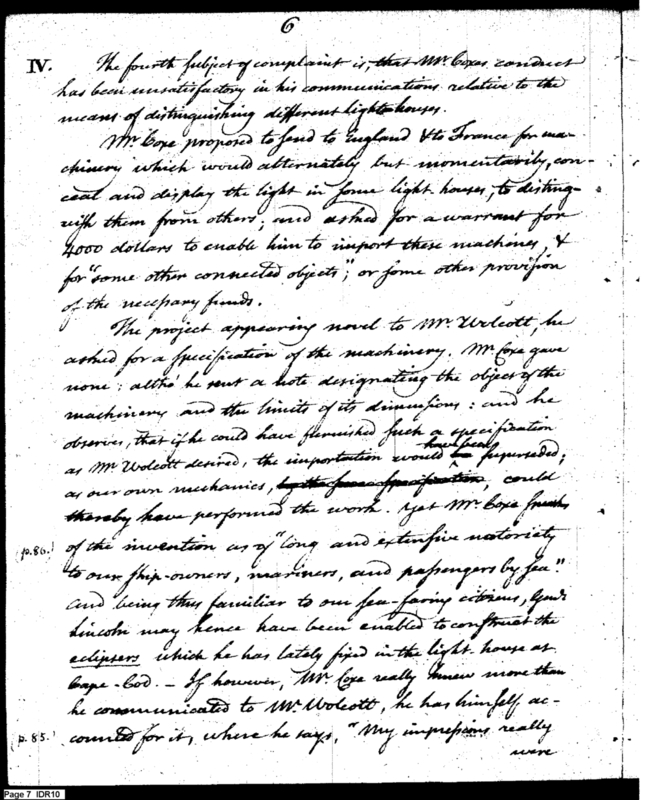
**IV.** The fourth subject of complaint is, that Mr Coxe's conduct has been unsatisfactory in his communications relative to the means of distinguishing different light-houses.
Mr Coxe proposed to send to England & to France for machinery which would alternately but momentarily, conceal and display the light in some light-houses, to distinguish them from others; and asked for a warrant for 4000 dollars to enable him to import these machines, & for some other connected objects; or some other provision of the necessary funds.
The project appearing novel to Mr Wolcott, he asked for a specification of the machinery. Mr Coxe gave none: altho' he sent a note designating the object of the machinery and the limits of its dimensions: and he observes, that if he could have furnished such a specification as Mr Wolcott desired, the importation would [strikethrough: have been] superseded; as our own mechanics, [strikethrough: by the same specification], could thereby have performed the work. Yet Mr Coxe founds
(p.80.) the fame of the invention as of "long and extensive notoriety to our Ship-owners, mariners, and passengers by sea." and being thus familiar to our sea-faring citizens, & Lincoln may hence have been enabled to construct the eclipsers which he has lately fixed in the light-house at Cape-Cod. — If however, Mr Coxe really knew more than he communicated to Mr Wolcott, he has himself ac-
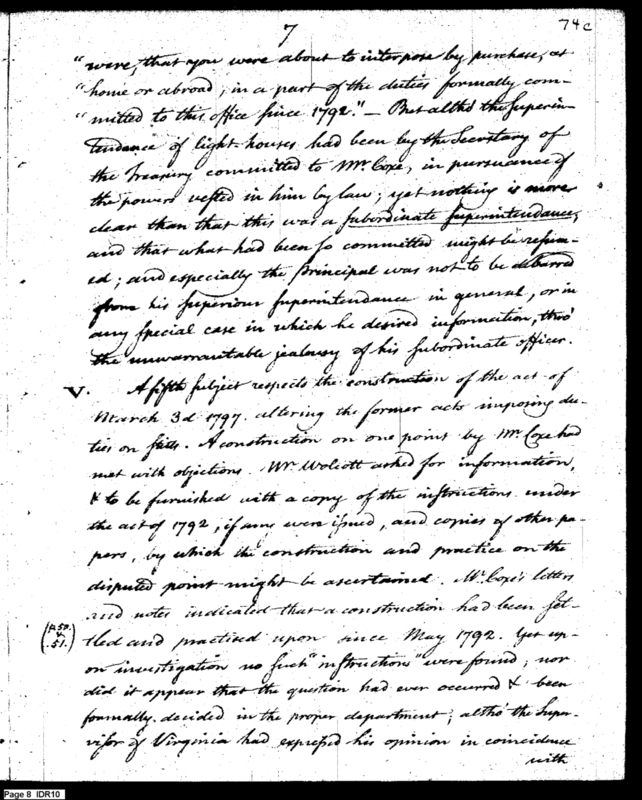
(p.85.) counted for it, where he says, "My impressions really were, that you were about to interpose by purchase, at "home or abroad, in a part of the duties formally committed to this office since 1792." — But altho' the Superintendance of light-houses had been by the Secretary of the Treasury committed to Mr Coxe, in pursuance of the powers vested in him by law; yet nothing is more clear than that this was a subordinate superintendance; and that what had been so committed might be resumed; and especially the principal was not to be deterred from his Superior Superintendance in general, or in any special case in which he desired information, thro' the unwarrantable jealousy of his Subordinate officer.
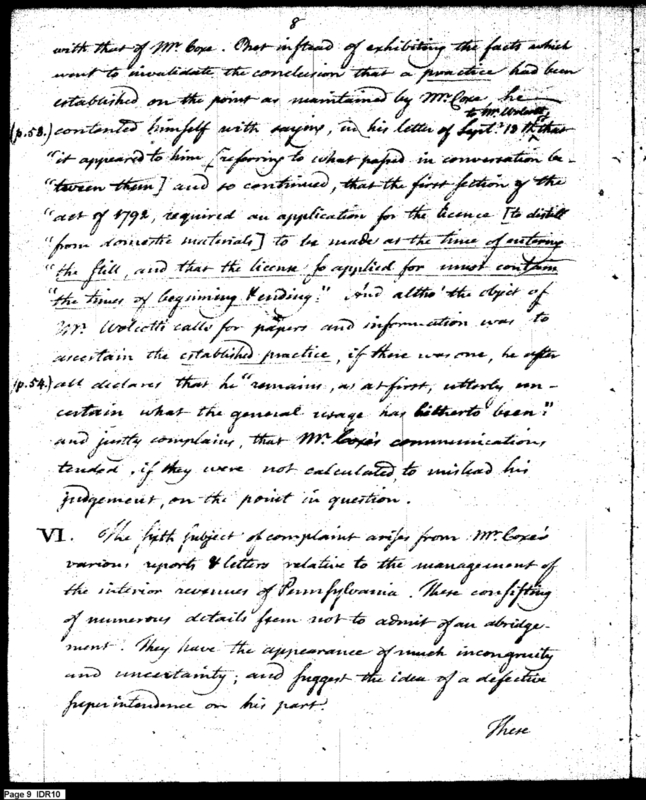
**V.** A fifth subject respects the construction of the act of March 3d 1797, altering the former acts imposing duties on Stills. A construction on one point by Mr Coxe had met with objections. Mr Wolcott asked for information, & to be furnished with a copy of the instructions under the act of 1792, if any were issued, and copies of other papers, by which the construction and practice on the disputed point might be ascertained. Mr Coxe's letters and notes indicated that a construction had been settled and practiced upon since May 1792. Yet upon investigation no such "instructions" were found; nor did it appear that the question had ever occurred & been formally decided in the proper department; altho' the Supervisor of Virginia had expressed his opinion in coincidence with that of Mr Coxe. But instead of exhibiting the facts which went to invalidate the conclusion that a practice had been established on the point as maintained by Mr Coxe, he
(p.58.) contented himself with saying, in his letter of Sept. 13th, to Mr Wolcott, that "it appeared to him [referring to what passed in conversation between them] and so continued, that the first section of the "act of 1792, required an application for the licence [to distil "from domestic materials] to be made at the time of entering "the Still, and that the licence so applied for must conform "the times of beginning & ending." And altho' the object of Mr Wolcott calls for papers and information was to ascertain the established practice, if there was one, he after
(p.54.) all declares that he "remains, as at first, utterly uncertain what the general usage has hitherto been;" and justly complains, that Mr Coxe's communications tended, if they were not calculated to mislead his judgement, on the point in question.
**VI.** The Sixth subject of complaint arises from Mr Coxe's various reports & letters relative to the management of the interior revenues of Pennsylvania. These consisting of numerous details too not to admit of an abridgement. They have the appearance of much incongruity and uncertainty; and suggest the idea of a defective Superintendance on his part.
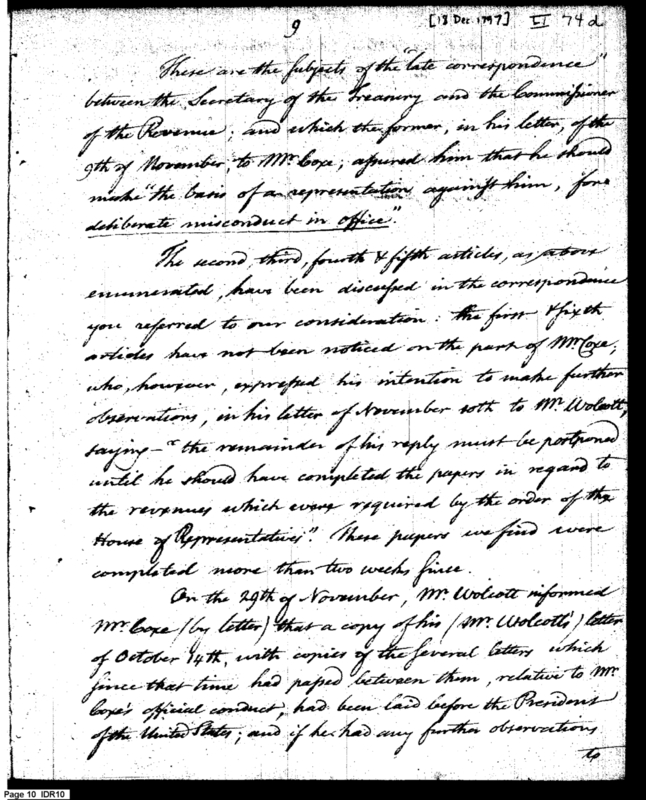
These are the subjects of the late correspondence between the Secretary of the Treasury and the Commissioner of the Revenue; and which the former, in his letter, of the 9th of November, to Mr Coxe, assured him that he should make the basis of a representation against him, for [underline: "deliberate misconduct in office."]
The second, third, fourth & fifth articles, as above enumerated, have been discussed in the correspondence you referred to our consideration: the first & sixth articles have not been noticed on the part of Mr Coxe; who, however, expressed his intention to make further observations, in his letter of November 10th to Mr Wolcott, saying — "the remainder of his reply must be postponed until he should have completed the papers in regard to the revenues which were required by the order of the House of Representatives." Those papers we find were completed more than two weeks since.
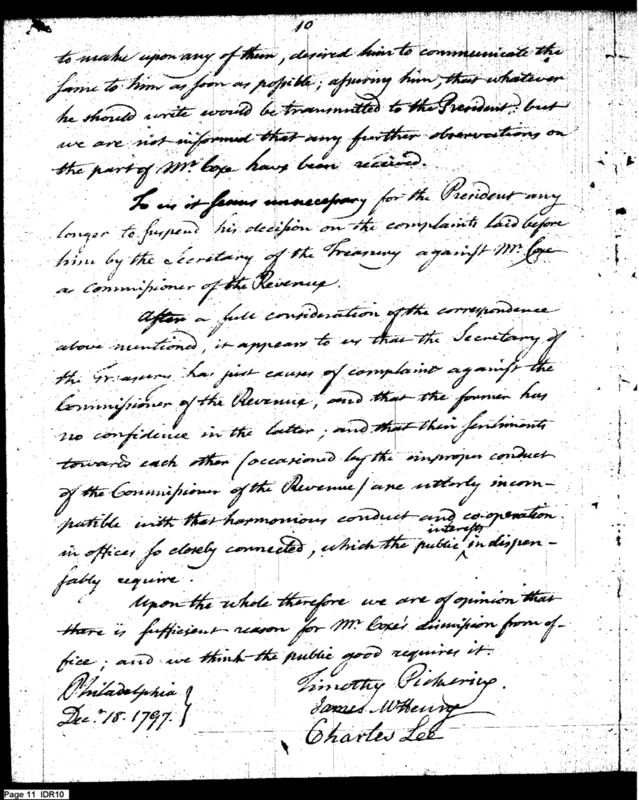
On the 29th of November, Mr Wolcott informed Mr Coxe [by letter] that a copy of his [Mr Wolcott's] letter of October 14th, with copies of the several letters which since that time had passed between them, relative to Mr Coxe's official conduct, had been laid before the President of the United States; and if he had any further observations to make upon any of them, desired him to communicate the same to him as soon as possible; assuring him, that whatever he should write would be transmitted to the President: but we are not informed that any further observations on the part of Mr Coxe have been received.
To us it seems unnecessary for the President any longer to suspend his decision on the complaints laid before him by the Secretary of the Treasury against Mr Coxe as Commissioner of the Revenue.
After a full consideration of the correspondence above mentioned, it appears to us that the Secretary of the Treasury has just causes of complaint against the Commissioner of the Revenue, and that the former has no confidence in the latter; and that their sentiments towards each other (occasioned by the improper conduct of the Commissioner of the Revenue) are utterly incompatible with that harmonious conduct and co-operation interests in offices so closely connected, which the public indispensably require.
Upon the whole therefore we are of opinion that there is sufficient reason for Mr Coxe's dimission from office; and we think the public good requires it.
Philadelphia } Timothy Pickering.
Dec. 18. 1797. } James McHenry
Charles Lee