No human transcription currently available for this document.
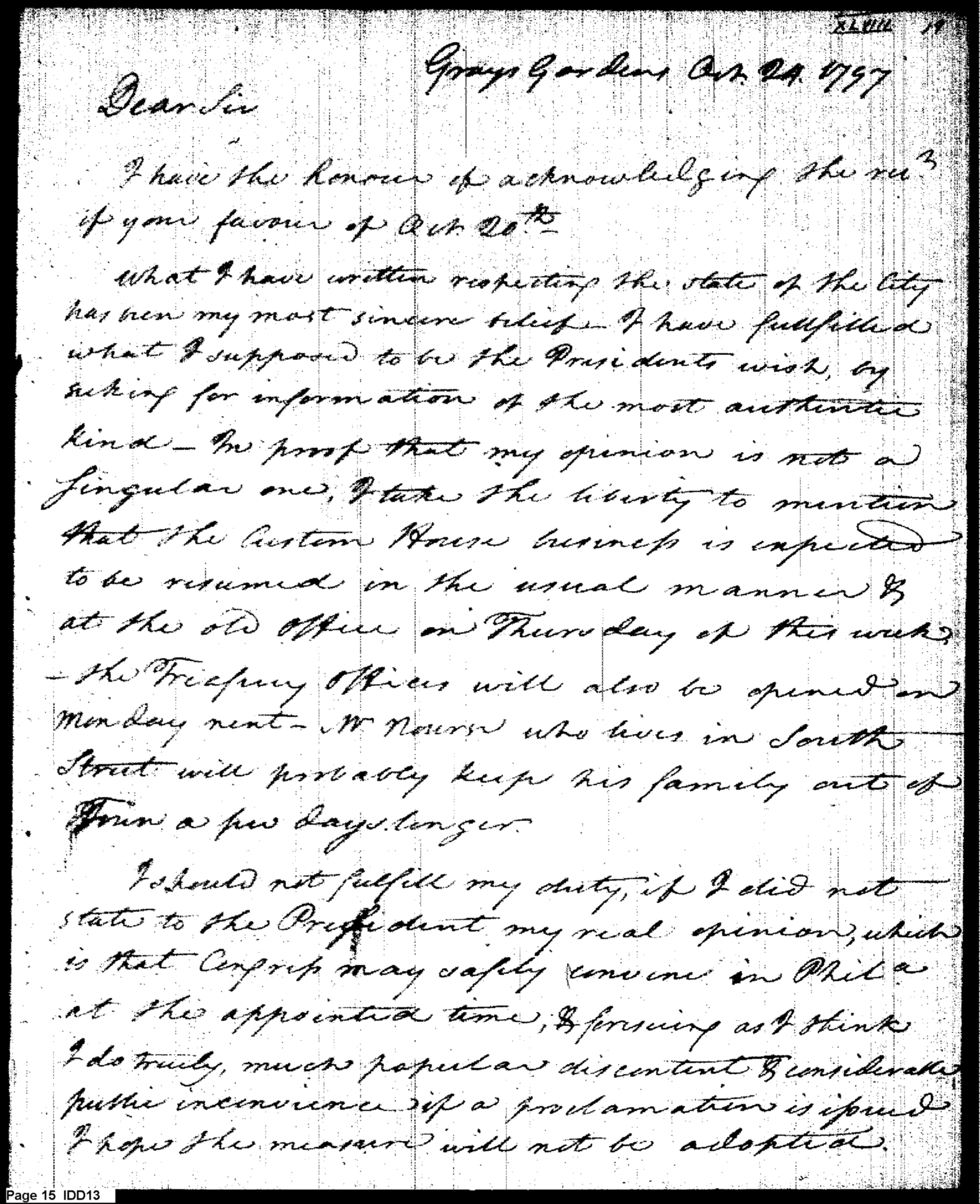
Grays Gardens, Oct. 24, 1797
Dear Sir
I have the honour of acknowledging the rect if your favour of Oct. 20th.
What I have written respecting the state of the City has been my most sincere belief — I have fulfilled what I supposed to be the Presidents wish, by asking for information of the most authentic kind — In proof that my opinion is not a singular one, I take the liberty to mention that the Custom House business is expected to be resumed in the usual manner & at the old Office on Thursday of this week — the Treasury Offices will also be opened on Monday next — Mr Nourse who lives in South Street will probably keep his family out of Town a few Days longer.
I should not fulfill my duty, if I did not state to the President my real opinion, which is that Congress may safely convene in Phila at the appointed time; & persuing as I think I do truly, mucs popular discontent & considerable public inconvenience if a proclamation is issued — I hope the measure will not be adopted.
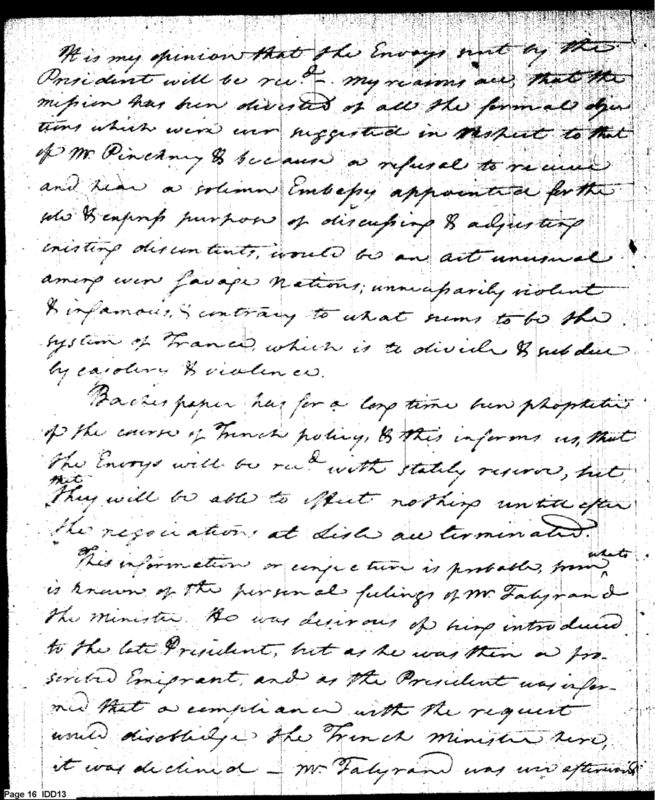
It is my opinion that the Envoys sent by the President will be recd. — my reasons are, that the mission has been divested of all the formal objections which were ever suggested in respect to that of Mr Pinckney & because a refusal to receive and hear a solemn Embassy appointed for the sole & express purpose of discussing & adjusting existing discontents, would be an act unusual among even Savage Nations; unwarrantably violent & infamous, & contrary to what seems to be the system of France which is to divide & subdue by caolery & violence.
Baches paper has for a long time been prophetick of the course of French policy, & this informs us, that the Envoys will be recd with stately reserve, but they will be able to effect nothing untill after the negotiations at Lisle are terminated.
This information or conjecture is probable, from what is known of the personal feelings of Mr Tallyrand the Minister. He was desirous of being introduced to the late President, but as he was then a proscribed Emigrant, and as the President was informed that a compliance with the request would disoblige the French Minister here, it was declined — Mr Tallyrand was now afterwards
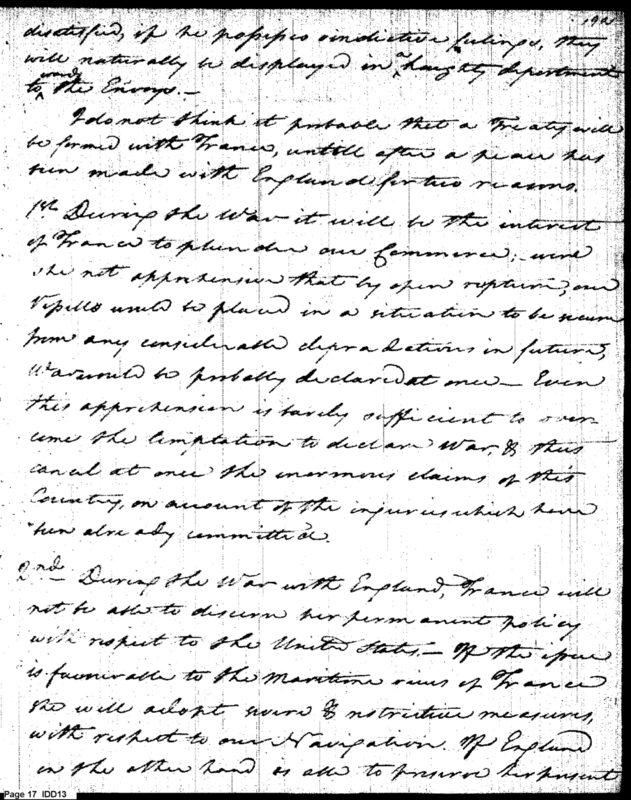
dissatisfied, if he possesses vindictive feelings, they will naturally be displayed in haughty deportment to the Envoys. —
I do not think it probable that a Treaty will be formed with France, untill after a peace has been made with England for two reasons.
1st During the War it will be the interest of France to plunder our Commerce; and she not apprehensive that by open rupture, our Vessels would be placed in a situation to be secure from any considerable depredations in future; War would be probably declared at once — Even this apprehension is barely sufficient to overcome the temptation to declare War, & thus cancel at once the enormous claims of this Country, on account of the injuries which have been already committed.
2nd — During the War with England, France will not be able to discern her permanent policy with respect to the United States — If the issue is favourable to the Maritime views of France she will adopt more & restrictive measures, with respect to our Navigation. If England on the other hand is able to preserve her present
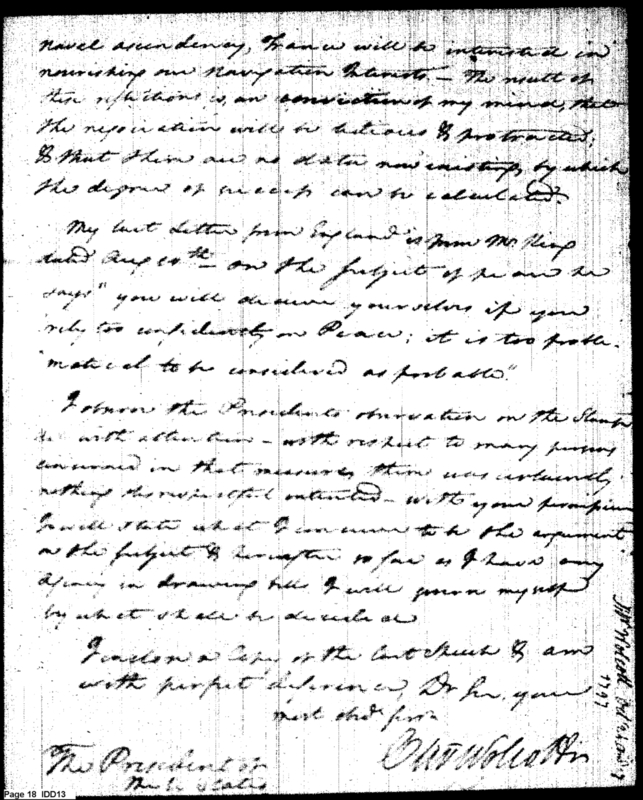
naval ascendency, France will be interested in nourishing our Navigation & Interests — The result of these reflections is, an conviction of my mind, that the negotiation will be tedious & protracted, & that there are no data now existing, by which the degrees of success can be calculated.
My last Letter from England is from Mr King dated Aug 14th — on the subject of peace and he says " you will deceive yourselves if you rely too confidently on Peace; it is too problematical to be considered as probable."
I omit the Presidents observation on the Stamp tax with attention — with respect to many persons concerned in that measures, there was certainly nothing therein which entitled — With your permission I will state what I conceive to be the argument on the subject & hereafter so far as I have any defect in drawing this I will govern myself by what shall be decided on.
I enclose a copy of the last Clause & am with perfect deference, Dr Sir, your most obedt Servt
[signature: Wolcott Jr]
[addressed:] The President of the Ud States
[docketed: Philadelphia Oct. 24. 1797]