No human transcription currently available for this document.
[To J.A.]
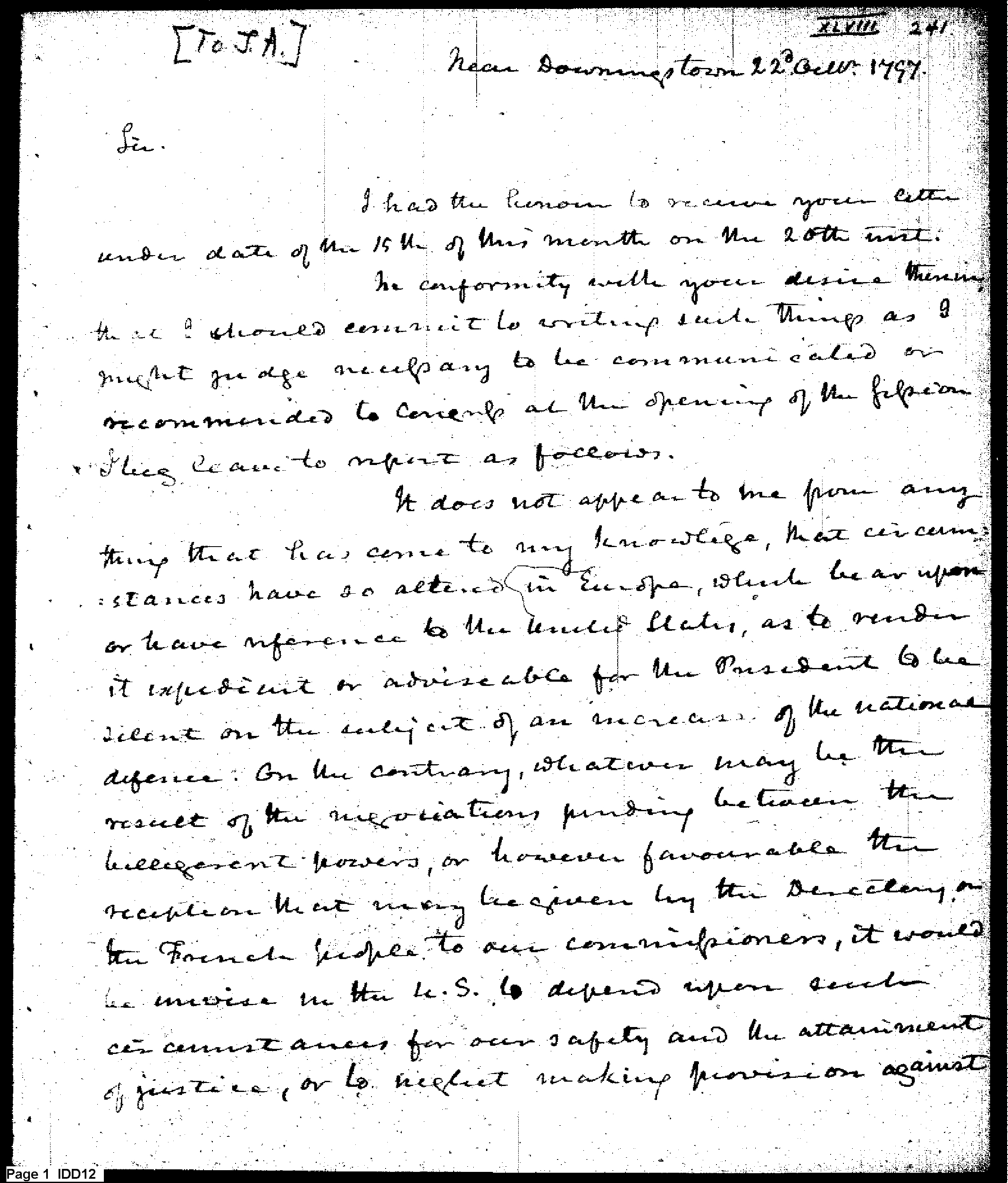
Near Downingstown 22d Octr 1797.
Sir.
I had the honour to receive your letter under date of the 15th of this month on the 20th inst. In conformity with your desire therein that I should commit to writing such things as I might judge necessary to be communicated or recommended to Congress at the opening of the Session, I beg leave to report as follows.
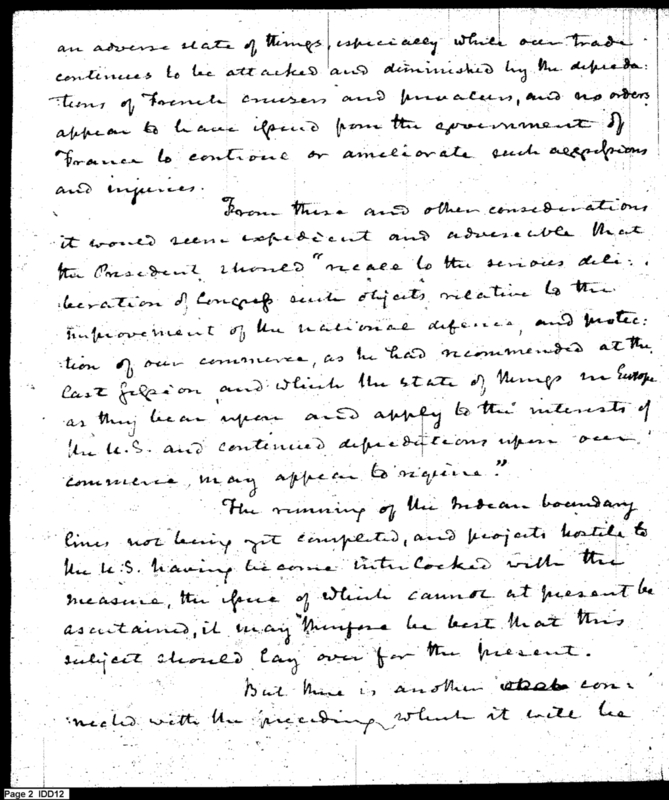
It does not appear to me from any thing that has come to my knowledge, that circumstances have so altered in Europe, which bear upon or have reference to the United States, as to render it expedient or adviseable for the President to be silent on the subject of an increase of the national defence. On the contrary, whatever may be the result of the negotiations pending between the belligerent powers, or however favourable the reception that may be given by the Directory, or the French people to our commissioners, it would be unwise in the U.S. to depend upon such circumstances for our safety and the attainment of justice, or to neglect making provision against an adverse state of things, especially while our trade continues to be attacked and diminished by the depredations of French cruisers and privateers, and no orders appear to have issued from the government of France to controul or ameliorate such aggressions and injuries.
From these and other considerations it would seem expedient and adviseable that the President should "recal to the serious deliberation of Congress such objects relative to the improvement of the national defence, and protection of our commerce, as he had recommended at the last Session, and which the state of things in Europe as they bear upon and apply to the interests of the U.S. and continued depredations upon our commerce, may appear to require."
The running of the Indian boundary lines not being yet completed, and projects hostile to the U.S. having become interlocled with the measure, the force of which cannot at present be ascertained, it may therefore be best that this subject should lay over for the present.
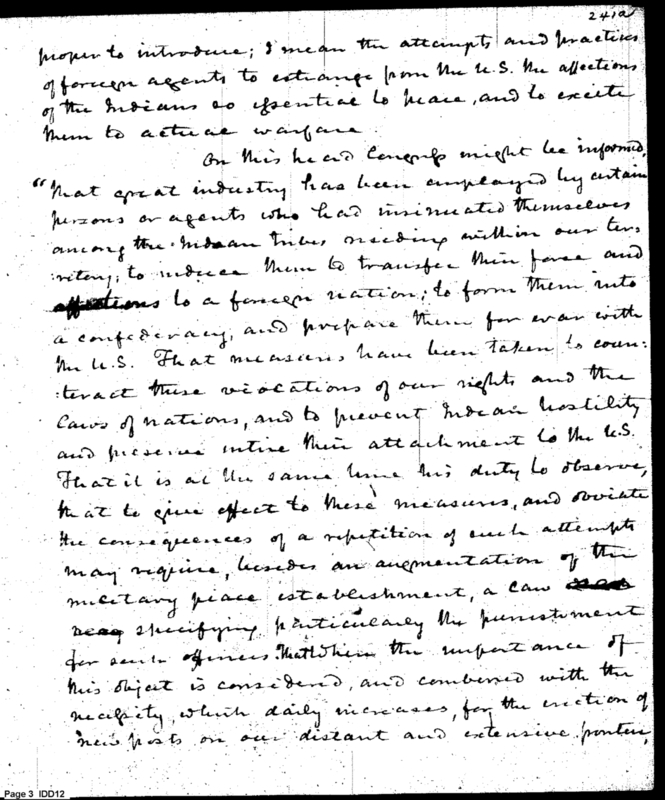
But there is another object connected with the preceding which it will be proper to introduce; I mean the attempts and practices of foreign agents to estrange from the U.S. the affections of the Indians so essential to peace, and to excite them to actual warfare.
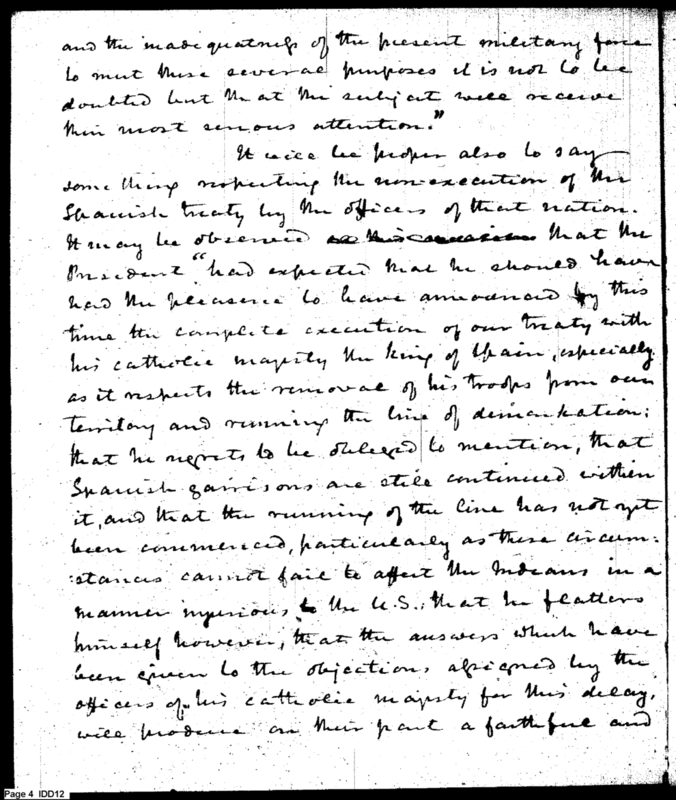
On this head Congress might be informed, "that great industry has been employed by certain persons or agents who had insinuated themselves among the Indian tribes residing within our territory, to induce them to transfer their force and [strikethrough: affections] to a foreign nation; to form them into a confederacy, and prepare them for war with the U.S. That measures have been taken to counteract these violations of our rights and the laws of nations, and to prevent Indian hostility and preserve entire their attachment to the U.S. That it is at the same time his duty to observe, that to give effect to these measures, and obviate the consequences of a repetition of such attempts may require, besides an augmentation of the military peace establishment, a law [undecipherable] penal specifying particularly the punishment for such offences. That when the importance of this object is considered, and combined with the necessity, which daily increases, for the erection of new posts on our distant and extensive frontier, and the inadequateness of the present military force to meet these several purposes it is not to be doubted but that the subject will receive their most serious attention."
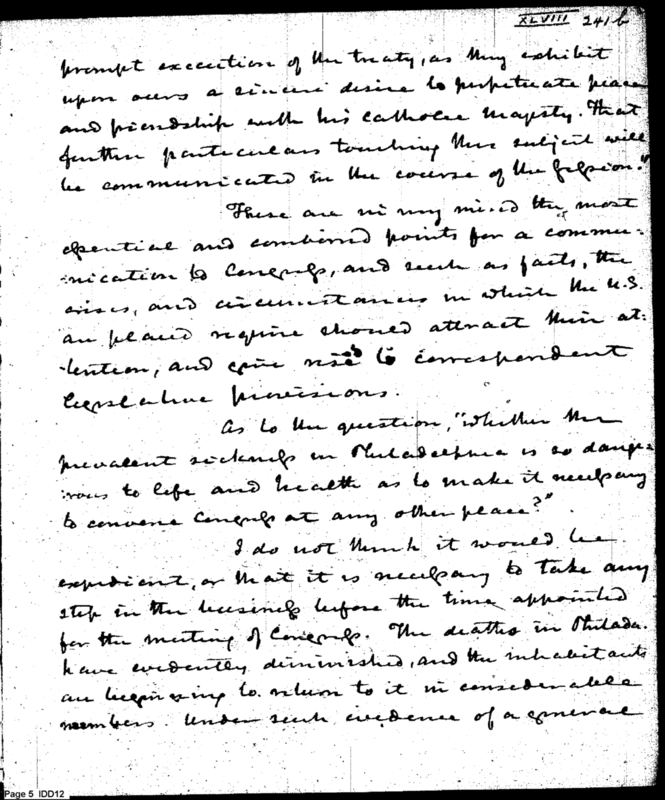
It will be proper also to say something respecting the non-execution of the Spanish treaty by the officers of that nation. It may be observed on this occasion that the President "had expected that he should have had the pleasure to have announced by this time the complete execution of our treaty with his catholic majesty the king of Spain, especially as it respects the removal of his troops from our territory and running the line of demarcation; that he regrets to be obliged to mention, that Spanish garrisons are still continued within it, and that the running of the line has not yet been commenced, particularly as these circumstances cannot fail to affect the Indians in a manner injurious to the U.S.; that he flatters himself however, that the answers which have been given to the objections alledged by the officers of his catholic majesty for this delay, will produce on their part a faithful and prompt execution of the treaty, as they exhibit upon ours a sincere desire to perpetuate peace and friendship with his catholic majesty. That further particulars touching this subject will be communicated in the course of the Session."
These are in my mind the most essential and combined points for a communication to Congress, and such as facts, the crises, and circumstances in which the U.S. are placed require should attract their attention, and give rise to correspondent legislative provisions.
As to the question, "whether the prevalent sickness in Philadelphia is so dangerous to life and health as to make it necessary to convene Congress at any other place?"
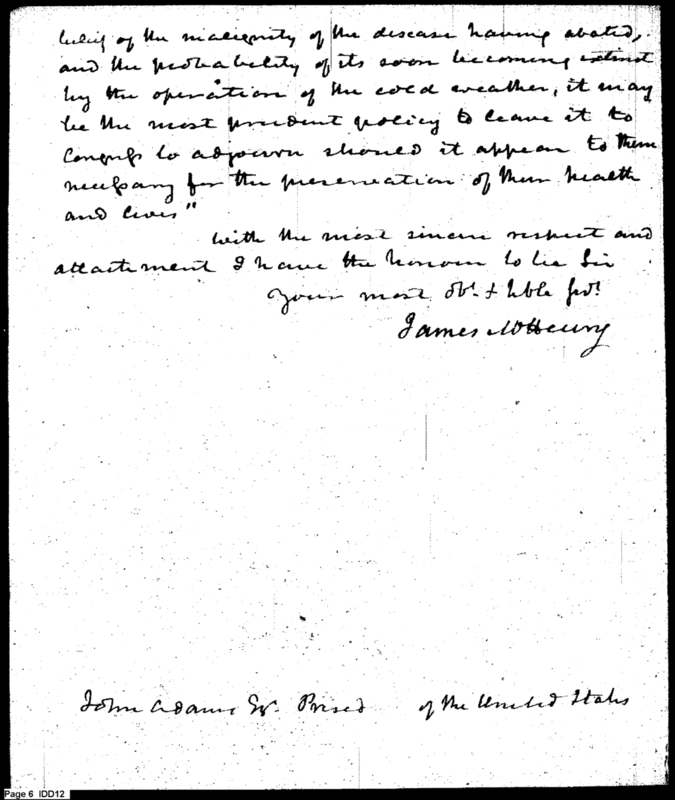
I do not think it would be expedient, or that it is necessary to take any step in the business before the time appointed for the meeting of Congress. The deaths in Philada. have evidently diminished, and the inhabitants are beginning to return to it in considerable numbers. Under such evidence of a general belief of the malignity of the disease having abated, and the probability of its soon becoming extinct by the operation of the cold weather, it may be the most prudent policy to leave it to Congress to adjourn should it appear to them necessary for the preservation of their health and lives."
With the most sincere respect and attachment I have the honour to be Sir
Your most Obt & hble Sert
James McHenry
John Adams W. Presidt of the United States