No human transcription currently available for this document.
[E post 5 May 1797] [XLVIII 231]
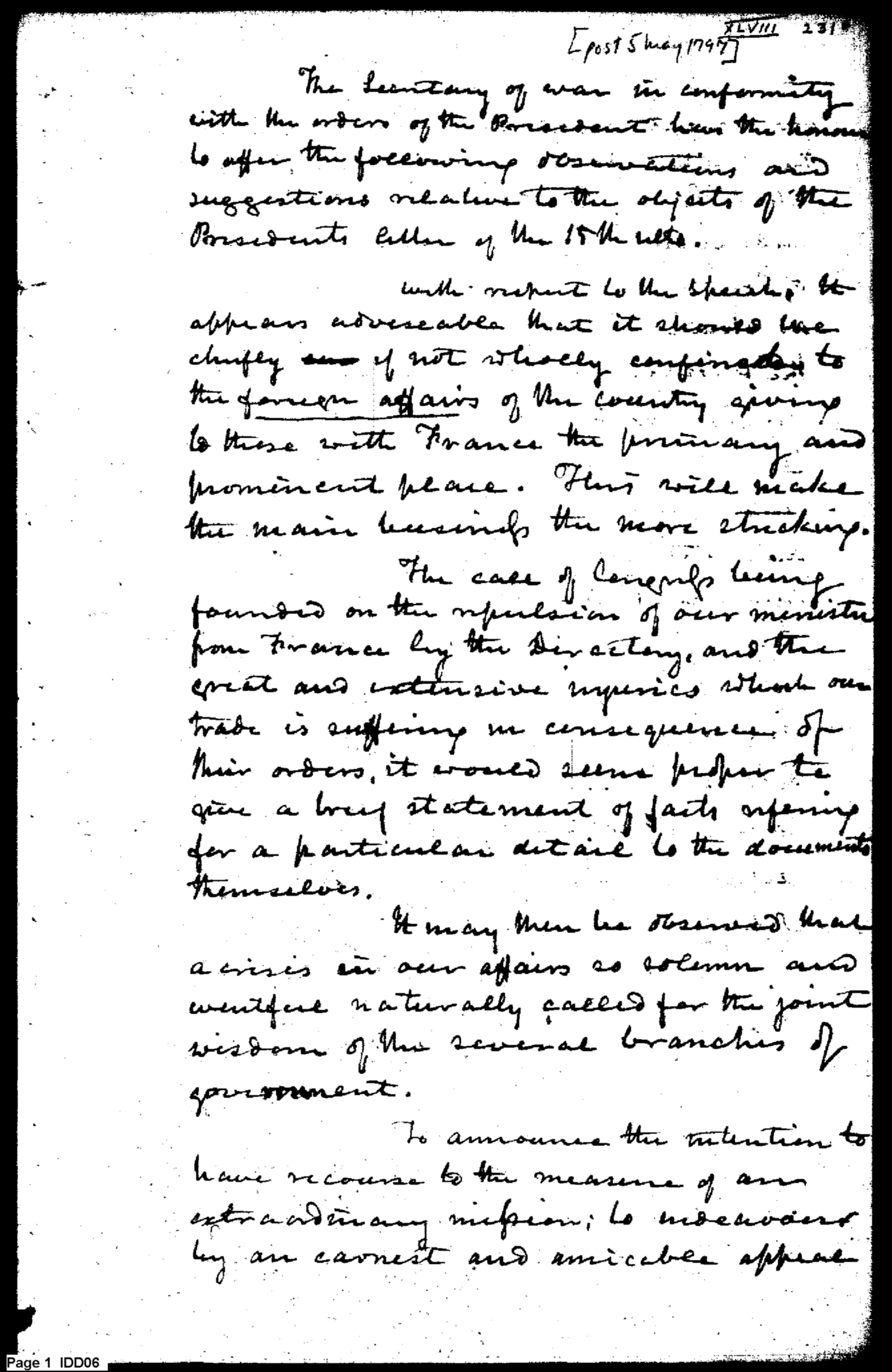
The Secretary of war in conformity with the orders of the President has the honor to offer the foregoing observations and suggestions relative to the objects of the President's letter of the 15th ults.
With respect to the Speech, it appears adviseable that it should be chiefly and if not wholly confined to the foreign affairs of the country, giving to these with France the primary and prominent place. This will make the main business the more striking.
The case of Congress being founded on the expulsion of our minister from France by the Directory, and the great and extensive injuries which our trade is suffering in consequence of their orders, it would seem proper to give a brief statement of facts opening for a particular detail to the documents themselves.
It may then be observed that a crisis in our affairs so solemn and weighty naturally called for the joint wisdom of the several branches of government.
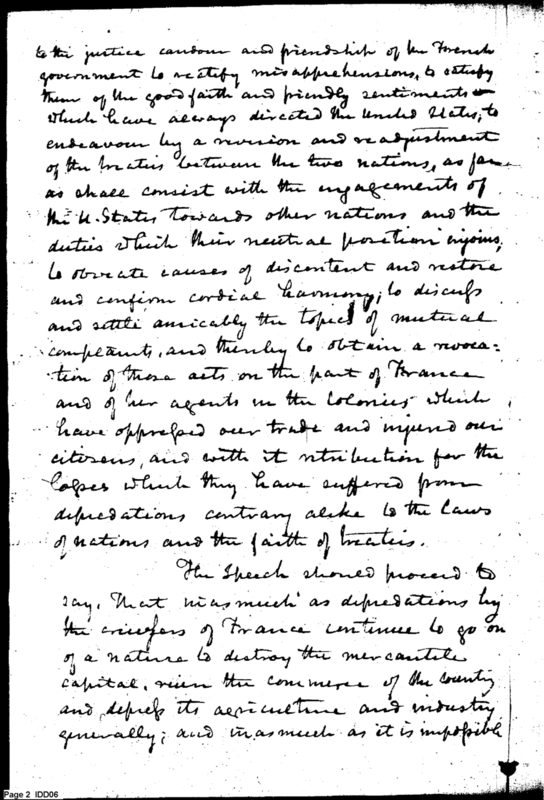
To announce the intention to have recourse to the measure of an extraordinary mission; to endeavour by an earnest and amicable appeal to the justice candour and friendship of the French government to rectify misapprehensions, to satisfy them of the good faith and friendly sentiments which have always directed the United States, to endeavour by a revision and readjustment of the treaties between the two nations, as far as shall consist with the engagements of the U. States towards other nations and the duties which their neutral position enjoins, to obviate causes of discontent and restore and confirm cordial harmony; to discuss and settle amicably the topics of mutual complaints, and thereby to obtain a revocation of those acts on the part of France and of her agents in the colonies which have oppressed our trade and injured our citizens, and with it retribution for the losses which they have suffered from depredations contrary alike to the laws of nations and the faith of treaties.
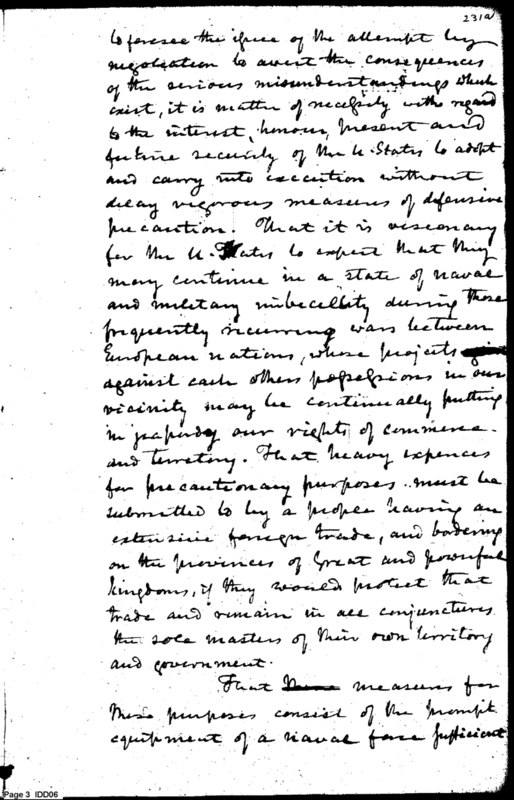
The Speech should proceed to say, That inasmuch as depredations by the cruisers of France continue to go on of a nature to destroy the mercantile capital, ruin the commerce of the country and depress its agriculture and industry generally; and inasmuch as it is impossible to foresee the issue of the attempt by negotiation to avert the consequences of the serious misunderstandings which exist, it is matter of necessity with regard to the interest, honour, present and future security of the U. States to adopt and carry into execution without delay vigorous measures of defensive precaution. That it is visionary for the U. States to expect that they may continue in a state of naval and military imbecellity during those frequently recurring wars between European nations, whose projects against each others possessions in our vicinity may be continually putting in jeopardy our rights of commerce and territory. That heavy expences for precautionary purposes must be submitted to by a people having an extensive foreign trade, and bordering on the provinces of great and powerful kingdoms, if they would protect that trade and remain in all conjunctures the sole masters of their own territory and government.
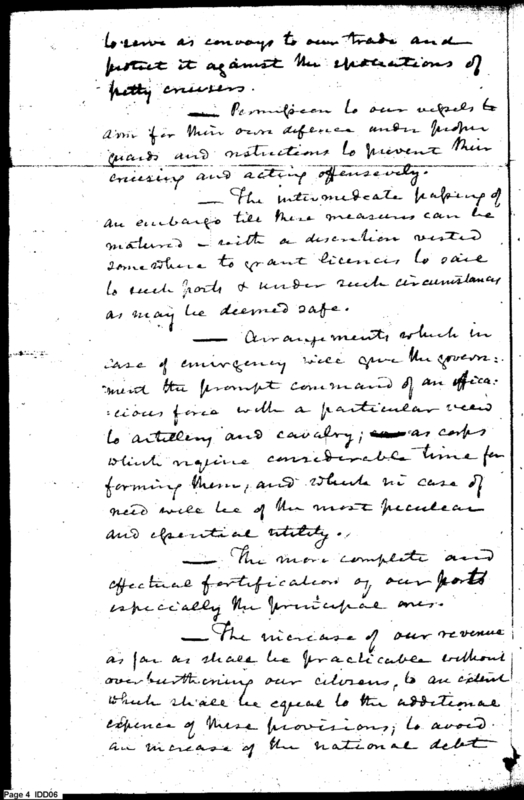
That [these] measures for these purposes consist of the prompt equipment of a naval force sufficient to serve as convoys to our trade and protect it against the depredations of petty cruisers.
— Permission to our vessels to arm for their own defence under proper guards and restrictions to prevent their cruising and acting offensively.
— The intermediate halting of an embargo till these measures can be matured — with a discretion vested somewhere to grant licences to sail to such ports & under such circumstances as may be deemed safe.
— Arrangements which in case of emergency will give the government the prompt command of an efficacious force with a particular view to artillery and cavalry; [strikethrough: as corps] which require considerable time for forming them, and which in case of need will be of the most peculiar and essential utility.
— The more complete and effectual fortification of our ports especially the principal ones.
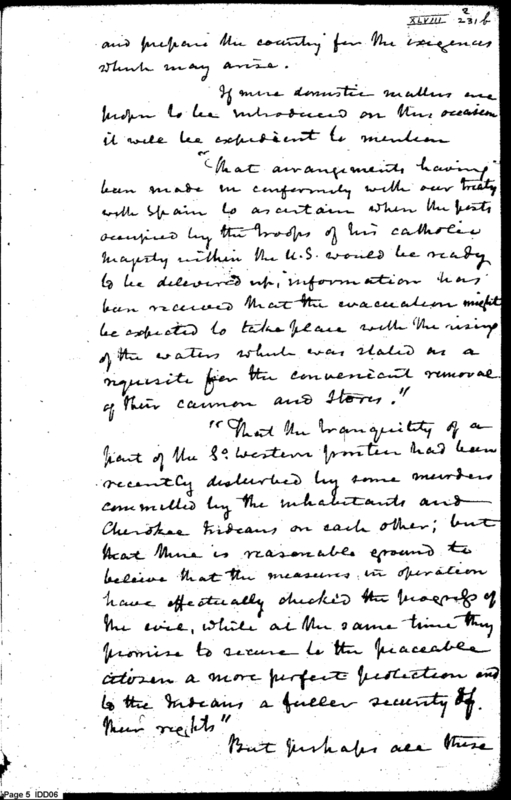
— The increase of our revenue as far as shall be practicable without overburthenening our citizens, to an extent which shall be equal to the additional expence of these provisions; to avoid an increase of the national debt and prepare the country for the exigencies which may arise.
If more domestic matters are proper to be introduced on this occasion it will be expedient to mention
"That arrangements having been made in conformity with our treaty with Spain to ascertain when the posts occupied by the troops of his catholics Majesty within the U.S. would be ready to be delivered up; information has been received that the evacuation might be expected to take place with the rising of the waters which was stated as a requisite for the convenient removal of their cannon and Stores."
"That the tranquility of a part of the So Western frontier had been recently disturbed by some murders committed by the inhabitants and Cherokee Indians on each other; but that there is reasonable ground to believe that the measures in operation have effectually checked the progress of the evil, while at the same time they promise to secure to the peaceable citizen a more perfect protection and to the Indians a fuller security of their rights"
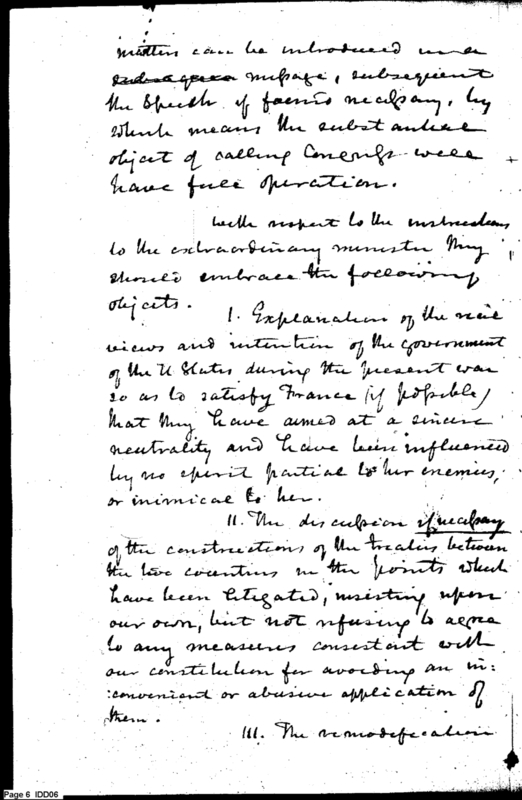
But perhaps all these matters can be introduced under such a preface, subsequent the Speech if found necessary, by which means the subordinate object of calling Congress will have full operation.
With respect to the instructions to the extraordinary minister they should embrace the following objects.
I. Explanation of the real views and intention of the government of the U States during the present war so as to satisfy France (if possible) that they have aimed at a sincere neutrality and have been influenced by no spirit partial to her enemies, or inimicable to her.
II. The discussion if necessary of the constructions of the treaties between the two countries on the points which have been litigated, insisting upon our own, but not refusing to agree to any measures consistent with our constitution for avoiding an inconvenient or abusive application of them.
III. The remodification of the guarantee in our treaty of alliance into a dispensation of specific succours in future wars.
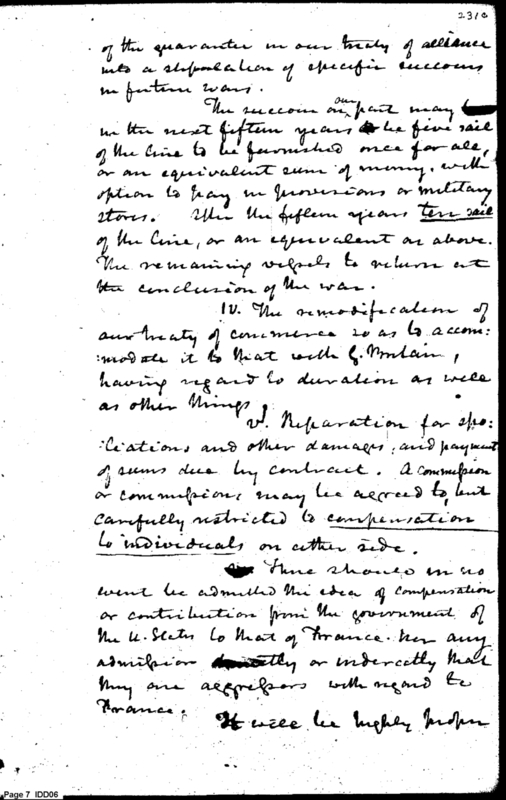
The succours our part may be in the next fifteen years [strikethrough: to be] five sail of the line to be furnished once for all, or an equivalent sum of money, with option to France in provisions or military stores. After the fifteen years [underline: ten sail] of the line, or an equivalent as above. The remaining vessels to return at the conclusion of the war.
IV. The remodification of our treaty of commerce so as to accommodate it to that with G. Britain, having regard to duration as well as other things.
V. Reparation for depredations and other damages, and payment of sums due by contract. A commission or commissions may be agreed to, but carefully restricted to compensation to individuals on either side.
[strikethrough: The] There should in no event be admitted the idea of compensation or contribution from the government of the U. States to that of France. Nor any admission [strikethrough: directly] or indirectly that they are aggressors with regard to France;
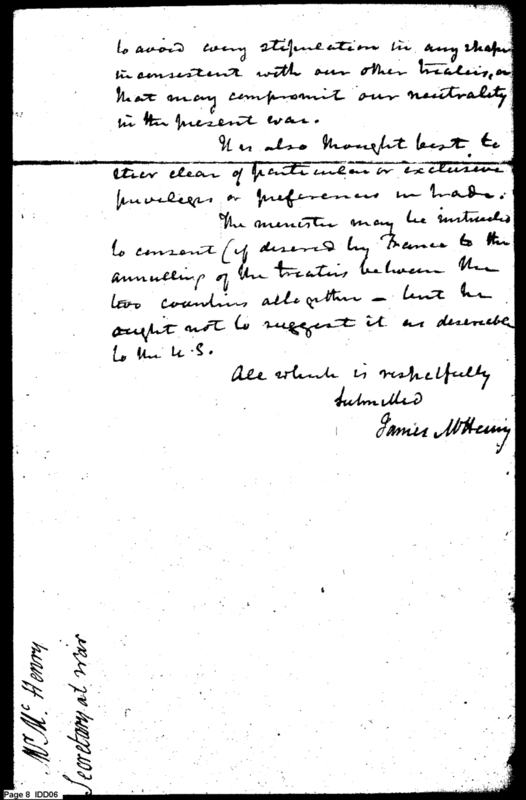
It will be highly impor[tant] to avoid every stipulation in any shape inconsistent with our other treaties, or that may compromise our neutrality in the present war.
It is also thought best to steer clear of particular or exclusive privileges or preferences in trade.
The minister may be instructed to consent (if desired by France) to the annulling of the treaties between the two countries altogether — but he ought not to suggest it as desireable to the U.S.
All which is respectfully
Submitted
James McHenry
[rotated, bottom left:] Mr Mc Henry
Secretary at War