

[General Orders]
Document 1797Directs compliance with regulations designed to make practices uniform through hierarchy of necessity.

No human transcription currently available for this document.
This transcription was generated by machine using Anthropic's Claude Code (model sonnet 4.6). It may contain errors or inaccuracies. Please verify against the document image. Learn more about our generative AI methodology.
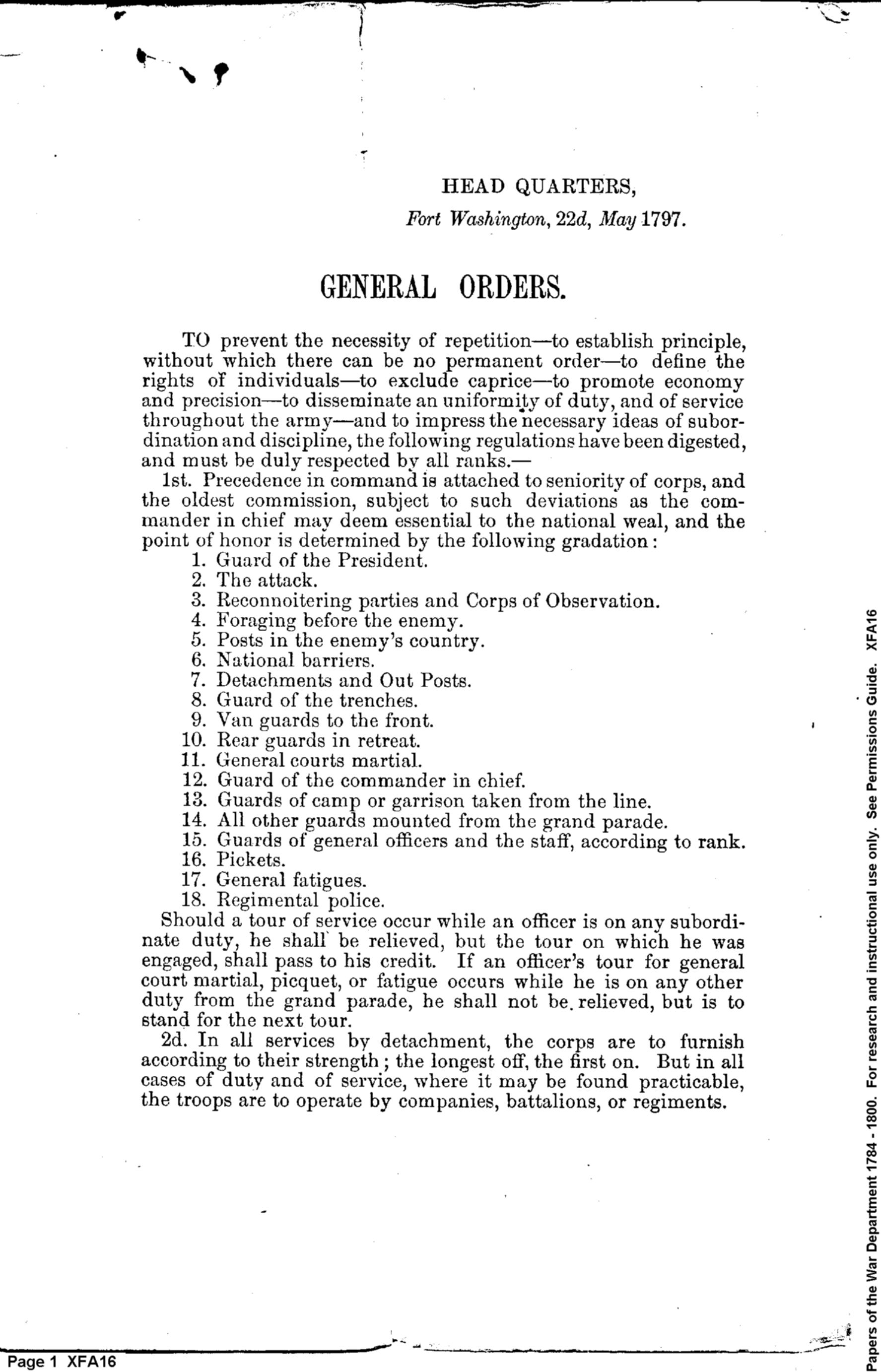
HEAD QUARTERS,
*Fort Washington, 22d, May 1797.*
# GENERAL ORDERS.
TO prevent the necessity of repetition—to establish principle, without which there can be no permanent order—to define the rights of individuals—to exclude caprice—to promote economy and precision—to disseminate an uniformity of duty, and of service throughout the army—and to impress the necessary ideas of subordination and discipline, the following regulations have been digested, and must be duly respected by all ranks.—
1st. Precedence in command is attached to seniority of corps, and the oldest commission, subject to such deviations as the commander in chief may deem essential to the national weal, and the point of honor is determined by the following gradation:
1. Guard of the President.
2. The attack.
3. Reconnoitering parties and Corps of Observation.
4. Foraging before the enemy.
5. Posts in the enemy's country.
6. National barriers.
7. Detachments and Out Posts.
8. Guard of the trenches.
9. Van guards to the front.
10. Rear guards in retreat.
11. General courts martial.
12. Guard of the commander in chief.
13. Guards of camp or garrison taken from the line.
14. All other guards mounted from the grand parade.
15. Guards of general officers and the staff, according to rank.
16. Pickets.
17. General fatigues.
18. Regimental police.
Should a tour of service occur while an officer is on any subordinate duty, he shall be relieved, but the tour on which he was engaged, shall pass to his credit. If an officer's tour for general court martial, picquet, or fatigue occurs while he is on any other duty from the grand parade, he shall not be relieved, but is to stand for the next tour.
2d. In all services by detachment, the corps are to furnish according to their strength; the longest off, the first on. But in all cases of duty and of service, where it may be found practicable, the troops are to operate by companies, battalions, or regiments.
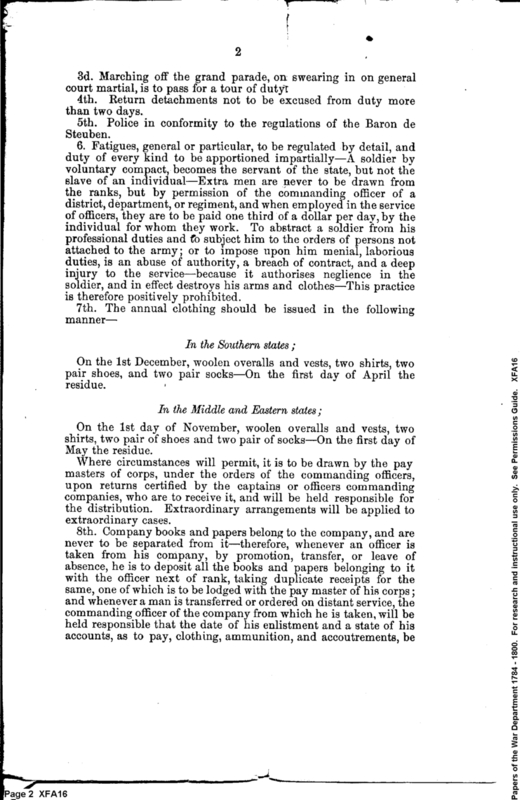
3d. Marching off the grand parade, on swearing in on general court martial, is to pass for a tour of duty†
4th. Return detachments not to be excused from duty more than two days.
5th. Police in conformity to the regulations of the Baron de Steuben.
6. Fatigues, general or particular, to be regulated by detail, and duty of every kind to be apportioned impartially—A soldier by voluntary compact, becomes the servant of the state, but not the slave of an individual—Extra men are never to be drawn from the ranks, but by permission of the commanding officer of a district, department, or regiment, and when employed in the service of officers, they are to be paid one third of a dollar per day, by the individual for whom they work. To abstract a soldier from his professional duties and to subject him to the orders of persons not attached to the army; or to impose upon him menial, laborious duties, is an abuse of authority, a breach of contract, and a deep injury to the service, because it authorises negligence in the soldier, and in effect destroys his arms and clothes—This practice is therefore positively prohibited.
7th. The annual clothing should be issued in the following manner—
*In the Southern states;*
On the 1st December, woolen overalls and vests, two shirts, two pair shoes, and two pair socks—On the first day of April the residue.
*In the Middle and Eastern states;*
On the 1st day of November, woolen overalls and vests, two shirts, two pair of shoes and two pair of socks—On the first day of May the residue.
Where circumstances will permit, it is to be drawn by the pay masters of corps, under the orders of the commanding officers, upon returns certified by the captains or officers commanding companies, who are to receive it, and will be held responsible for the distribution. Extraordinary arrangements will be applied to extraordinary cases.
8th. Company books and papers belong to the company, and are never to be separated from it—therefore, whenever an officer is taken from his company, by promotion, transfer, or leave of absence, he is to deposit all the books and papers belonging to it with the officer next of rank, taking duplicate receipts for the same, one of which is to be lodged with the pay master of his corps; and whenever a man is transferred or ordered on distant service, the commanding officer of the company from which he is taken, will be held responsible that the date of his enlistment and a state of his accounts, as to pay, clothing, ammunition, and accoutrements, be transmitted to the commanding officer of the corps, garrison, or detachment which he is to join. Certificates of provision are always to accompany individual soldiers and non-commissioned officers' commands from post to post.
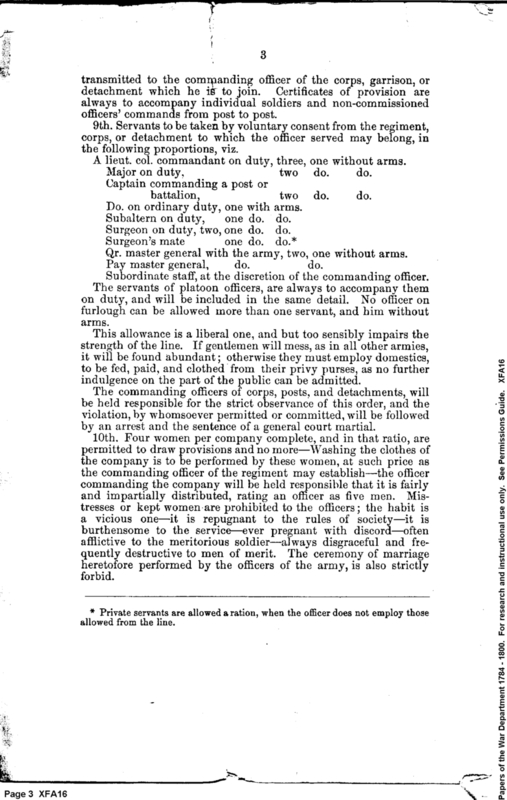
9th. Servants to be taken by voluntary consent from the regiment, corps, or detachment to which the officer served may belong, in the following proportions, viz.
A lieut. col. commandant on duty, three, one without arms.
Captain on duty, two do. do.
Captain commanding a post or
battalion, two do. do.
Do. on ordinary duty, one with arms.
Subaltern on duty, one do. do.
Surgeon on duty, two, one do. do.
Surgeon's mate one do. do.*
Qr. master general with the army, two, one without arms.
Pay master general, do. do.
Subordinate staff, at the discretion of the commanding officer.
The servants of platoon officers, are always to accompany them on duty, and will be included in the same detail. No officer on furlough can be allowed more than one servant, and him without arms.
This allowance is a liberal one, and but too sensibly impairs the strength of the line. If gentlemen will mess, as in all other armies, it will be found abundant; otherwise they must employ domestics, to be fed, paid, and clothed from their privy purses, as no further indulgence on the part of the public can be admitted.
The commanding officers of corps, posts, and detachments, will be held responsible for the strict observance of this order, and the violation, by whomsoever permitted or committed, will be followed by an arrest and the sentence of a general court martial.
10th. Four women per company complete, and in that ratio, are permitted to draw provisions and no more—washing the clothes of the company is to be performed by these women, at such price as the commanding officer of the regiment may establish—the officer commanding the company will be held responsible that it is fairly and impartially distributed, rating no officer as five men. Mistresses or kept women are prohibited to the officers; the habit is a vicious one—it is repugnant to the rules of society—it is burthesome to the service—ever pregnant with discord—often afflictive to the meritorious soldiers—always disgraceful and frequently destructive to men of merit. The ceremony of marriage heretofore performed by the officers of the army, is also strictly forbid.
[* Private servants are allowed a ration, when the officer does not employ those allowed from the line.]
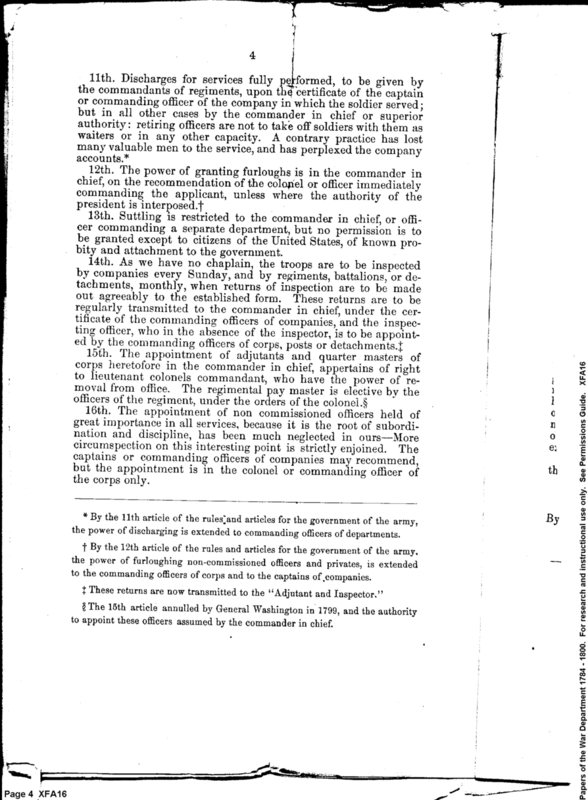
11th. Discharges for services fully performed, to be given by the commandants of regiments, upon the certificate of the captain or commanding officer of the company in which the soldier served; but in all other cases by the commander in chief or superior authority: retiring officers are not to take off soldiers with them as waiters or in any other capacity. A contrary practice has lost many valuable men to the service, and has perplexed the company accounts.*
12th. The power of granting furloughs is in the commander in chief, on the recommendation of the colonel or officer immediately commanding the applicant, unless where the authority of the president is interposed.
13th. Suttling is restricted to the commander in chief, or officer commanding a separate department, but no permission is to be granted except to citizens of the United States, of known probity and attachment to the government.
14th. As we have no chaplain, the troops are to be inspected by companies every Sunday, and by regiments, battalions, or detachments, monthly, when returns of inspection are to be made out agreeably to the established form. These returns are to be regularly transmitted to the commander in chief, under the certificate of the commanding officers of companies, and the inspecting officer, who in the absence of the inspector, is to be appointed by the commanding officers of corps, posts or detachments.†
15th. The appointment of adjutants and quarter masters of corps heretofore in the commander in chief, appertains of right to lieutenant colonels commandant, who have the power of removal from office. The regimental pay master is elective by the officers of the regiment, under the orders of the colonel.‡
16th. The appointment of non commissioned officers held of great importance in all services, because it is the root of subordination and discipline, has been much neglected in ours—More circumspection on this interesting point is strictly enjoined. The captains or commanding officers of companies may recommend, but the appointment is in the colonel or commanding officer of the corps only.
[* By the 11th article of the rules and articles for the government of the army, the power of discharging is extended to commanding officers of departments.]
[† By the 12th article of the rules and articles for the government of the army, the power of furloughing non-commissioned officers and privates, is extended to the commanding officers of corps and to the captains of companies.]
[‡ These returns are now transmitted to the "Adjutant and Inspector."]
[§ The 15th article annulled by General Washington in 1799, and the authority to appoint these officers assumed by the commander in chief.]
17th. Reformation being the end of all punishments, a soldier is never to be chastised when drunk, but when found in that disgraceful situation, he is to be confined until he recovers his senses, and is then to be punished.
18th. The residence of the regimental staff is at the head quarters of the regiment, except the surgeons' mates who are subject to be detached.
19th. Stoppages of pay are to be rigorously enforced for lost arms, ammunition, accoutrements, and clothing which cannot be satisfactorily accounted for; it is therefore indispensible, that company and regimental books, as well as those of the paymaster and quarter master, should be kept with great exactness, and that councils of administration should sit quarterly whenever practicable, to scrutinize the regimental accounts.
20th. Garrisons of posts are not to be varied except by the officer who establishes them, or his superior; but subordinate officers commanding posts in a department, are to report monthly to the head quarters of the regiment to which they belong.
21st. Commanding officers of posts under the grade of a field officer, are to be relieved annually, and majors biennially. This rotation is founded in the principles of justice and sound policy.*
22d. The use of cards and dice are strictly prohibited in camp or quarters, except for the game of backgammon.
23d. In military institutions the force of example is incalculable. No officer therefore off duty can be excused from parades, regimental or general, except in case of actual sickness or confinement. The officer who feigns sickness, to elude duty, is a dishonor to his cloth, and will be held in infamy. And should any officer or non-commissioned officer (be his command ever so diminutive) betray such indolence and insensibility of professional obligation, as to omit one regular roll call, he shall be made an example to the army.
These orders are to be read to the troops on the first da[y] of the months of January, April, July, and October.
JA: WILKINSON.
By the general's command.
JOHN T. LOVELL,
*Major of Brigade.*
[* The 21st annulled]
Type
Printed or published document
Description
Directs compliance with regulations designed to make practices uniform through hierarchy of necessity.
Date
05/22/1797
Author
Sent from
Fort Washington
Document number
1797052290101
Page start
1
Notable persons
James Wilkinson
George Washington
Baron de Steuben
mistresses
kept women
Notable locations
Fort Washington
United States
Notable items
regulations
seniority
posts
reconnaissance
forage
trenches
vanguard
courts martial
parade
pickets
police
arms
clothes
shirts
shoes
vests
overalls
socks
pay
enlistment
mess
washing
furloughs