

[Memo discussing negotiation and war with France.]
Document 1797Document, memorandum advises care in negotiating with France.
No human transcription currently available for this document.
This transcription was generated by machine using Anthropic's Claude Code (model sonnet 4.6). It may contain errors or inaccuracies. Please verify against the document image. Learn more about our generative AI methodology.
Opinions on questions proposed by the President
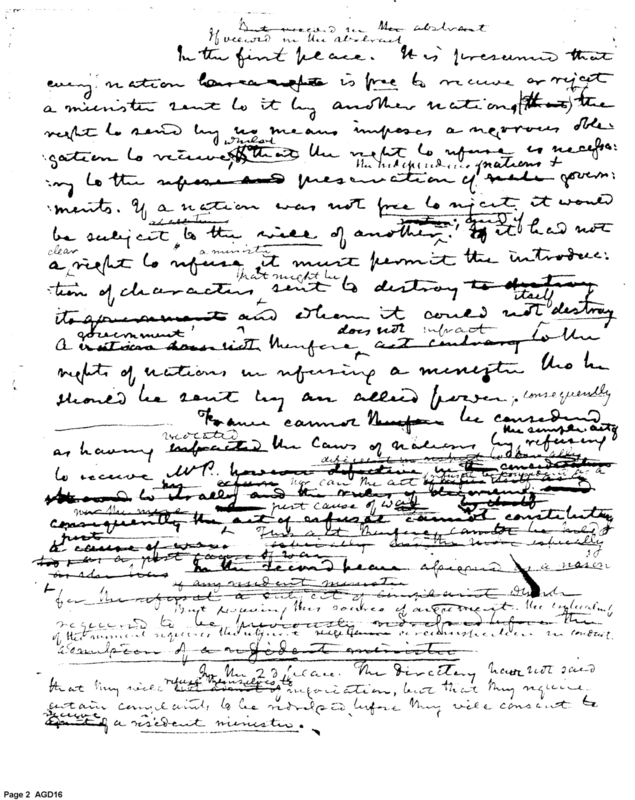
[strikethrough: But more d. in the abstract]
[strikethrough: If viewed in the abstract]
In the first place. It is presumed that every nation [strikethrough: hereafter] is free to receive or reject a minister sent to it by another nation[strikethrough: that] the right to send by no means imposes a necessary obligation to receive[strikethrough: that] the right to refuse is necessary to the [strikethrough: upse] and preservation of stable governments. If a nation was not free to reject it would be subject to the will of another. [strikethrough: and if it had not] [clear] a minute a right to refuse it must permit the introduction of characters, [that might be] sent to destroy [strikethrough: to destroy itself] its government and whom it could not destroy a nation [strikethrough: does not] [strikethrough: infract] [a nation does not] therefore act contrary to the rights of nations in refusing a minister tho he should be sent by an allied power. [consequently] France cannot therefore be considered as having [recently] [strikethrough: imported] the laws of nations by refusing to receive Mr. [undecipherable] [strikethrough: because defective] [undecipherable] [strikethrough: the act of the nation to] [strikethrough: observed to] [undecipherable] [strikethrough: next cause of war by which] consequently [strikethrough: the act of refusal cannot] constitute a cause of war. [subsequently] [the act] [undecipherable] [consequently] for [undecipherable] is not a just cause of war.
In the second place [undecipherable] a nation [for the refusal] of a [undecipherable] [undecipherable] [undecipherable] [referred to] [of the minister] [undecipherable] in context
[assumption of a resident minister]
In the 3d place. The Directory have not said that they will [strikethrough: not furnish] [satisfaction], but that they require certain [undecipherable] to be redressed before they will consent to [strikethrough: giving] a resident minister.
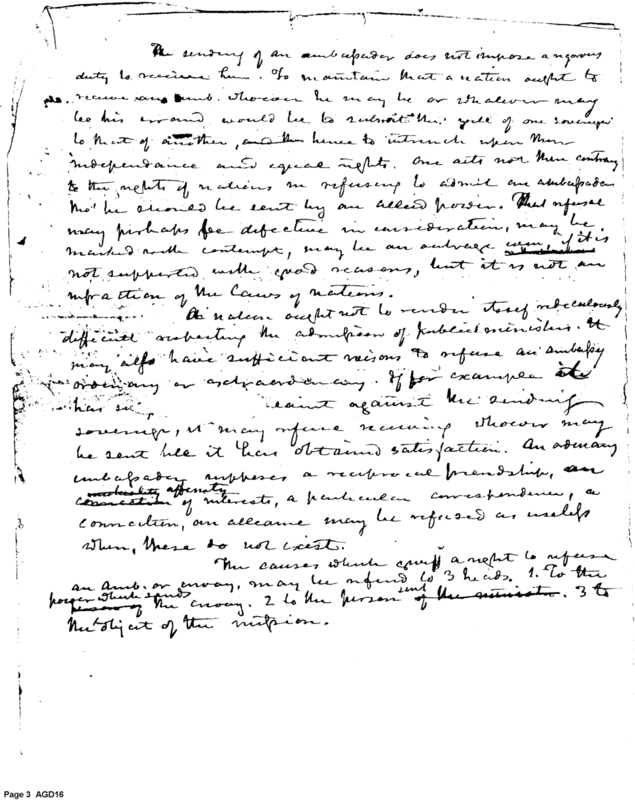
The sending of an ambassador does not impose a rigorous duty to receive him. To maintain that a nation ought to receive any Amb. tho' ever he may be or whatever may be his errand would be to submit the will of one sovereign to that of another, and the more to intrench upon their independance and equal rights. One acts not then contrary to the rights of nations in refusing to admit an ambassador tho' he should be sent by an allied power. That refusal may perhaps be defective in consideration, may be marked with contempt, may be an outrage [when] if it is not supported with good reasons, but it is not an infraction of the laws of nations.
[undecipherable] A nation ought not to render itself ridiculously difficult respecting the admission of public ministers. It may also have sufficient reasons to refuse an ambassador ordinary or extraordinary. If for example [it] has a [undecipherable] claim against the sending sovereign, it may refuse receiving whoever may be sent till it has obtained satisfaction. An ambassador embassador supposes a reciprocal friendship, an [strikethrough: community] [connection of] interests, a particular correspondance, a connection, an alliance may be refused as useless when these do not exist.
The causes which confer a right to refuse an Amb. or envoy, may be referred to 3 heads. 1. To the [strikethrough: proper title] [nature] of the enemy. 2. to the person [sent] of the ambassador. 3. to the subject of the mission.
Type
Draft Document
Description
Document, memorandum advises care in negotiating with France.
Date
04/1797
Author
Collection
Document number
1797049900101
Page start
1
Note
Filed with several other documents under the genral title: How to Avoid War with France.
Notable persons
James McHenry
President
Notable locations
France
Notable items
must drop no expressing
evidence that he prefers a state of hostility with France
a sound principle to endeavor by all honorable means to avoid war
sound principle to be prepared
should negotiation prove abortive
sound policy for a nation not to suffer its resources while negotiation is on foot to be so impaired by the hostile operations of the power with war