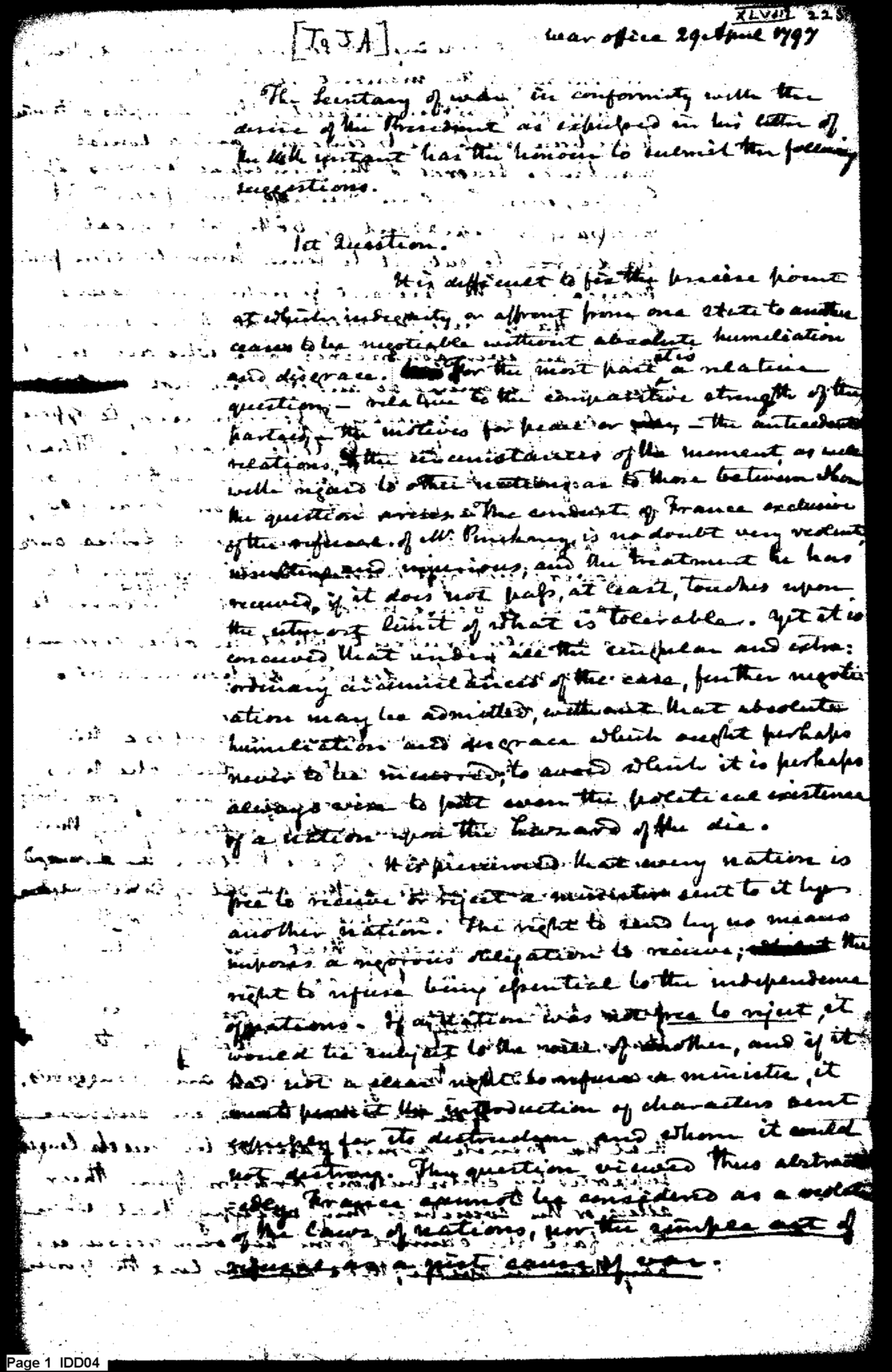
[ToJA] — War office 29 April 1797
The [undecipherable] of war, in conformity with the desire of the President as expressed in his letter of the 14th inst: has the honour to submit the following suggestions.
1st Question
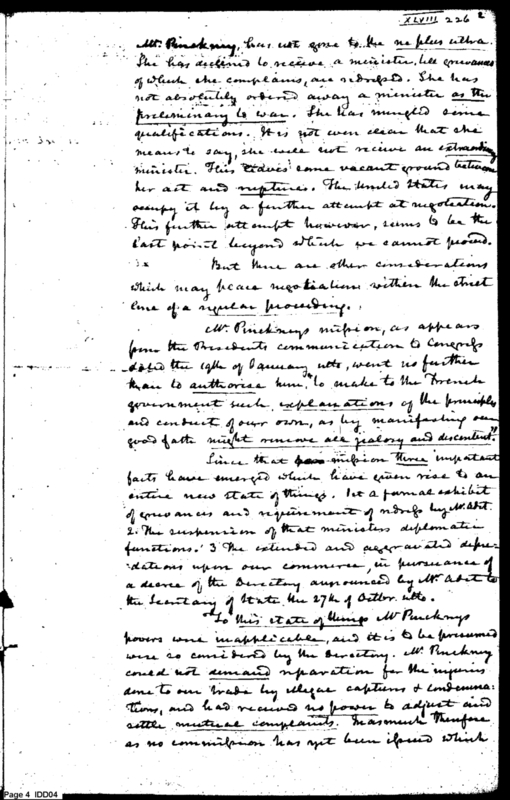
It is difficult to fix the precise point at which indignity, or affront from one state to another ceases to be negotiable without absolute humiliation and disgrace. [undecipherable] the most part [undecipherable] relative to the question — relative to the comparative strength of the parties, the motives for peace or war — the antecedent relations [of] the circumstances of the moment, as well with regard to other nations as to those between them. The question arises: the conduct of France exclusive of the offense of Mr Pinckney is no doubt very rude and wounding to our opinions, and the treatment he has received, if it does not pass, at least, touches upon the utmost limit of what is "tolerable". Yet it is conceded that under all the singular and extraordinary circumstances of the case, further negotiation may be admitted, without that absolute humiliation and disgrace which ought perhaps never to be incurred, to avoid which it is perhaps always wise to prize even the political existence of a nation upon the hazard of the die.
It is presumed that every nation is free to receive or reject a minister sent to it by another nation. The right to send by no means imposes a rigorous obligation to receive; [strikethrough: the] right to reject being essential to the independence of nations. If a nation was [at] force to reject it, it would be subject to the will of another, and if it had not a clear right to [refuse] a minister, it would permit the introduction of [its] affairs [and] [undecipherable] determination and [undecipherable] whom it could not [undecipherable]. The [undecipherable] viewed thus abstractly [undecipherable] connected [undecipherable] as a [rule] of the [law] of nations, for the simple act of [undecipherable] [undecipherable]
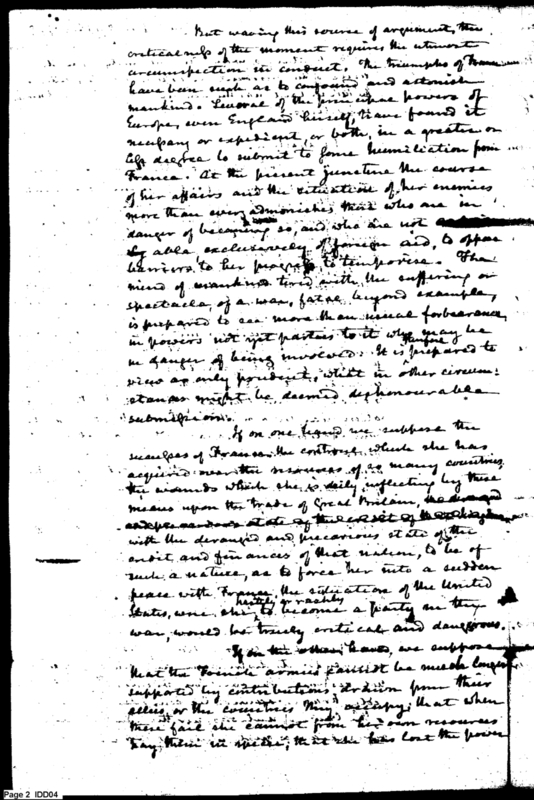
But waiving this course of argument, the critical ends of the moment requires the utmost circumspection in its conduct. The triumphs of France have been such as to confound and astonish mankind. Several of the first rate powers of Europe, even England herself, have found it necessary or expedient, or both, in a greater or less degree to submit to some humiliation from France. At the present juncture the course of her affairs and the situation of her enemies more than every [admonishes?] that who are in danger of becoming so, and who are not altogether [exclusively?] of foreign aid, to spare [barriers] to her progress, [is] temporary. The view of mankind tired with the suffering or spectacle of a war, fatal beyond example, is prepared to see more than usual forbearance in powers not yet parties to it who may be in danger of being involved. It is prepared to view as only prudent, what in other circumstances might be deemed dishonourable submission.
If on one hand we suppose the success of France in the contrary, [while] she has acquired more the resources of so many countries, the wounds which she is daily inflicting by these means upon the trade of Great Britain, the deranged and [undecipherable] state of the [credit?] of the [undecipherable] with the deranged and precarious state of the credit and finances of that nation, to be of such a nature, as to force her into a sudden peace with France; the situation of the United States would also to become a party in the war, would be truly critical and dangerous.
If on the other hand, we suppose that the French armed [forces] to be much longer supported by contributions from their allies or the countries [they occupy?], that when these fail she cannot from her own resources [undecipherable] that she has lost the power
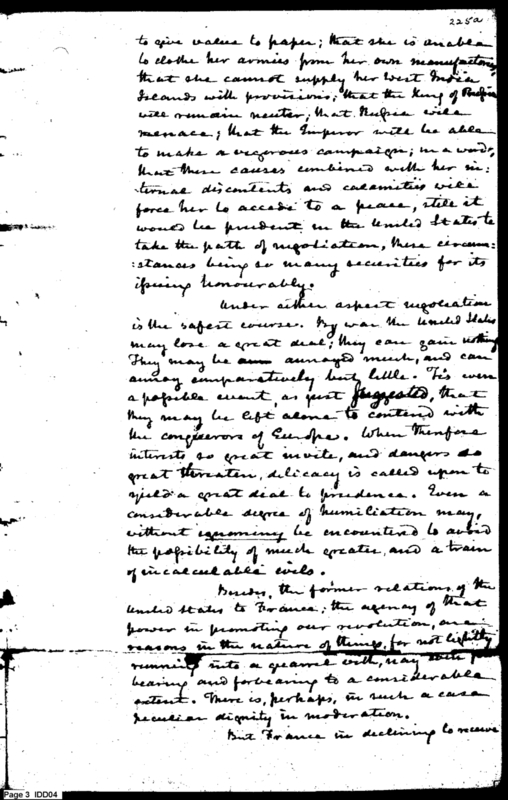
to give value to paper; that she is unable to clothe her armies from her own manufactures; that she cannot supply her West India Islands with provisions; that the king of Prussia will remain neuter; that Russia will be a menace; that the Emperor will be able to make a vigorous campaign; in a word, that these causes combined with her internal discontents and calamities will force her to accede to a peace, still it would be prudent in the United States to take the path of negotiation, these circumstances being so many securities for its issuing honourably.
Under either aspect negotiation is the safest course. By war the United States may lose a great deal; they can gain little. They may be somewhat annoyed much, and can annoy comparatively but little. 'Tis even a possible event, as just suggested, that they may be left alone to contend with the conquerors of Europe. When therefore interests so great invite, and dangers so great threaten, delicacy is called upon to yield a great deal to prudence. Even a considerable degree of humiliation may, without ignominy be encountered to avoid the possibility of much greater, and a train of incalculable evils.
Besides, the former relations of the United States to France; the agency of that power in promoting our revolution; are reasons in the nature of things, for not lightly running into a quarrel with, nay, [call for?] bearing and forbearing to a considerable extent. There is, perhaps, in such a case a peculiar dignity in moderation.
But France in declining to receive
Mr Pinckney, has not gone to the ne plus ultra. She has declined to receive a minister, but [the] grievances of which she complains, are redressed. She has not absolutely ordered away a minister as the preliminary to war. She has mingled some qualifications. It is not even clear that she means to say, she will not receive an extraordinary minister. This leaves some vacant ground between her act and rupture. The United States may occupy it by a further attempt at negotiations. This further attempt however, seems to be the last point beyond which we cannot proceed.
2x But there are other considerations which may place negotiations within the strict line of a regular proceeding.
Mr Pinckney's mission, as appears from the Presidents communication to Congress dated the 19th of January ult: went no further than to authorize him to make to the French government such explanations of the principles and conduct of our own, as by manifesting our good faith might remove all jealousy and discontent.
Since that mission three important facts have emerged which have given rise to an entire new state of things. 1st A formal exhibit of grievances and requirements of redress by [that?] [nation?]. 2. The suspension of that ministers diplomatic functions. 3 The extended and aggravated depredations upon our commerce, in pursuance of a decree of the Directory announced by Mr Adet to the Secretary of State the 27th of October ult:.
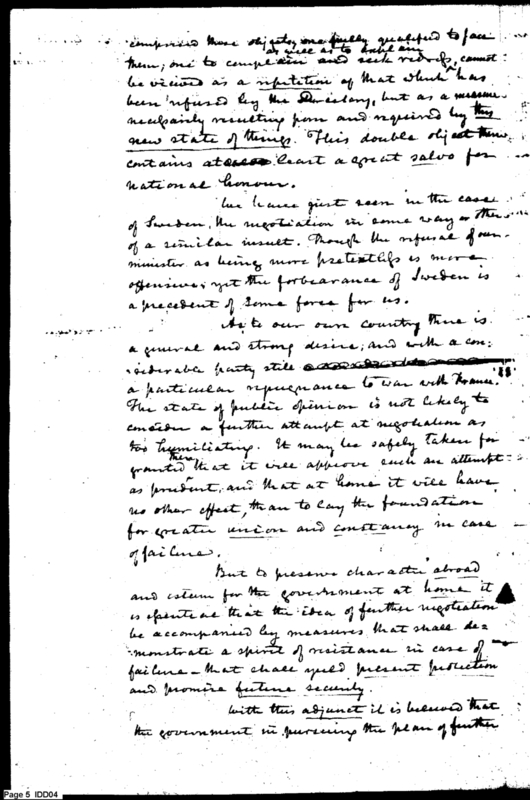
To this state of things Mr Pinckney's powers were inapplicable, and it is to be presumed were so considered by the Directory. Mr Pinckney could not demand reparation for the injuries done to our trade by illegal captures and condemnations, and had received no power to adjust and settle mutual complaints. It is manifest therefore as no commission has yet been issued which
[comprised?] more objects, more fully qualified to face them; one to complain and seek redress, cannot be viewed as a reputation of that which has been refused by the Directory, but as a measure necessarily resulting from and required by this new state of things. This double object contains at least a great salvo for national honour.
We have just seen in the case of Sweden, the negotiation in some way [or] the [same?] of a similar insult. Though the refusal of [our] minister as being more pretestile is more offensive, yet the forbearance of Sweden is a precedent of some force for us.
As to our own country there is a general and strong desire, and with a considerable party still [undecipherable] a particular repugnance to war with France. The state of public opinion is not likely to endorse a further attempt at negotiation as too humiliating. It may be safely taken for granted that it will approve such an attempt as prudent, and that at home it will have no other effect, than to lay the foundation for greater union and constancy in case of failure.
But to preserve character abroad and esteem for the government at home it is essential that the idea of further negotiation be accompanied by measures that shall demonstrate a spirit of resistance in case of failure — that shall yield present protection and promise future security.
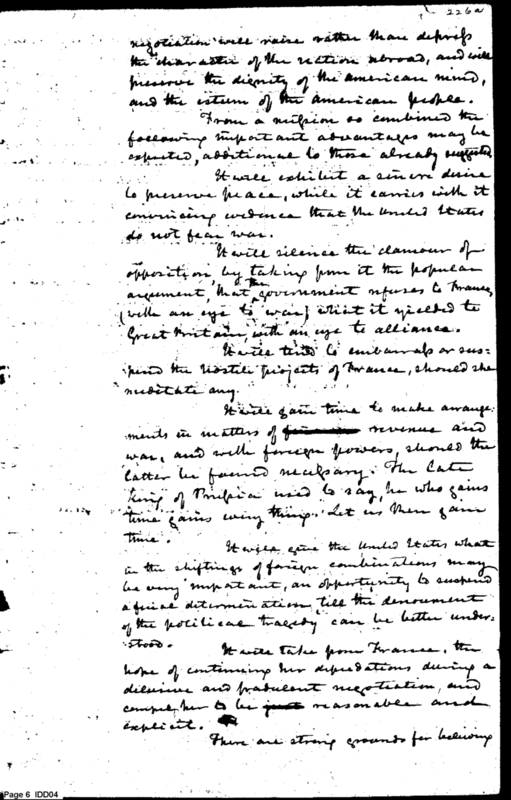
With this adjunct it is believed that the government in pursuing the plan of further
negotiation will raise rather than depress the character of the nation abroad, and will preserve the dignity of the American mind, and the esteem of the American people.
From a mission so combined the following important advantages may be expected, additional to those already suggested.
It will exhibit a sincere desire to preserve peace, while it carries with it convincing evidence that the United States do not fear war.
It will silence the clamour of opposition by taking from it the popular argument, that government refuses to [treat] with France, with an eye to [war] [what?] it yielded to Great Britain, with an eye to alliance.
It [tends] to embarrass or suspend the hostile projects of France, should she meditate any.
It will gain time to make arrangements in matters of [finance] revenue and war, and with foreign powers, should the latter be found necessary. The Cato king of [Prufica?] used to say he who gains time, gains every thing — Let us then gain time.
It will give the United States what in the shiftings of foreign combinations may be very important, an opportunity to suspend a fixed determination, till the denouement of the political [tragedy?] can be better understood.
It will take from France, the hope of continuing her depredations during a delusive and fraudulent negotiation, and compel her to be just, reasonable and explicit.
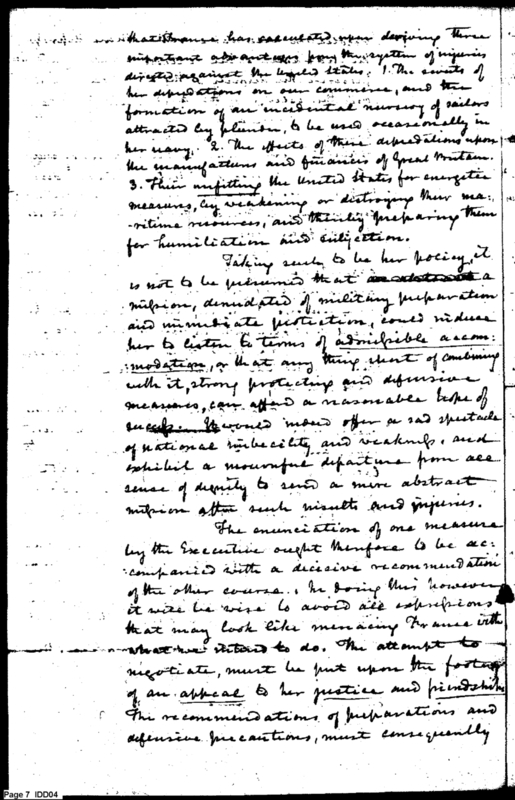
There are strong grounds for believing
that France has proceeded upon devising three important advantages from a system of injuries directed against the United States. 1 The avails of her depredations on our commerce, and the formation of an incidental nursery of sailors attracted by plunder, to be used occasionally in her navy. 2 The effects of these depredations upon the manufacturers and [financiers?] of Great Britain. 3 Their unfitting the United States for energetic measures, by weakening or destroying their maritime resources; and thirdly, preparing them for humiliation and subjection.
Taking such to be her policy, it is not to be presumed that [an] [undecipherable] a mission, divested of military preparation and immediate protection, could induce her to listen to terms of admissible accommodation, or that any thing short of combining with it, strong protecting and defensive measures, can afford a reasonable hope of success. [The second?] would indeed offer a sad spectacle of national imbecility and weakness, and exhibit a mournful departure from all sense of dignity to send a mere abstract mission after such results and injuries.
The enunciation of one measure by the Executive ought therefore to be accompanied with a decisive recommendation of the other course. In doing this however, it will be wise to avoid all expressions that may look like menacing France into what we intend to do. The attempt to negotiate, must be put upon the footing of an appeal to her justice and friendship. The recommendations of preparations and defensive precautions, must consequently
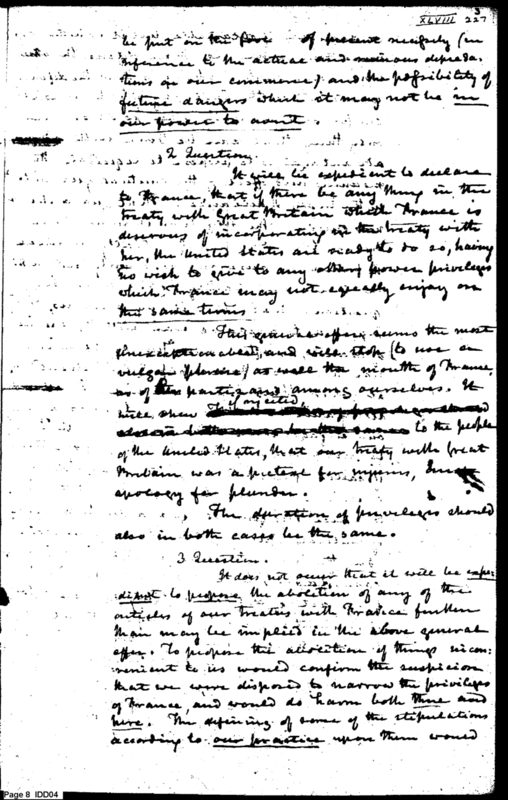
be first [in] the [line?] of present necessity (in reference to the actual and various depredations in our commerce) and the possibility of future dangers which it may not be in our power to avert.
2 Question.
It goes to appear expedient to declare to France, that if there be any thing in the treaty with Great Britain which France is desirous of incorporating in the treaty with her, the United States are ready to do so, having no wish to give to any other power privileges which France may not equally enjoy on the same terms.
This [remark?] seems the most unexceptionable, and [undecipherable] (to use an vulgar phrase) as well the mouth of France, and of the parties and among ourselves. It will shew [undecipherable] [undecipherable] to the people of the United States, that our treaty with Great Britain was a pretext for injuries, [but a?] [undecipherable] apology for plunder.
The duration of privileges should also in both cases be the same.
3 Question.
It does not occur that it will be [expedient] to propose the abolition of any of the articles of our treaties with France further than may be implied in the above general offer. To propose the abolition of things inconvenient to us would confirm the suspicion that we were disposed to narrow the privileges of France, and would do harm both there and here. The defining of some of the stipulations according to our practice upon them would
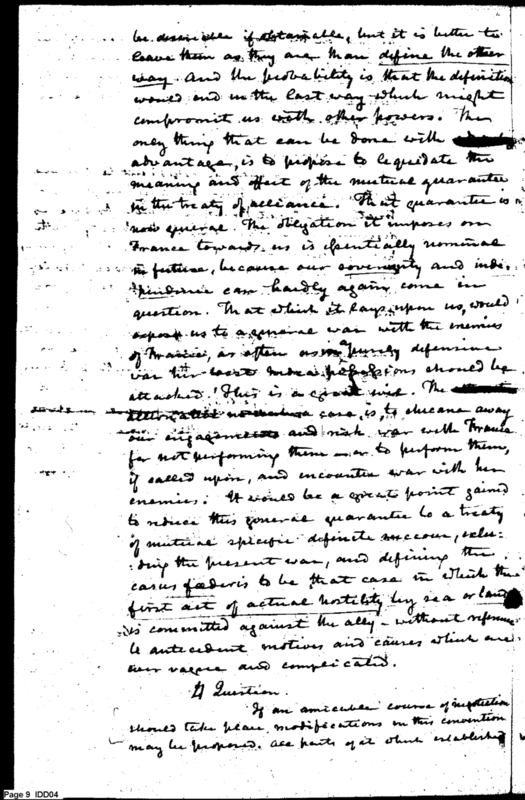
be admissible if [attainable?], but it is better to leave them as they are, than define the other way. And the probability is that the definition would end in the last way which might compromise us with other powers. The only thing that can be done with advantage, is to propose to liquidate the meaning and effect of the mutual guarantee in the treaty of alliance. The guarantee is a new [?] [guarantee?]. The obligation it imposes on France towards us is essentially nominal in future, because our sovereignty and independence can hardly again come in question. That which it [imposes] upon us, would expose us to a general war with the enemies of France, as often as [something] purely defensive [?] can be [?] the [cases] [?] [modifications?] should be attacked. This is a great evil. The [undecipherable] case is, to discuss away our engagements and risk war with France for not performing them — or to perform them, if called upon, and encounter war with her enemies. It would be a great point gained to reduce this general guarantee to a treaty of mutual specific definite succour, [?] the present war, and defining the cases of aid to be that case in which the first act of actual hostility by sea or land is committed against the ally — without reference to antecedent motives and causes which are ever vague and complicated.
4 Question.
If an amicable course of negotiation should take place, modifications in this convention may be proposed. As parts of it other established
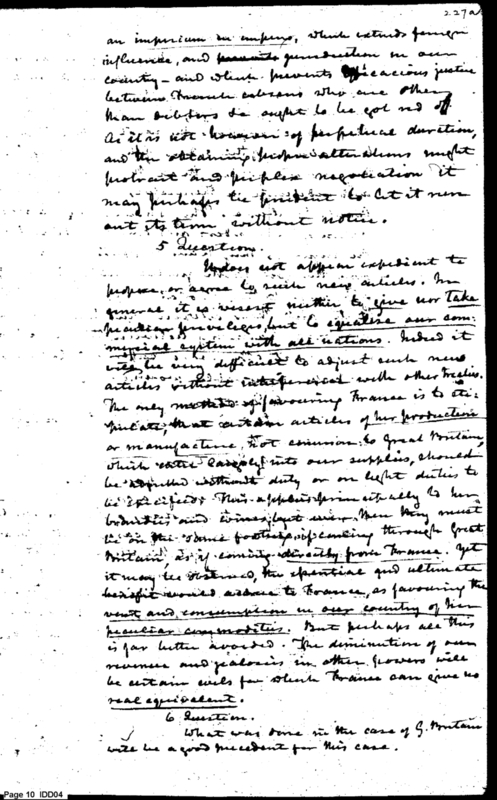
an imperium in imperio, which extends foreign influence, and prevents jurisdiction in our country — and which prevents efficacious justice between French citizens who are others than debtors to be got rid of. As this is not however of perpetual duration, and the objectionably [undecipherable] [?] might not protract and perplex negotiation it may perhaps be prudent to let it run out its term without notice.
5 Question.
It [does] not appear expedient to propose, or avow by such new articles. In general it is wisest neither to give nor take peculiar privileges, but to equalize our commerce [?] [?] system with all nations. Indeed it might be very difficult to adjust such new articles without interference with other treaties. The only method of serving France is to this: stipulate that certain articles of her productions or manufactures, not common to Great Britain, which enter among our supplies, should be admitted without duty or on least duties to be specified. This proposition is [?] to be [understandable] and [transparent?]. Then they must be in the same footing, as if coming directly from France — yet it may be intended, the essential and ultimate benefit would accrue to France, as favouring the vent and consumption in our country of her peculiar commodities. But perhaps all this is far better avoided. The diminution of our revenues and jealousy in other powers will be certain evils for which France can give no real equivalent.
6 Question.
What was done in the case of G. Britain will be a good precedent for this case.
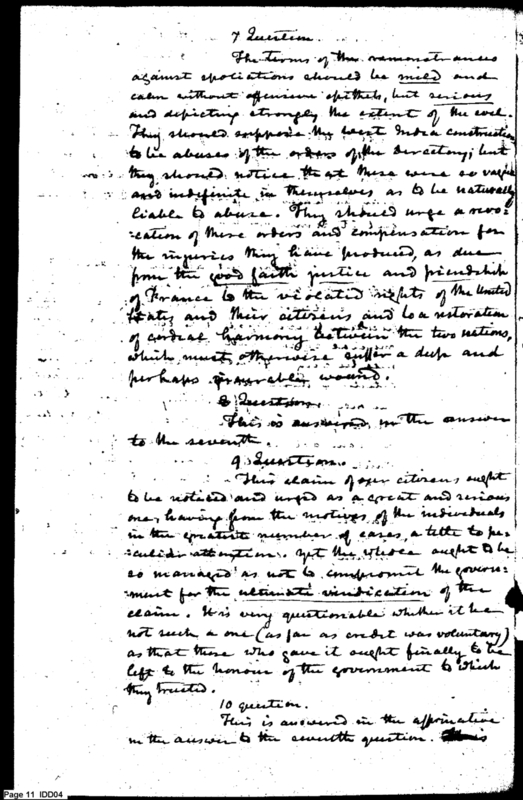
7 Question.
The terms of the remonstrances against spoliations should be mild and calm without offensive epithets, but serious and depicting strongly the extent of the evil. They should suppose the best and most construction to the abuses of the orders of the Directory; but they should notice that these were so vague and indefinite in themselves, as to be naturally liable to abuse. They should urge a recollection of these orders and compensation for the injuries they have produced, as due from the good faith, justice and friendship of France to the violated rights of the United States, their citizens and to a restoration of cordial harmony between the two nations, which must otherwise suffer a deep and perhaps irreparable wound.
8 Question.
This is answered in the answer to the seventh.
9 Question.
This claim of our citizens, ought to be noticed and urged as a great and serious one, bearing from the motives of the individuals in the greatest number of cases, a title to peculiar attention. Yet the choice ought to be so managed as not to compromise the government for the ultimate vindication of the claim. It is very questionable whether it be not such a one (as far as credit was voluntary) as that those who gave it ought finally to be left to the honour of the government to which they trusted.
10 Question.
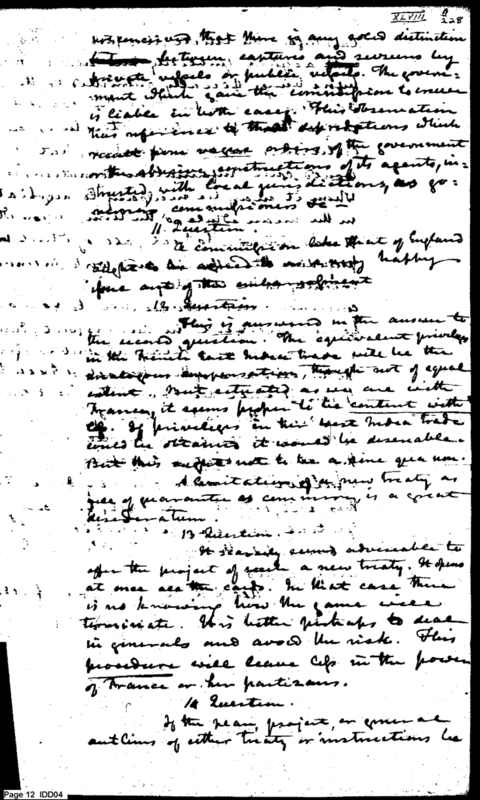
This is answered in the affirmative in the answer to the seventh question. [This is?]
not perceived that there is any solid distinction between captures and seizures by private vessels or public vessels. The government which gains the commissions to cruise is liable in both cases. This observation has reference [to such?] depredations which result from vague orders of the government, or the obtaining commissions of its agents, in [?] dealings with Great Britain [?] and [undecipherable] commissioners [?]
11 Question.
A Commission [?] takes [?] of England [?] to [?] [undecipherable] [?] [undecipherable] [?]
12 Question.
This is answered in the answer to the second question. The equivalent privileges in the [?] East India trade will be the [undecipherable] compensations, though not of equal extent [?]. Not activated as way with France, it seems proper to be content with [?]. Of privileges in this West India trade could be obtained it would be desirable. But this appears not to be a sine qua non.
A limitation of the new treaty as [that?] of guarantees as commerce is a great [consideration?].
13 Question.
It scarcely seems advisable to offer the project of such a new treaty. It opens at once all the cards. In that case there is no knowing how the game will terminate. It is better perhaps to deal in generals and avoid this risk. This procedure will leave [lips?] in the power of France or her partisans.
14 Question.
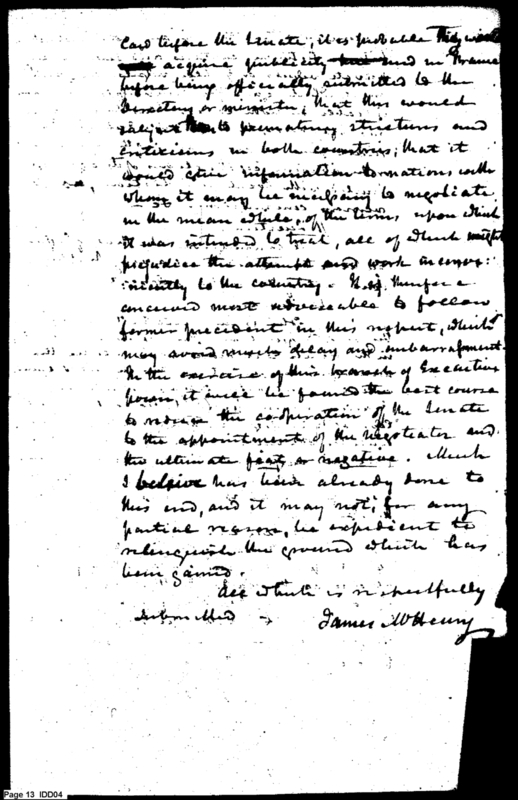
If the treaty project or general outlines of either treaty or instructions be
laid before the Senate, it is probable they will acquire publicity, and in France before being officially submitted to the Directory or minister. But this would subject to premature strictures and criticisms in both countries; that it might give information to nations, which it may be misleading to negotiate in the mean while, with time, upon which it was intended to treat, all of which might prejudice the attempt and work in [contradicting?] to the country. It is therefore a concurrence most advisable to follow former precedent in this respect, which may avoid much delay and embarrassment. In the exercise of this branch of Executive power, it need be found the best course to obtain the co-operation of the Senate to the appointment of the Negotiators and to the ultimate fact or negative. Much I believe has been already done to this end, and it may not, for any particular reason, be expedient to relinquish the ground which has been gained.
All this is respectfully submitted → James McHenry