

Regulations for Commanders of Frontier & Maritime Posts
Document 1797Regulations for maritime and frontier forts & posts, which address post security, not divulging fort layouts and garrisons, record-keeping of visitors to the post, punishment of unauthorized persons violating Indian territory, keeping a close eye on foreigners and strangers nearby, and the secrecy of these orders.
No human transcription currently available for this document.
This transcription was generated by machine using Anthropic's Claude Code (model sonnet 4.6). It may contain errors or inaccuracies. Please verify against the document image. Learn more about our generative AI methodology.
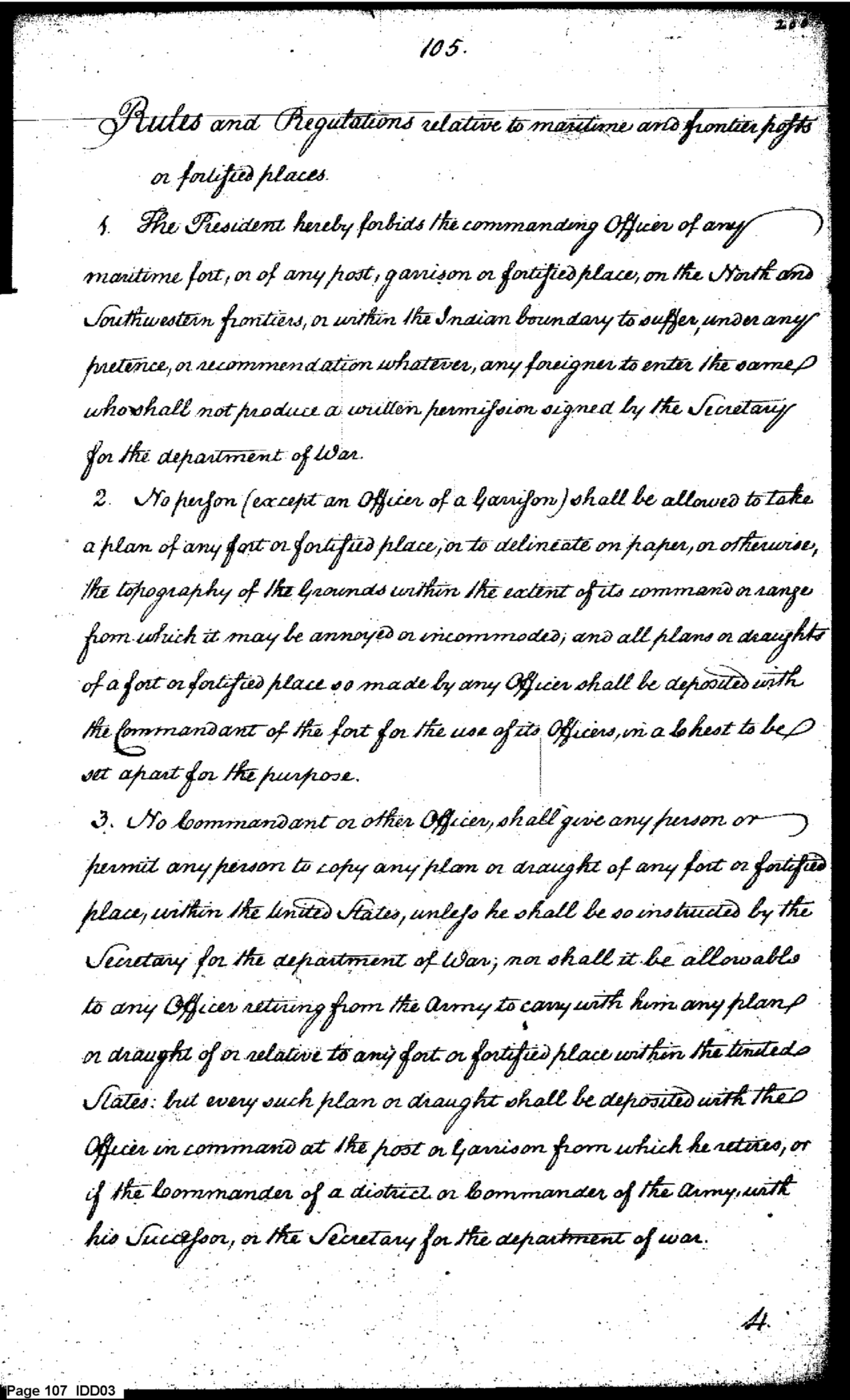
Rules and Regulations relative to maritime and frontier posts or fortified places.
1. The President hereby forbids the commanding Officer of any maritime fort, or of any post, garrison or fortified place, on the North and Southwestern frontiers, or within the Indian boundary to suffer, under any pretence, or recommendation whatever, any foreigner to enter the same, who shall not produce a written permission signed by the Secretary for the department of War.
2. No person (except an Officer of a Garrison) shall be allowed to take a plan of any fort or fortified place, or to delineate on paper, or otherwise, the topography of the Grounds within the extent of its command or range from which it may be annoyed or incommoded, and all plans or draughts of a fort or fortified place so made by any Officer shall be deposited with the Commandant of the fort for the use of its Officers, in a chest to be set apart for the purpose.
3. No Commandant or other Officer, shall give any person or permit any person to copy any plan or draught of any fort or fortified place, within the United States, unless he shall be so instructed by the Secretary for the department of War; nor shall it be allowable to any Officer retiring from the Army to carry with him any plans or draught of or relative to any fort or fortified place within the United States: but every such plan or draught shall be deposited with the Officer in command at the post or Garrison from which he retires, or if the Commander of a district or Commander of the Army, with his Successor, or the Secretary for the department of War.
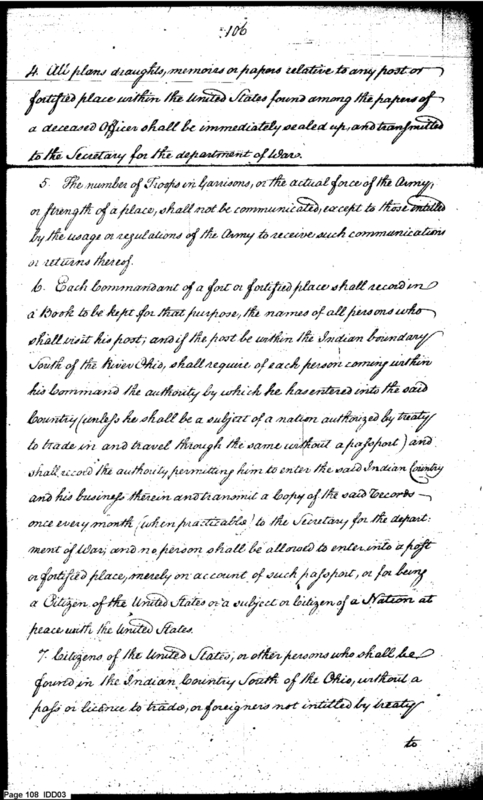
4. All plans draughts, memoirs or papers relative to any post or fortified place within the United States found among the papers of a deceased Officer shall be immediately sealed up, and transmitted to the Secretary for the department of War.
5. The number of Troops in Garrisons, or the actual force of the Army, or strength of a place, shall not be communicated, except to those entitled by the usage or regulations of the Army to receive such communications or relations thereof.
6. Each Commandant of a fort or fortified place shall record in a book to be kept for that purpose, the names of all persons who shall visit his post; and if the post be within the Indian boundary South of the river Ohio, shall require of each person coming within his command the authority by which he has entered into the said Country (unless he shall be a subject of a nation authorized by treaty to trade in and travel through the same without a passport) and shall record the authority permitting him to enter the said Indian Country and his business therein and transmit a Copy of the said Records once every month (when practicable) to the Secretary for the department of War; and no person shall be allowed to enter into a post or fortified place, merely on account of such passport, or for being a Citizen of the United States or a subject or Citizen of a Nation at peace with the United States.
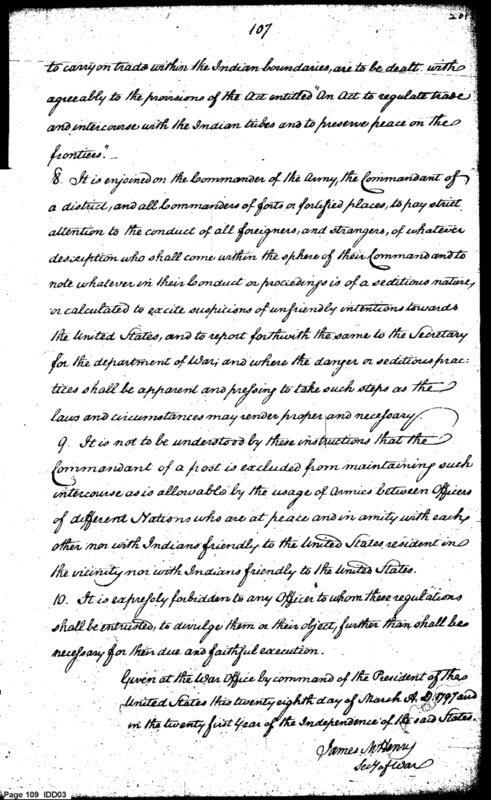
7. Citizens of the United States, or other persons who shall be found in the Indian Country South of the Ohio, without a pass or licence to trade, or foreigners not intitled by treaty to carry on trade within the Indian boundaries, are to be dealt with agreeably to the provisions of the Act entitled "An Act to regulate trade and intercourse with the Indian tribes and to preserve peace on the frontiers."
8. It is enjoined on the Commander of the Army, the Commandant of a district, and all Commanders of forts or fortified places, to pay strict attention to the conduct of all foreigners, and strangers, of whatever description who shall come within the sphere of their command and to note whatever in their Conduct or proceedings is of a seditious nature, or calculated to excite suspicions of unfriendly intentions towards the United States, and to report forthwith the same to the Secretary for the department of War; and where the danger or seditious practices shall be apparent and pressing to take such steps as the laws and circumstances may render proper and necessary.
9. It is not to be understood by these instructions that the Commandant of a post is excluded from maintaining such intercourse as is allowable by the usage of Amities between Officers of different Nations who are at peace and in amity with each other nor with Indians friendly to the United States resident in the vicinity nor with Indians friendly to the United States.
10. It is expressly forbidden to any Officer to whom these regulations shall be entrusted, to divulge them or their object, further than shall be necessary for their due and faithful execution.
Given at the War Office by command of the President of the United States this twenty eighth day of March A.D. 1797 and in the twenty first Year of the Independence of the said States.
James McHenry
Secy of War
Type
Letterbook Copy
Description
Regulations for maritime and frontier forts & posts, which address post security, not divulging fort layouts and garrisons, record-keeping of visitors to the post, punishment of unauthorized persons violating Indian territory, keeping a close eye on foreigners and strangers nearby, and the secrecy of these orders.
Date
03/28/1797
Author
Sent from
War Office
Repository
Collection
Document number
1797032815055
Page start
107
Note
No tif image.
Notable persons
James McHenry
Secretary of War
foreigner
strangers
President United States
commanding officer
commandant
commander of army
Indian tribes
Notable locations
frontier forts
posts
Indian Territory
maritime fort
War Office
Indian boundary
south of Ohio River
Notable items
security
rules and regulations
fort layouts
record keeping
paper
topography
plans
draughts
treaty
license to trade
seditious nature