No human transcription currently available for this document.
25 Feb 1797
Sir
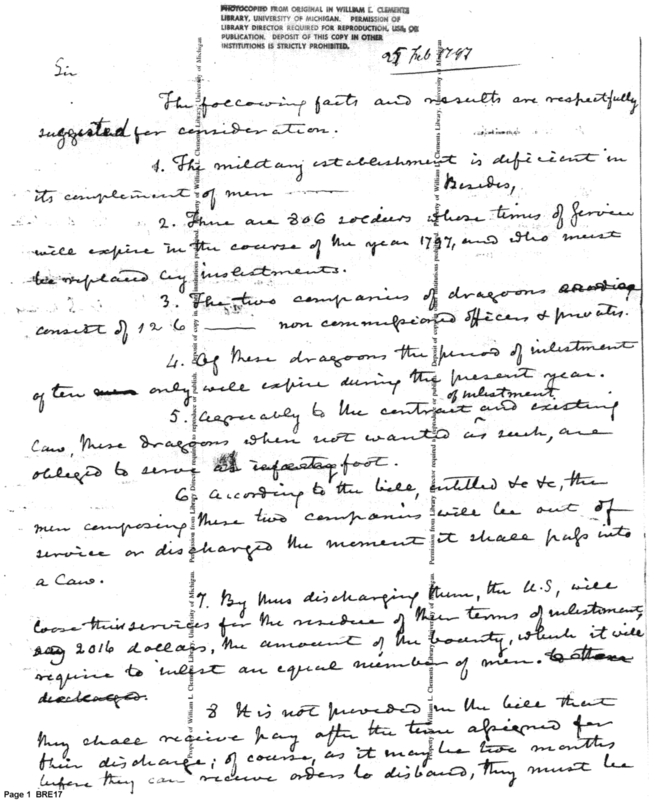
The following facts and results are respectfully suggested for consideration.
1. The military establishment is deficient in its complement of men Besides,
2. There are 306 soldiers whose times of service will expire in the course of the year 1797, and who must be replaced by inlistments.
3. The two companies of dragoons [strikethrough: [word]] consist of 12 6 [blank] non commissioned Officers & privates.
4. Of these dragoons the [terms] of inlistment of ten [strikethrough: men] only will expire during the present year. [of inlistment]
5. According to the contract and existing law, these dragoons when not wanted as such, are obliged to serve [strikethrough: [word]] as infantry foot.
6. According to the bill entitled &c &c, the men composing these two companies will be out of service or discharged the moment it shall pass into a Law.
7. By thus discharging them, the U.S. will lose this service for the residue of their terms of inlistment, say 2016 dollars, the amount of the bounty, which it will require to inlist an equal number of men. [strikethrough: to others discharged.]
8. It is not provided in the bill that they shall receive pay after the time assigned for their discharge; of course, as it may be two months before they can receive orders to disband, they must be deprived of pay for the period between, the [expiration] of the law and their discharge, [until] [strikethrough: [word]] the Congress [future] shall [strikethrough: [word]] authorize it by a [special] act.
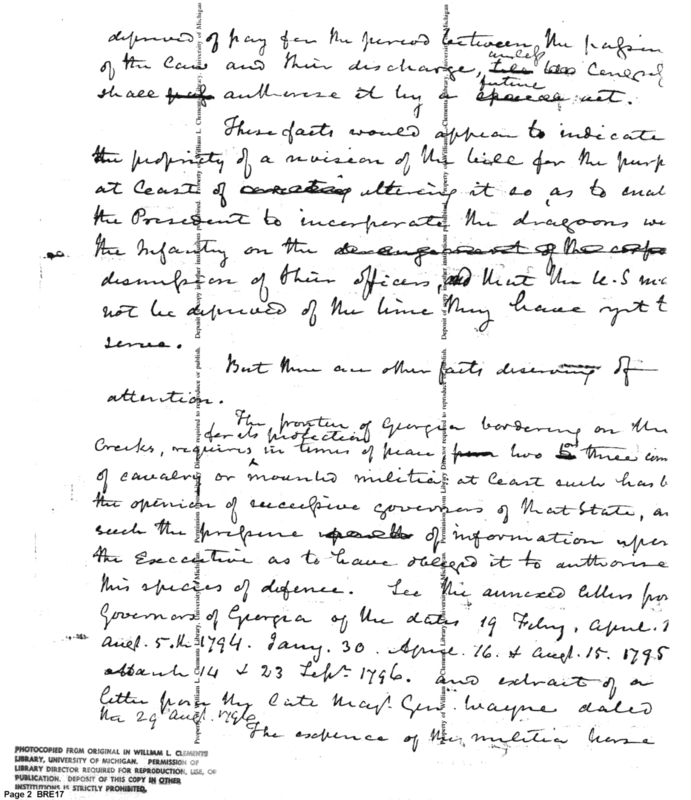
These facts would appear to indicate the propriety of a revision of the bill for the purp[ose] at least of [strikethrough: correcting] altering it so as to enable the President to incorporate the dragoons w[it]h the Infantry on the [strikethrough: [words]] dismission of their Officers, and that the U.S. may not be deprived of the time they have yet to serve.
But there are other facts deserving of attention.
The portion of Georgia bordering on the Creeks, [for its protection] requires in times of peace [strikethrough: from] two to three com[panies] of cavalry or mounted militia at least such has been the opinion of successive governors of that State, as such the [strikethrough: [word]] [undecipherable] of information upon the Executive as to have obliged it to authorize this species of defence. See the annexed letters from Governors of Georgia of the dates 19 Feby, April 1 and 5th 1794. Jany. 30. April. 16. & Aug. 15. 1795 March 14 & 23 Sept. 1796. and extract of a letter from the late Majr. Genl. Wayne dated No. 29 Aug 1796.
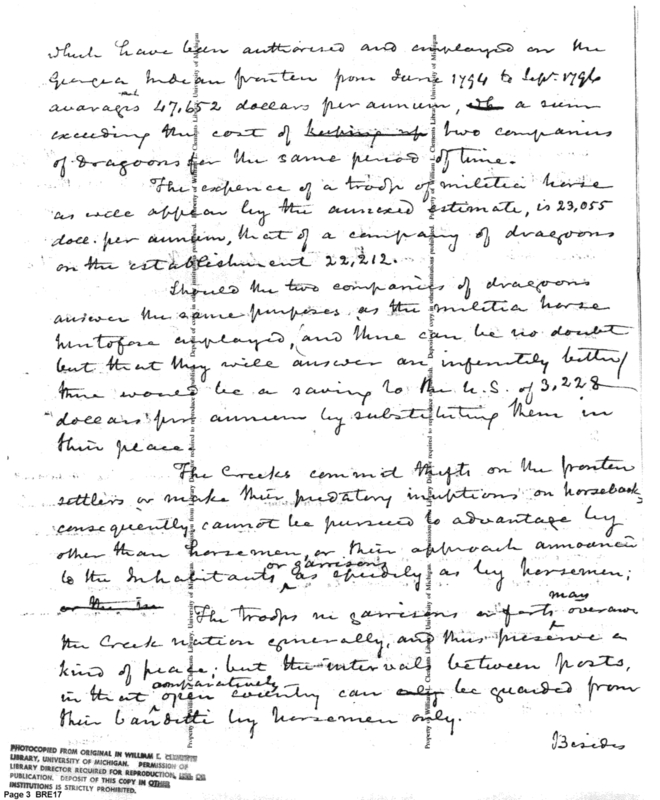
The expence of the militia horse which have been authorized and employed on the Georgia Indian frontier from June 1794 to Sep. 1796 averages [at] 47,652 dollars per annum, [strikethrough: the] a sum exceeding the cost of [keeping up] two companies of Dragoons for the same period of time.
The expence of a troop of militia horse as will appear by the annexed estimate, is 23,055 dol. per annum, that of a company of dragoons on the establishment 22,212.
Should the two companies of dragoons answer the same purposes as the militia horse hurtofore employed, and there can be no doubt but that they will answer an infinitely better[,] there would be a saving to the U.S. of 3,228 dollars per annum by substituting them in their place.
The Creeks commit Thefts on the frontier settlers or make their predatory inruptions on horseback consequently cannot be pursued to advantage by other than horsemen, or their approach announced to the Inhabitants, [or Garrisons,] as speedily as by horsemen; [strikethrough: [words]]
The troops in garrisons or forts [may] overawe the Creek nation generally, and thus preserve a kind of peace, but the interval between posts, in that open country can [comparatively] only be guarded from their banditti by horsemen only.
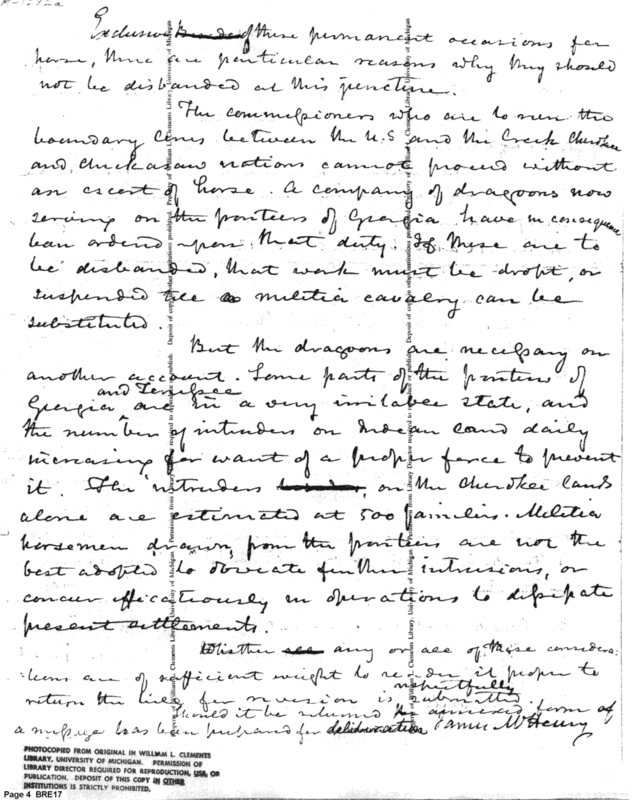
Besides Exclusive [strikethrough: [word]] of these permanent occasions for horse, there are particular reasons why they should not be disbanded at this juncture.
The commissioners who are to run the boundary lines between the U.S and the Creek Chero[kee] and Chickasaw nations cannot proceed without an escort of horse. A company of dragoons now serving on the frontiers of Georgia have in consequen[ce] been ordered upon that duty. If these are to be disbanded, that work must be dropt, or suspended till as militia cavalry can be substituted.
But the dragoons are necessary on another account. Some parts of the frontiers of Georgia and Tennessee are in a very irritable state, and the number of intruders on Indian land daily increasing for want of a proper force to prevent it. The intruders [strikethrough: [word]], on the Cherokee lands alone are estimated at 500 families. Militia horsemen drawn from the frontiers are not the best adapted to obviate further intrusions, or concur efficaciously in operations to disipate present settlements.
Whether all any or all of these considerations are of sufficient weight to render it proper to return the bill for revision is [respectfully] submitted. Should it be returned the annexed form of a message has been prepared for deliberation. James McHenry