

Outlines Chickasaw Treaty
Document 1797Refers to treaty with Chickosaw Indians. Requests release of all prisoners, blacks, and property taken from citizens. Promises sovereignty and protection to Chickosaws.



No human transcription currently available for this document.
This transcription was generated by machine using Anthropic's Claude Code (model sonnet 4.6). It may contain errors or inaccuracies. Please verify against the document image. Learn more about our generative AI methodology.
[Illegible Text: Some or all of the pages of this file are wholly or in part illegible. We have not been able either to locate a better copy of the document, or to enhance its legibility electronically.]
[undecipherable] [undecipherable] [undecipherable] [undecipherable] [undecipherable] [undecipherable] [undecipherable] [undecipherable] [undecipherable] [undecipherable] [undecipherable] [undecipherable] [undecipherable] [undecipherable] [undecipherable] [undecipherable] [undecipherable] [undecipherable] [undecipherable] [undecipherable] [undecipherable] [undecipherable] [undecipherable] [undecipherable] [undecipherable] [undecipherable] [undecipherable] [undecipherable] [undecipherable]
See the [undecipherable] of [undecipherable] from the [undecipherable] [undecipherable] [undecipherable] by any promise [undecipherable] charge repul[undecipherable] their treaty, and if needed, [undecipherable] the protection apply to the cases in question.
The United States concluded a treaty with the Chickasaw Nation, on the [undecipherable] upon [undecipherable] in which the United States [undecipherable] granted peace to the Nation, [undecipherable] with their [undecipherable] and protection, on the [undecipherable] conditions among them are:
That all prisoners Citizens of the United States and all Negroes and property taken from the Citizens thereof during the war should be restor'd.
That the Chickasaws should be under the protection of the United States and no other Sovereign whosoever.
That they should have and live within certain defined boundaries.
That they should deliver up to be punished by the laws of the United States, any Indian or other person taking refuge among them, who should commit robbery, murder or other capital crime on any Citizen of the United States or person under their protection &c.
Such are the conditions required to be observed by the Chickasaws to intitle them to the protection of the United States. Have they fulfilled these conditions? It would perhaps be found on examination, that, they have neither restor'd all property taken from the Citizens of the United States during the war, nor yet conducted themselves in all other respects agreeably to the Treaty. It is certain also, that the nation, or a part of it, have permitted Spain to erect a fort and garrison it, within their limits, under colour of protecting them. Having failed in these points on their part it might be said, that they cannot claim of right a perfect compliance on ours.
I would not mean to intimate however, that these departures from conditions of the Treaty have absolved in any degree the United States from her engagements. They are such as might have been expected — have happen'd
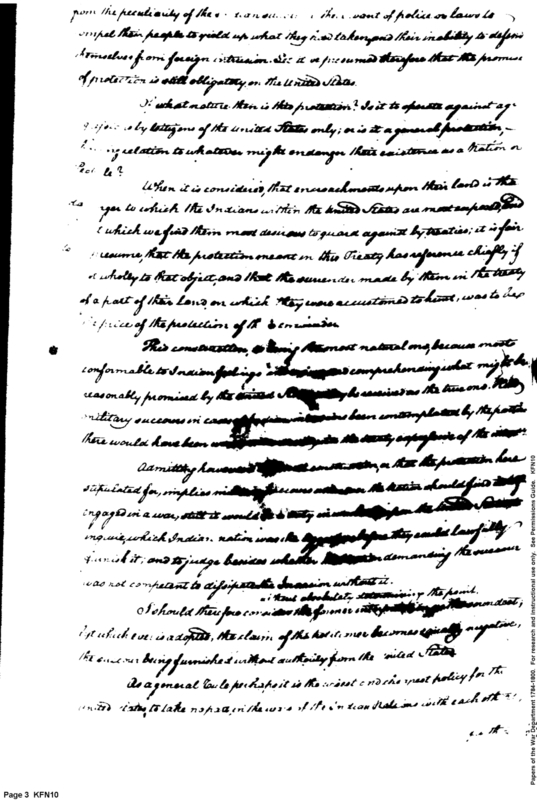
from the peculiarity of the [undecipherable] [undecipherable] [undecipherable] the want of police or laws to compel their people to yield up what they had taken, and their inability to defend themselves from foreign intrusion. So it is presumed therefore that the promise of protection is still obligatory on the United States.
Of what nature then is this protection? Is it to operate against aggressions only by Citizens of the United States only; or is it a general protection, having relation to whatever might endanger their existence as a Nation or People?
When it is considered that encroachments upon their land is the [undecipherable] to which the Indians within the United States are most exposed, and which we find them most anxious to guard against by treaties; it is fair to assume, that the protection meant in this Treaty has reference chiefly if not wholly to that object, and that the surrender made by them in the treaty of a part of their land on which they were accustomed to hunt, was to be in [undecipherable] price of the protection of the [undecipherable] [undecipherable].
This construction is being the most natural one, because most conformable to Indian feelings, and comprehending what might be reasonably promised by the United States, [undecipherable] be received as the true one. [undecipherable] military successes in case [undecipherable] [undecipherable] [undecipherable] have been contemplated by the parties, there would have been more [undecipherable] [undecipherable] [undecipherable] to the treaty, expressive of the intent.
Admitting, however, [undecipherable] construction, or that the protection here stipulated for, implies military [undecipherable] measures when the nation should find itself engaged in a war, still it would be [undecipherable] [undecipherable] upon the United States to inquire which Indian nation was the [undecipherable] [undecipherable] they could lawfully defend it, and to judge besides whether [undecipherable] demanding the measure was not competent to [undecipherable] state [undecipherable] without it.
I should therefore [undecipherable] [undecipherable] [undecipherable] [undecipherable] [undecipherable] [undecipherable] [undecipherable] [undecipherable], but which ever is adopted, the claim of the [undecipherable] more becomes equally negative, the answer being furnished with no authority from the United States.
As a general rule perhaps it is the wisest and the best policy for the United States to take no part in the war of the Indian nations with each other [undecipherable]
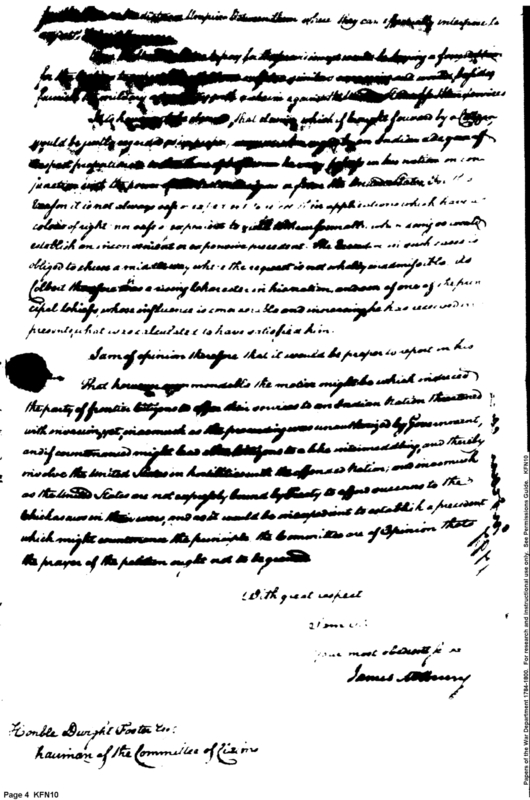
[undecipherable] disputes between them [undecipherable] they can [undecipherable] effectually interpose to [undecipherable] [undecipherable].
[undecipherable] The United States to pay for the [undecipherable] it must be keeping a [undecipherable] [undecipherable] [undecipherable] [undecipherable] [undecipherable] [undecipherable] Citizens [undecipherable] arms against the [undecipherable] [undecipherable] [undecipherable] [undecipherable] services [undecipherable] [undecipherable] [undecipherable] there, during which, if brought forward by a Citizen, [undecipherable] would be justly repaid, [undecipherable] [undecipherable] [undecipherable] on [undecipherable] Indian [undecipherable] degree of [undecipherable] their [undecipherable] [undecipherable] [undecipherable] [undecipherable] [undecipherable] on [undecipherable] [undecipherable] [undecipherable] in [undecipherable] with the [undecipherable] [undecipherable] [undecipherable] a force the United States. It is therefore it is not always [undecipherable] [undecipherable] [undecipherable] [undecipherable] [undecipherable] in [undecipherable] applications which have a colour of right, nor safe or expedient to yield [undecipherable] demands [undecipherable] who being so would establish an inconvenient or expensive precedent. The President in such cases is obliged to choose a middle way, who is the request is not wholly inadmissible, [undecipherable] follows therefore, that a strong [undecipherable] [undecipherable] in his [undecipherable] [undecipherable] in the case of one of the principal things, whose influence is considerable and increasing, he has received presents, that was calculated to establish him.
I am of opinion therefore that it would be proper to report in his [undecipherable]
That however, [undecipherable] [undecipherable] the motive might be which induced the party of frontier Citizens to offer their services to an Indian Nation threatened with invasion yet, inasmuch as the proceeding was unauthorized by Government, and if countenanced might lead other Citizens to a like adventurous thing, and thereby involve the United States in hostilities with the offending Nation; and inasmuch as the United States are not properly bound by Treaty to afford succour to the Chickasaws in their case, and as it would be inexpedient to establish a precedent which might countenance the principle, the Committee are of Opinion that the prayer of the petition ought not to be granted.
With great respect
I am Sir
Your most Obedient [undecipherable]
James McHenry
Honble Dwight Foster [undecipherable]:
Chairman of the Committee of Claims
Type
Autograph Letter Signed
Description
Refers to treaty with Chickosaw Indians. Requests release of all prisoners, blacks, and property taken from citizens. Promises sovereignty and protection to Chickosaws.
Date
01/16/1797
Author
Recipient
Sent from
War Office
Repository
Collection
Document number
1797011600101
Page start
1
Note
Difficult to read.
Notable persons
Dwight Foster
James McHenry
Chickosaws
Chairman of Committee of Liasons
Notable locations
War Office
Spain