

Refers to Talks with Choctaws
Document 1796Refers to US treaty with Choctaw, alluding to boundaries determined by the chief's father. Refers to his desire to have Choctaw law respected by whites to protect land, which may happen when the Spanish leave the Natchez. Refers to requests made by his father to the Secretary of War involving other chiefs.


No human transcription currently available for this document.
This transcription was generated by machine using Anthropic's Claude Code (model sonnet 4.6). It may contain errors or inaccuracies. Please verify against the document image. Learn more about our generative AI methodology.
[undecipherable]
Answer
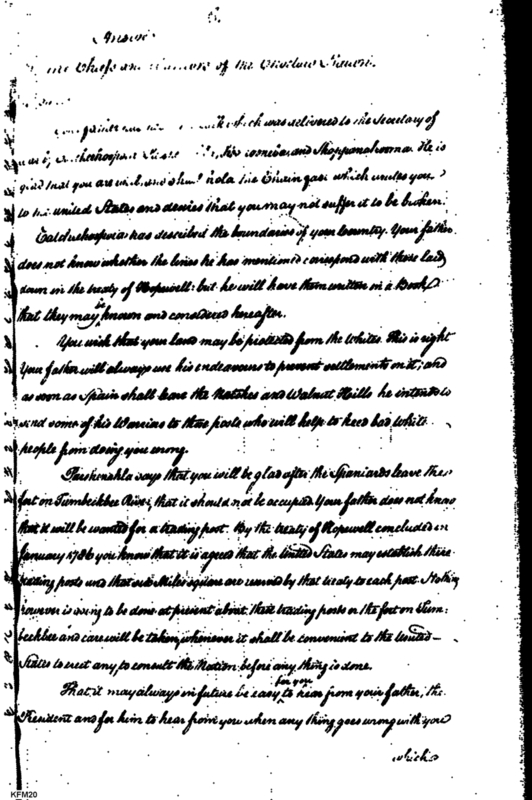
To the Chiefs and Warriors of the [undecipherable] Nation
[undecipherable] a letter [undecipherable] which was delivered to the Secretary of
[undecipherable] [undecipherable] [undecipherable], His [undecipherable] and Shoppemohanna He is
glad that you are well, and shall not let his [undecipherable] which unites you
to the United States and desires that you may not suffer it to be broken.
Caskiehoqua has described the boundaries of your Country. Your father
does not know whether the lines he has mentioned corresponds with those laid,
down in the treaty of Hopewell: but he will have them written in a Book,
that they may known and considered hereafter.
You wish that your lands may be protected from the Whites. This is right.
Your father will always use his endeavours to prevent settlements on it; and
as soon as Spain shall leave the Natchez and Walnut Hills he intends to
send some of his Warriors to those posts who will help to keep bad white
people from doing you wrong.
Tushkahoka says that you will be glad after the Spaniards leave the
fort on Tumbeckbee River, that it should not be occupied. Your father does not know
that it will be wanted for a trading post. By the treaty of Hopewell concluded in
January 1786 you know that it is agreed that the United States may establish three
trading posts and that such Military [undecipherable] are named by that treaty to each post. Nothing
however is going to be done at present about those trading posts on the fort on Tum-
beckbee and care will be taken whenever it shall be convenient to the United
States to meet and to consult the Nation before any thing is done.
That it may always in future be easy to hear from your father, the
Resident and for him to hear from you when any thing goes wrong with you
[undecipherable] can act right. he has appointed Mr. Benjamin Hawkins his
[undecipherable] Agent to reside in the [undecipherable] States and [undecipherable] him to visit from
time to time his children the [undecipherable], and to appoint some person if he sees
fit to write with you to keep him [undecipherable] [undecipherable] about his children and the
Conduct of any whites that may come into your nation as Traders or Visitors. He
desires you therefore to regard Mr. Hawkins as his beloved Man and to believe
whatever he says to you.
Your chiefs who have been to visit your father have asked him to send
some presents annually to the whole Nation. Your father would very gladly help
his children in this manner: but the great Council of the United States has not
given him any money to bestow in this manner and while he gets it from them
he cannot send it to his children. He will, however, should they enable him to
make an annual present inform them of it by his beloved Man Mr. Hawkins.
Your father has requested his Secretary of War to give some presents
to your chiefs who have been to visit him and to send by them to some of his
[undecipherable] [undecipherable] some marks of his kindness. He is glad to hear that most
of the old chiefs and young Warriors who signed the treaty of Hopewell are living.
He sends his love to them and to all his children and wishes them never to
forget that treaty and to be assured that the United States will always consider
them as their friends and Children.
Given at the War Office in Philadelphia this twenty first
day of December Ao 1796 and in the twenty first year
of the Independence of the United States of America.
James McHenry
Secretary of War
Type
Letterbook
Description
Refers to US treaty with Choctaw, alluding to boundaries determined by the chief's father. Refers to his desire to have Choctaw law respected by whites to protect land, which may happen when the Spanish leave the Natchez. Refers to requests made by his father to the Secretary of War involving other chiefs.
Date
12/21/1796
Author
Sent from
War Office
Repository
Collection
Document number
1796122100101
Page start
1
Notable persons
James McHenry
Chief, Choctaw Nation
Spanish
Natchez
Paiskenaskla
Calduskaspaia
Notable locations
War Office
Tumbeikbee River
Philadelphia