No human transcription currently available for this document.
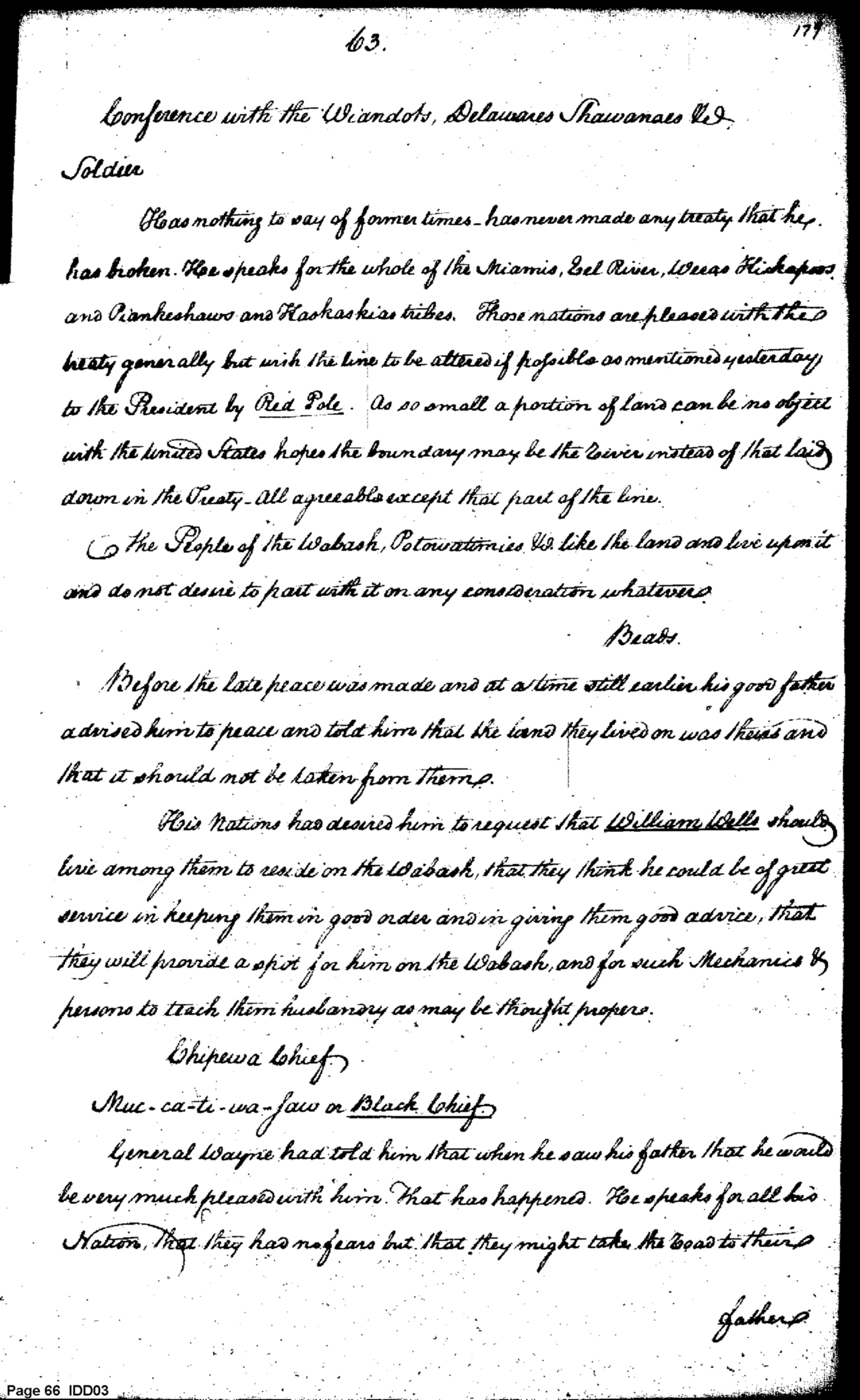
Conference with the Wiandots, Delawares Shawanoes &c—
Soldier.
Has nothing to say of former times. has never made any treaty that he has broken. He speaks for the whole of the Miamis, Eel River, Weas Hickapoos and Piankeshaws and Kaskaskias tribes. Those nations are pleased with the treaty generally but wish the line to be altered if possible as mentioned yesterday to the President by Red Pole. As so small a portion of land can be no object with the United States hopes the boundary may be the [undecipherable] instead of that laid down in the Treaty. All agreeable except that part of the line.
The People of the Wabash, Potawatomies &c like the land and live upon it and do not desire to part with it on any consideration whatever.
Bears.
Before the late peace was made and at a time still earlier his good father advised him to peace and told him that the land they lived on was theirs and that it should not be taken from them.
His Nations has desired him to request that William Wells should live among them to reside on the Wabash, that they think he could be of great service in keeping them in good order and in giving them good advice, that they will provide a spot for him on the Wabash, and for such Mechanics & persons to teach them husbandry as may be thought proper.
Chippewa Chief.
Muc-ca-te-wa-Jaw or Black Chief.
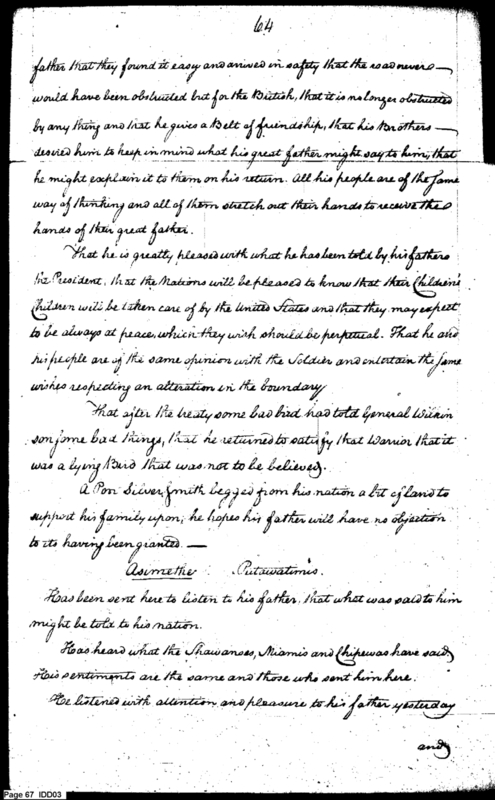
General Wayne had told him that when he saw his father that he would be very much pleased with him. That has happened. He speaks for all his Nation. That they had no fears but that they might take the road to their fathers that they found it easy and arrived in safety that the road never would have been obstructed but for the British, that it is no longer obstructed by any thing and that he gives a Belt of friendship, that his Brothers desired him to keep in mind what his great father might say to him, that he might explain it to them on his return. All his people are of the same way of thinking and all of them stretch out their hands to receive the hands of their great father.
That he is greatly pleased with what he has been told by his fathers the President, that the Nations will be pleased to know that their Childrens children will be taken care of by the United States and that they may expect to be always at peace which they wish should be perpetual. That he and his people are of the same opinion with the Soldier and entertain the same wishes respecting an alteration in the boundary.
That after the treaty some bad bird had told General Wilkins son some bad things, that he returns to satisfy that Warrior that it was a lying Bird that was not to be believed.
A Pon Silver-Smith begged from his nation a bit of land to support his family upon, he hopes his father will have no objection to its having been granted. —
Asirnethe Putrawatomis.
Has been sent here to listen to his father, that what was said to him might be told to his nation.
Has heard what the Shawanoes, Miamis and Chippewas have said. His sentiments are the same and those who sent him here.
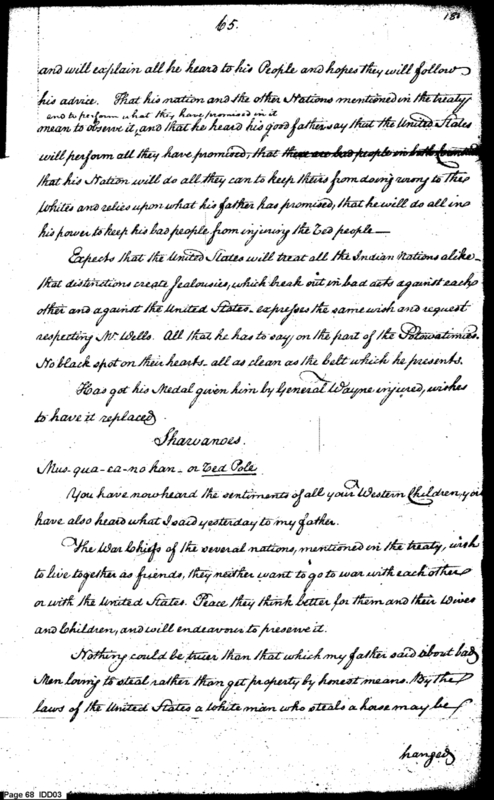
He listened with attention and pleasure to his father yesterday and will explain all he heard to his People and hopes they will follow his advice. That his nation and the other Nations mentioned in the treaty and to perform what they have promised in it, and that he heard his good father say that the United States will perform all they have promised; that [strikethrough: there are bad people on both sides] that his Nation will do all they can to keep theirs from doing wrong to the Whites and relies upon what his father has promised, that he will do all in his power to keep his bad people from injuring the Red people —
Expects that the United States will treat all the Indian Nations alike that distinctions create jealousies, which break out in bad acts against each other and against the United States. expresses the same wish and request respecting Mr Wells. All that he has to say, on the part of the Potawatomis. No black spot on their hearts. all as clean as the belt which he presents.
Has got his Medal given him by General Wayne injured, wishes to have it replaced.
Shawanoes.
Mus-qua-ca-no-han— or Red Pole.
You have now heard the sentiments of all your Western Children you have also heard what I said yesterday to my father.
The War chiefs of the several nations, mentioned in the treaty, wish to live together as friends, they neither want to go to war with each other or with the United States. Peace they think better for them and their Wives and children, and will endeavour to preserve it.
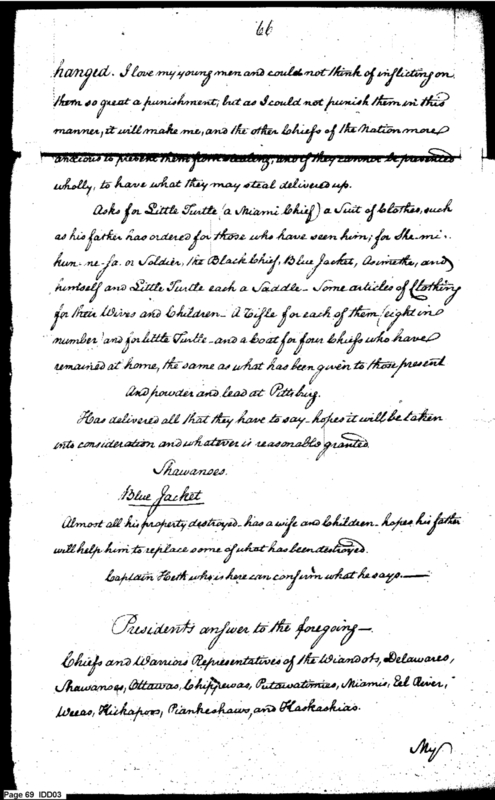
Nothing could be truer than that which my father said about bad Men loving to steal rather than get property by honest means. By the Laws of the United States a white man who steals a horse may be hanged. I love my young men and could not think of inflicting on them so great a punishment, but as I could not punish them in this manner, it will make me, and the other Chiefs of the Nation more anxious to prevent them from stealing, and if they cannot be prevented wholly, to have what they may steal delivered up.
Asks for Little Turtle (a Miami Chief) a Suit of clothes, such as his father has ordered for those who have seen him; for the Mi-hum-ne-fa or Soldier, the Black Chief, Blue Jacket, Asirnethe, and himself and Little Turtle each a Saddle. Some articles of Clothing for their Wives and Children. A Rifle for each of them, eight in number and for little Turtle and a boat for four chiefs who have remained at home, the same as what has been given to those present. And powder and lead at Pittsburg.
Has delivered all that they have to say. hopes it will be taken into consideration and whatever is reasonable granted.
Shawanoes.
Blue Jacket.
Almost all his property destroyed. has a wife and children. hopes his father will help him to replace some of what has been destroyed.
Captain Heath who is here can confirm what he says. —
President's answer to the foregoing—
Chiefs and Warriors Representatives of the Wiandots, Delawares, Shawanoes, Ottawas, Chippewas, Putawatomies, Miamis, Eel River, Weas, Hickapoos, Piankeshaws, and Kaskaskias.
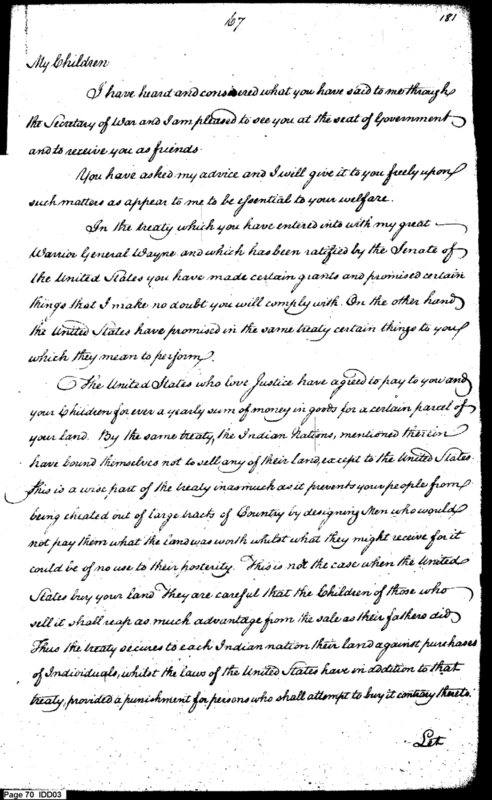
My Children
I have heard and considered what you have said to me through the Secretary of War and I am pleased to see you at the seat of Government and to receive you as friends.
You have asked my advice and I will give it to you freely upon such matters as appear to me to be essential to your welfare.
In the treaty which you have entered into with my great Warrior General Wayne and which has been ratified by the Senate of the United States you have made certain grants and promised certain things that I make no doubt you will comply with. On the other hand, the United States have promised in the same treaty certain things to you which they mean to perform.
The United States who love justice have agreed to pay to you and your children forever a yearly sum of money in goods for a certain parcel of your land. By the same treaty, the Indian Nations, mentioned therein have bound themselves not to sell any of their land except to the United States. This is a wise part of the treaty inasmuch as it prevents your people from being cheated out of large tracts of Country by designing men who would not pay them what the land was worth whilst what they might receive for it could be of no use to their posterity. This is not the case when the United States buy your land they are careful that the Children of those who sell it shall reap as much advantage from the sale as their fathers did. Thus the treaty secures to each Indian nation their land against purchases of Individuals, whilst the laws of the United States have in addition to that treaty, provided a punishment for persons who shall attempt to buy it contrary thereto.
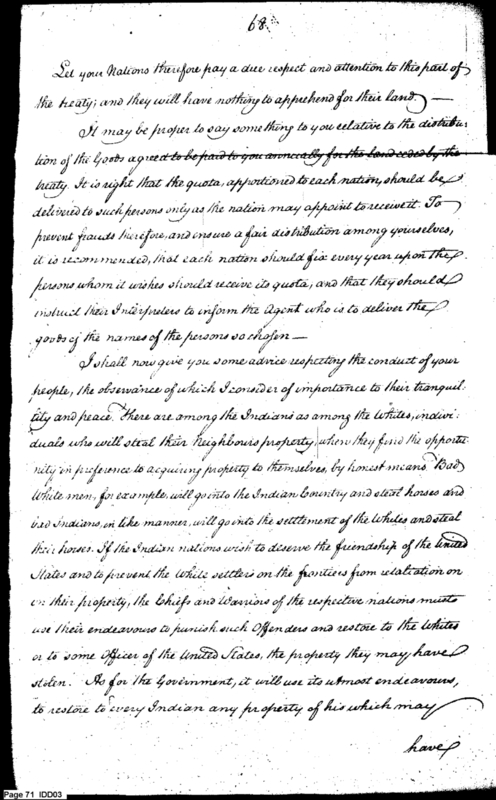
Let your Nations therefore pay a due respect and attention to this part of the treaty; and they will have nothing to apprehend for their land. —
It may be proper to say something to you relative to the distribution of the Goods agreed to be paid to you annually for the land ceded by the treaty. It is right that the quota, apportioned to each nation, should be delivered to such persons only, as the nation may appoint to receive it. To prevent frauds therefore and ensure a fair distribution among yourselves, it is recommended, that each nation should fix every year upon the persons whom it wishes should receive its quota, and that they should instruct their Interpreters to inform the Agent who is to deliver the goods of the names of the persons so chosen. —
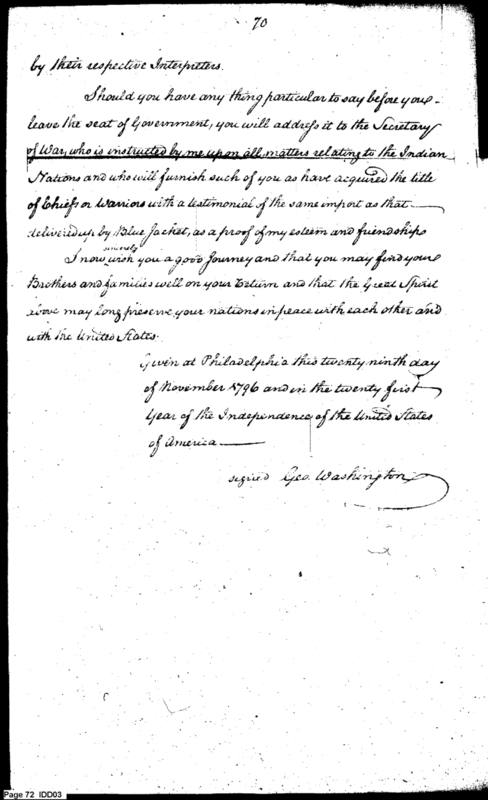
I shall now give you some advice respecting the conduct of your people, the observance of which I consider of importance to their tranquility and peace. There are among the Indians as among the Whites, individuals who will steal their Neighbours property, when they find the opportunity, in preference to acquiring property to themselves, by honest means. Bad White men, for example, will go into the Indian Country and steal horses and bad Indians in like manner, will go into the settlement of the Whites and steal their horses. If the Indian nations wish to deserve the friendship of the United States and to prevent the White settlers on the frontiers from retaliation on their property, the Chiefs and Warriors of the respective nations must use their endeavours to punish such Offenders and restore to the Whites or to some Officer of the United States, the property they may have stolen. As for the Government, it will use its utmost endeavours, to restore to every Indian any property of his which may have by their respective Interpreters.
Should you have any thing particular to say before you leave the seat of Government, you will address it to the Secretary of War, who is [underline: instructed by me upon all matters relating to the Indian Nations] and who will furnish such of you as have acquired the title of Chiefs or Warriors with a testimonial of the same import as that delivered up by Blue Jacket, as a proof of my esteem and friendship.
I now wish you a good journey and that you may find your Brothers and families well on your return and that the Great Spirit may long preserve your nations in peace with each other and with the United States.
Given at Philadelphia this twenty ninth day of November 1796 and in the twenty first year of the Independence of the United States of America. ——
signed Geo. Washington