6
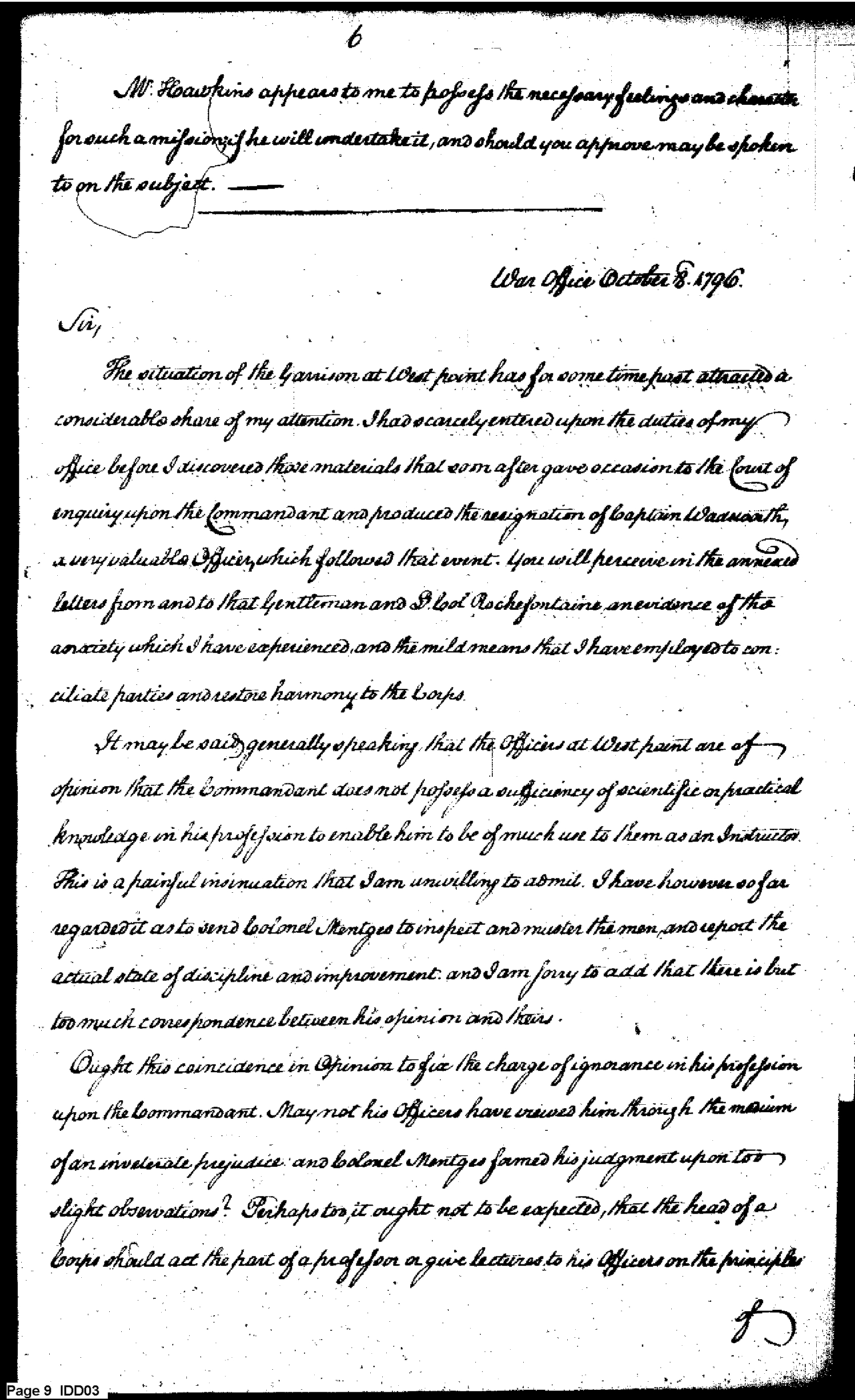
W. Hawkins appears to me to possess the necessary feelings and character for such a mission if he will undertake it, and should you approve may be spoken to on the subject.-
War Office October 8, 1796.
Sir,
The situation of the garrison at West point has for some time past attracted a considerable share of my attention. I had scarcely entered upon the duties of my office before I discovered those materials that soon after gave occasion to the Court of enquiry upon the Commandant and produced the resignation of Captain Wadsworth, a very valuable Officer, which followed that event. You will perceive in the annexed letters from and to that gentleman and Lt Col Rochefontaine an evidence of the anxiety which I have experienced, and the mild means that I have employed to conciliate parties and restore harmony to the Corps.
It may be said, generally speaking, that the Officers at West point are of opinion that the Commandant does not possess a sufficiency of scientific or practical knowledge in his profession to enable him to be of much use to them as an Instructor. This is a painful insinuation that I am unwilling to admit. I have however so far regarded it as to send Colonel Mentges to inspect and muster the men, and report the actual state of discipline and improvement, and I am sorry to add that there is but too much correspondence between his opinions and theirs.
Ought this coincidence in Opinion to fix the charge of ignorance in his profession upon the Commandant. May not his Officers have viewed him through the medium of an inveterate prejudice and Colonel Mentges formed his judgment upon too slight observations? Perhaps too, it ought not to be expected, that the head of a Corps should act the part of a professor or give lectures to his Officers on the principles of
–Ereeves 18:02, 3 February 2012 (EST)
7 151
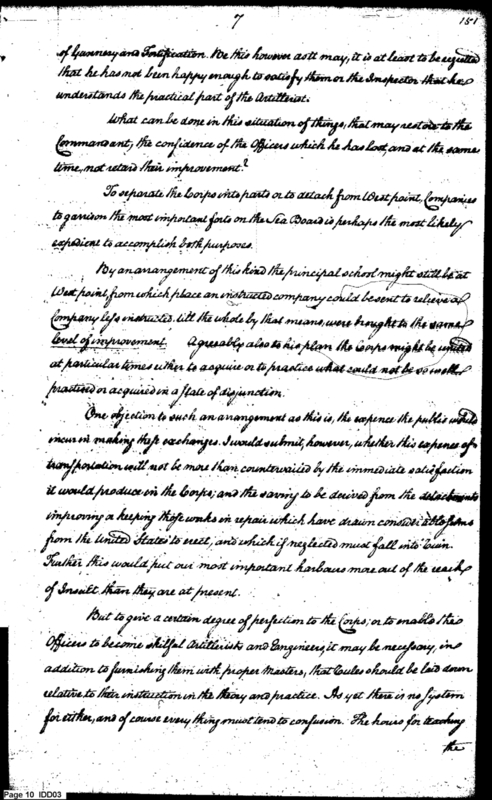
of Gunnery and Fortification. Be this as it may, it is at least to be acquitted that he has not been happy enough to satisfy them or the Inspector that he understands the pratical part of the Artillerist.
What can be done in this situation of things, that may restore to the Commandant, the confidence of the Officers which he has lost, and at the same time, not retard this improvement?
To separate the Corps into parts or to detach from West point, Companies to garrison the most important forts on the Sea Board is perhaps the most expedient to accomplish both purposes.
By an arrangement of this kind the principal school might still be at West point, from which plave and instructed company couls be sent to relieve of Company less instructed, till the whole by that means, were brought to the same level of improvement. Agreeably also to his plan the Corps might be united at particular times to acquire or to practice what could not be so well practised or acquired in a State of disjunction.
One objection to such an arangement as this is, the expence the public will incur in making these exchanges. I would submit, however, whether this expence of transportation will not be more than countervailed by the immediate satisfaction it would produce in the Corps, and the saving to be derived from the detachments improving or keeping those works in repair which have drawn considerable obligations from the United States to erect, and which if neglected must fall into ruin. Further this would put our most important harbours more out of the reach of Insult than they are at present.
But to give a certain degree of perfection to the Corps; or to enable the Officers to become skillful Artillerists and Engineers, it may be necessary, in addition to furnishing them with proper Masters, that rules should be laid down relative to their instruction in the theory and practice. As yet there is no System for either, and of course every thing must tend to confusion. The hours for teaching the
–Ereeves 06:14, 13 February 2012 (EST)
[Mr Hawkins appears to me to possess the necessary feelings and character for such a mission; if he will undertake it, and should you approve, may be spoken to on the subject. ——]
War Office October 8. 1796.
Sir,
The situation of the Garrison at West point has for some time past attracted a considerable share of my attention. I had scarcely entered upon the duties of my office before I discovered those materials that soon after gave occasion to the Court of inquiry upon the Commandant and produced the resignation of Captain Waemsarth, a very valuable Officer, which followed that event. You will perceive in the annexed letters from and to that Gentleman and Colonel Rochefontaine an evidence of the anxiety which I have experienced, and the mild means that I have employed to conciliate parties and restore harmony to the Corps.
It may be said, generally speaking, that the Officers at West point are of opinion that the Commandant does not possess a sufficiency of scientific or practical knowledge in his profession to enable him to be of much use to them as an Instructor. This is a painful insinuation that I am unwilling to admit. I have however so far regarded it as to send Colonel Montges to inspect and muster the men, and report the actual state of discipline and improvement; and I am sorry to add that there is but too much correspondence between his opinion and theirs.
Ought this coincidence in Opinion to fix the charge of ignorance in his profession upon the Commandant. May not his Officers have viewed him through the medium of an invincible prejudice. and Colonel Montges formed his judgment upon too slight observations? Perhaps too, it ought not to be expected, that the head of a Corps should act the part of a professor or give lectures to his Officers on the principles of Gunnery and Fortification. Be this however as it may, it is at least to be regretted that he has not been happy enough to satisfy them or the Inspector that he understands the practical part of the Artillerist.
What can be done in this situation of things, that may restore to the Commandant, the confidence of the Officers which he has lost, and at the same time, not retard their improvement?
To separate the Corps into parts or to detach from West point Companies to garrison the most important forts on the Sea Board is perhaps the most likely expedient to accomplish both purposes.
By an arrangement of this kind the principal school might still be at West point, from which place an instructed company could be sent to relieve a Company less instructed, till the whole by that means were brought to the same level of improvement. Agreeably also to his plan the Corps might be united at particular times either to acquire or to practice what could not be so well practised or acquired in a state of disjunction.
One objection to such an arrangement as this is, the expense the public would incur in making these exchanges. I would submit, however, whether this expense of transportation will not be more than countervailled by the immediate satisfaction it would produce in the Corps; and the saving to be derived from the detachments improving & keeping those works in repair which have drawn considerable sums from the United States to erect, and which if neglected must fall into ruin. Further this would put our most important harbours more out of the reach of Insult than they are at present.
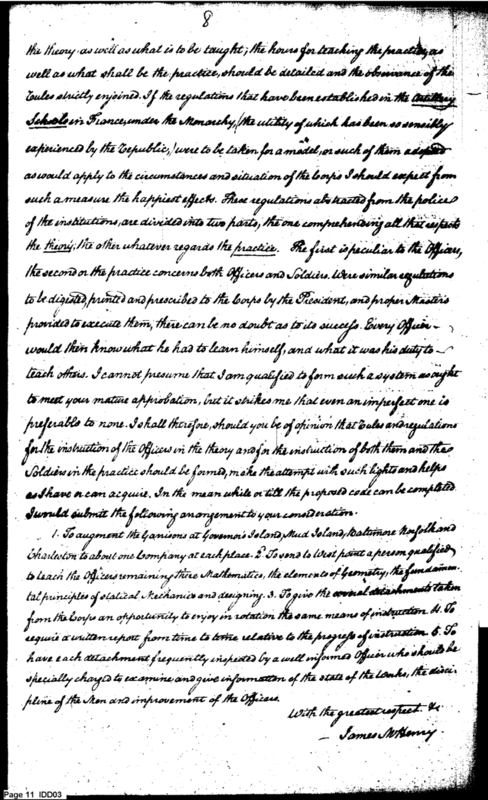
But to give a certain degree of perfection to the Corps; or to enable the Officers to become skilful Artillerists and Engineers, it may be necessary, in addition to furnishing them with proper Masters, that Rules should be laid down relative to their instruction in the theory and practice. As yet there is no system for either, and of course every thing must tend to confusion. The hours for teaching the theory as well as what is to be taught; the hours for teaching the practice, as well as what shall be the practice, should be detailed and the observance of the rules strictly enjoined. If the regulations that have been established in the [underline: Military Schools] in France, (made the Monarchy,) the utility of which has been so sensibly experienced by the Republic, were to be taken for a model, or such of them adopted as would apply to the circumstances and situation of the Corps I should expect from such a measure the happiest effects. These regulations [strikethrough: abstracted from the police of the institutions,] are divided into two parts, the one comprehending all that respects the [underline: theory], the other whatever regards the [underline: practice]. The first is peculiar to the Officers, the second or the practice concerns both Officers and Soldiers. Were similar regulations to be digested, printed and prescribed to the Corps by the President, and proper Masters provided to execute them, there can be no doubt as to its success. Every Officer would then know what he had to learn himself, and what it was his duty to teach others. I cannot presume that I am qualified to form such a system as ought to meet your mature approbation, but it strikes me that even an imperfect one is preferable to none. I shall therefore, should you be of opinion that rules and regulations for the instruction of the Officers in the theory and in the instruction of both them and the Soldiers in the practice should be formed, make the attempt with such lights and helps as I have & can acquire. In the mean while or till the proposed code can be completed I would submit the following arrangements to your consideration.
1. To augment the Garrisons at Governors Island, Mud Island, Baltimore, Norfolk and Charleston to about one Company at each place. 2. To send to West point a person qualified to learn the Officers remaining there Mathematics, the elements of Geometry, the fundamental principles of statical Mechanics and designing. 3. To give the several detachments taken from the Corps an opportunity to enjoy in rotation the same means of instruction. 4. To require a written report from time to time relative to the progress of instruction. 5. To have each detachment frequently inspected by a well informed Officer who should be specially charged to examine and give information of the state of the Corps, the discipline of the men and improvement of the Officers.
With the greatest respect &c
James McHenry