

Instructions to Indian Agent to the Creeks & Other Indians South of the Ohio
Document 1796Official commission and instructions for Benjamin Hawkins, as Principal Temporary Agent for Indian Affairs, within the Indian Nations South of the Ohio, and North of the Territorial Line. Includes instructions for managing trade, seeing to the sale of land between Indians & the states (principally Georgia), overseeing boundaries, etc.
No human transcription currently available for this document.
This transcription was generated by machine using Anthropic's Claude Code (model sonnet 4.6). It may contain errors or inaccuracies. Please verify against the document image. Learn more about our generative AI methodology.
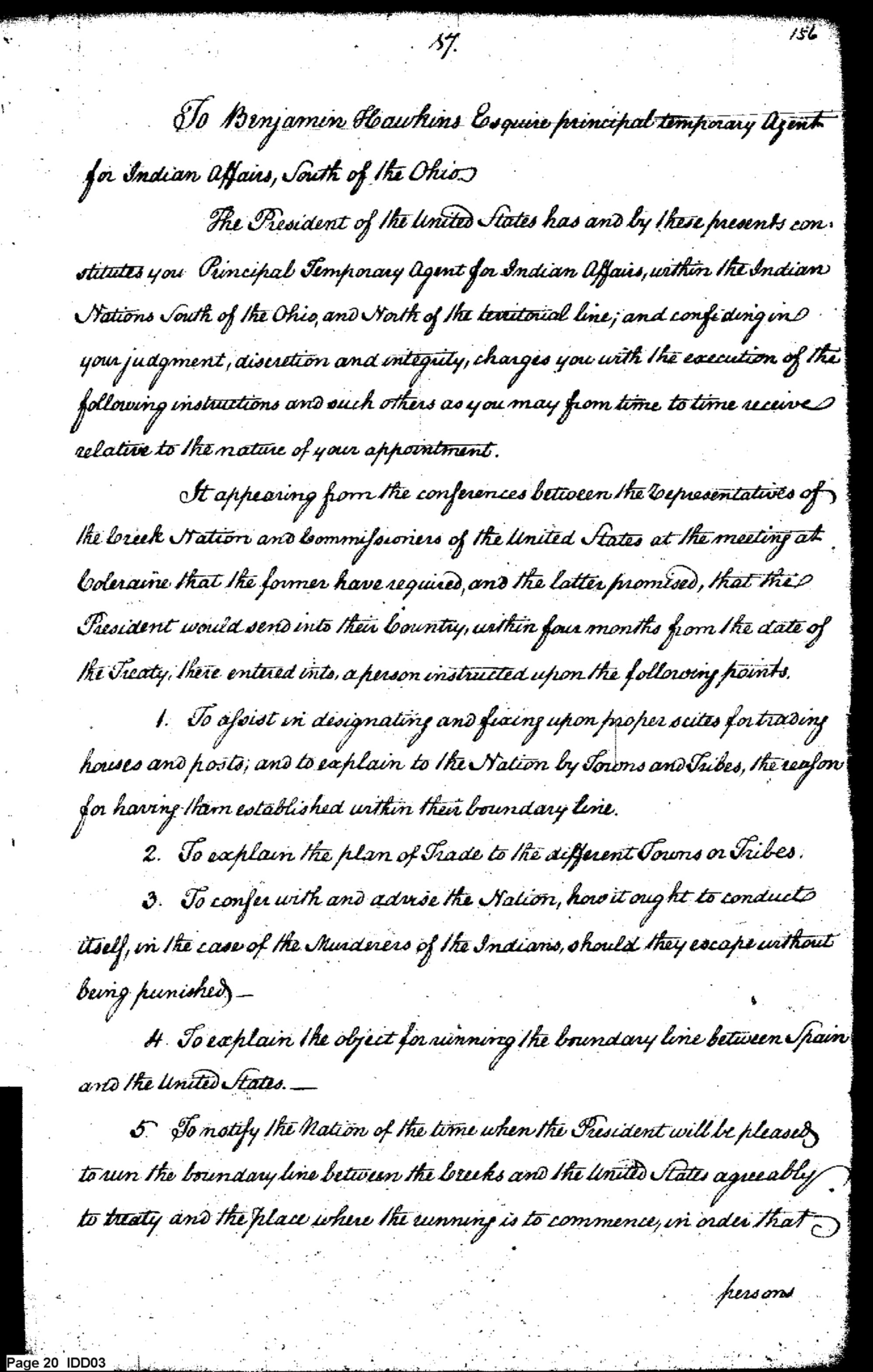
To Benjamin Hawkins Esquire principal temporary Agent for Indian Affairs, South of the Ohio
The President of the United States has and by these presents constitutes you Principal Temporary Agent for Indian Affairs, within the Indian Nations South of the Ohio, and North of the territorial line; and confiding in your judgment, discretion and integrity, charges you with the execution of the following instructions and such others as you may from time to time receive relative to the nature of your appointment.
It appearing from the conferences between the Representatives of the Creek Nation and Commissioners of the United States at the meeting at Coleraine that the former have required, and the latter promised, that the President would send into their country, within four months from the date of the Treaty, there entered into, a person instructed upon the following points.
1. To assist in designating and fixing upon proper sites for trading houses and posts; and to explain to the Nation by Towns and Tribes, the reason for having them established within their boundary line.
2. To explain the plan of Trade to the different Towns or Tribes.
3. To confer with and advise the Nation, how it ought to conduct itself, in the case of the Murderers of the Indians, should they escape without being punished.—
4. To explain the object for running the boundary line between Spain and the United States.—
5. To notify the Nation of the time when the President will be pleased to run the boundary line between the Creeks and the United States agreeably to treaty and the place where the running is to commence, in order that
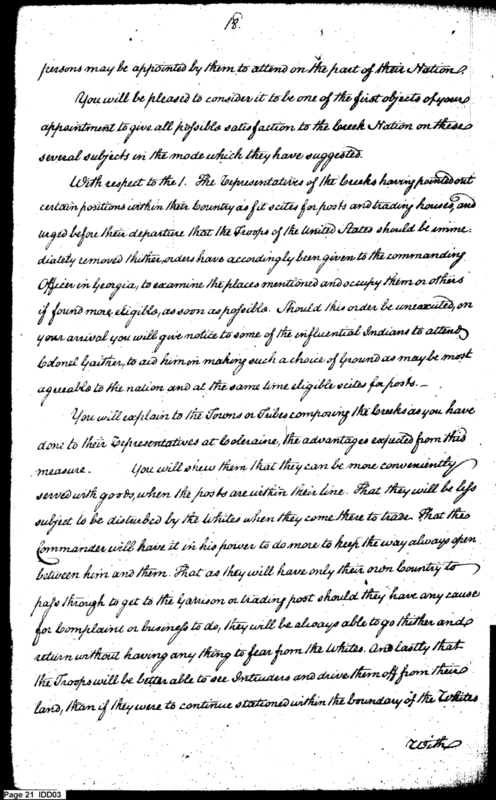
persons may be appointed by them to attend on the part of their Nation.
You will be pleased to consider it to be one of the first objects of your appointment to give all possible satisfaction to the Creek Nation on these several subjects in the mode which they have suggested.
With respect to the 1. The Representatives of the Creeks having pointed out certain positions within their country as fit sites for posts and trading houses, and urged before their departure that the Troops of the United States should be immediately removed thither, orders have accordingly been given to the commanding Officer in Georgia, to examine the places mentioned and occupy them or others if found more eligible, as soon as possible. Should this order be unexecuted, on your arrival you will give notice to some of the influential Indians to attend Colonel Gaither, to aid him in making such a choice of ground as may be most agreeable to the nation and at the same time eligible sites for posts.—
You will explain to the Towns or Tribes composing the Creeks as you have done to their Representatives at Coleraine, the advantages expected from this measure. You will shew them that they can be more conveniently served with goods, when the posts are within their line. That they will be less subject to be disturbed by the Whites when they come there to trade. That the Commander will have it in his power to do more to keep the way always open between him and them. That as they will have only their own country to pass through to get to the Garrison or trading post should they have any cause for complaint or business to do, they will be always able to go thither and return without having any thing to fear from the Whites. And lastly that the Troops will be better able to see Intruders and drive them off from their land, than if they were to continue stationed within the boundary of the Whites.
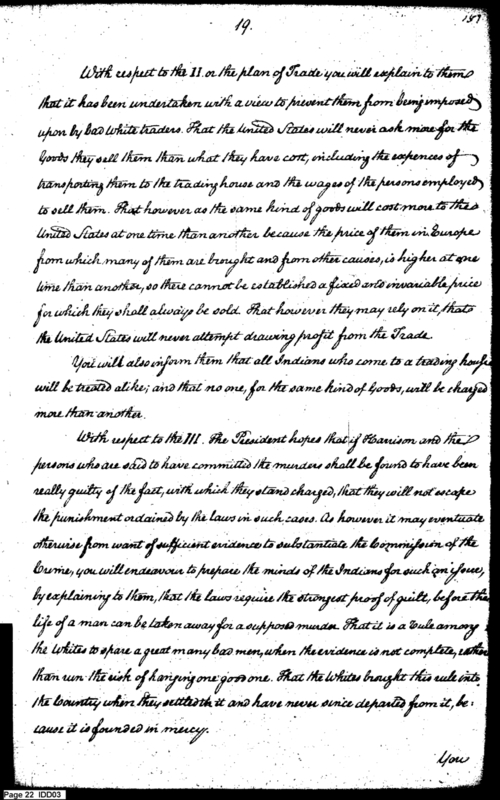
With respect to the II on the plan of Trade you will explain to them that it has been undertaken with a view to prevent them from being imposed upon by bad white traders. That the United States will never ask more for the Goods they sell them than what they have cost, including the expences of transporting them to the trading house and the wages of the persons employed to sell them. That however as the same kind of goods will cost more to the United States at one time than another because the price of them in Europe from which many of them are brought and from other causes, is higher at one time than another, so there cannot be established a fixed and invariable price for which they shall always be sold. That however they may rely on it, that the United States will never attempt drawing profit from the Trade.
You will also inform them that all Indians who come to a trading house will be treated alike; and that no one, for the same kind of goods, will be charged more than another.
With respect to the III. The President hopes that if Harrisom and the persons who are said to have committed the murders shall be found to have been really guilty of the fact, with which they stand charged, that they will not escape the punishment ordained by the laws in such cases. As however it may eventuate otherwise from want of sufficient evidence to substantiate the commission of the Crime, you will endeavour to prepare the minds of the Indians for such an issue, by explaining to them, that the laws require the strongest proof of guilt, before the life of a man can be taken away for a supposed murder. That it is a rule among the Whites to spare a great many bad men, when the evidence is not complete, rather than run the risk of hanging one good one. That the Whites brought this rule into the country when they settled it and have never since departed from it, because it is founded in mercy.
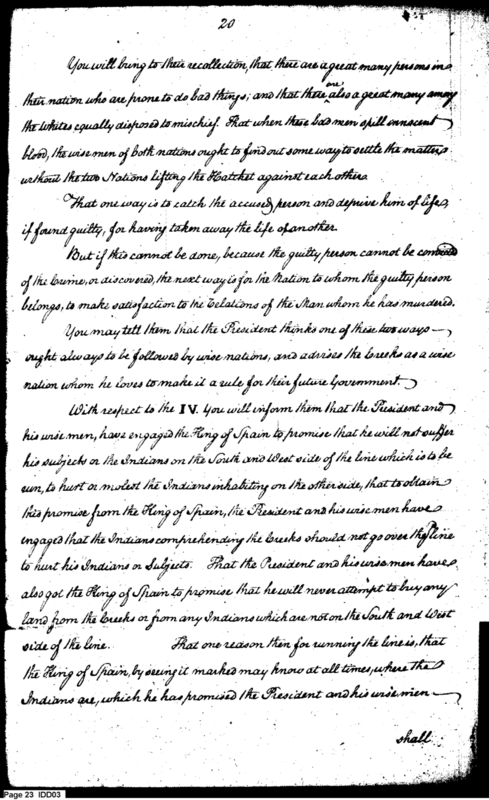
You will bring to their recollection, that there are a great many persons in their nation who are prone to do bad things; and that there also a great many among the Whites equally disposed to mischief. That when these bad men spill innocent blood, the wise men of both nations ought to find out some way to settle the matter without the two Nations lifting the Hatchet against each other.
That one way is to catch the accused person and deprive him of life, if found guilty, for having taken away the life of another.
But if this cannot be done, because the guilty person cannot be convicted of the crime, or discovered, the next way is for the Nation to whom the guilty person belongs, to make satisfaction to the Relations of the Man whom he has murdered.
You may tell them that the President thinks one of these two ways ought always to be followed by wise nations, and advises the Creeks as a wise nation whom he loves to make it a rule for their future Government.
With respect to the IV. You will inform them that the President and his wise men, have engaged the King of Spain to promise that he will not suffer his subjects or the Indians on the South and West side of the line which is to be run, to hurt or molest the Indians inhabiting on the other side, that to obtain this promise from the King of Spain, the President and his wise men have engaged that the Indians comprehending the Creeks should not go over the line to hurt his Indians or Subjects. That the President and his wise men have also got the King of Spain to promise that he will never attempt to buy any land from the Creeks or from any Indians which are not on the South and West side of the line. That one reason then for running the line is, that the King of Spain, by seeing it marked may know at all times where the Indians are, which he has promised the President and his wise men
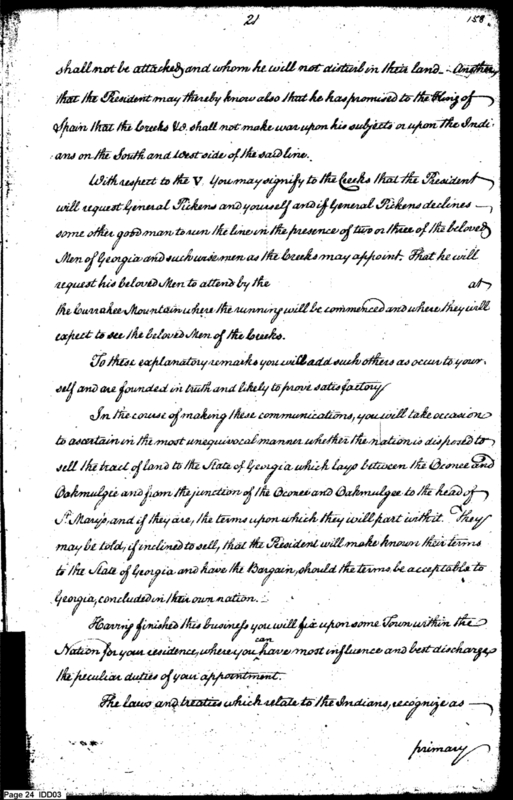
shall not be attacked, and whom he will not disturb in their land.— Another, that the President may thereby know also that he has promised to the King of Spain that the Creeks &c shall not make war upon his subjects or upon the Indians on the South and West side of the said line.
With respect to the V. You may signify to the Creeks that the President will request General Pickens and yourself and if General Pickens declines, some other good man to run the line in the presence of two or three of the beloved Men of Georgia and such wise men as the Creeks may appoint. That he will request his beloved Men to attend by the at the Curruhkee Mountain where the running will be commenced and where they will expect to see the beloved Men of the Creeks.
To these explanatory remarks you will add such others as occur to yourself and are founded in truth and likely to prove satisfactory.
In the course of making these communications, you will take occasion to ascertain in the most unequivocal manner whether the nation is disposed to sell the tract of land to the State of Georgia which lays between the Oconee and Oakmulgee and from the junction of the Oconee and Oakmulgee to the head of St. Marys, and if they are, the terms upon which they will part with it. They may be told, if inclined to sell, that the President will make known their terms to the State of Georgia and have the Bargain, should the terms be acceptable to Georgia, concluded in their own nation.
Having finished this business you will fix upon some Town within the Nation for your residence, where you have most influence and best discharge the peculiar duties of your appointment.
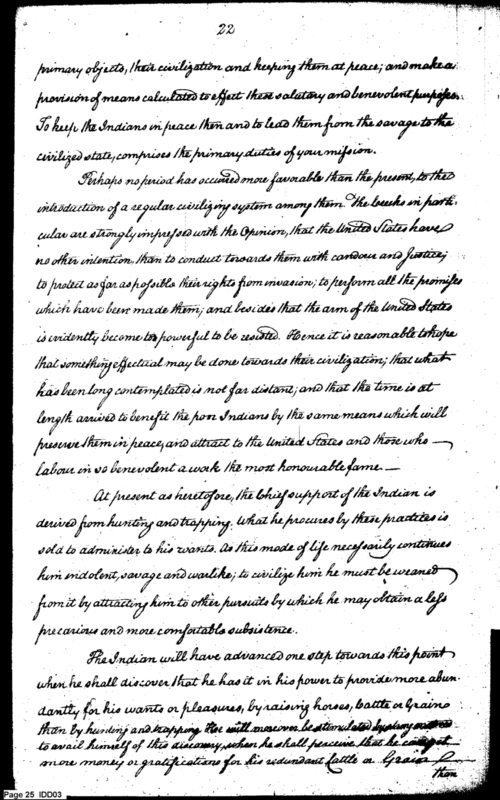
The laws and treaties which relate to the Indians, recognize as primary objects, their civilization and keeping them at peace; and make a provision of means calculated to effect these salutary and benevolent purposes. To keep the Indians in peace then and to lead them from the savage to the civilized state, comprises the primary duties of your mission.
Perhaps no period has occurred more favorable than the present, to the introduction of a regular civilizing system among them. The Creeks in particular are strongly impressed with the Opinion, that the United States have no other intention, than to conduct towards them with candour and Justice; to protect as far as possible their rights from invasion; to perform all the promises which have been made them; and besides that the arm of the United States is evidently become too powerful to be resisted. Hence it is reasonable to hope that something effectual may be done towards their civilization; that what has been long contemplated is not far distant; and that the time is at length arrived to benefit the poor Indians by the same means which will preserve them in peace, and attract to the United States and those who labour in so benevolent a work the most honourable fame.—
At present as heretofore, the chief support of the Indian is derived from hunting and trapping. What he procures by these practices is sold to administer to his wants. As this mode of life necessarily continues him indolent, savage and warlike; to civilize him he must be weaned from it by attracting him to other pursuits by which he may obtain a less precarious and more comfortable subsistence.
The Indian will have advanced one step towards this point when he shall discover that he has it in his power to provide more abundantly for his wants or pleasures, by raising horses, cattle or Grains than by hunting and trapping. He will moreover be stimulated by the same motive to avail himself of this discovery, when he shall perceive that he can get more money or gratifications for his redundant cattle or Grain
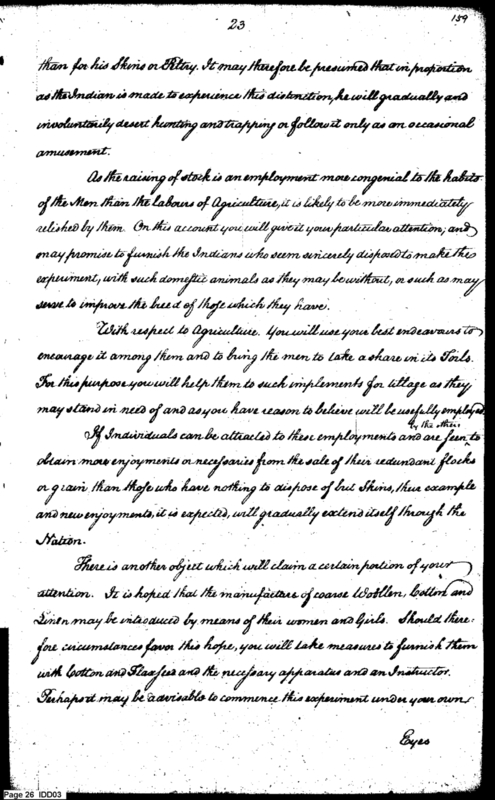
than for his Skins or Peltry. It may therefore be presumed that in proportion as the Indian is made to experience this distinction, he will gradually and involuntarily desert hunting and trapping or follow it only as an occasional amusement.
As the raising of stock is an employment more congenial to the habits of the Men than the labours of Agriculture, it is likely to be more immediately relished by them. On this account you will give it your particular attention, and may promise to furnish the Indians who seem sincerely disposed to make the experiment, with such domestic animals as they may be without, or such as may serve to improve the breed of those which they have.
With respect to Agriculture. You will use your best endeavours to encourage it among them and to bring the men to take a share in its Toils. For this purpose you will help them to such implements for tillage as they may stand in need of and as you have reason to believe will be usefully employed by the men. If Individuals can be attracted to these employments and are found to obtain more enjoyments or necessaries from the sale of their redundant flocks or grain than those who have nothing to dispose of but Skins, their example and new enjoyments, it is expected, will gradually extend itself through the Nation.
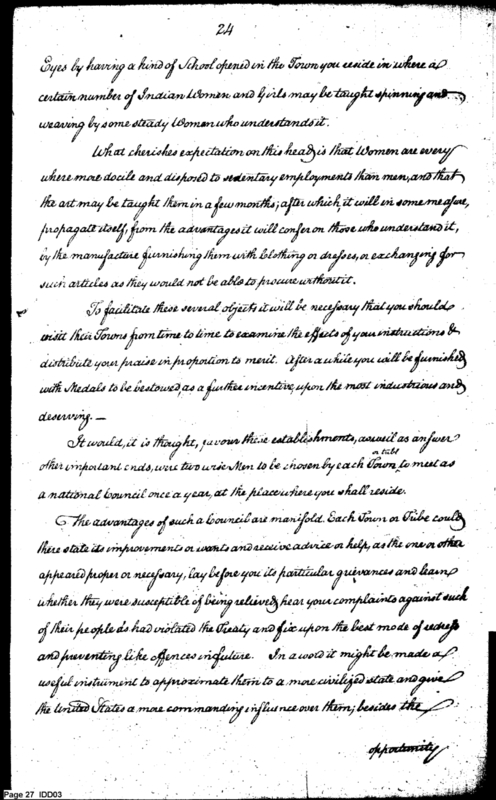
There is another object which will claim a certain portion of your attention. It is hoped that the manufacture of coarse Woollen, Cotton and Linen may be introduced by means of their women and Girls. Should therefore circumstances favor this hope, you will take measures to furnish them with Cotton and Flax Seed and the necessary apparatus and an Instructor. Perhaps it may be advisable to commence this experiment under your own
Eyes by having a kind of School opened in the Town you reside in where a certain number of Indian Women and Girls may be taught spinning and weaving by some steady Women who understands it.
What cherishes expectation on this head, is that Women are every where more docile and disposed to sedentary employments than men; and that the art may be taught them in a few months; after which, it will in some measure, propagate itself, from the advantages it will confer on those who understand it, by the manufacture furnishing them with Clothing or dresses, or exchanging for such articles as they would not be able to procure without it.
To facilitate these several objects it will be necessary that you should visit their Towns from time to time to examine the effects of your instructions & distribute your praise in proportion to merit. After a while you will be furnished with Medals to be bestowed as a further incentive, upon the most industrious and deserving.—
It would, it is thought, favour these establishments, as well as answer other important ends, were two wise Men to be chosen by each Town, to meet as a national Council once a year, at the place where you shall reside.
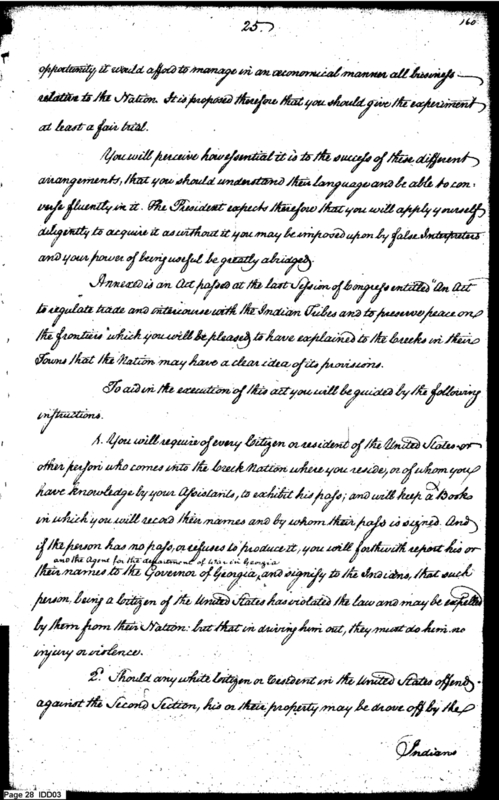
The advantages of such a Council are manifold. Each Town or Tribe could there state its improvements or wants and receive advice or help, as the one or other appeared proper or necessary, lay before you its particular grievances and learn whether they were susceptible of being relieved, hear your complaints against such of their people as had violated the Treaty and fix upon the best mode of redress and preventing like offences in future. In a word it might be made a useful instrument to approximate them to a more civilized state and give the United States a more commanding influence over them; besides the
opportunity it would afford to manage in an oeconomical manner all business relative to the Nation. It is proposed therefore that you should give the experiment at least a fair trial.
You will perceive how essential it is to the success of these different arrangements, that you should understand their language and be able to converse fluently in it. The President expects therefore that you will apply yourself diligently to acquire it as without it you may be imposed upon by false Interpreters and your power of being useful be greatly abridged.
Annexed is an Act passed at the last Session of Congress entitled "An Act to regulate trade and intercourse with the Indian Tribes and to preserve peace on the frontiers" which you will be pleased to have explained to the Creeks in their Towns that the Nation may have a clear idea of its provisions.
To aid in the execution of this act you will be guided by the following instructions.
1. You will require of every Citizen or resident of the United States or other person who comes into the Creek Nation where you reside, or of whom you have knowledge by your Assistants, to exhibit his pass; and will keep a Book in which you will record their names and by whom their pass is signed. And if the person has no pass, or refuses to produce it, you will forthwith report his or their names to the Governor of Georgia, and the Agent for the department of War in Georgia, and signify to the Indians, that such person being a Citizen of the United States has violated the law and may be expelled by them from their Nation: but that in driving him out, they must do him no injury or violence.
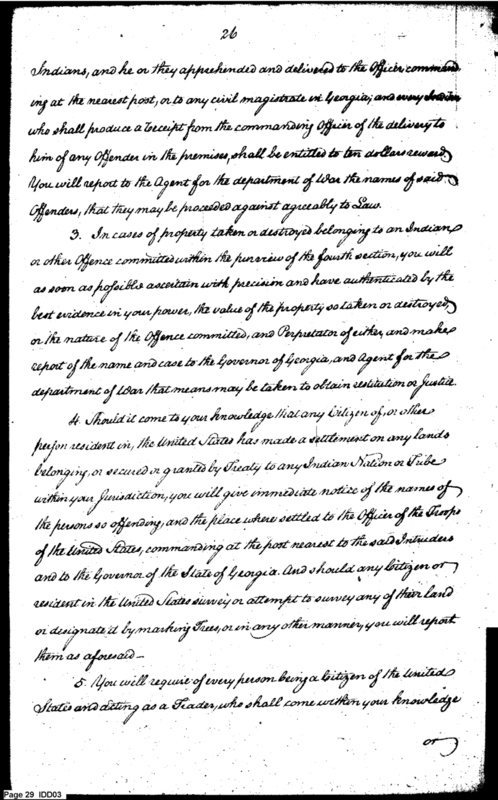
2d. Should any white Citizen or resident in the United States offend against the Second Section, his or their property may be drove off by the
Indians, and he or they apprehended and delivered to the Officer commanding at the nearest post, or to any civil magistrate in Georgia; and every Indian who shall produce a receipt from the commanding Officer of the delivery to him of any Offender in the premises, shall be entitled to ten dollars reward. You will report to the Agent for the department of War the names of said Offenders, that they may be proceeded against agreeably to Law.
3. In cases of property taken or destroyed belonging to an Indian or other Offence committed within the purview of the fourth section, you will as soon as possible ascertain with precision and have authenticated by the best evidence in your power, the value of the property so taken or destroyed, or the nature of the Offence committed, and Perpetuator of either, and make report of the name and case to the Governor of Georgia, and Agent for the department of War that means may be taken to obtain restitution or Justice.
4. Should it come to your knowledge that any Citizen of, or other person resident in, the United States has made a settlement on any lands belonging, or secured or granted by Treaty to any Indian Nation or Tribe within your Jurisdiction, you will give immediate notice of the names of the persons so offending, and the place where settled to the Officer of the Troops of the United States, commanding at the post nearest to the said Intruders and to the Governor of the State of Georgia. And should any Citizen or resident in the United States survey or attempt to survey any of their land or designate it by marking Trees, or in any other manner, you will report them as aforesaid.—
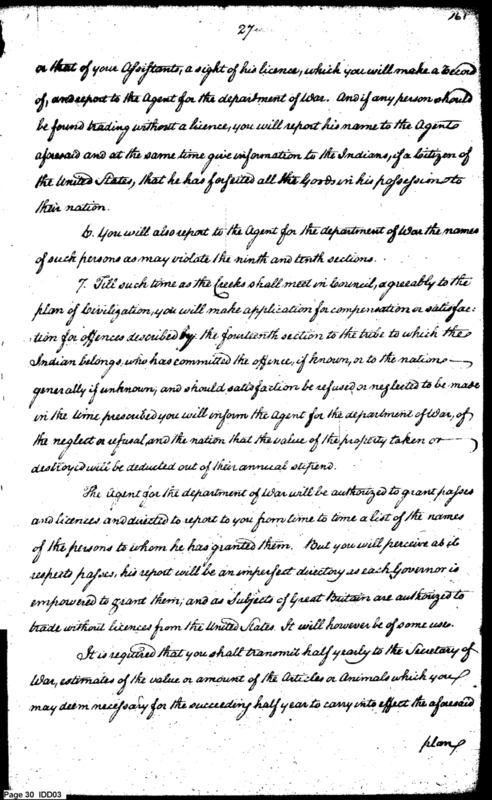
5. You will require of every person being a Citizen of the United States and acting as a Trader, who shall come within your knowledge
or that of your Assistants, a sight of his licence, which you will make a record of, and report to the Agent for the department of War. And if any person should be found trading without a licence, you will report his name to the Agent aforesaid and at the same time give information to the Indians, of a Citizen of the United States, that he has forfeited all the Goods in his possession to their nation.
6. You will also report to the Agent for the department of War the names of such persons as may violate the ninth and tenth sections.
7. Till such time as the Creeks shall meet in Council, agreeably to the plan of Civilization, you will make application for compensation or satisfaction for offences described by the fourteenth section to the tribe to which the Indian belongs, who has committed the offence, if known, or to the nation generally if unknown; and should satisfaction be refused or neglected to be made in the time prescribed you will inform the Agent for the department of War, of the neglect or refusal, and the nation that the value of the property taken or destroyed will be deducted out of their annual stipend.
The Agent for the department of War will be authorized to grant passes and licences and directed to report to you from time to time a list of the names of the persons to whom he has granted them. But you will perceive as it respects passes, his report will be an imperfect directory as each Governor is empowered to grant them; and as Subjects of Great Britain are authorized to trade without licences from the United States. It will however be of some use.
It is required that you shall transmit half yearly to the Secretary of War, estimates of the value or amount of the Articles or Animals which you may deem necessary for the succeeding half year to carry into effect the aforesaid
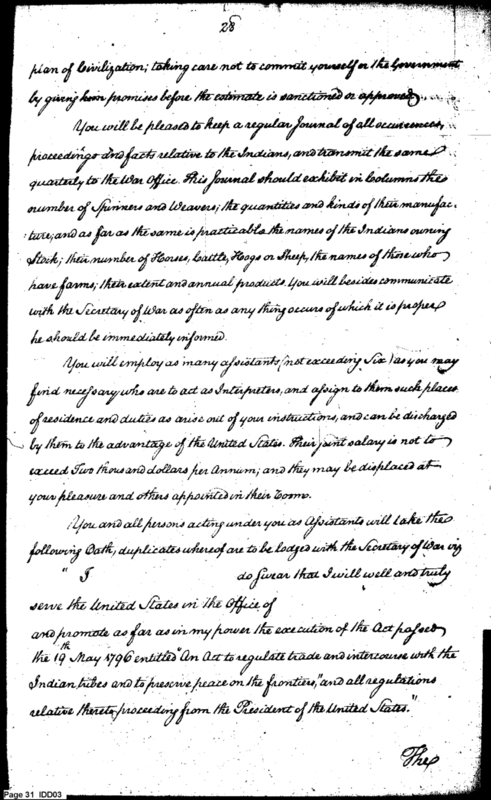
plan of Civilization; taking care not to commit yourself or the Government by giving them promises before the estimate is sanctioned or approved.
You will be pleased to keep a regular Journal of all occurrences, proceedings and facts relative to the Indians, and transmit the same quarterly to the War Office. This Journal should exhibit in Columns the number of Spinners and Weavers; the quantities and kinds of their manufactures; and as far as the same is practicable the names of the Indians owning Stock; their number of Horses, Cattle, Hogs or Sheep, the names of those who have farms; their extent and annual produce. You will besides communicate with the Secretary of War as often as any thing occurs of which it is proper he should be immediately informed.
You will employ as many Assistants, not exceeding Six, as you may find necessary who are to act as Interpreters, and assign to them such places of residence and duties as arise out of your instructions, and can be discharged by them to the advantage of the United States. Their joint salary is not to exceed Two thousand dollars per Annum; and they may be displaced at your pleasure and others appointed in their rooms.
You and all persons acting under you as Assistants will take the following Oath, duplicates whereof are to be lodged with the Secretary of War viz.
"I do Swear that I will well and truly serve the United States in the Office of
and promote as far as in my power the execution of the Act passed the 19 May 1796 entitled 'An Act to regulate trade and intercourse with the Indian tribes and to preserve peace on the frontiers,' and all regulations relative thereto proceeding from the President of the United States."
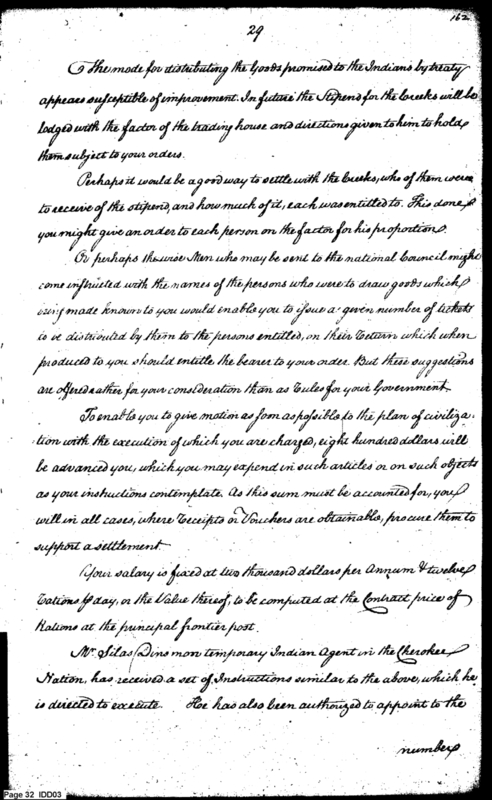
The mode for distributing the Goods promised to the Indians by Treaty appears susceptible of improvement. In future the Stipend for the Creeks will be lodged with the factor of the trading house and directions given to him to hold them subject to your orders.
Perhaps it would be a good way to settle with the Creeks, who of them were to receive of the stipend, and how much of it, each, was entitled to. This done, you might give an order to each person on the factor for his proportion.
Or perhaps the wise Men who may be sent to the national Council might come intrusted with the names of the persons who were to draw goods, which being made known to you would enable you to issue a given number of tickets to be distributed by them to the persons entitled, on their return which when produced to you should entitle the bearer to your order. But these suggestions are offered as hints for your consideration than as Rules for your Government.
To enable you to give motion as soon as possible to the plan of civilization with the execution of which you are charged, eight hundred dollars will be advanced you, which you may expend in such articles or on such objects as your instructions contemplate. As this sum must be accounted for, you will in all cases, where Receipts or Vouchers are obtainable, procure them to support a settlement.
Your salary is fixed at two thousand dollars per Annum & twelve Rations ℔ day, or the Value thereof, to be computed at the Contract price of Rations at the principal frontier post.
Mr. Silas Dinsmon temporary Indian Agent in the Cherokee Nation, has received a set of Instructions similar to the above, which he is directed to execute. He has also been authorized to appoint to the
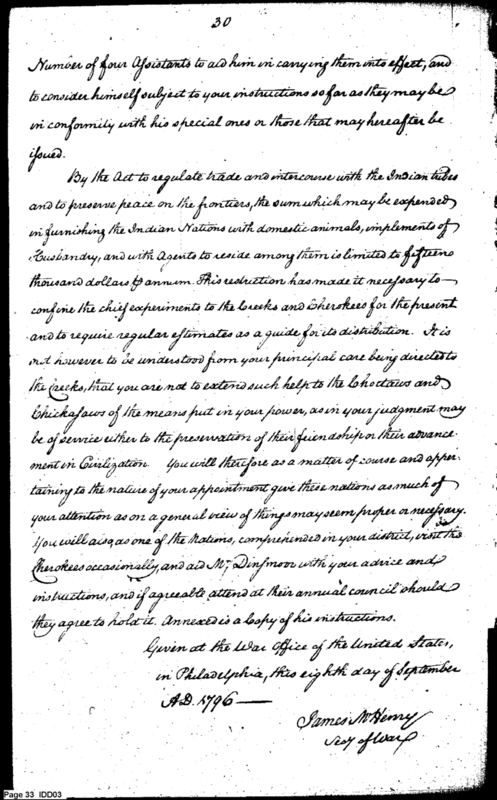
Number of four Assistants to aid him in carrying them into effect; and to consider himself subject to your instructions so far as they may be in conformity with his special ones or those that may hereafter be issued.
By the Act to regulate trade and intercourse with the Indian tribes and to preserve peace on the frontiers, the sum which may be expended in furnishing the Indian Nations with domestic animals, implements of Husbandry, and with Agents to reside among them is limited to fifteen thousand dollars per annum. This restriction has made it necessary to confine the chief experiments to the Creeks and Cherokees for the present and to require regular estimates as a guide for its distribution. It is not however to be understood from your principal care being directed to the Creeks, that you are not to extend such help to the Choctaws and Chickasaws of the means put in your power, as in your judgment may be of service either to the preservation of their friendships or their advancement in Civilization. You will therefore as a matter of course and appertaining to the nature of your appointment give these nations as much of your attention as on a general view of things may seem proper or necessary. You will also, as one of the Nations, comprehended in your district, visit the Cherokees occasionally and aid Mr. Dinsmon with your advice and instructions, and if agreeable attend at their annual council should they agree to hold it. Annexed is a Copy of his Instructions.
Given at the War Office of the United States,
in Philadelphia, this eighth day of September
A.D. 1796.—
James McHenry
Sy of War
Type
Letterbook Copy
Description
Official commission and instructions for Benjamin Hawkins, as Principal Temporary Agent for Indian Affairs, within the Indian Nations South of the Ohio, and North of the Territorial Line. Includes instructions for managing trade, seeing to the sale of land between Indians & the states (principally Georgia), overseeing boundaries, etc.
Date
09/08/1796
Author
Recipient
Sent from
War Office
Repository
Collection
Document number
1796090800002
Page start
20
Notable persons
Benjamin Hawkins
James McHenry
President
Creek Nation
Commissioners of the United States
Colonel Gaither
troops
white traders
Harrison
murderers
King of Spain
General Andrew Pickens
State of Georgia
national Council
subjects of Great Britain
Governors
Silas Dinsmoor
Choctaw
Chickasaw
Notable locations
War Office
Colerain
trading posts
Georgia
Currakee Mountain
Oconee
Ookulgie
St. Mary's
Philadelphia
Notable items
instructions
appointment
trading houses
plan of trade
boundary between Spain and the United States
crime
murder
land
skins
stock
agriculture
manufacture of coarse woolen, cotton, and linen
weaving
language
act
theft
journal
oath
stipend
salary