

Outlines Plan for Civilizing Cherokees
Document 1796Requests report of Cherokee Nation. Laments lack of success in civilizing the Indians. Suggests weaning Indians from hunting and trapping. Refers to the President's plan. Suggests that women are more docile than men. Lists plans to work with farming, animals, supplies, property, dealings with U.S. citizens, etc. Requests regular reports. Outlines salary.





No human transcription currently available for this document.
This transcription was generated by machine using Anthropic's Claude Code (model sonnet 4.6). It may contain errors or inaccuracies. Please verify against the document image. Learn more about our generative AI methodology.
[undecipherable]
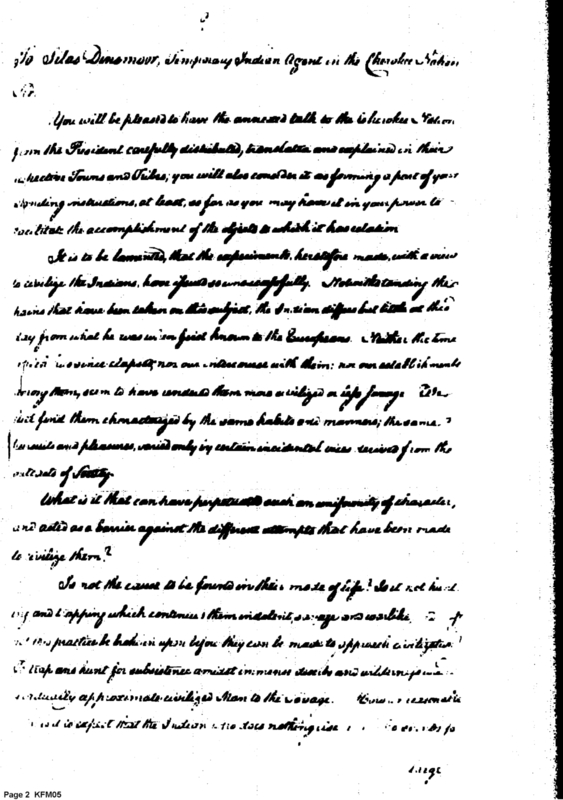
To Silas Dinsmore, Temporary Indian Agent in the Cherokee Nation
Sir,
You will be pleased to have the annexed talk to the Cherokee Nation from the President carefully distributed, translated and explained in their respective Towns and Tribes; you will also consider it as forming a part of your standing instructions, at least, so far as you may find it in your power to facilitate the accomplishment of the objects to which it has relation.
It is to be lamented, that the experiments, heretofore made, with a view to civilize the Indians, have proved so unsuccessfully. Notwithstanding the means that have been taken on this subject, the Indian differs but little at this day from what he was in one point known to the Europeans. Neither the time spent in service elapsed, nor our intercourse with them; nor our establishments among them, seem to have conducted them more a civilized a life [savages?]. This still finds them characterized by the same habits and manners; the same pursuits and pleasures, varied only by certain incidental vices received from the intercourse of Society.
What is it that can have perpetuated such an uniformity of character, and acted as a barrier against the different attempts that have been made to civilize them?
Is not the cause to be found in their mode of life? Is it not hunting and trapping which continues them in that violent, savage and warlike [undecipherable]. If this practice be broken upon before they can be made to approach civilization [undecipherable]. They can hunt for subsistence amidst immense woods and wilderness [undecipherable] approximately civilized Man to the savage. There is reason [undecipherable] and to expect that the Indian who does nothing else [undecipherable] to do so
large a portion of his time in such avocations should yet in civilize.
I can entertain no such expectation.
To civilize him he must be weaned from hunting and trapping, by having set before his eyes other pursuits by which he may obtain a life's provisions and more comfortable a subsistence; and by rendering hunting and trapping by indirect means disreputable as a mode of livelihood.
The Indian will have advanced one step towards this point, when he shall discover, that he has it in his power to provide better for his wants by raising cattle and grain than by hunting and trapping. He will then also be stimulated by every motive to avail himself of the discovery when he shall find that he can get more money or gratifications for his [undecipherable] with grain or Tobacco, than he can for his Skins or furs.
To aid his associations on this subject, it would seem expedient what he raised in the one way should meet a ready market and as much encouragement as possible; and what he got in the other to be at least repeatedly discouraged. This in proportion as the Indian now perceives and experiences this distinction a progress between Skins and Cattle or grain, he will gradually and involuntarily desert hunting and trapping or practice it only as an occasional amusement.
I have made these observations with a view to illustrate the basis upon which the talk of the President is founded, and to direct your attention and efforts to the execution of the civilizing system which it contemplates. After the talk has been sufficiently explained to the Indians, you will commence carrying of it, and your first to elicit its disposition to join its objects.
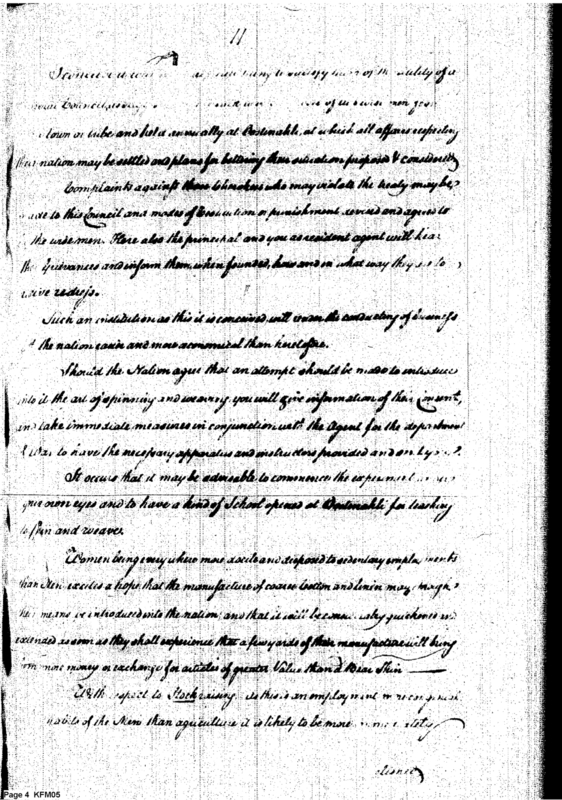
[undecipherable] ready among to multiply in the middle of a [undecipherable] town or tribe and hold annually at [undecipherable], at which all affairs respecting that nation may be settled and plans for bettering their situation projected & considered. Complaints against those Cherokees who may violate the treaty may be sent to this Council and modes of [taxation?] or punishment concerted and agreed to the use men. These also the principal ones you as assistant agent will keep [undecipherable]. [Justices?] and inform them where found, how and in what way they are to be made redress.
Such an institution as this is conceived will ensure the [undecipherable] of [undecipherable] of the nation and more economical than heretofore.
Should the Nation agree that an attempt should be made to introduce into the art of spinning and weaving, you will give information of this [concern?] and take immediate measures in conjunction with the Agent for the department (this: to have the necessary apparatus and instructions provided and [set?] by [the?] [undecipherable].
On account that it may be advisable to commence the experiment [undecipherable] you are to have a kind of school opened at [undecipherable] for teaching spinning and weaving.
Women being everywhere more excited and disposed to sedentary employment than men, receive in hope that the manufacture of coarse linen and linen may, though the means be introduced into the nation, and that it will become, why quickness and received as soon as they shall experience that a few yards of their manufactures will bring them more money in exchange for articles of greater value than it does their Skins.
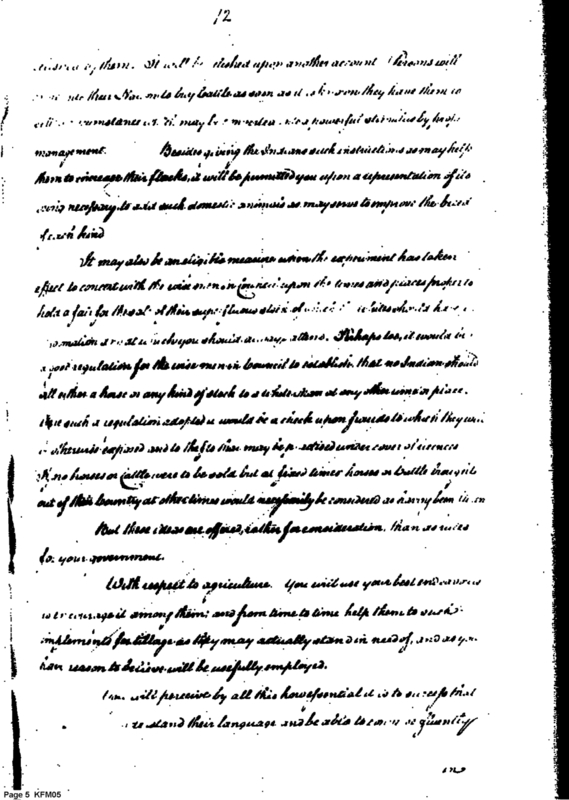
With respect to Stock raising, as this is an employment or occupation more of the Men than agriculture it is likely to be more [undecipherable] [easily?]
induced of them. It will be relied upon on another account: the men will [then] use their [undecipherable] to buy textiles as soon as it is [shown?] they have them to sell. [Circumstances] [it?] may be [needed?] into a powerful alternative by good management. Besides giving the Indians such instructions as may help them to manage their flocks, it will be permitted you upon a representation of its being necessary, to assist such domestic animals as may serve to improve the breed of such kind.
It may also be an eligible measure when the experiment has taken effect to consult with the wise men or [from] Council upon the towns and pieces proper to hold a fair for that Nation. [Representatives?] of which [undecipherable] is elsewhere to have [a position?] at which you should [always?] attend. Perhaps too, it would be a good regulation for the wise men in Council to establish, that no Indian should sell either a horse or any kind of stock to a white man or any other man in place. If such a regulation adopted it would be a check upon frauds to which they are otherwise exposed, and thefts then may be practiced under cover of licences. If no horses or cattle were to be sold but at fixed times, horses or cattle brought out of this country at other times would necessarily be considered as having been stolen.
But these ideas are offered rather for consideration, than as notes to your government.
With respect to agriculture, you will use your best endeavours to encourage it among them; and from time to time help them to such implements for tillage as they may actually stand in need of, and as you have reason to believe will be usefully employed.
You will perceive by all this how essential it is to our plan that you understand their language and be able to converse so fluently
that the [manner?] express it plainly yourself diligently to acquire it, as without it your power of being useful will be greatly abridged.
I enclose you an act passed at the last session of Congress entitled 'An Act to regulate trade and intercourse with the Indian tribes, and to preserve peace on the frontiers' which you will be pleased to have explained to the Cherokees that they may have a clear idea of its provisions.
To aid in the execution of this act you will be guided by the following instructions.
1. You will require from every person who comes into the Cherokee country whether resident or whom you have knowledge to exhibit his pass, and you will keep a book in which you will record their names and by whom their pass is signed. If the person has no pass or refuses to produce it, you will forthwith report his or her names to the Governor of the State of Tennessee, and the Agent for the department of War and notify to the Indians that such person having violated the Law may be expelled by them from their Nation; but that in pursuing him out they must do him no injury or violence.
2. Should any white citizen or a resident in the United States offend against the second sections of the aforesaid act, his or their property may be [undecipherable] off, and he or they apprehended by the Indians and delivered to the [Agent commanding at Tellico?] or to any Magistrate in the [area?], for no injury must be offered to their persons. The name of every offender is also to be reported to the Agent for the department of war; and for every person delivered and for which the Indians shall produce you a receipt from the commanding Officer or a Magistrate as aforesaid, you may pay five dollars.
3. In case of property taken or destroyed belonging to an Indian or
other offence committed within the provisions of the fourth section aforesaid, you will as soon as possible ascertain with precision and have authenticated by the best evidence in your power, the value of the property taken or destroyed, and the nature of the offence committed and make report of the case to the Governor of the State of Tennessee and the Agent for the department of War, that means may be taken to obtain satisfaction.
4. Should it come to your knowledge that any citizen or other person resident in the United States has made a settlement on any land belonging or secured or granted by treaty to the Cherokees, you will give immediate notice of the name of the person so offending and the place where he has settled to the Office of the Troops of the United States commanding at the post nearest to the said Intruder, and the Governor of the State of Tennessee. And should any citizen or resident of the United States survey or attempt to survey any of their land or designate it by making trees or otherwise, you will report them in like manner and as aforesaid.
5. If you will require of every person acting as a Trader among the Cherokees and who comes within your knowledge as that of your Assistants, a sight of his licence, which you will make a record of and report to the Agent for the department of War. And if any person is found without a licence you will report his name also and at the same time give information to the Indians that he has forfeited all the goods in his possession to the nation. You will in like manner inform the Agent of the names of such persons as may violate the ninth and tenth sections of the law aforesaid.
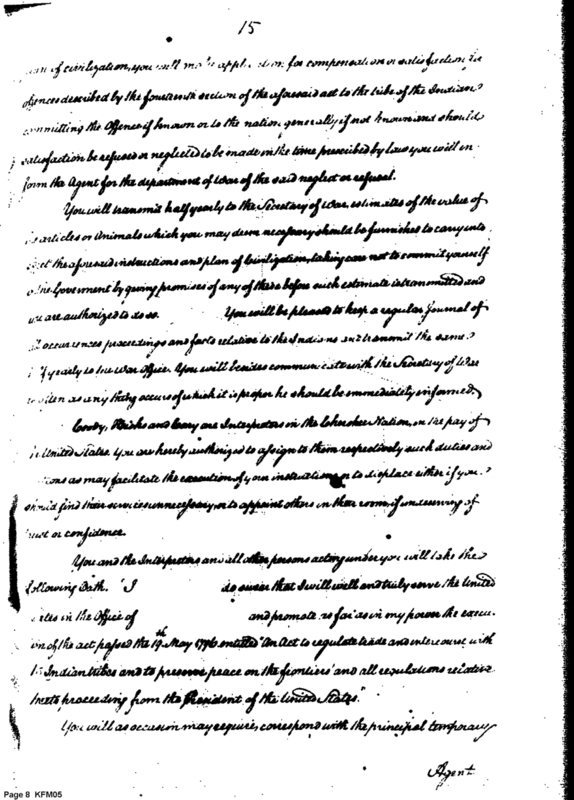
6. Till such time as the Cherokees shall meet in Council agreeably to the
aim of civilization, you will make application for compensation or satisfaction for offences described by the fourteenth section of the aforesaid act to the tribe of the Cherokee committing the offence, if known, or to the nation generally, if not known; and should satisfaction be refused or neglected to be made in the time prescribed by law, you will inform the Agent for the department of War of the said neglect or refusal.
You will transmit half yearly to the Secretary of War estimates of the value of articles or animals which you may deem necessary should be furnished to carry into effect the aforesaid instructions and plan of civilization, taking care not to commit yourself to His Government by giving promises of any of these before such estimate is transmitted and we are authorized to do so. You will be pleased to keep a regular journal of occurrences and proceedings and facts relative to the Indians and transmit the same [half?] yearly to the War office. You will besides communicate with the Secretary of War as often as any thing occurs of which it is proper he should be immediately informed.
Lowry, Hicks and Lewis are Interpreters in the Cherokee Nation, on the pay of the United States. You are hereby authorized to assign to them respectively such duties and ones as may facilitate the execution of your instructions, or to displace them if you should find them [unnecessary?] or to appoint others in their room of [undecipherable] trust or confidence.
You and the Interpreters and all other persons acting under you will take the following Oath. 'I do swear that I will well and truly serve the United States in the Office of and promote so far as in my power the execution of the act, passed the 19th May 1796 entitled "An Act to regulate trade and intercourse with the Indian tribes and to preserve peace on the frontiers and all regulations relative thereto proceeding from the President of the United States."'
You will as occasion may require, correspond with the principal temporary
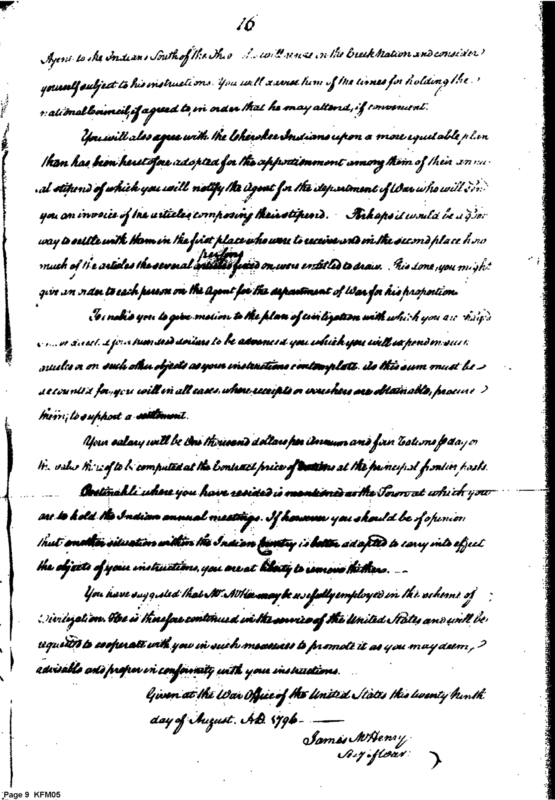
Agent to the Indians South of the [Ohio?] [undecipherable] in the Creek Nation and consider yourself subject to his instructions. You will acquaint him of the times for holding the rational Council if agreed to in order that he may attend, if convenient.
You will also agree with the Cherokee Indians upon a more equitable plan than has been heretofore adopted for the apportionment among them of their annual stipend, of which you will notify the Agent for the department of War who will [issue?] you an invoice of the articles composing the stipend. Perhaps it would be a fair way to settle with them in the first place how were to receive and in the second place how much of the articles the several [individuals?] [undecipherable] on were entitled to draw. This done, you might give an order to each person on the Agent for the department of War for his proportion.
To enable you to give motion to the plan of civilization with which you are [charged?] [undecipherable] your own desires to be advanced at you which you will expend in such articles or on such other objects as your instructions contemplate. As this sum must be accountable for, you will in all cases where receipts or vouchers are obtainable, procure them to support a settlement.
Your salary will be one thousand dollars per annum and [Rations?] at the rate of [undecipherable] which is to be computed at the Contract price of [Rations?] at the principal frontier posts. [Oostanaula?] is where you have resided is mentioned as the Town at which you are to hold the Indian annual meetings. If however you should be of opinion that another situation within the Indian Country is better adapted to carry into effect the objects of your instructions, you are at liberty to remove thither.
You have suggested that Mr. [McMinn?] may be usefully employed in the scheme of civilization. He is therefore continued in the service of the United States and will be requested to cooperate with you in such measures to promote it as you may deem advisable and proper in conformity with your instructions.
Given at the War Office of the United States this twenty ninth day of August A.D. 1796.
James McHenry
Sec'y of War
Type
Autograph Letter Signed
Description
Requests report of Cherokee Nation. Laments lack of success in civilizing the Indians. Suggests weaning Indians from hunting and trapping. Refers to the President's plan. Suggests that women are more docile than men. Lists plans to work with farming, animals, supplies, property, dealings with U.S. citizens, etc. Requests regular reports. Outlines salary.
Date
08/29/1796
Author
Recipient
Sent from
War Office
Repository
Collection
Document number
1796082900001
Page start
1
Notable persons
Silas Dinsmoor
James McHenry
Indians
Europeans
President
George Washington
Cherokees
Tennessee Governor
Secretary of War
US Citizens
Indian Interpreters
Indian Agent
Notable locations
War Office
Cherokee Nation
Tennessee
Department of War