

Discussion of a Speech to Encourage the Cherokee to Higher Civilization
Document 1796Encloses a draft of a speech to the Cherokeeswhich is designed to encourage their civilization and make its management [by the U.S.?] more economical. Asks Washington's opinion on that document, and opines on the respectability of the proposed emissary to the Cherokee, a Mr. Dinsmore
100%
⇣
No human transcription currently available for this document.
This transcription was generated by machine using Anthropic's Claude Code (model sonnet 4.6). It may contain errors or inaccuracies. Please verify against the document image. Learn more about our generative AI methodology.
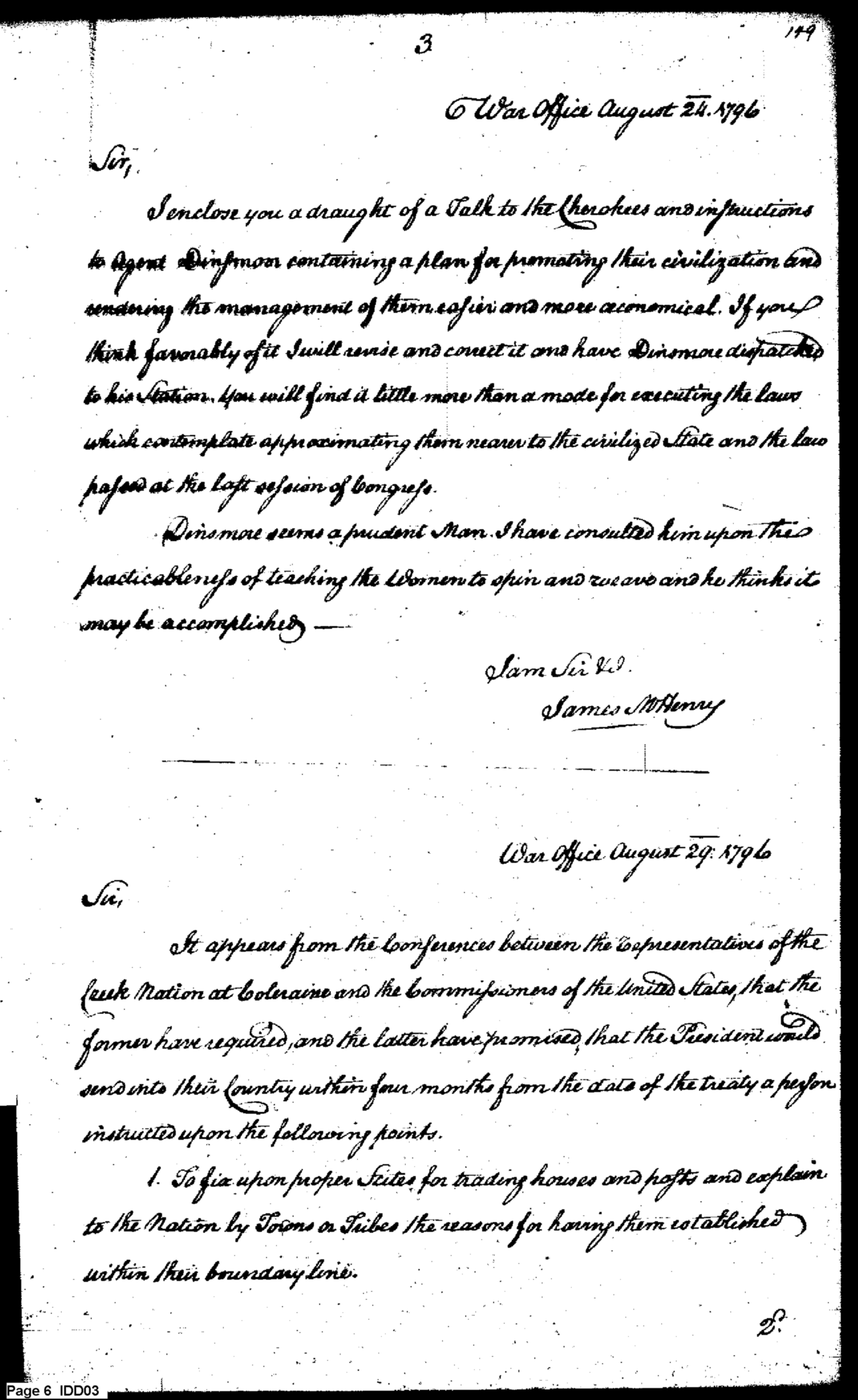
War Office August 2d. 1796
Sir,
I enclose you a draught of a Talk to the Cherokees and instructions to Agent Dinsmore containing a plan for promoting their civilization and rendering the management of them easier and more œconomical. If you think favorably of it I will revise and correct it and have Dinsmore dispatched to his Station. You will find it little more than a mode for executing the laws which contemplate approximating them nearer to the civilized State and the law passed at the last session of Congress.
Dinsmore seems a prudent Man. I have consulted him upon the practicableness of teaching the Women to spin and weave and he thinks it may be accomplished. —
Sam Sir &c.
James McHenry
War Office August 29. 1796
Sir,
It appears from the Conferences between the Representatives of the Creek Nation at Coleraine and the Commissioners of the United States, that the former have required, and the latter have promised, that the President would send into their Country within four months from the date of the treaty a person instructed upon the following points.
1. To fix upon proper Sites for trading houses and posts and explain to the Nation by Towns or Tribes the reasons for having them established within their boundary line.
2. To explain the plan of Trade to the different Towns or Tribes.
3. To confer with and advise the Nation how it ought to conduct itself, in case the Murders of the Indians by Harrison and others should escape without being punished.
4. To explain the object for running the boundary line between Spain and the United States.
5. To notify the Nation of the time when the President will be pleased to run the boundary line between the Creeks and the United States, and the place where the running is to commence, in order that persons may be appointed to attend on the part of the Nation.
As these explanations have been promised and have been deemed necessary by the Indians who convened at Coleraine and the Commissioners, it might not be proper to with hold them upon a mere point of economy, especially as there are other objects of importance that may be accomplished by the person whom the President shall be pleased to employ on the occasion.
One of the points I allude to is to ascertain in execution of the intimation given by the President to the State of Georgia, whether the Creek Nation are disposed to sell their land laying between the Oconee and Oakmulgee, and if they are the terms upon which they will part with it.
Another point is to ascertain whether the state of things in the Creek Nation be favourable to the introduction of a system of civilization and plan for managing them such as has been adopted for trial on the Cherokees.
It strikes me that several circumstances conspire which would render such an experiment more likely to succeed now than at any former period —
The Creeks are strongly impressed with the opinion that the United States mean to conduct towards them with candour and justice; to protect all their rights; to perform the promises which have been made them; and besides are become sensible that the Arm of the United States is too powerful to be resisted.
Whatever therefore may be proposed by the President (so long as they find themselves and their land protected by the United States) will, it is probable, be well received by them, and submitted to or adopted, if not too repugnant to their habits or established prejudices.
This idea cherishes the hope, that something effectual may be done towards their civilization. That what has been long contemplated is not far distant; that the feed which has been sown is not all destroyed; and that the time is arrived to benefit the poor Indian by the same means which will preserve them in a State of peace and attract to the United States the most honourable of fame.
The States which are anxious to get the Indian land will see large portions of it by the operation of these causes become useless to them, and consequently placed in a situation to be easily obtained. Besides, if they can be brought to support themselves on a smaller circumference of land, they will have fewer points from which to attack the frontier inhabitants and will be more in the power of the United States than when spread over an immense tract of Country.
To render the system from which these effects are expected operative, requires no more than a certain degree of patience on the part of the States which covet their land, and a due application of the means which the laws have places within the reach of the Executive.
If you should approve of sending a person into their Country to execute any or all of these purposes, I shall turn my attention to frame the proper instructions and lay them before you as soon as possible for consideration a
Type
Letter Signed
Description
Encloses a draft of a speech to the Cherokeeswhich is designed to encourage their civilization and make its management [by the U.S.?] more economical. Asks Washington's opinion on that document, and opines on the respectability of the proposed emissary to the Cherokee, a Mr. Dinsmore
Date
08/24/1796
Author
Recipient
Sent from
War Office
Repository
Collection
Document number
1796082400002
Page start
6
Note
Recipient cannot be confirmed from image.
Notable persons
George Washington
James McHenry
Cherokee
Indians
Dinsmoor
Dinsmore
agent
Cherokee women
Notable locations
War Office
Notable items
talk
management
laws
session of Congress
teaching
spin
weave