No human transcription currently available for this document.
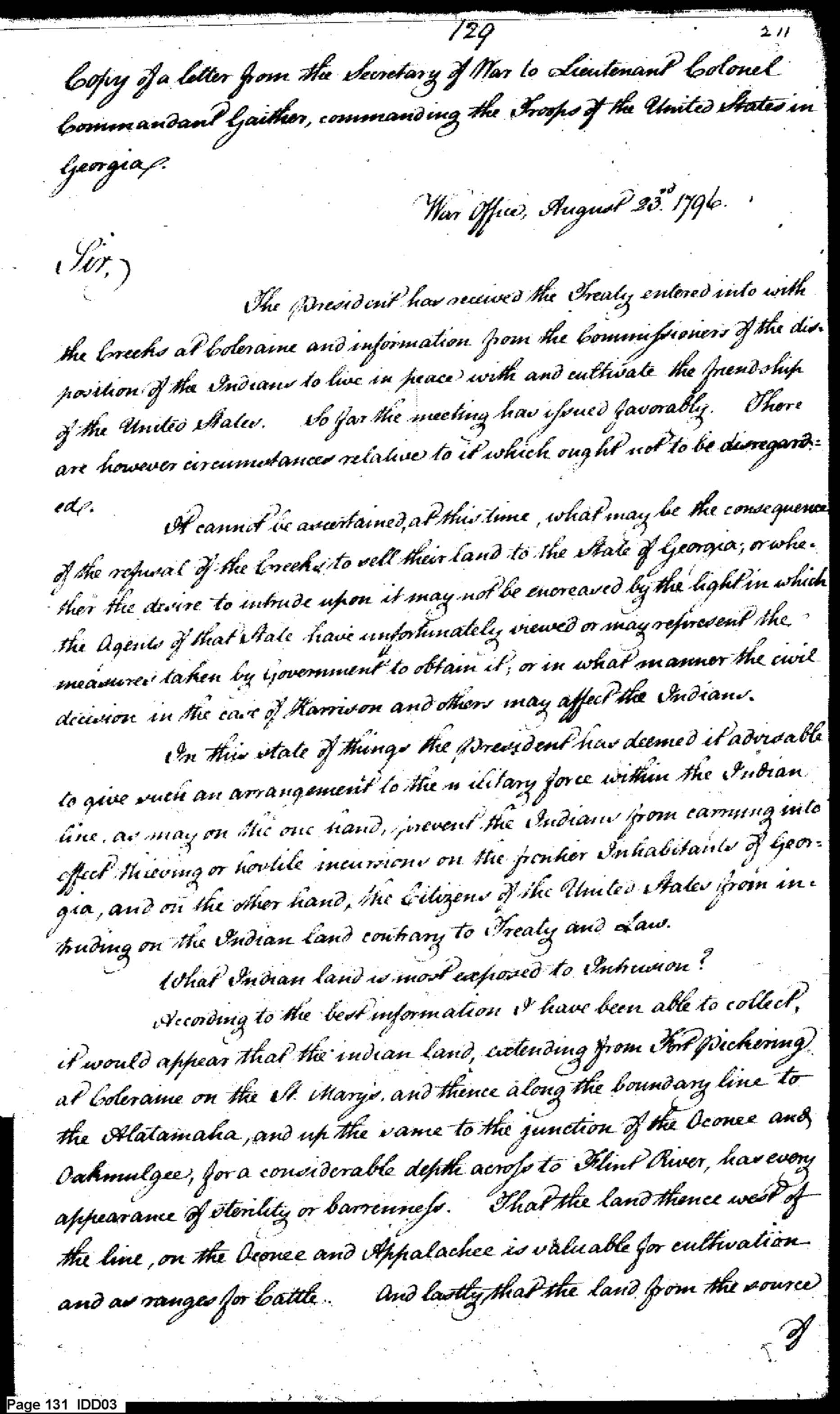
[Copy of a letter from the Secretary of War to Lieutenant Colonel Commandant Gaither, commanding the Troops of the United States in Georgia.]
War Office, August 25th 1796.
Sir,
The President has received the Treaty entered into with the Creeks at Coleraine and information from the Commissioners of the disposition of the Indians to live in peace with and cultivate the friendship of the United States. So far the meeting has issued favorably. There are however circumstances relative to it which ought not to be disregarded.
It cannot be ascertained, at this time, what may be the consequence of the refusal of the Creeks to sell their land to the State of Georgia; or whether the desire to intrude upon it may not be encreased by the light in which the Agents of that State have unfortunately viewed or may represent the measures taken by government to obtain it, or in what manner the civil decision in the case of Harrison and others may affect the Indians.
In this state of things the President has deemed it adviseable to give such an arrangement to the military force within the Indian line, as may on the one hand, prevent the Indians from coming into open, thieving or hostile incursions on the frontier Inhabitants of Georgia, and on the other hand, the Citizens of the United States from intruding on the Indian land contrary to Treaty and Law.
What Indian land is most exposed to Intrusion?
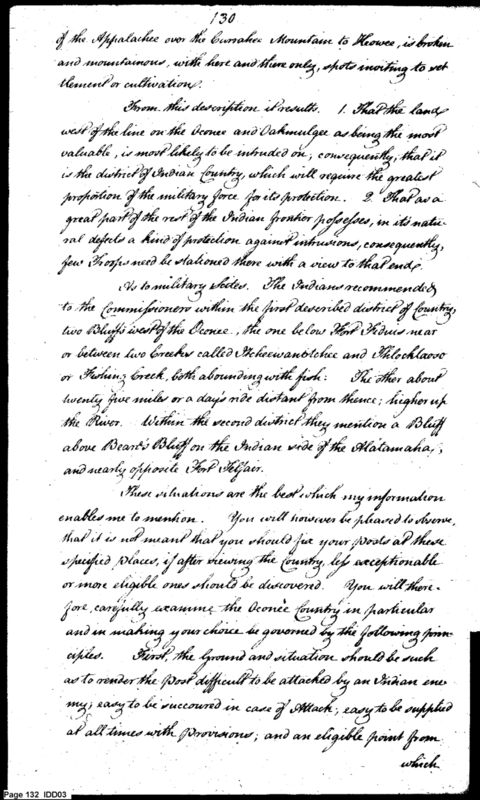
According to the best information I have been able to collect, it would appear that the Indian land, extending from Fort Pickering at Coleraine on the St. Marys, and thence along the boundary line to the Alatamaha, and up the same to the junction of the Oconee and Oahmulgee, for a considerable depth across to Flint River, has every appearance of fertility or barrenness. That the land thence west of the line, on the Oconee and Appalachee is valuable for cultivation and as ranges for Cattle. And lastly that the land from the source
of the Appalachee over the Cherokee Mountain to Hiowee, is broken and mountainous, with here and there only, spots inviting to settlement or cultivation.
From this description it results. 1. That the land west of the line on the Oconee and Oahmulgee as being the most valuable, is most likely to be intruded on, consequently, that it is the district of Indian Country, which will require the greatest proportion of the military force for its protection. 2. That as a great part of the rest of the Indian frontier possesses, in its natural defects a kind of protection against intrusions, consequently, few Troops need be Stationed there with a view to that end.
As to military sites. The Indians recommended, to the Commissioners within the first described district of Country, two Bluffs west of the Oconee, the one below Fort Fidius, near or between two Creeks called Atchewanatchee and Hitchclarco or Fishing Creek, both abounding with fish. The other about twenty five miles or a days ride distant from thence, higher up the River. Within the second district they mention a Bluff above Beard's Bluff on the Indian side of the Alatamaha, and nearly opposite Fort Alfiier.
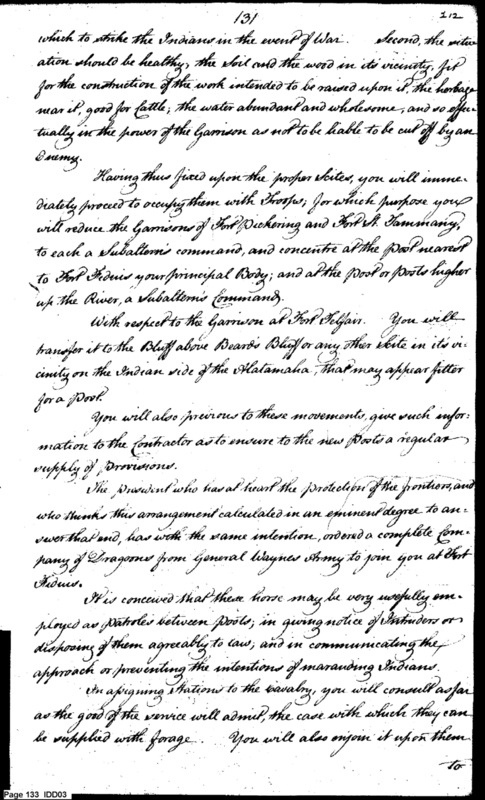
These situations are the best which my information enables me to mention. You will however be pleased to observe, that it is not meant that you should fix your posts at those specified places, if after viewing the Country, less exceptionable or more eligible ones should be discovered. You will therefore, carefully examine the Oconee Country in particular and in making your choice be governed by the following principles. First, the ground and situation should be such as to render the post difficult to be attacked by an Indian enemy; easy to be succoured in case of Attack; easy to be supplied at all times with provisions; and an eligible point from which
to strike the Indians in the event of War. Second, the situation should be healthy; the soil and the wood in its vicinity, fit for the construction of the work intended to be raised upon it, the herbage manure, good for cattle; the water abundant and wholesome, and so effectually in the power of the Garrison as not to be liable to be cut off by an Enemy.
Having thus fixed upon the proper sites, you will immediately proceed to occupy them with Troops; for which purpose you will reduce the Garrisons of Fort Pickering and Fort St. Tammaniny, to each a Subalterns command, and concentrate at the post nearest to Fort Fidius your principal Body; and at the post or posts higher up the River, a Subalterns command.
With respect to the Garrison at Fort Alfiier. You will transfer it to the Bluff above Beard's Bluff or any other site in its vicinity on the Indian side of the Alatamaha, that may appear fitter for a Post.
You will also previous to these movements, give such information to the Contractor as to ensure to the new Posts a regular supply of Provisions.
The President who has at heart the protection of the frontier, and who thinks this arrangement calculated in an eminent degree to answer that end, has with the same intention, ordered a complete Company of Dragoons from General Waynes Army to join you at Fort Fidius.
It is conceived that these horse may be very usefully employed as patroles between posts; in giving notice of Intruders or disposing of them agreeably to law, and in communicating the approach or preventing the intentions of marauding Indians.
In assigning Stations to the cavalry, you will consult as far as the good of the service will admit, the ease with which they can be supplied with forage. You will also enjoin it upon them
to secure their Quarters and horses every Night in such a manner as to prevent surprize or theft. The President requires the strictest observance of this regulation, and that it be considered a standing Order.
I enclose for your Government an Act passed the last Session of Congress entitled "An act to regulate trade and intercourse with the Indian Tribes and to preserve peace on the Frontiers."
I am Sir
with great respect
your obedt. Servant
signed, James McHenry
[Lieut Colo. Henry Gaither.]