

Discussion of Caulking and Frigate Timbers
Document 1796Describes the method of caulking ships used in the English dock yards, and discusses timber for frigates.

No human transcription currently available for this document.
This transcription was generated by machine using Anthropic's Claude Code (model sonnet 4.6). It may contain errors or inaccuracies. Please verify against the document image. Learn more about our generative AI methodology.
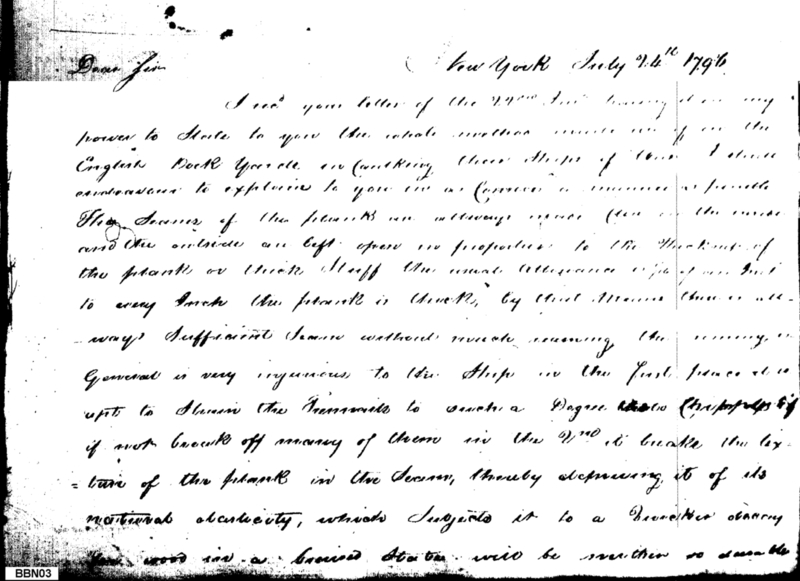
Dear Sir New York July 24th 1796
I rec'd your letter of the 19th Inst. having done my power to State to you the relative motion under water of the English Built Vessels on [undecipherable] their Shape of how I above [undecipherable] to express to you in Concern a manner [undecipherable] the former of the planks an allways upon the [undecipherable] the underwater articles are left, upon in proportion to the thickness of the plank or [undecipherable] Staff. The usual allowance [undecipherable] but to every thick the plank is [undecipherable], by that Means there is allways Sufficient Space without much running the [undecipherable]. General is very injurious to the Ship in the first place it is apt to [undecipherable] the Timbers to such a Degree [undecipherable] if not [break?] off many of them in the W[undecipherable] & besides the [undecipherable] train of the plank in the Seam, thereby depriving it of its [undecipherable] elasticity, which Subjects it to a [undecipherable] [undecipherable] in a bruised State. will be neither so [undecipherable]
[119]
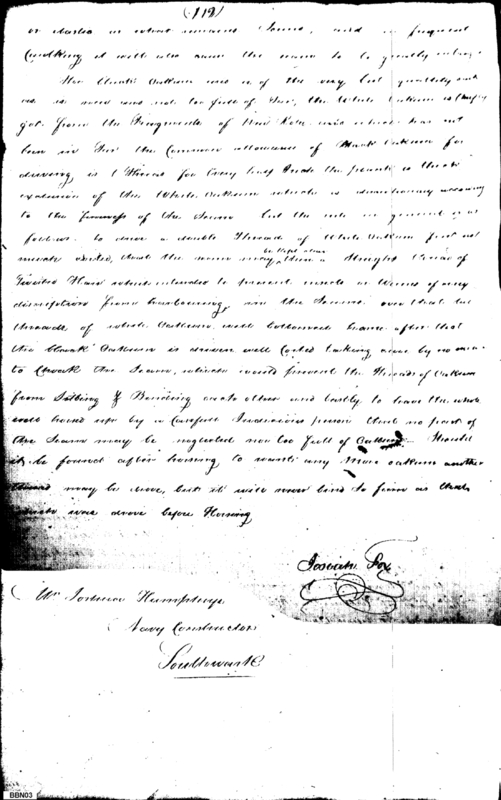
or [undecipherable] as [undecipherable] [undecipherable], and in frequent [undecipherable], it will also cause the [undecipherable] to be [undecipherable] [undecipherable]
The [undecipherable] [undecipherable] of the very best quality and as it need [undecipherable] not be full of [undecipherable], the [undecipherable] [undecipherable] got from the [undecipherable] of New [undecipherable] and [undecipherable] has not been in [undecipherable] The Common allowance of [undecipherable] [undecipherable] for [undecipherable] is [undecipherable] for every long [undecipherable] the plank is [undecipherable] expansion of the [undecipherable] [undecipherable] is [undecipherable] [undecipherable] to the [undecipherable] of the Seams. But the rule in general is as follows: to drive a double Thread of [undecipherable] [undecipherable] first [undecipherable] [undecipherable], about [undecipherable] there in a Straight [undecipherable] of [undecipherable] [undecipherable] intended to prevent [undecipherable] or [undecipherable] of any dissipation from [undecipherable], and the Seams [undecipherable] that but [undecipherable] of [undecipherable] [undecipherable] will [undecipherable] [undecipherable] that the [undecipherable] [undecipherable] is [undecipherable] well [undecipherable] [undecipherable] near by no means to [undecipherable] the Seams, [undecipherable] would prevent the Thread of [undecipherable] from [undecipherable] & [undecipherable] onto other and lastly to leave the inner [undecipherable] round [undecipherable] by a Careful [undecipherable] [undecipherable]. Close no part of the Seam may be neglected nor too full of [undecipherable]. Should it be found after [undecipherable] to [undecipherable] any [undecipherable] [undecipherable] another Thread may be drove, but it will never [undecipherable] so [undecipherable] as those [undecipherable] were drove before [undecipherable]
Josiah Fox
Mr Fortescue Humphreys
Navy Constructor
[undecipherable]
Type
Letterbook Copy
Description
Describes the method of caulking ships used in the English dock yards, and discusses timber for frigates.
Date
07/24/1796
Author
Recipient
Sent from
New York
Repository
Collection
Document number
1796072415101
Page start
1
Notable persons
Joshua Humphreys
Josiah Fox
navy constructor
Notable locations
Southwark
New York
English dock yard
Notable items
caulking
seams of the planks
plank
thick stuff
ship
trunnel
trunnill
natural elasticity
wood
black oakum
white oakum
kneads
thickness of the plank
usual allowance
injurious to his ship
well coiled
threads of oakum