No human transcription currently available for this document.
[Recruiting Instructions for Capt. William Preston.]
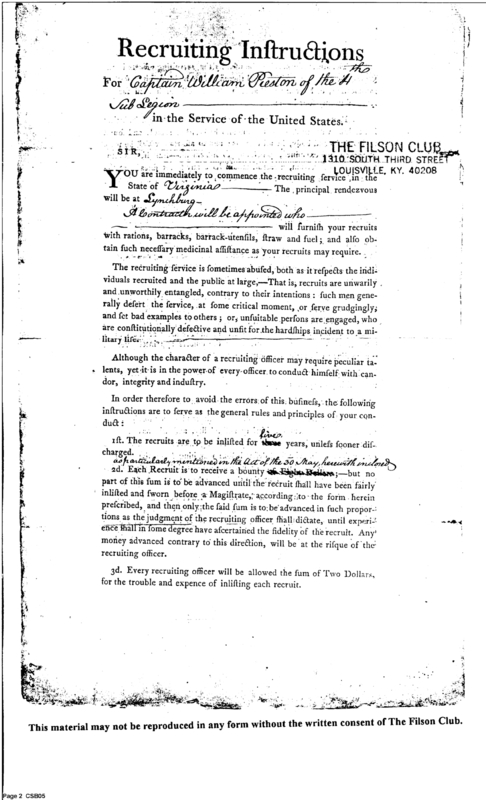
Recruiting Instructions
For Captain William Preston of the 4th
Sub Legion
in the Service of the United States.
SIR,
YOU are immediately to commence the recruiting service in the State of Virginia ————— The principal rendezvous will be at Lynchburg —————
A contractor will be appointed who ————————————————
—————————————————— will furnish your recruits with rations, barracks, barrack-utensils, straw and fuel; and also obtain such necessary medicinal assistance as your recruits may require.
The recruiting service is sometimes abused, both as it respects the individuals recruited and the public at large,—That is, recruits are unwarily and unworthily entangled, contrary to their intentions: such men generally desert the service, at some critical moment, or serve grudgingly; and set bad examples to others; or, unsuitable persons are engaged, who are constitutionally defective and unfit for the hardships incident to a military life.
Although the character of a recruiting officer may require peculiar talents, yet it is in the power of every officer to conduct himself with candor, integrity and industry.
In order therefore to avoid the errors of this business, the following instructions are to serve as the general rules and principles of your conduct:
1st. The recruits are to be inlisted for [strikethrough: three] lives years, unless sooner discharged.
as particularly mentioned in the Act of the 30 May herewith inclosed
2d. Each Recruit is to receive a bounty [strikethrough: of Eight Dollars];—but no part of this sum is to be advanced until the recruit shall have been fairly inlisted and sworn before a Magistrate, according to the form herein prescribed, and then only the said sum is to be advanced in such proportions as the judgment of the recruiting officer shall dictate, until experience shall in some degree have ascertained the fidelity of the recruit. Any money advanced contrary to this direction, will be at the risque of the recruiting officer.
3d. Every recruiting officer will be allowed the sum of Two Dollars, for the trouble and expence of inlisting each recruit.
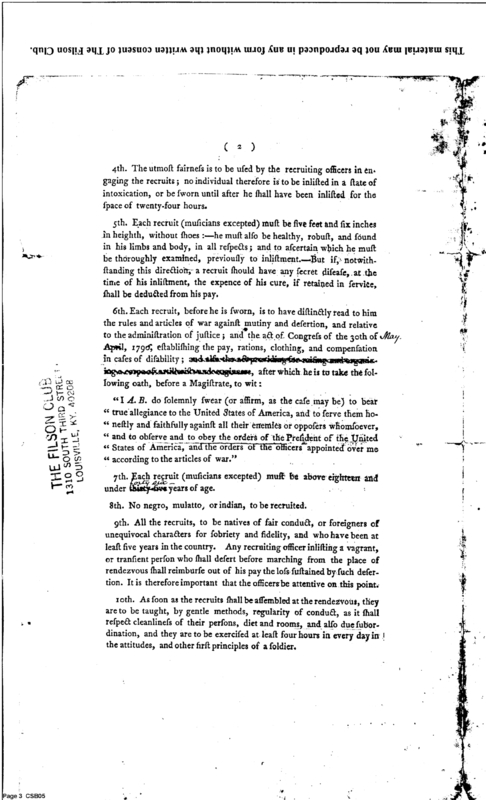
( 2 )
4th. The utmost fairness is to be used by the recruiting officers in engaging the recruits; no individual therefore is to be inlisted in a state of intoxication, or be sworn until after he shall have been inlisted for the space of twenty-four hours.
5th. Each recruit (musicians excepted) must be five feet and six inches in heighth, without shoes:—he must also be healthy, robust, and found in his limbs and body, in all respects; and to ascertain which he must be thoroughly examined, previously to inlistment.—But if, notwithstanding this direction, a recruit should have any secret disease, at the time of his inlistment, the expence of his cure, if retained in service, shall be deducted from his pay.
6th. Each recruit, before he is sworn, is to have distinctly read to him the rules and articles of war against mutiny and desertion, and relative to the administration of justice; and the act of Congress of the 30th of [strikethrough: May] April, 1796, establishing the pay, rations, clothing, and compensation in cases of disability; and also the act providing for raising and organiz- [strikethrough: ing corps of artificers and docompanies,] after which he is to take the following oath, before a Magistrate, to wit:
"I A. B. do solemnly swear (or affirm, as the case may be) to bear
" true allegiance to the United States of America, and to serve them ho-
" nestly and faithfully against all their enemies or opposers whomsoever,
" and to observe and to obey the orders of the President of the United
" States of America, and the orders of the officers appointed over me
" according to the articles of war."
7th. Each recruit (musicians excepted) must be above eighteen and under [strikethrough: thirty-five] forty five years of age.
8th. No negro, mulatto, or indian, to be recruited.
9th. All the recruits, to be natives of fair conduct, or foreigners of unequivocal characters for sobriety and fidelity, and who have been at least five years in the country. Any recruiting officer inlisting a vagrant, or transient person who shall desert before marching from the place of rendezvous shall reimburse out of his pay the loss sustained by such desertion. It is therefore important that the officers be attentive on this point.
10th. As soon as the recruits shall be assembled at the rendezvous, they are to be taught, by gentle methods, regularity of conduct, as it shall respect cleanliness of their persons, diet and rooms, and also due subordination, and they are to be exercised at least four hours in every day in the attitudes, and other first principles of a soldier.
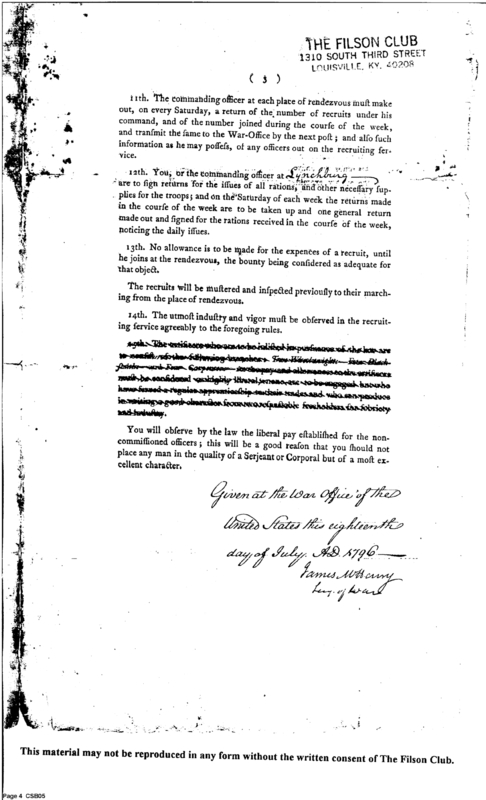
( 3 )
11th. The commanding officer at each place of rendezvous must make out, on every Saturday, a return of the number of recruits under his command, and of the number joined during the course of the week, and transmit the same to the War-Office by the next post; and also such information as he may possess, of any officers out on the recruiting service.
12th. You, or the commanding officer at Lynchburg are to sign returns for the issues of all rations, and other necessary supplies for the troops; and on the Saturday of each week the returns made in the course of the week are to be taken up and one general return made out and signed for the rations received in the course of the week, noticing the daily issues.
13th. No allowance is to be made for the expences of a recruit, until he joins at the rendezvous, the bounty being considered as adequate for that object.
The recruits will be mustered and inspected previously to their marching from the place of rendezvous.
14th. The utmost industry and vigor must be observed in the recruiting service agreeably to the foregoing rules.
[strikethrough: 15th. The officers who are to be inlifted in purfuance of the law are to enliſt for the following branches: Two Wheelwrights. Two Blackſmiths and Two Coopers. The pay and allowances to the artificers muft be confidered as ſlightly liberal perſons, are to be engaged, but who have ſerved a regular apprenticeſhip to their trades and who can produce in writing a good character from two reſpectable freeholders for ſobriety and induſtry.]
You will observe by the law the liberal pay established for the non-commissioned officers; this will be a good reason that you should not place any man in the quality of a Serjeant or Corporal but of a most excellent character.
Given at the War Office of the
United States this eighteenth
day of July, AD 1796 —
James McHenry
Secy of War