

Treaty at Colerain with the Creek Nation
Document 1796Treaty between the United States and the Creek Nation, establishing clear boundaries. The Creeks agree to release all prisoners and annex a portion of their land to the U.S. government. The United States, in return for the Creeks allowing the government to establish trading and military posts on their lands, will allot goods to the value of $6,000 and two blacksmiths to be employed for the Creek people.








No human transcription currently available for this document.
This transcription was generated by machine using Anthropic's Claude Code (model sonnet 4.6). It may contain errors or inaccuracies. Please verify against the document image. Learn more about our generative AI methodology.
[Copy]
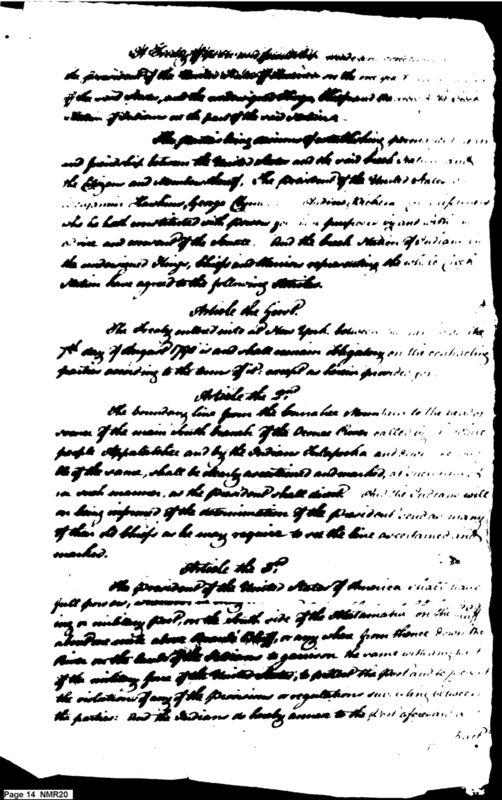
A Treaty of Peace and Friendship, made and concluded between the President of the United States of America, on the one part, and behalf of the said States, and the undersigned Kings, Chiefs and Warriors of the Creek Nation of Indians, on the part of the said Nation.
The parties being desirous of establishing permanent peace and friendship between the United States and the said Creek Nation and the citizens and members thereof, and to remove the causes of war, by ascertaining their limits, and making other necessary, just and friendly arrangements. The President of the United States by Benjamin Hawkins, George [undecipherable] and Andrew [undecipherable], commissioners, authorized as hath constituted with powers for these purposes, by and with the advice and consent of the Senate, and the Creek Nation of Indians, by the undersigned Kings, Chiefs and Warriors, representing the whole Creek Nation, have agreed to the following Articles:—
Article 1
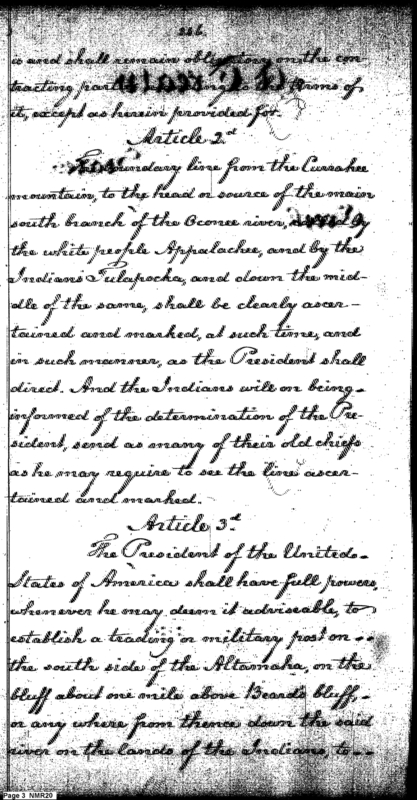
The treaty entered into at New York between the parties on the [undecipherable] is and shall remain obligatory on the contracting parties, according to the terms of it, except as herein provided for.
Article 2d
The boundary line from the Currahee Mountain, to the head or source of the main south branch of the Oconee river, [undecipherable] the little rocks [undecipherable], and by the Indians [undecipherable], and down the middle of the stream, shall be clearly ascertained and marked, at such time, and in such manner, as the President shall direct. And the Indians will on being informed of the determination of the President, send as many of their old chiefs as he may require to see the line ascertained and marked.
Article 3d
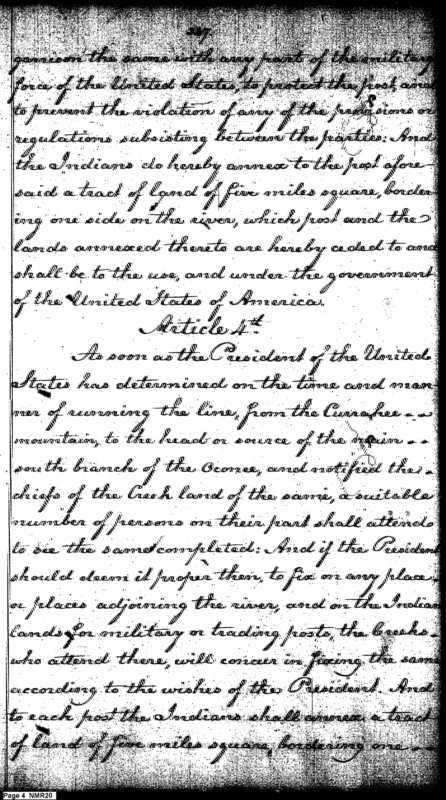
The President of the United States shall have full power, whenever he may deem it advisable, to establish a trading or military post on the south side of the Altamaha, on the [undecipherable] about one mile above [undecipherable] Bluff, or any other from thence down the said river on the lands of the Indians to garrison the same with any part of the military force of the United States, to protect the post and to prevent the violations of any of the stipulations or regulations subsisting between the parties. And the Indians do hereby annex to the post aforesaid a tract of land of five miles square, bordering one side on the right, and the lands annexed thereto are hereby ceded to and shall be to the use, and under the government of the United States of America.
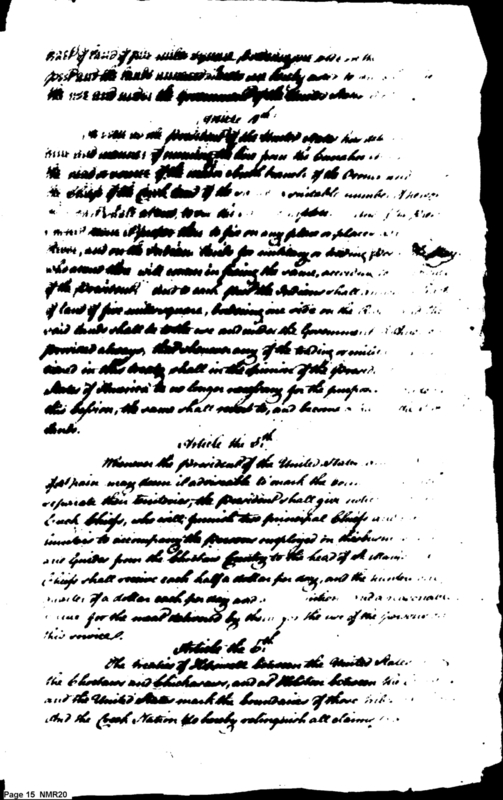
Article 4th
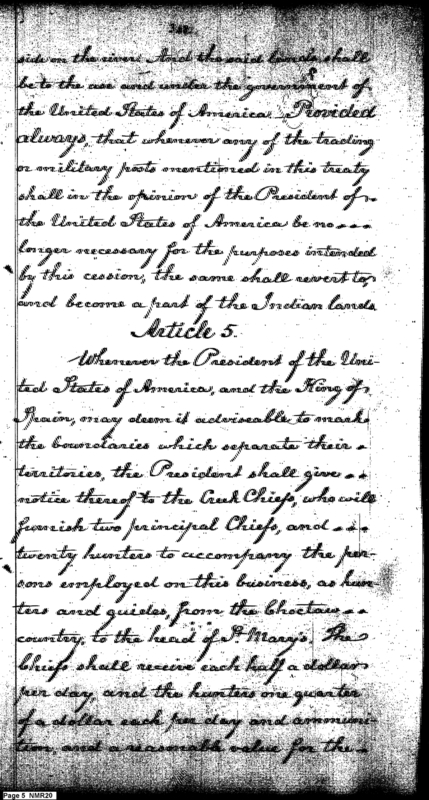
As soon as the President of the United States has determined on the time and manner of running the line, from the Currahee Mountain, to the head or source of the main south branch of the [undecipherable], and notified the chiefs of the Creek land of the same, a suitable number of persons on their part shall attend to see the same completed. And if the President should deem it proper then, to fix on any place or places on the river, or places adjoining the river, and on the Indian lands for military or trading posts, the chiefs who attend there, will concur in fixing the same, according to the wishes of the President. And to each post the Indians shall annex a tract of land of five miles square, bordering one side on the river; and that the said lands shall be to the use and under the government of the United States of America. Provided always, that whenever any of the trading or military posts mentioned in this treaty shall in the opinion of the President of the United States be no longer necessary for the purposes intended by this [undecipherable], the same shall revert to, and become a part of the Indian lands.
Article 5.
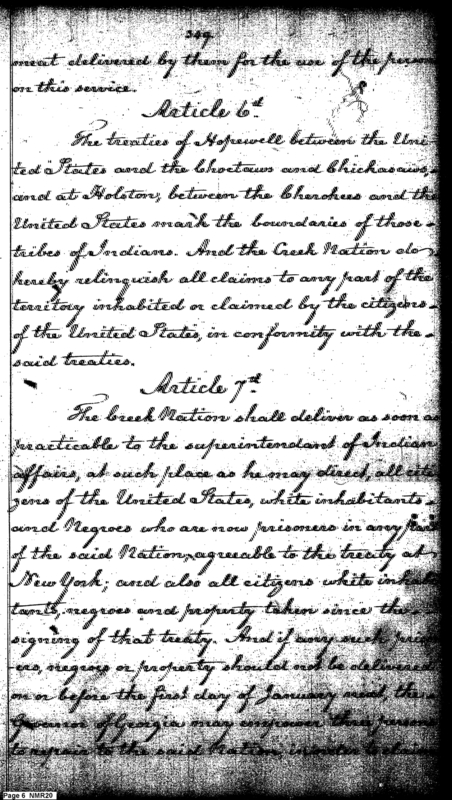
Whenever the President of the United States and the Kings of [undecipherable], may deem it advisable to mark the boundaries which separate their territories, the President shall give a notice thereof to the Creek Chiefs, who will furnish two principal Chiefs, and a [undecipherable] hunters to accompany the persons employed on this business, as hunters and guides, from the [undecipherable] country, to the head of St. Marys. The Chief shall receive each half a dollar per day, and the hunters one [undecipherable] of a dollar each per day, and ammunition, and a reasonable value for the [undecipherable] delivered by them for the use of the persons on this service.
Article 6th
The treaties of [undecipherable] between the United States and the Cherokees and Chickasaws; and at Holston, between the Cherokees and the United States, mark the boundaries of those tribes of Indians. And the Creek Nation also hereby relinquish all claims to any land of the territory inhabited or claimed by the citizens of the United States, in conformity with the said treaties.
Article 7th
The Creek Nation shall deliver as soon as practicable to the superintendent of Indian Affairs, at such place as he may direct, all citizens of the United States, white inhabitants, and Negroes who are now prisoners in any part of the said Nation, agreeable to the treaty at New York; and also all citizens white inhabitants, negroes and property taken since the signing of that treaty. And if any such citizens, negroes or property should not be delivered on or before the first day of January next, the Governor of Georgia may communicate the [undecipherable] and receive such prisoners, negroes and property, under the direction of the President of the United States.
Article 8th
In consideration of the friendly disposition of the Creek Nation towards the government of the United States, evidenced by the stipulations in the present treaty, and particularly the leaving it to the discretion of the President to establish trading or military posts on their lands. The commissioners of the United States, on behalf of the said States, give to the said Nation, goods to the value of six thousand dollars, and stipulate to send to the Indians Nation two Blacksmiths with [undecipherable], to be employed for the [undecipherable] and [undecipherable], with the necessary tools.
Article 9th
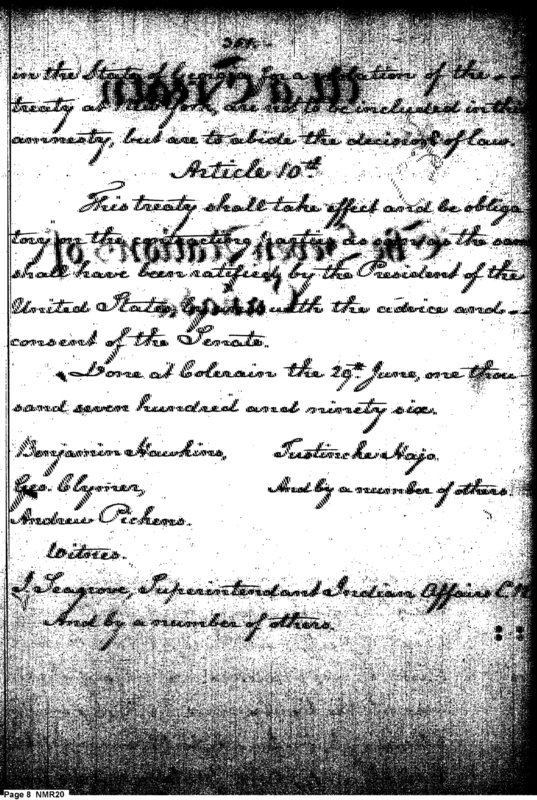
All animosities for past grievances shall henceforth cease, and the contracting parties will carry the foregoing Treaty into full execution, with all good faith and sincerity. Provided nevertheless that [undecipherable] [undecipherable] be included in the [undecipherable], but not to abide the decision of law.
Article 10th
This treaty shall take [undecipherable] and be obligatory on the contracting parties [undecipherable] the same shall have been ratified by the President of the United States, by and with the advice and consent of the Senate.
Done at Colerain the 29th June, one thousand seven hundred and ninety six.
Benjamin Hawkins, [undecipherable]
Geo. [undecipherable], And by a number of others.
Andrew [undecipherable].
Witness.
[undecipherable] Superintendent and Indian Affairs [undecipherable]
And by a number of others.
Type
Copy of Signed Document
Description
Treaty between the United States and the Creek Nation, establishing clear boundaries. The Creeks agree to release all prisoners and annex a portion of their land to the U.S. government. The United States, in return for the Creeks allowing the government to establish trading and military posts on their lands, will allot goods to the value of $6,000 and two blacksmiths to be employed for the Creek people.
Date
06/29/1796
Collection
Document number
1796062990001
Page start
1
Notable persons
Creek Nation of Indians
Negroes
Benjamin Hawkins
George Clymer
Andrew Pickens
Spanish
blacksmiths
President [Washington]
white people
old Chiefs
King of Spain
hunters
Choctaws
Chickasaws
Cherokees
Superintendent of Indian Affairs
white inhabitants
prisoners
Governor of Georgia
Commissioners
blacksmiths
Upper Creeks
Lower Creeks
persons now under arrest
James Seagrove
Henry Gaither
Constant Freeman
Samuel Tinsley
Samuel Allison
John W. Thompson
George Gillaspy
Timothy Barnard
James Burgess
James Jordan
Richard Thomas
Alexander Cornekls
William Eaton
Senate of the United States
John Adams
Timothy Pickering
Notable locations
Colerain
Georgia
Currahee Mountain
Oconee River
Appalatchee
Tulapocka
Creek Nation
St. Mary's River
Alatamaha
Beards Bluff
Choctaw Country
Holston
Georgia
Notable items
Treaty
tools
peace and friendship
causes of war
trading or military posts
bluff
garrison
violation of the provisions
tract of land
government of the United States
river
cession
Indian lands
ammunition
Treaty of Hopewell
claims to territory
friendly disposition of the Creek Nation
goods
animosities for past grievances
violation of the Treaty of New York
amnesty
resolution
full powers