

Matters before the Court and Local Politics
Document 1796James Winchester writes from Baltimore regarding a court case, and General Smith's conduct, which opposes the sense of his constituents. He writes of political matters and treaties without making direct reference to what they are. Refers to someone who must go out because they cannot stand another election.
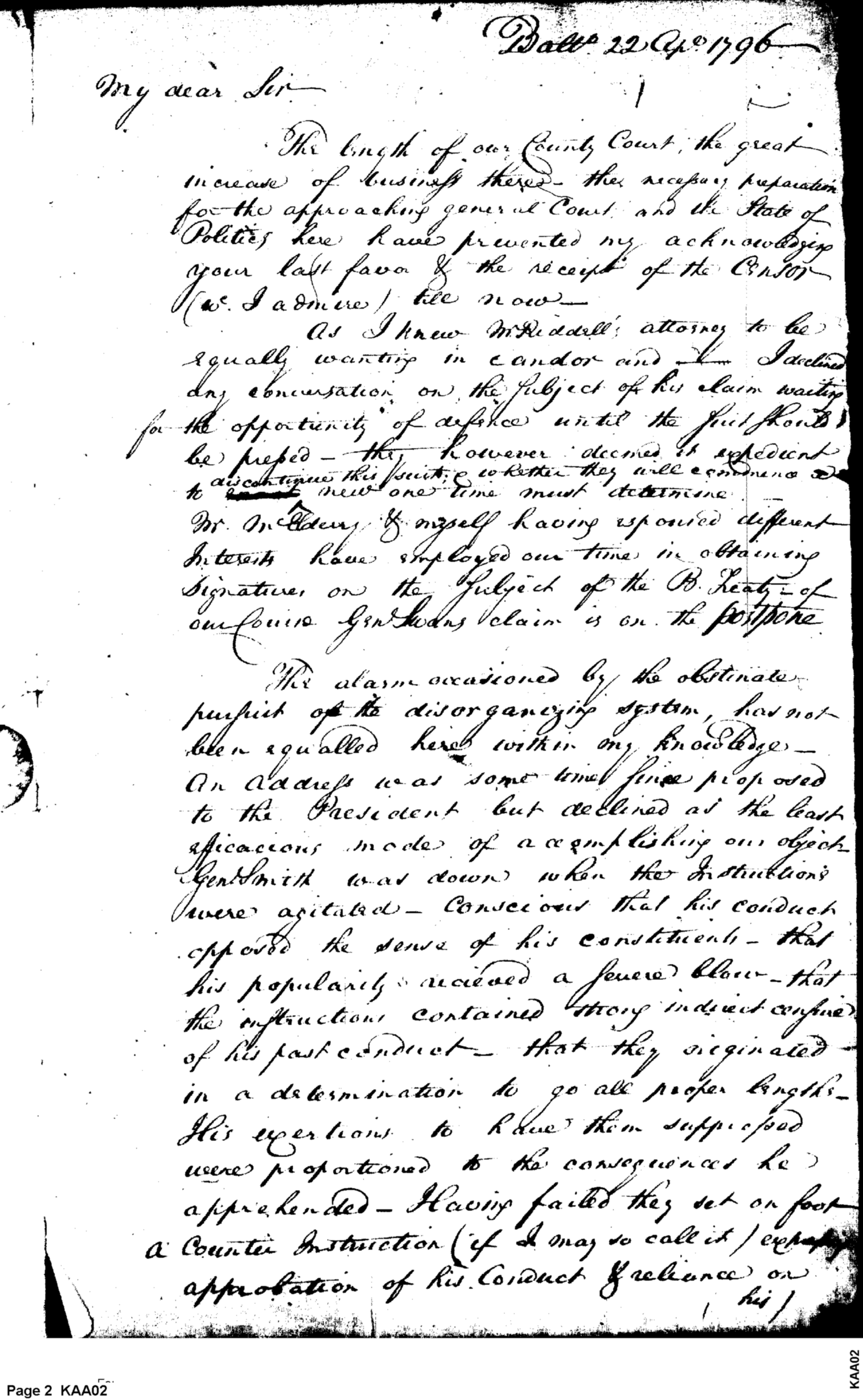
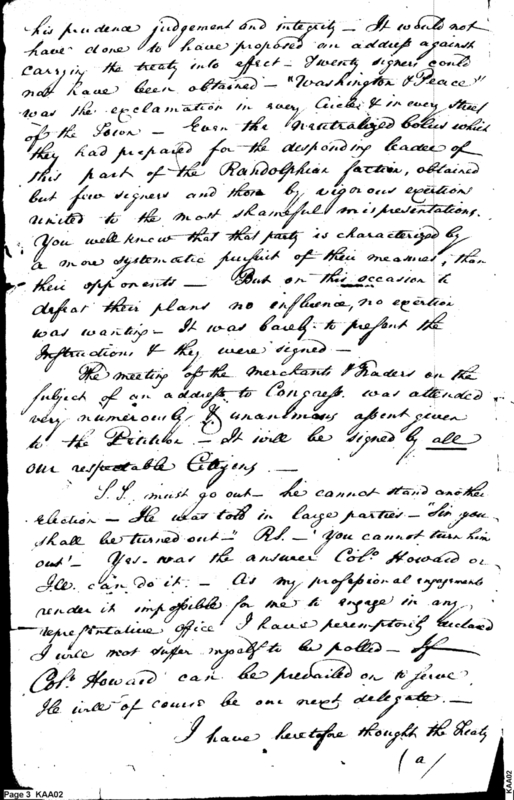
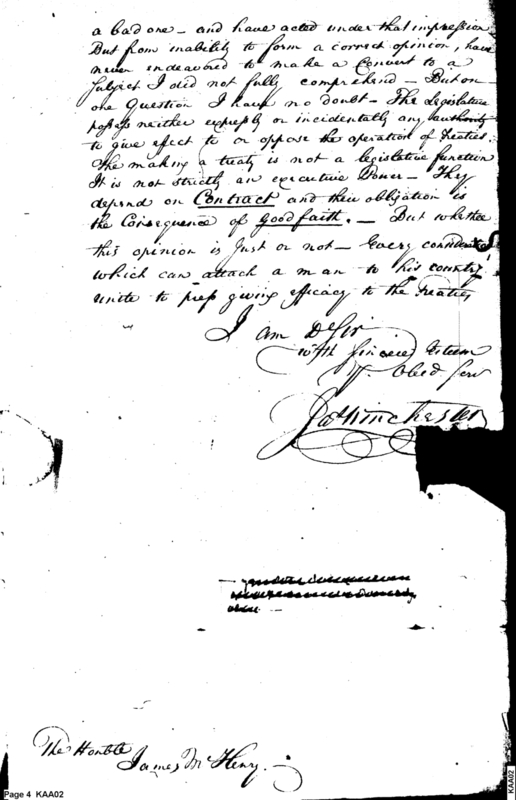
No human transcription currently available for this document.
This transcription was generated by machine using Anthropic's Claude Code (model sonnet 4.6). It may contain errors or inaccuracies. Please verify against the document image. Learn more about our generative AI methodology.
Balto 22 Apro 1796
My dear Sir
The length of our County Court, the great increase of business there — the necessary preparation for the approaching general Court, and the State of Politics here have prevented my acknowledging your last favor & the receipt of the C[undecipherable]n (w. I admire) till now —
As I knew McRiddell's attorney to be equally wanting in candor and — I declined any conversation on the subject of his claim waiting for the opportunity of defence until the [undecipherable] should be [undecipherable] — they however deemed it expedient to discontinue this suit; & whether they will commence a new one time must determine.
Mr. McHenry & myself having espoused different interests have employed our time in obtaining Signatures on the Subject of the B. Treaty — of our course Gent. [undecipherable]'s claim is on the [undecipherable]
The alarm occasioned by the obstinate pursuit of the disorganizing System, has not been equalled here within my knowledge — An Address was some time since proposed to the President but declined as the least efficacious mode of accomplishing our object. Goldsmith was down when the Instructions were agitated — Conscious that his conduct opposed the sense of his constituents — that his popularity received a severe blow — that the instructions contained strong indirect censure of his past conduct — that they originated in a determination to go all proper lengths — His exertions to have them suppressed were proportioned to the consequences he apprehended — Having failed they set on foot a Counter Instruction (if I may so call it) expressing approbation of his Conduct & reliance on his
his prudence judgement and integrity — It would not have done to have proposed an address against carrying the treaty into effect — Twenty signers could not have been obtained — "Washington & Peace" was the exclamation in every Circle & in every street of the Town — Even the neutralized bolus which they had prepared for the desponding leaders of this part of the Randolphean faction, obtained but few signers and those by vigorous exertions united to the most shameful misrepresentations.
You well know that that party is characterized by a more systematic pursuit of their measures, than their opponents — But on this occasion to defeat their plans no influence, no exertion was wanting — It was barely to present the Instructions & they were signed —
The meeting of the Merchants & Traders on the subject of an address to Congress was attended very numerously & unanimous assent given to the Petition — It will be signed by [underline: all] our respectable Citizens. —
S.S. must go out — he cannot stand another election — He was told in large parties — "Sir you shall be turned out" Rb. — "you cannot turn him out" — Yes — was the answer Colo Howard or I'll. can do it — As my professional engagements render it impossible for me to engage in any representative office I have peremptorily declared I will not suffer myself to be polled — if Colo Howard can be prevailed on to serve, He will of course be our next delegate. —
I have heretofore thought the Treaty a bad one — and have acted under that impression. But from inability to form a correct opinion, have never endeavored to make a Convert to a subject I did not fully comprehend — But on one Question I have no doubt — The Legislature possesses neither expressly or incidentally any authority to give effect to or oppose the operation of Treaties. The making a treaty is not a legislative function It is not strictly an executive Power — They depend on [underline: Contract] and their obligation is the Consequence of [underline: good faith]. — But whether this opinion is Just or not — Every consideration which can attach a man to his country unite to keep giving efficacy to the treaties
I am Dr Sir
with sincere Esteem
Yr obedt Servt
[undecipherable: signature]
[undecipherable docketing notes]
The Honble James McHenry.
Type
Autograph Letter Signed
Description
James Winchester writes from Baltimore regarding a court case, and General Smith's conduct, which opposes the sense of his constituents. He writes of political matters and treaties without making direct reference to what they are. Refers to someone who must go out because they cannot stand another election.
Date
04/22/1796
Author
Recipient
Sent from
Baltimore
Repository
Collection
Document number
1796042240001
Page start
1
Notable persons
James McHenry
James Winchester
merchants
traders
Congress
Colonel Howard
Colonel Swan
Mr. Riddell
General Smith
Notable locations
Philadelphia
Baltimore
Notable items
election
petition