No human transcription currently available for this document.
[undecipherable]
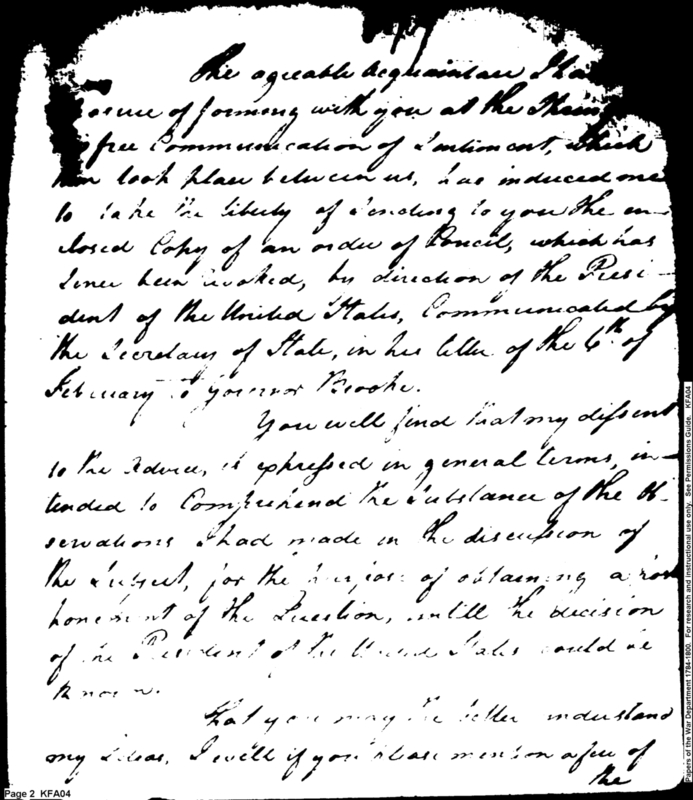
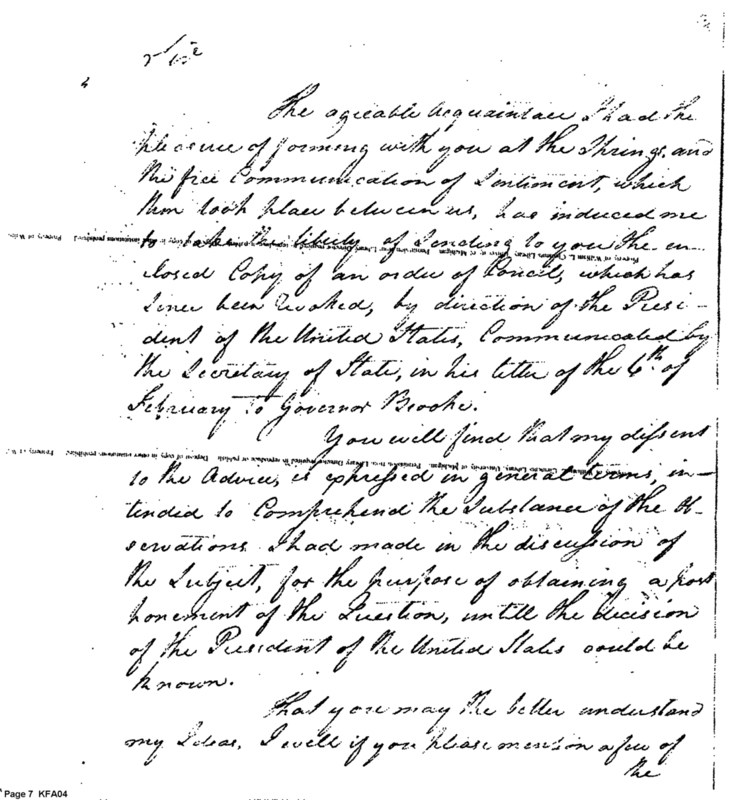
the agreeable acquaintance I had the pleasure of forming with you at the Springs, and the free Communication of Sentiment, which has took place between us, has induced me to take the liberty of Sending to you the enclosed Copy of an order of Council, which has Since been revoked, by direction of the President of the United States, Communicated by the Secretary of State, in his letter of the 6th of February to Governor Brooke.
You will find that my dissent to the Advice, is expressed in general Terms, intended to Comprehend the Substance of the Observations I had made in the discussion of the Subject, for the purpose of obtaining a postponement of the Question, untill the decision of the President of the United States could be known.
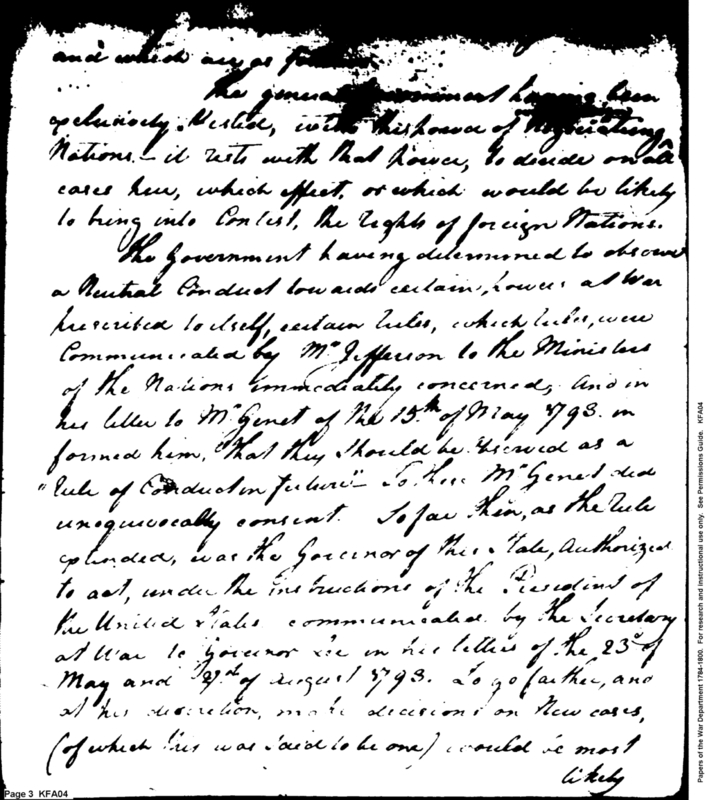
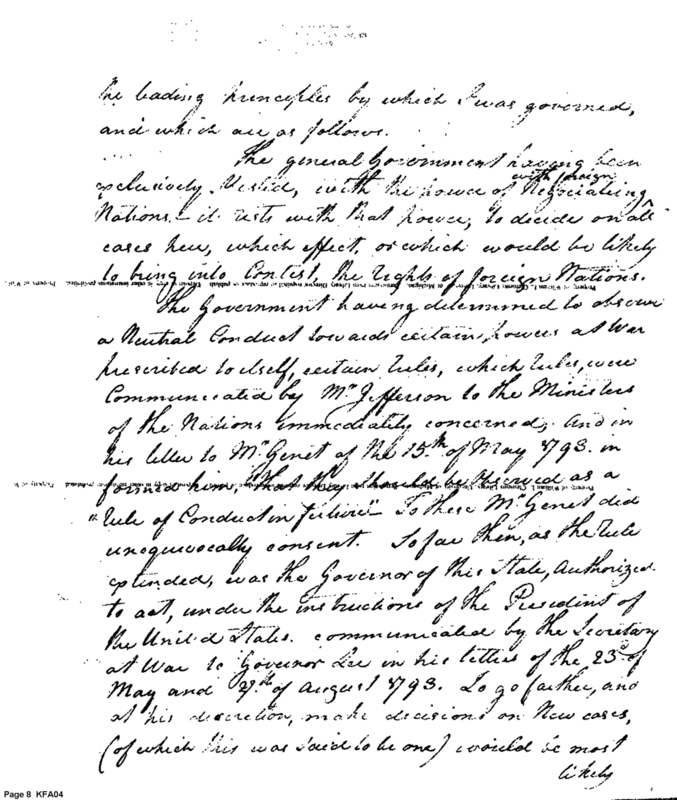
That you may the better understand my Ideas, I will if you please mention a few of the leading principles by which I was governed, and which are as follows.
The general Government having been exclusively Vested, with the power of Negotiating with foreign Nations,— it rests with that power, to decide on all cases here, which affect, or which would be likely to bring into Contest, the Rights of foreign Nations.
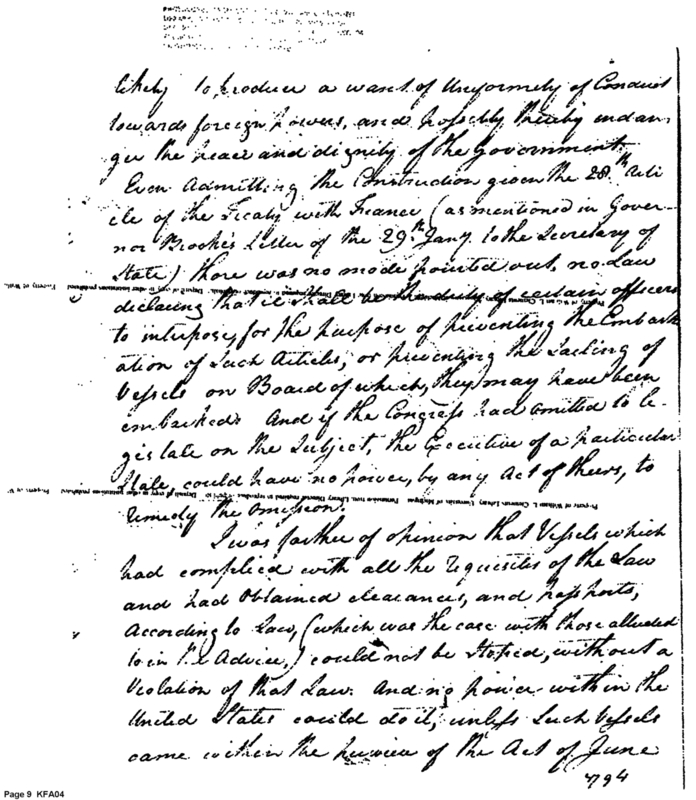
The Government having determined to observe a Neutral Conduct towards certain Powers at War, prescribed to itself, certain Rules, which Rules, were Communicated by Mr Jefferson to the Ministers of the Nations immediately concerned; And in his letter to Mr Genet of the 15th of May 1793. informed him, that they Should be Served as a "Rule of Conduct in future" To these Mr Genet did unequivocally consent. So far then, as the Rule extended, was the Governor of this State, Authorized to act, under the instructions of the President of the United States communicated by the Secretary at War to Governor Lee in his letters of the 23d of May and 29th of August 1793. To go farther, and at his discretion, make decisions on New cases, (of which this was Said to be one) would be most likely to produce a want of Uniformity of Conduct towards foreign Powers, and possibly thereby endanger the peace and dignity of the Government.
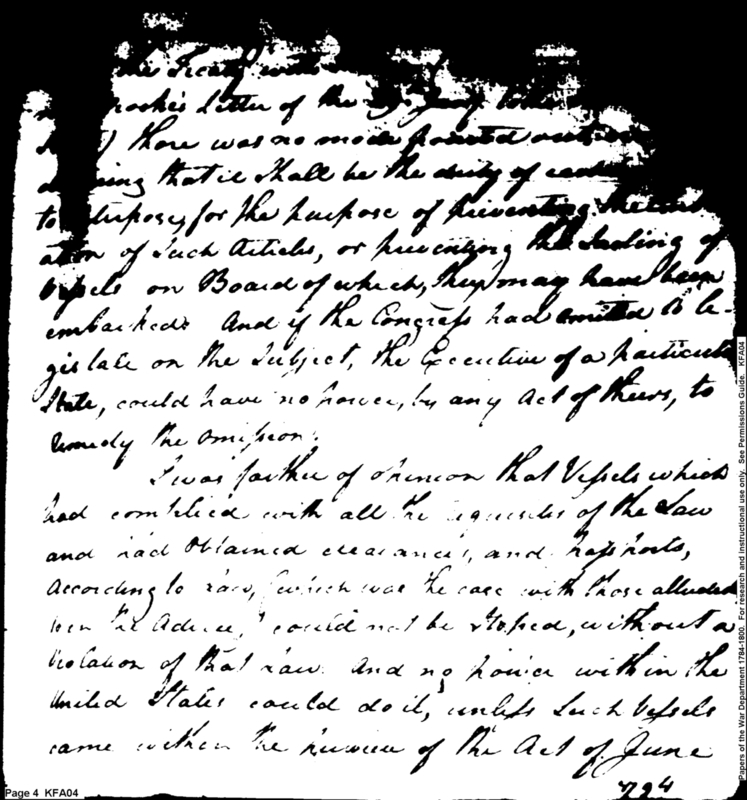
Even Admitting the [undecipherable] 28th Article of the Treaty with France (as mentioned in Governor Brooke's letter of the 29th Jany. to the Secretary of State) there was no mode pointed out, no Law declaring that it Shall be the duty of certain officers to interpose for the purpose of preventing the Embarkation of Such Articles, or preventing the Sailing of Vessels on Board of which, they may have been embarked. And if the Congress had omitted to legislate on the Subject, the Executive of a particular State, could have no power, by any Act of theirs, to remedy the Omission.
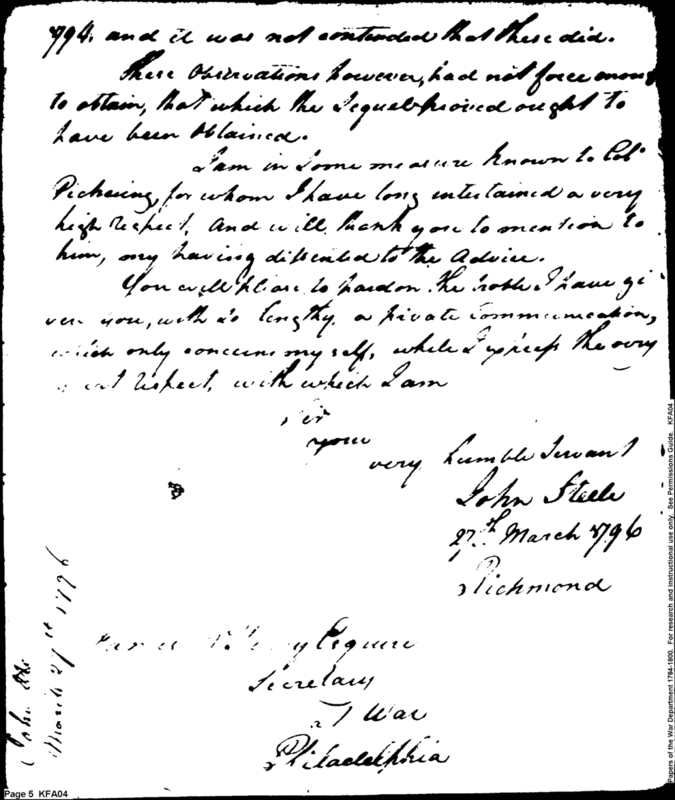
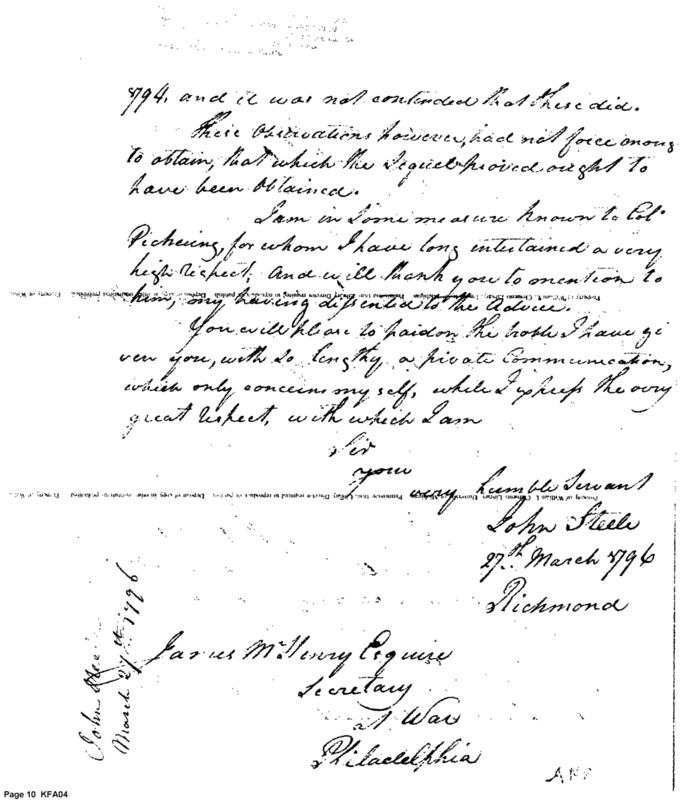
I was farther of opinion that Vessels which had complied with all the Requisites of the Law and had Obtained clearances, and Passports, According to law, (which was the case with those alluded to in the Advice,) could not be Stopped, without a Violation of that Law. And no power with in the United States could do it, unless Such Vessels came within the purview of the Act of June 1794, and it was not contended that these did.
These Observations however, had not force enough to obtain, that which the Sequel proved ought to have been Obtained.
I am in Some measure known to Col. Pickering, for whom I have long entertained a very high Respect, and will thank you to mention to him, my having dissented to the Advice.
You will please to pardon the trouble I have given you, with so lengthy, a private Communication, which only concerns my self, while I subscribe the very great Respect, with which I am
Sir
your
very humble Servant
John Steele
27th March 1796
Richmond
[John Steele / March 27th 1796]
James McHenry Esquire
Secretary
at War
Philadelphia
[ANr]