

Constitutional powers of Congress in respect to treaties
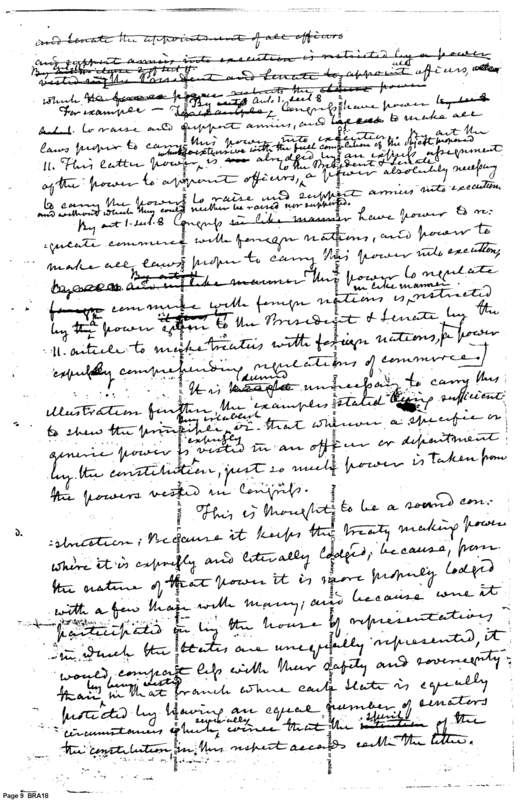
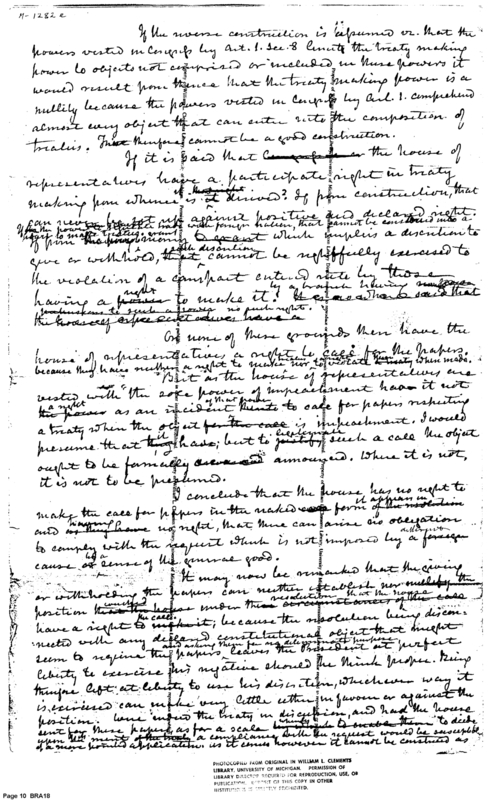
Document 1796McHenry argues that the right to make treaties is exclusively vested in the President and the Senate, according to the Constitution. McHenry also asserts that the House of Representatives has no right to demand the papers behind a treaty without the President's permission, despite the Congressional power to regulate commerce with foreign nations. McHenry suggests that the reason Congress demands the papers is in order to make a case for impeachment.

No human transcription currently available for this document.
This transcription was generated by machine using Anthropic's Claude Code (model sonnet 4.6). It may contain errors or inaccuracies. Please verify against the document image. Learn more about our generative AI methodology.
[26 March 1796
A answer complete
ASP by James
McHenry]
[Hn tte]
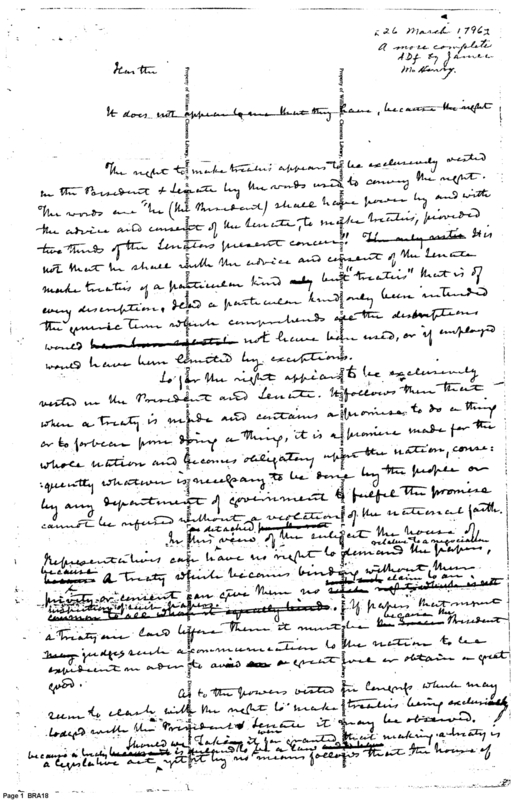
It does not appear to me that they have, because the right—
The right to make treaties appears to be exclusively vested in the President & Senate by the words used to convey the right. The words are "he (the President) shall have power by and with the advice and consent of the Senate to make treaties, provided two thirds of the Senators present concur." [strikethrough: The only article of this not that must be placed with the advice and consent of the Senate not must be a treaty of a particular kind and] but "treaties" that is of every description, [strikethrough: and a particular kind only been intended the general term] [strikethrough: would] not leave have been used, or if employed would have been limited by exceptions.
So far the right appears to be exclusively vested in the President and Senate. It follows then that when a treaty is made, and contains a promise to do a thing, or to forbear from doing a thing, it is a promise made for the whole nation and becomes obligatory upon the nation; consequently whatever is necessary to be done by the people or by any department of government to fulfil the promise cannot be refused without a violation of the national faith.
[undecipherable: several heavily crossed-out lines]
[undecipherable] [undecipherable] [undecipherable] [undecipherable] the [undecipherable] [undecipherable] [undecipherable]
As to [undecipherable] I conclude [undecipherable] the [undecipherable] [seems?] to clash with the [undecipherable] powers vested in [Congress?] [undecipherable] [undecipherable] [undecipherable] because [undecipherable] [undecipherable] [undecipherable] [undecipherable] [undecipherable]
[undecipherable: bottom lines heavily corrected and crossed out]
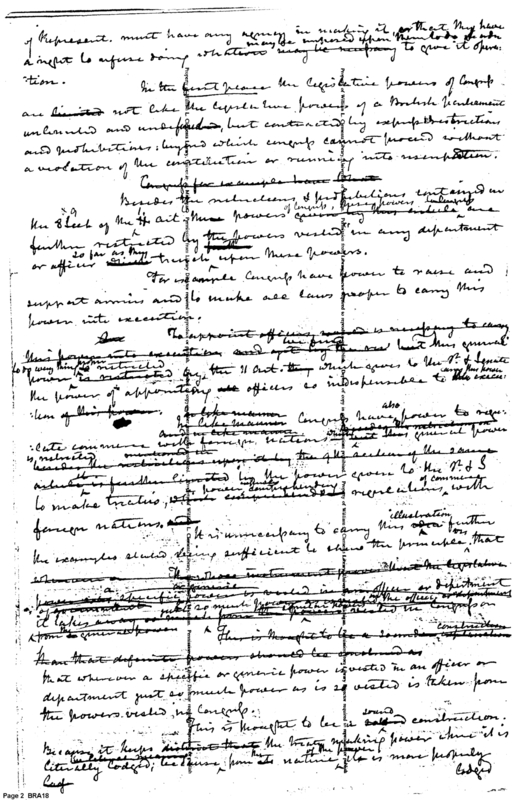
of Representatives must have any agency in making it—[undecipherable] they have a right to require doing [undecipherable] as may be necessary to give it operation.
In the [undecipherable] place. The Legislative powers of Congress are limited, not like the legislative powers of a British Parliament unlimited and unmodified, but constrained by representations and prohibitions, beyond which congress cannot proceed without a violation of the constitution or running into usurpation.
Congress for example have [undecipherable]:
Besides the [undecipherable] of [undecipherable] functions combined in [undecipherable] the [undecipherable] of [undecipherable] Act these powers [undecipherable] [are?] vested in any department [undecipherable] [undecipherable]
or [officers?] [undecipherable] to [undecipherable] upon [undecipherable] Governors.
For [instance?] Congress have power to raise and support armies, and to make all laws [proper?] to carry this [undecipherable] into execution.
The [appointment?] of officers [undecipherable] [undecipherable] is [necessary?] [undecipherable] [undecipherable] [undecipherable] however [undecipherable] [undecipherable] the [appointment?] [undecipherable] [undecipherable] officers is [undecipherable] to the [undecipherable] [undecipherable] [undecipherable] [undecipherable] [undecipherable].
[also] Congress [having?] power to [regulate?] [undecipherable] [undecipherable] [undecipherable] [undecipherable] [undecipherable] [undecipherable] [undecipherable] [undecipherable] [undecipherable] [undecipherable] [undecipherable] [undecipherable]
[undecipherable section]
[foreign relations section, heavily corrected]
It is unnecessary to carry this [undecipherable] the examples [stated?] [undecipherable] to [show?] the principle that [undecipherable]
[undecipherable sections]
A [conclusion?] to be a [sound?] construction.
Because [undecipherable] [the treaty making power?] [undecipherable] [literally?] [undecipherable] [undecipherable] [undecipherable]
lodged with a few, and because were it [not parceled?] [undecipherable] by the house of representatives alone it would [undecipherable] [undecipherable] [undecipherable] [undecipherable] [undecipherable] [undecipherable] [all?] equally [undecipherable] by the [undecipherable] of [undecipherable] [undecipherable] [undecipherable] [undecipherable]
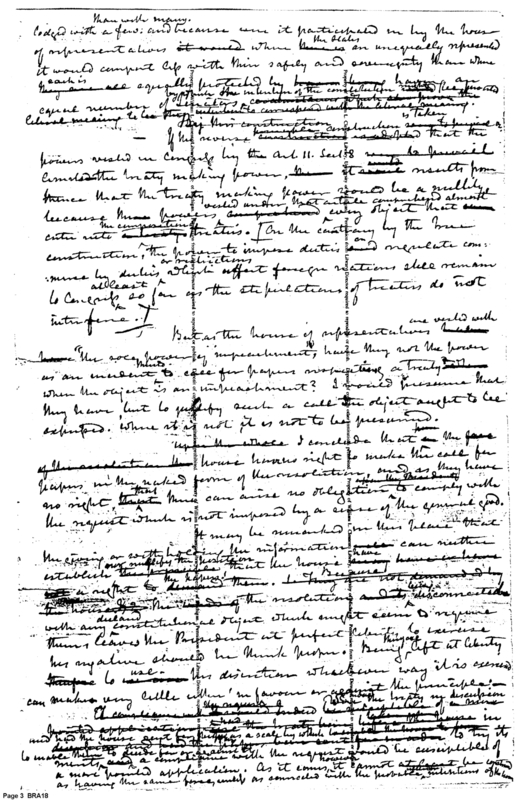
— If the [several?] [constitutions?] [undecipherable] that the powers vested in Congress by the Act [II §?] [undecipherable] be [construed?] [undecipherable] constitution [treaty?] making [power?] [undecipherable] it [would?] [result?] from hence that the treaty making power [should?] be [undecipherable] because [treaty?] making [powers?] [undecipherable] [undecipherable] [undecipherable]
[construction?] the [power?] to impose duties and [regulate?] commerce [undecipherable] foreign relations [shall?] remain to Congress as far as the [pertentions?] of treaties do not interfere.
[undecipherable] we [would?] with
But the houses of representatives [would?] not have the [powers?] [to?] [impede?] a treaty [undecipherable] [have?] making a resolution [undecipherable] [providing?] [undecipherable] a treaty [undecipherable]. Is [not?] [impeachment?]? I would [presume?] [undecipherable] they have [undecipherable] a right to [undecipherable] [undecipherable] the object ought to be [announced?] [undecipherable] where if it is not, it is not to be [presumed?].
[undecipherable: several heavily crossed-out paragraphs]
[undecipherable] I conclude [undecipherable] [the?] [President?] [undecipherable] [the?] [house?] [of?] [representatives?] [undecipherable]
[undecipherable: multiple heavily corrected lines]
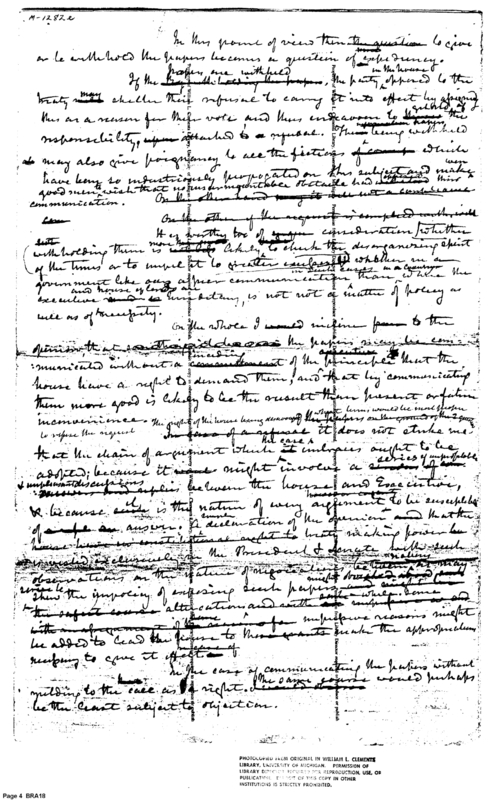
In [this?] point of view [the?] [question?] [becomes?] a question of [expediency?].
If the [President?] [undecipherable] [the party?] [opposed?] to the treaty [undecipherable] no weight [undecipherable] him as a reason for [their?] vote and [their?] endeavour to [show?] [undecipherable] [undecipherable] [undecipherable] may also give [undecipherable] to see the [positions?] [undecipherable] which have [long?] [undecipherable] [undecipherable] on [this?] [undecipherable] making [undecipherable] [undecipherable] [undecipherable]
[A?] [consideration?] [withholding?] them is [suitable?] [while?] to [check?] the [undecipherable] spirit of [the?] [mind?] at [undecipherable] to [insist?] [undecipherable] [undecipherable] which [undecipherable] in the government [undecipherable] [undecipherable] [undecipherable]
On the whole I would [conclude?] [power?] to [undecipherable]
[The?] [House?] [of Representatives?] [undecipherable] [may?] [have?] [undecipherable] house have a right to demand them, and that by communicating them more good is likely to be [the result than present refusal?] [undecipherable] [undecipherable]. [The?] part of the [House?] [being?] many of [the?] [members?] of [the?] [party?] [undecipherable] [refuse?] the request.
[The chain of argument?] [undecipherable] [undecipherable] [undecipherable] [undecipherable] [undecipherable]
[undecipherable] because [undecipherable] [undecipherable] between [undecipherable] [undecipherable]
[undecipherable section]
[The?] [question?] of [approaching?] [such?] [proposals?] [undecipherable] [undecipherable]
[undecipherable section] might [undecipherable] be added to [head?] the [parties?] [undecipherable]
In the [case?] of communicating the papers without [undecipherable] to those of right the [same?] [powers?] would [undecipherable] be the least [subject?] to rejection.
[Last page of AO#3
26 March 1796]
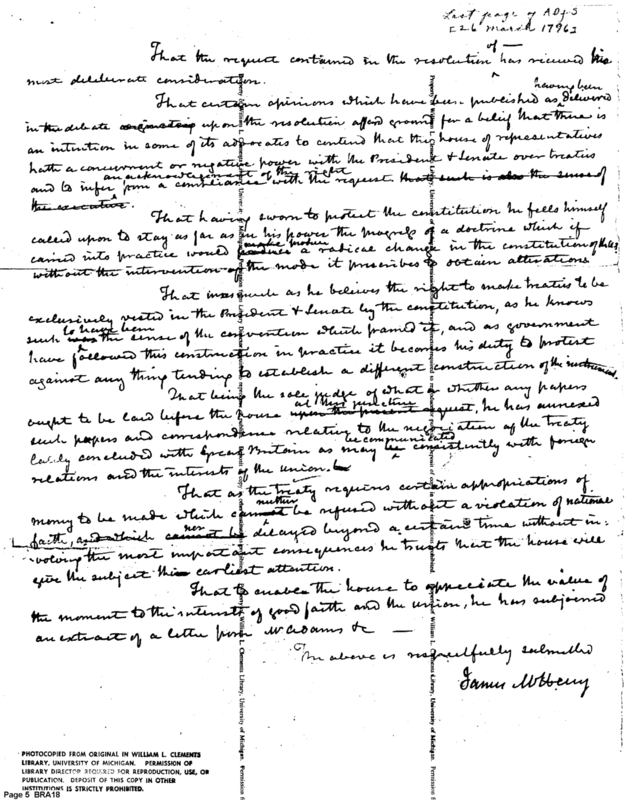
That the request contained in the resolution has received his most deliberate consideration.
That certain opinions which have been published as [delivered?] in the debate concerning upon the resolution afford ground for a belief that there is an intention in some of its advocates to contend [undecipherable] that the house of representatives hath a concurrence or negative power with the President & Senate over treaties and to infer from a communication of the request [that such is?] also the sense of the executive.
That having sworn to protect the constitution, he feels himself called upon to stay as far as in his power [undecipherable] the [opinion?] of a doctrine which if carried into practice would [introduce?] a radical change in the constitution [without?] the intervention of the mode it prescribes to obtain alterations.
That inasmuch as he believes the right to make treaties to be exclusively vested in the President & Senate by the constitution, as he knows [such?] [undecipherable] of the convention which framed it, and as government have followed this construction in practice it becomes his duty to protest against any thing tending to establish a different construction of the instrument.
That being the sole judge of what [undecipherable] any papers ought to be laid before the house at [their request?], he has annexed such papers and correspondence relating to [undecipherable] the negotiation of the treaty lately concluded with [Great Britain?] as [many?] be consistently with foreign relations and the interests of the union. [strikethrough text]
That as the treaty requires certain appropriations of money to be made which cannot be refused without a violation of national faith, and [neither?] cannot be delayed beyond a certain time without involving the most important consequences he trusts that the house will give the subject [their?] earliest attention.
That to enable the house to appreciate the value of the moment to the interests of good faith and the union, he has subjoined an extract of a letter from Wm Adams &c —
The above is respectfully submitted
James McHenry
[Other Copies — The following copies of this document are provided either because they are substantively different from the primary source copy or because they can aid in deciphering portions of the primary source copy that are in some way obscured or otherwise difficult to read.]
[Copy]
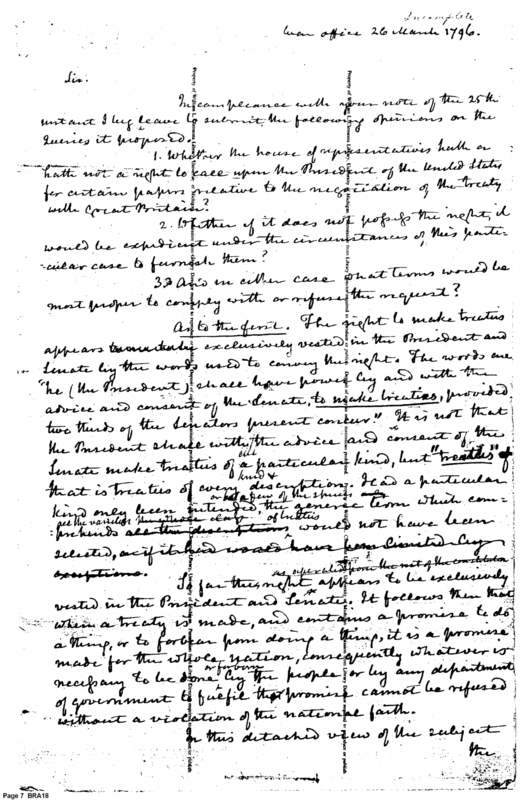
War office 26 March 1796.
Sir—
In compliance with your note of the 25th instant I beg leave to submit the following opinions on the queries it proposed.
1. Whether the house of representatives hath or hath not a right to call upon the President of the United States for certain papers relative to the negotiation of the treaty with Great Britain?
2. Whether if it does not [fall to?] the right, it would be expedient under the circumstances of this particular case to furnish them?
3. And in either case what terms would be most proper to comply with or refuse the request?
As to the first. The right to make treaties appears [immediately?] exclusively vested in the President and Senate by the words used to convey the right. The words are "he (the President) shall have power by and with the advice and consent of the Senate, to make treaties, provided two thirds of the Senators present concur." It is not that the President shall make treaties of a particular kind, but "treaties" of every description. It is a particular kind only been [understood?], the general terms from which [undecipherable] the descriptions would not have been selected, or if [fixed?] words have [undecipherable] been [chosen?] exceptions.
So far this right appears to be [as?] exclusively vested in the President and Senate. It follows from this construction, that when a treaty is made, and contains a promise to do a thing, or to forbear from doing a thing, it is a promise made for the whole nation, consequently whatever is necessary to be done by the people or by any department of government to fulfil that promise cannot be refused without a violation of the national faith.
In this detached view of the subject the—
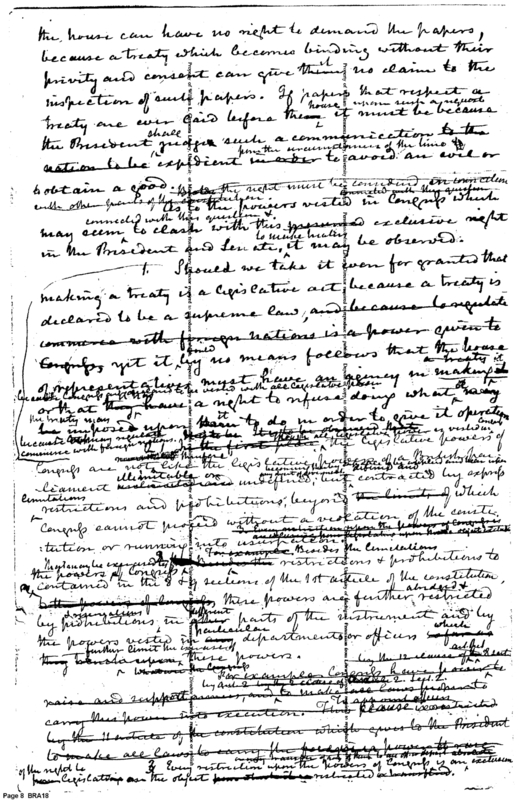
the house can have no right to demand the papers, because a treaty which becomes binding without their [consent?] can give them no claim to the inspection of such papers. [Of?] papers that respect a treaty are ever laid before them, it must be because the President [shall?] give such a communication [undecipherable] at the time [undecipherable] to be expedient in order to prevent an evil or obtain a good.
[strikethrough: obtain a good.] [It must be for?] inspection [with?] [undecipherable] [powers?] vested the Congress which [may?] [seem?] to clash with this [undecipherable] exclusive right vested in the President and Senate, it may be observed—
1. Should we take it even for granted that making a treaty is a legislative act, because a treaty is declared to be a supreme law, and because to regulate commerce with foreign nations is a power given to Congress, yet it by no means follows that the house [strikethrough: of Representatives?] must have [undecipherable] in making it, [or?] that [undecipherable] have a right to refuse a demand of any papers [undecipherable] a treaty [undecipherable].
A [Representative?] [undecipherable] must have [undecipherable] [money?] in [undecipherable] [undecipherable] [undecipherable] when [the?] [undecipherable] is [undecipherable] [impeachment?]. I would [presume?] [undecipherable] at [impeachment?], but to [undecipherable] such a call the object ought to be [formally?] announced. When it is not, it is not to be presumed.
[undecipherable: several heavily corrected lines]
I conclude that the house [has?] no right to make the call for papers in [the?] form of the resolution; [undecipherable] [there?] can arise no obligation to comply with the [request?] which [is?] not imposed by a [sense?] of the national good.
It may be [remarked?] on [this] [point?] that [undecipherable] [power?] can [neither?] be established [undecipherable] [undecipherable] [undecipherable]
[undecipherable section about the institution?]
with any constitutional right [undecipherable] seems to [require?] [undecipherable] to [pursue?] him [undecipherable] his direction [undecipherable] should be [the same?] [the President?] at [perfect?] liberty [undecipherable] his direction [undecipherable]. If it [is?] [exceed?] [undecipherable] his instruction should be the [same?] [period?] can never be cited to compel him [undecipherable].
In the case of communicating the papers [without?] [alluding?] to those of right, the [same?] powers would [infinitely?] be the least subject to rejection.
and Senate the appointment of all officers [undecipherable] [undecipherable] is [entrusted?] [undecipherable] [undecipherable] by [a?] specific [undecipherable] vesting the President and Senate [undecipherable]
[undecipherable section]
For [instance?] [undecipherable] [undecipherable] power [undecipherable] [undecipherable] [undecipherable]
[undecipherable lines]
The power [undecipherable] [undecipherable] [undecipherable] [undecipherable] [undecipherable] [undecipherable] [undecipherable]
[By art?] [1 §?] [undecipherable] [undecipherable] [undecipherable] [undecipherable] [undecipherable] [undecipherable] [undecipherable] [undecipherable] [undecipherable] [undecipherable] [undecipherable] [undecipherable]
to make all laws [undecipherable] [undecipherable]
carry [undecipherable] [undecipherable] [undecipherable] power to raise and support armies [undecipherable]
[undecipherable lines]
II. This [constitutional?] provision [undecipherable] [undecipherable] [undecipherable] [undecipherable] that [undecipherable] [undecipherable] [undecipherable] [undecipherable] the house of representatives [undecipherable] [undecipherable] [undecipherable] is absolutely necessary to carry [undecipherable] [undecipherable] is [undecipherable] [undecipherable] [undecipherable]
carry [undecipherable] power to raise and support armies into execution [undecipherable]
[undecipherable]
By [act?] 1st § [undecipherable] Congress are also [allowed?] [undecipherable] [undecipherable] [undecipherable] [undecipherable] [undecipherable] [undecipherable] [undecipherable] [undecipherable] [undecipherable]
[undecipherable section]
Congress cannot proceed without a [undecipherable] [undecipherable] instruction or running into [undecipherable] [undecipherable] [undecipherable] the limitations contained in the [9th?] sections of the [1st?] article of the constitution. [further?] [powers?] are [further?] limited by [undecipherable] in no part of the instrument which [undecipherable] the powers vested in any department or officers [undecipherable]
[undecipherable section about raising and supporting armies]
to make all laws [undecipherable] [undecipherable] [undecipherable] [undecipherable] [undecipherable] [undecipherable] [undecipherable]
[undecipherable section]
[undecipherable] that whenever a specific or general power is vested in an officer or department by the constitution, just so much power is taken from the powers vested in Congress.
This is [manifest?] to be a sound construction. Because it keeps the treaty making power where it is expressly and literally [lodged?], because from the nature of that power it is more properly [lodged?] with a few than with many, and because [in?] [participated?] in by the house of representatives, in which the States are [unequally?] represented, it would [be?] [compact?] less with their dignity and sovereignty than by [long?] [undecipherable] [settled?] rule where each State is equally protected by [having?] an equal number of senators [undecipherable] [undecipherable] [undecipherable] of the constitution, and [its?] import accords with the letter.
If the above construction is [assumed?] or [made?] the [house?] vested in Congress by Act I [§?] [8?] limits the treaty making power it would result from thence that the treaty making power is [undecipherable] [undecipherable] [undecipherable] [undecipherable] would result from thence that the treaty making power [undecipherable] [undecipherable] [undecipherable] [undecipherable] [undecipherable] [undecipherable] treaties. That [things?] cannot be a sound construction.
If it is said that [Constitution?] the house of representatives [having?] a [joint?] right [to?] the treaty making power from whence the demand [by?] from construction that [undecipherable] against [our?] treaty and [delayed?] [rest?] in the [undecipherable] [undecipherable] which implies a distribution [undecipherable] [undecipherable] [undecipherable] [undecipherable] [undecipherable] [undecipherable] [undecipherable] [undecipherable] [undecipherable] [undecipherable]
Of some of these grounds there have the house of Representatives a right to call for the papers [undecipherable] because they have [nothing?] a right to question [the?] constitutionality [undecipherable] [undecipherable] [undecipherable]
But as the house of Representatives have I [know not?] [undecipherable] [undecipherable] [undecipherable] [undecipherable] [undecipherable] [undecipherable] [undecipherable]
the [President?] [undecipherable] [undecipherable] to call for papers relating to a treaty [undecipherable]. [It would?] [presume?] [undecipherable] at [impeachment?], but to [undecipherable] such a call the object ought to be [formally?] [charged?] announced. When it is not, it is not to be presumed.
[undecipherable section]
I conclude that the house has no right to [undecipherable]
make the call for papers in the [undecipherable] form [undecipherable] and [undecipherable] [undecipherable] [undecipherable] it is because [undecipherable] is the nature of [undecipherable] governments to be [unequally?] [undecipherable] [undecipherable] [undecipherable] [undecipherable] [undecipherable]
And a concurrence [undecipherable] for his nature should he think proper. Being at liberty to use his discretion, whichsoever way it is exercised can make no valid claim against him [undecipherable] the [questions?] his position [undecipherable] [undecipherable] the treaty in [his?] position [to?] [date?] [and?] compel him to comply, but the request would [undecipherable] be the least subject to rejection.
Type
Autograph Draft Document Signed
Description
McHenry argues that the right to make treaties is exclusively vested in the President and the Senate, according to the Constitution. McHenry also asserts that the House of Representatives has no right to demand the papers behind a treaty without the President's permission, despite the Congressional power to regulate commerce with foreign nations. McHenry suggests that the reason Congress demands the papers is in order to make a case for impeachment.
Date
03/26/1796
Author
Recipient
Sent from
War Office
Repository
Collection
Document number
1796032600001
Page start
1
Note
Two drafts.
Notable persons
George Washington
James McHenry
executive
Senate
Congress
President
House of Representatives
Democratic-Republicans
Notable locations
War Office
United States
Great Britain
Notable items
Resolution