

Directions for the Factor of the Southern Trading Posts
Document 1795Pickering provides detailed instructions for James Byers, the new factor of the southern trading posts, and emphasizes the General Government's policy of treating the Indians with fairness and benevolence.

No human transcription currently available for this document.
This transcription was generated by machine using Anthropic's Claude Code (model sonnet 4.6). It may contain errors or inaccuracies. Please verify against the document image. Learn more about our generative AI methodology.
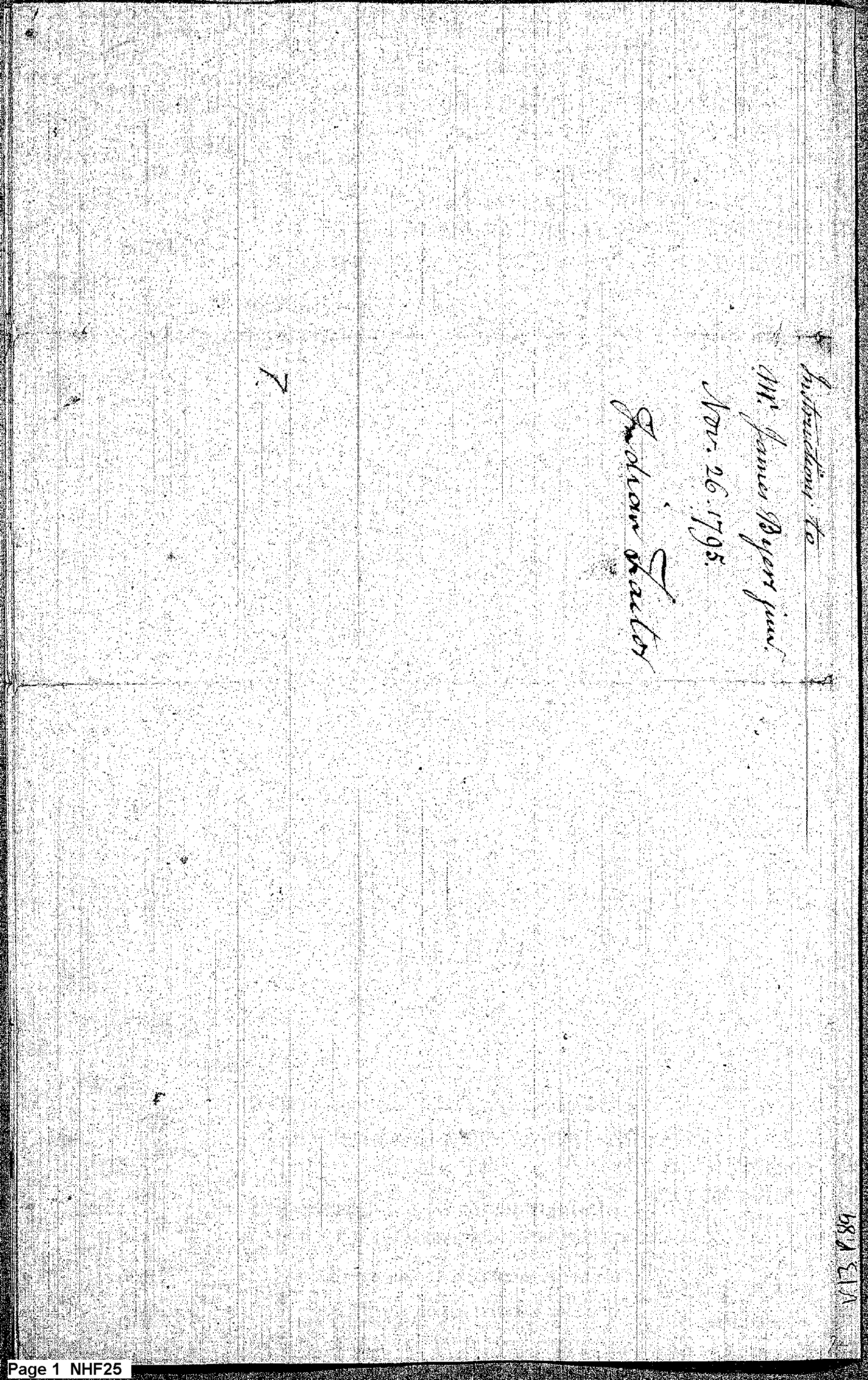
[Docket: Instructions to Mr James Byers junr. Nov. 26. 1795. Indian Trade.]
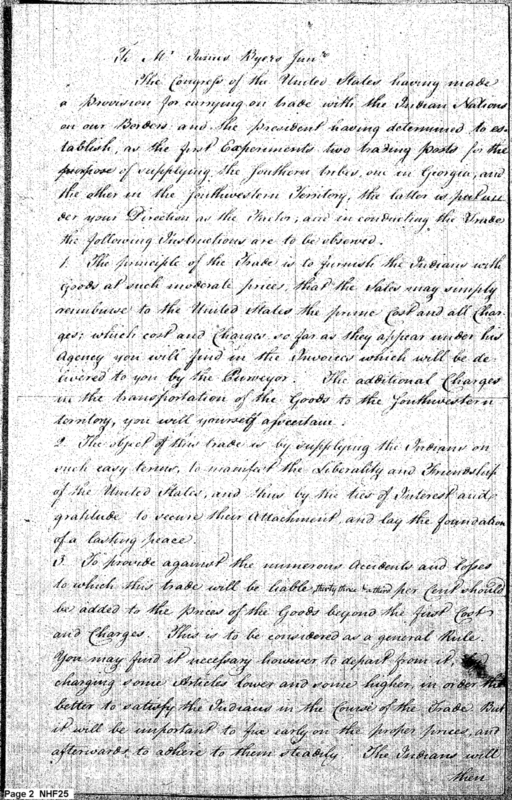
To Mr James Byers junr
The Congress of the United States having made a Provision for carrying on trade with the Indian Nations on our Borders and the President having determined to establish, as the first Experiments two trading posts for the purpose of supplying the Southern tribes, one in Georgia, and the other in the Southwestern Territory, the latter is put under your Direction as the Factor, and in conducting the trade the following Instructions are to be observed.
1 The principle of the Trade is to furnish the Indians with Goods at such moderate prices, that the sales may simply reimburse to the United States the prime Cost and all Charges; which cost and Charges so far as they appear under his Agency you will find in the Invoices which will be delivered to you by the Purveyor. The additional Charges in the transportation of the Goods to the Southwestern territory, you will yourself ascertain.
2 The object of this trade is by supplying the Indians on such easy terms, to manifest the liberality and Friendship of the United States, and thus by the ties of Interest and gratitude to secure their Attachment, and lay the foundation of a lasting peace.
3 To provide against the numerous Accidents and losses to which this trade will be liable [undecipherable] her Cost should be added to the prices of the Goods beyond the first Cost and Charges. This is to be considered as a general Rule. You may find it necessary however to depart from it, [undecipherable] charging some Articles lower and some higher, in order the better to satisfy the Indians in the Course of the Trade. But it will be important to fix early on the proper prices, and afterwards to adhere to them Steadily. The Indians will then know what to depend on, and not have their patience excited by the apprehension of unfair dealing, which a fluctuation of prices would be apt to beget.
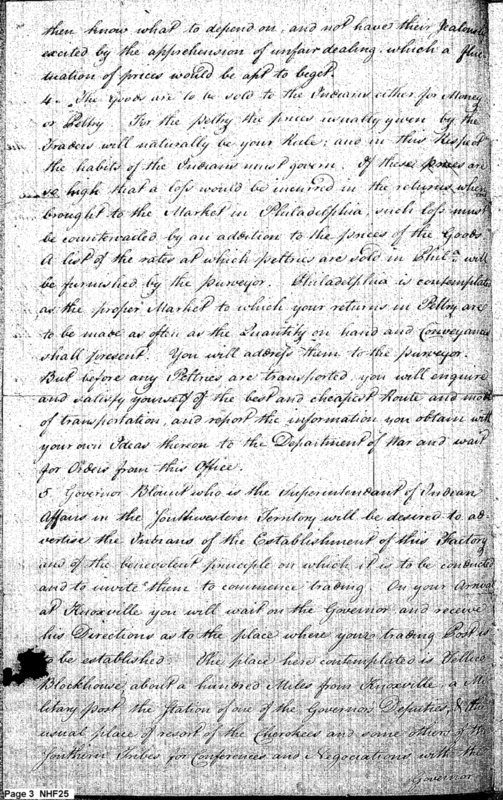
4. The goods are to be sold to the Indians either for Money or Pelley. For the Pelley the prices usually given by the Traders will naturally be your rule; and in this Respect the habits of the Indians must govern. If those prices are so high that a loss would be incurred in the [undecipherable] when brought to the Market in Philadelphia, such loss must be counteracted by an addition to the prices of the Goods. A list of the rates at which peltries are Sold in [undecipherable] will be furnished by the purveyor. Philadelphia is contemplated as the proper Market to which your returns in Pelley are to be made as often as the Quantity on hand and Conveyances shall [undecipherable: probable reading "permit"]. You will address them to the Purveyor. But before any Peltries are transported, you will enquire and satisfy yourself of the best and cheapest Route and mode of transportation, and report the information you obtain with your own Ideas thereon to the Department of War and wait for Orders from this Office.
5. Governor Blount who is the Superintendent of Indian Affairs in the Southwestern Territory will be desired to advise the Indians of the Establishment of this Factory, and of the benevolent principle on which it is to be conducted and to invite them to commence trading. On your Arrival at Knoxville you will wait on the Governor, and receive his Directions as to the place where your trading Post is to be established. The place here contemplated is Tellico Blockhouse about a hundred Miles from Knoxville, a Military post the Station of one of the Governors Deputies, & the usual place of resort of the Cherokees and some other of the Southern Tribes for Conferences and Negotiations with the Governor. It will of course be the place of residence of an Interpreter, who will be indispensably necessary to you in carrying on the trade.
6 One of the greatest Difficulties to be apprehended is the demand of Goods on Credit, either by the Indians themselves or the Indian Traders residing among them. But such Credits are wholly inadmissible; and selling to the Traders with or without Credit, would be subversive of the main principle, for such traders would probably sell at their usual high prices; while the true object of the United States is to supply the Indians at moderate prices, and with those benevolent views of the United States, you will on all occasions endeavour to make the Indians acquainted. If Difficulties should occur in carrying on the trade by the refusal of Credit to the Indians, and by the total denial of Goods to the Indian Traders, you will make report thereof to the Department of War, stating [undecipherable: probable reading "facts"], your Opinion thereon, and your Ideas of the best mode of furnishing Supplies to the Indians, to effect the Salutary Objects indicated in these Instructions.
7. The Purveyor will procure for you the necessary Information as to the mode of [undecipherable: probable reading "curing"] and packing the Peltries to ensure their getting to Market in good order.
8 You will doubtless find it necessary to obtain the assistance of an honest and industrious Man in the Sale and delivery of the Goods and in receiving and packing the Pellries. Great care must be observed in the Choice you make; he must be well recommended at first as to actual [undecipherable] maintain a Character of Irreproachability and Sobriety.
9 The commanding Officer of the Troops at the trading Post will at all times furnish you with necessary guard.
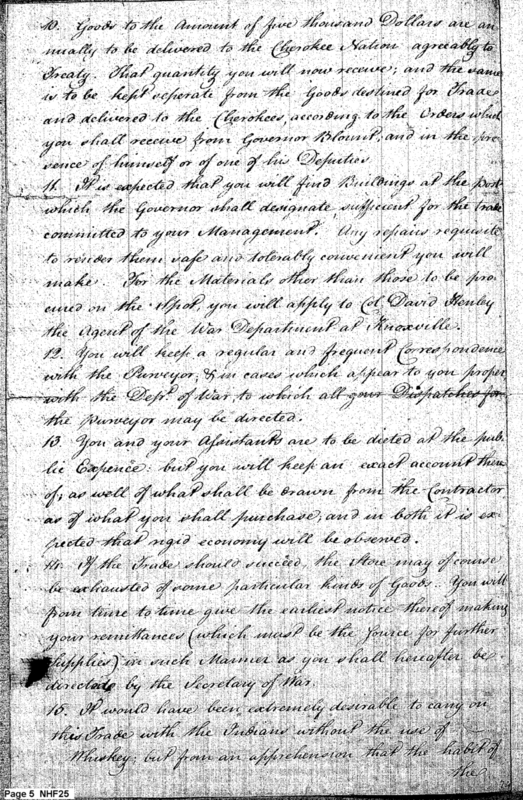
10. Goods to the amount of five thousand Dollars are annually to be delivered to the Cherokee Nation agreeably to Treaty. That quantity you will now receive; and the same is to be kept separate from the Goods destined for Trade and delivered to the Cherokees, according to the Orders which you shall receive from Governor Blount, and in the presence of himself or of one of his Deputies.
11. It is expected that you will find Buildings at the Post, which the Governor shall designate, sufficient for the trade committed to your Management. Any repairs requisite to render them safe and tolerably convenient you will make. For the Materials other than those to be procured on the Spot, you will apply to Col. David Henley the Agent of the War Department at Knoxville.
12. You will keep a regular and frequent Correspondence with the Purveyor, & in cases which appear to you proper with the Dept. of War, to which all your Dispatches for the Purveyor may be directed.
13. You and your Assistants are to be dieted at the public Expense; but you will keep an exact account thereof, as well of what shall be drawn from the Contractor and as of what you shall purchase; and in both it is expected that rigid economy will be observed.
14. If the Trade should succeed, the Store may of course be exhausted of some particular kinds of Goods. You will from time to time give the earliest notice thereof making your remittances (which must be the Source for further Supplies) in such Manner as you shall hereafter be directed by the Secretary of War.
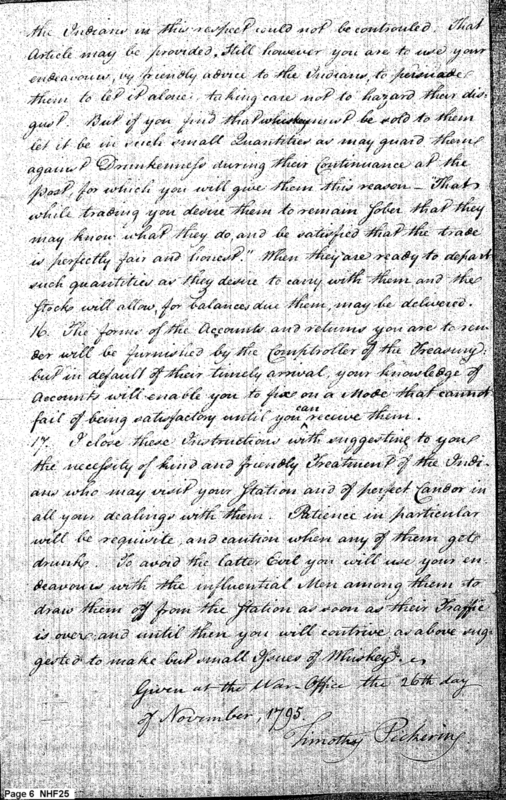
15. It would have been extremely desirable to carry on this Trade with the Indians without the use of Whiskey; but from an apprehension that the habit of the Indians in this respect would not be controlled. That Article may be provided, Still however you are to use your endeavours, by friendly advice to the Indians, to persuade them to let it alone, taking care not to hazard their disgust. But if you find that Whiskey must be sold to them, let it be in very small Quantities as may guard them against Drunkeness during their Continuance at the post; for which you will give them this reason — That while trading you desire them to remain Sober, that they may know what they do, and be satisfied that the trade is perfectly fair and honest. When they are ready to depart such quantities as they desire to carry with them and the Stock will allow, for balances due them, may be delivered.
16. The forms of the Accounts and returns you are to render will be furnished by the Comptroller of the Treasury; but in default of their timely arrival, your knowledge of Accounts will enable you to fix on a Mode that cannot fail of being satisfactory until you can receive them.
17. I close these Instructions with suggesting to you the necessity of kind and friendly Treatment of the Indians who may visit your Station, and of perfect Candor in all your dealings with them. Patience in particular will be requisite, and caution when any of them get drunk. To avoid the latter Evil you will use your endeavours with the influential Men among them to draw them off from the Station as soon as their Traffic is over, and until then you will contrive as above suggested to make but small Stores of Whiskey, &c.
Given at the War Office the 26th day of November, 1795.
Timothy Pickering
Type
Letter Signed
Description
Pickering provides detailed instructions for James Byers, the new factor of the southern trading posts, and emphasizes the General Government's policy of treating the Indians with fairness and benevolence.
Date
11/26/1795
Author
Recipient
Sent from
War Office
Collection
Document number
1795112640001
Page start
1
Notable persons
James Byers
Timothy Pickering
Congress
the President [Washington]
the Purveyor
traders
Governor Blount, Superintendent of Indian Affairs in the Southwestern Territory
Cherokee Nation
southern tribes
Interpreter
Commanding Officer of the troops at the Trading Post
Colonel David Henley
Contractor
Notable locations
War Office
Georgia
Southwestern territory
Knoxville
Notable items
trade with the Indian nations on our borders
trading posts
directions as the factor
instructions
moderate prices
sales
prime cost and all charges
invoices
transportation of the goods
easy terms
liberality and friendship of the United States
ties of interest and gratitude
foundation of a lasting peace
numerous accidents and losses
prices of the goods
unfair dealing
money or peltry
market in Philadelphia
factory
benevolent principles
blockhouse
refusal of credit
mode of saving and packing the peltries
character of perfect probity and sobriety
treaty
buildings
whiskey