

Filling the Office of Secretary of State
Document 1795Pickering, currently serving as both Secretary of State and Secretary of War, discusses his reluctance to accept the office of Secretary of State on a permanent basis but he feels it is his patriotic duty to do so. [A confidential letter.]

No human transcription currently available for this document.
This transcription was generated by machine using Anthropic's Claude Code (model sonnet 4.6). It may contain errors or inaccuracies. Please verify against the document image. Learn more about our generative AI methodology.
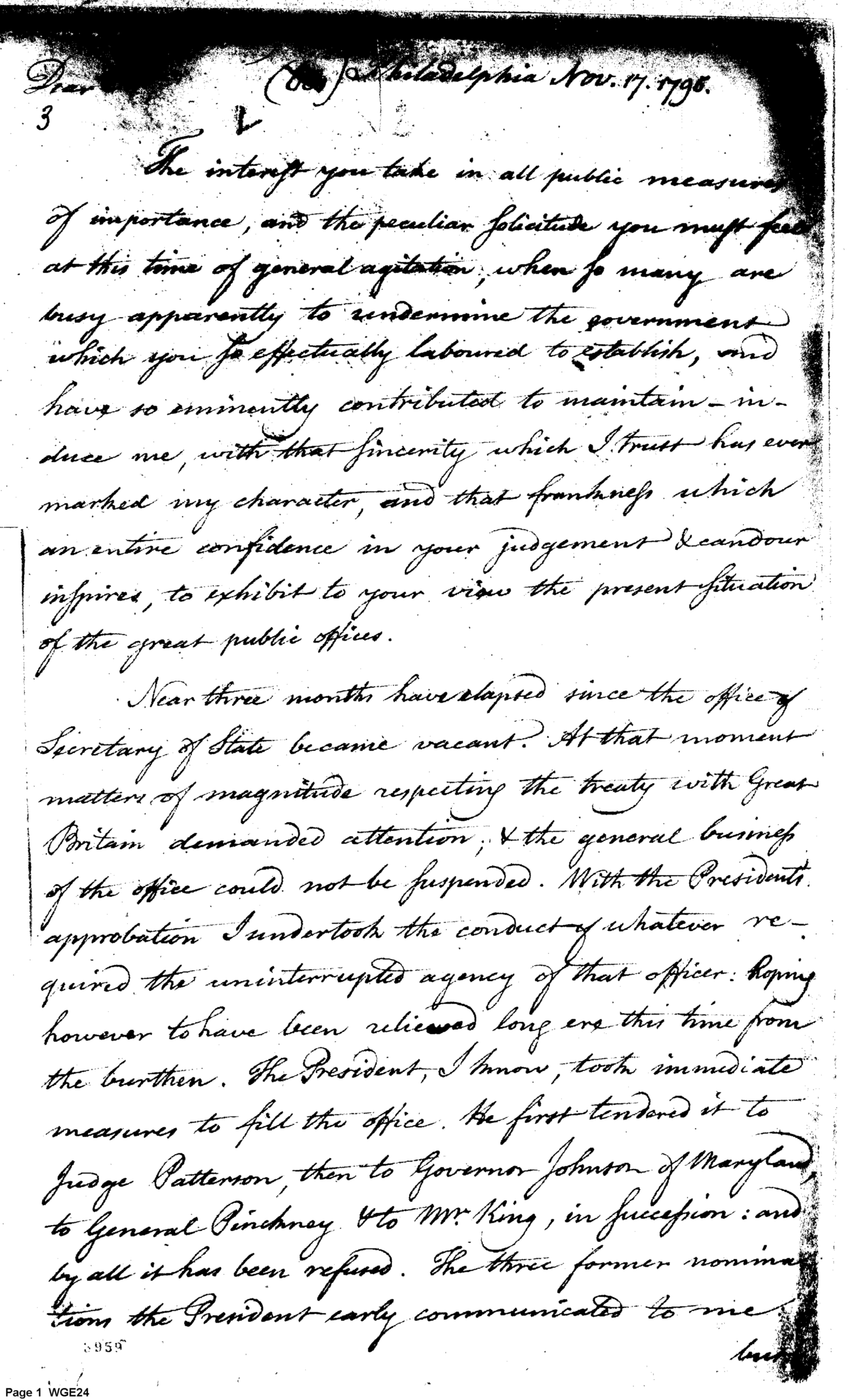
[Philadelphia Nov. 17, 1798.]
Dear [Sir,]
[3]
The interest you take in all public measures of importance, and the peculiar solicitude you must feel at this time of general agitation, when so many are busy apparently to undermine the government which you so effectually laboured to establish, and have so eminently contributed to maintain — induce me, with that sincerity which I trust has ever marked my character, and that frankness which an entire confidence in your judgement & candour inspires, to exhibit to your view the present situation of the great public office.
Near three months have elapsed since the office of Secretary of State became vacant. At that moment matters of magnitude respecting the Treaty with Great Britain demanded attention, & the general business of the office could not be suspended. With the Presidents approbation I undertook the conducting of whatever required the uninterrupted agency of that office. Hoping however to have been relieved long ere this time from the burthen. The President, I know, took immediate measures to fill the office. He first tendered it to Judge Patterson, then to Governor Johnson of Maryland, to General Pinckney & to Mr. King, in succession: and by all it has been refused. The three former nominations the President early communicated to me — but
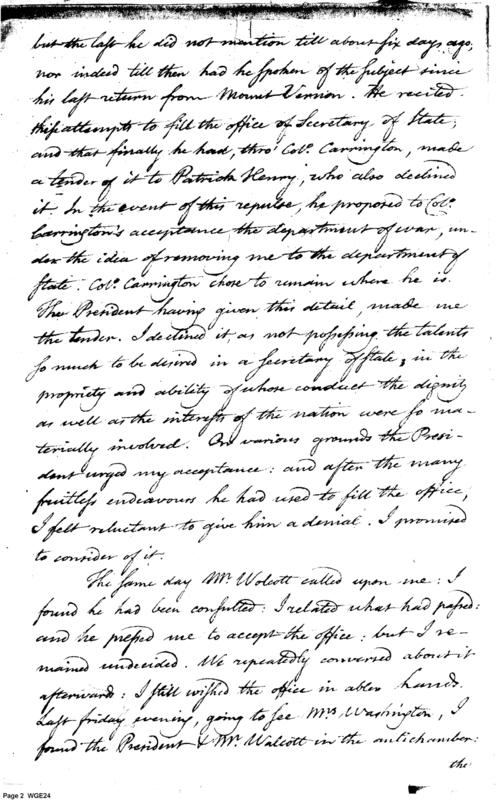
but the last he did not mention till about five days ago, nor indeed till then had he spoken of the subject since his last return from Mount Vernon. He recited his attempts to fill the office of Secretary of State; and that finally he had, thro' Col. Carrington, made a tender of it to Patrick Henry, who also declined it. In the event of this repulse, he proposed to Col. Carrington's acceptance the department of war, under the idea of removing me to the department of State. Col. Carrington chose to remain where he is. The President having given this detail made me the tender. I declined it as not professing the talents so much to be desired in a Secretary of State; in the propriety and ability of whose conduct the dignity as well as the interests of the nation were so materially involved. On various grounds the President urged my acceptance: and after the many fruitless endeavours he had used to fill the office, I felt reluctant to give him a denial. I promised to consider of it.
The same day Mr. Wolcott called upon me: I found he had been consulted. I related what had passed: and he pressed me to accept the office; but I remained undecided. We repeatedly conversed about it afterwards; I still wished the office in utter horror. Last friday evening, going to see Mrs. Washington, I found the President & Mr. Wolcott in the antichamber. the
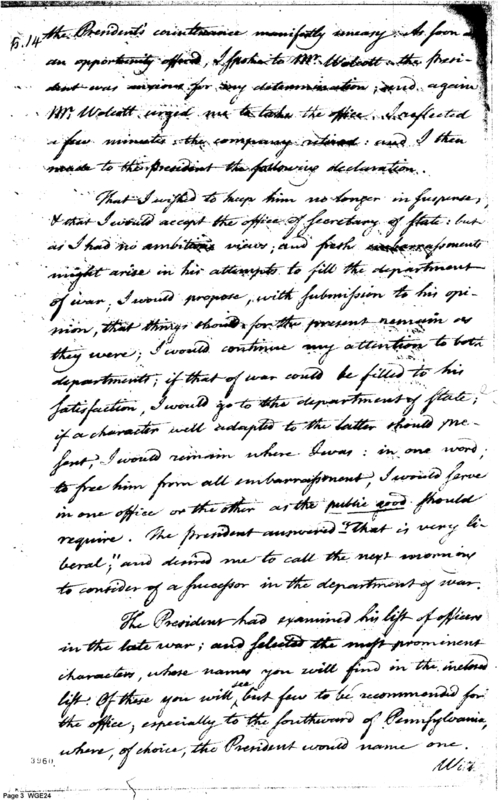
[p. 14] the Presidents countenance manifestly uneasy; & for an opportunity offered, I spoke to Mr. Wolcott; the President was anxious for my determination; and again Mr. Wolcott urged me to take the office. We parted a few minutes the company retired: and I then made to the President the following declaration.
That I wished to keep him no longer in suspense; & that I would accept the office of Secretary of State; but as I had no ambitious views, and fresh embarrassment might arise in his attempts to fill the department of war, I would propose, with submission to his opinion, that things should for the present remain as they were; I would continue my attention to both departments; if that of war could be filled to his satisfaction, I would go to the department of State; if a character well adapted to the latter should not present, I would remain where I was: in one word, to free him from all embarrassment, I would serve in one office or the other as the public good should require. The President answered "That is very liberal," and desired me to call the next morning to consider of a successor in the department of war.
The President had examined his list of officers in the late war; and [selected] the most prominent characters, whose names you will find in the inclosed list. Of those you will, but few to be recommended for the office, especially to the southward of Pennsylvania, where, of choice, the President would name one.
[3760]
[Wil]
[p. 15] With ample military talents, [undecipherable] is conceived to want other [undecipherable] essential to a Secretary of war. Embracing some great objects, the department comprehends a multitude of details, and economy in its numerous expenditures. This appointment would doubtless be extremely unpopular: it would be disapproved by the enemies of the government, without acquiring the confidence of its friends. These ideas I have already suggested to the President: Expressing his earnest desire to find a gentleman [southward] of Pennsylvania, the President remarked, that it would much be difficult to choose one from the other side of this State. But even there the object may perhaps be found not very easy to accomplish.
The State of New York has not now one officer on the general Staff of government. Colonel William North you will see is on the Presidents list. I have thought favourably of his character & abilities; but am not sufficiently acquainted to form any decisive opinion: you must know him well. Will you have the goodness to express your mind? Will you consider the whole life? Will you indulge me with your sentiments on all the subjects of this letter? One other idea ought perhaps to be taken into view: the President, beyond all doubt, will at the close of his present term, retire forever from public life; we do not know who will succeed him. Our internal politics and our exterior relations may be deeply
affected
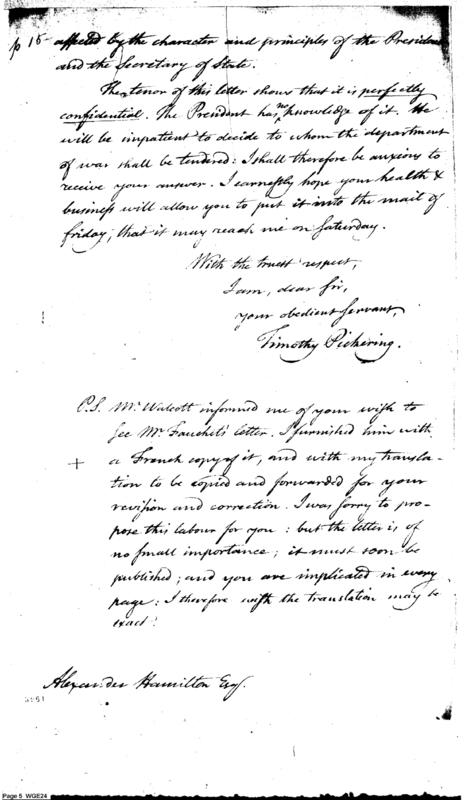
[p. 16] affected by the character and principles of the President and the Secretary of State.
The tenor of this letter shews that it is perfectly [underline: confidential]. The President has knowledge of it. He will be impatient to decide to whom the department of war shall be tendered: I shall therefore be anxious to receive your answer. I earnestly hope your health & business will allow you to put it into the mail of friday; that it may reach me on Saturday.
With the truest respect,
I am, dear Sir,
your obedient Servant,
Timothy Pickering.
P.S. Mr. Wolcott informed me of your wish to see Mr. Fauchet's letter. I furnished him with a French copy of it; and with my translation to be copied and forwarded for your revision and correction. I was sorry to propose this labour for you: but the letter is of no small importance; it must soon be published; and you are implicated in every page. I therefore wish the translation may be exact.
Alexander Hamilton Esq.
Type
Autograph Letter Signed
Description
Pickering, currently serving as both Secretary of State and Secretary of War, discusses his reluctance to accept the office of Secretary of State on a permanent basis but he feels it is his patriotic duty to do so. [A confidential letter.]
Date
11/17/1795
Author
Recipient
Sent from
Philadelphia
Repository
Collection
Document number
1795111700001
Note
Cited in Hamilton to Pickering, 11/20/1795.
A private letter.
Notable persons
Alexander Hamilton
Timothy Pickering
the President [Washington]
Judge [William] Patterson
Governor [Thomas] Johnson
General [Charles Cotesworth] Pinckney
Mr. [Rufus] King
Col. [Edward] Carrington
Patrick Henry
Mr. [Oliver] Wolcott
Mrs. [Martha] Washington
General [Henry] Lee
enemies of the government
Colonel William North
Capt. [Jonathan] Dayton
General [Edward] Hand
General [Jedediah] Huntington
General [William] Irvine
Col. Philip B. Bradley
Col. David Forman
Col. [John Eager] Howard
Col. William Heth
Col. Nathaniel Ramsay
General James Wood
Col. John Brooks
Col. David Cobb
Notable locations
Philadelphia
Maryland
Mount Vernon
Pennsylvania
New York
Notable items
great public offices
office of Secretary of State
treaty with Great Britain
department of war
department of state
internal politics
exterior relations