No human transcription currently available for this document.
[Tench Frances
Esquire]
War Office June 29 1793.
Sir,
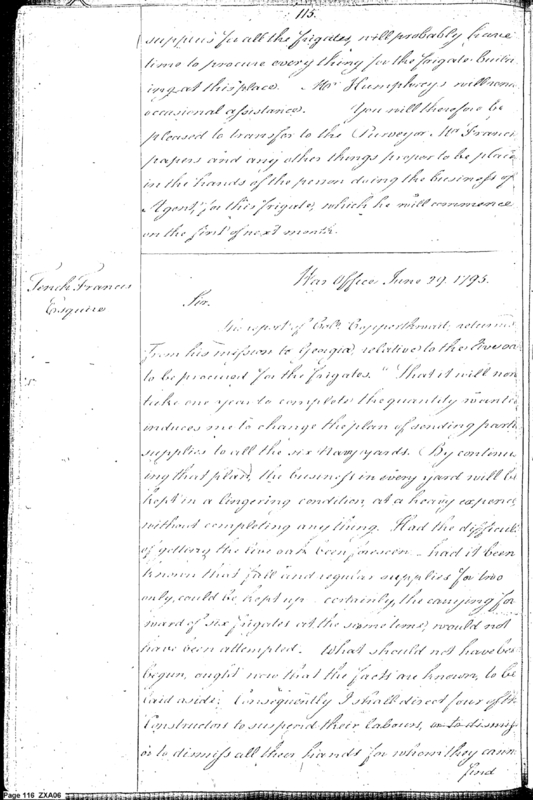
In report of Colo Copperthwait advices from his mission to Georgia, relative to the live oak to be procured for the frigates. "That it will now take one year to complete the quantity wanted" induces me to change the plan of sending partial supplies to all the six Navy yards. By continuing that plan, the business in every yard will be kept in a lingering condition, at a heavy expence, without completing any thing. Had the difficulty of getting the live oak been foreseen — had it been known that full and regular supplies for two only could be kept up — certainly, the carrying forward of six frigates at the same time, would not have been attempted. What should not have been begun, ought now that the facts are known, to be laid aside. Consequently I shall direct four of the Constructors to suspend their labours, or to dismiss, or to dismiss all their hands for whom they can-
find constant, and useful employment. Here I refer to any uncommon timber on hand, and to what may be expected by them in the vessels which shall be loaded wholly, or in part, when the new orders shall reach Mr Magan for their respective yards. If indeed, they should have on board only a small number of timbers (say about a dozen, in any one vessel) which have been already supplied to the two yards which are to be kept open, they may be sent to one or the other of those two yards — which are those of Philadelphia and Baltimore. Those few surplus sticks may be reshipped with any other surplus timber, to New York, and Norfolk.
Philadelphia and Baltimore are preferred for continuing the work, because those ports, especially the former, are the most likely to be cut off from winter supplies by means of ice.
Besides the saving of expence by changing the plan as now proposed, other advantages may arise. Two frigates may be completed many months by, on the whole, if carried on together, could be finished; and should there be a call for their service, they might be equipped, and sent to sea, while the rest were progressing. Some errors may be committed in the construction of the first frigates, improvements suggested. Then in the residue the error may be avoided, and the improvements adopted. You will now be pleased to give the requisite orders for the live oak procuring for the frigates in conformity with the ideas here expressed, including