

Attorney General responds to legal inquiry made by Secretary at War
Document 1795Document, discusses state claims on Indian lands; discusses State rights and Federal government; informs re Constitutional powers; discusses Congress; discusses United States Constitution.
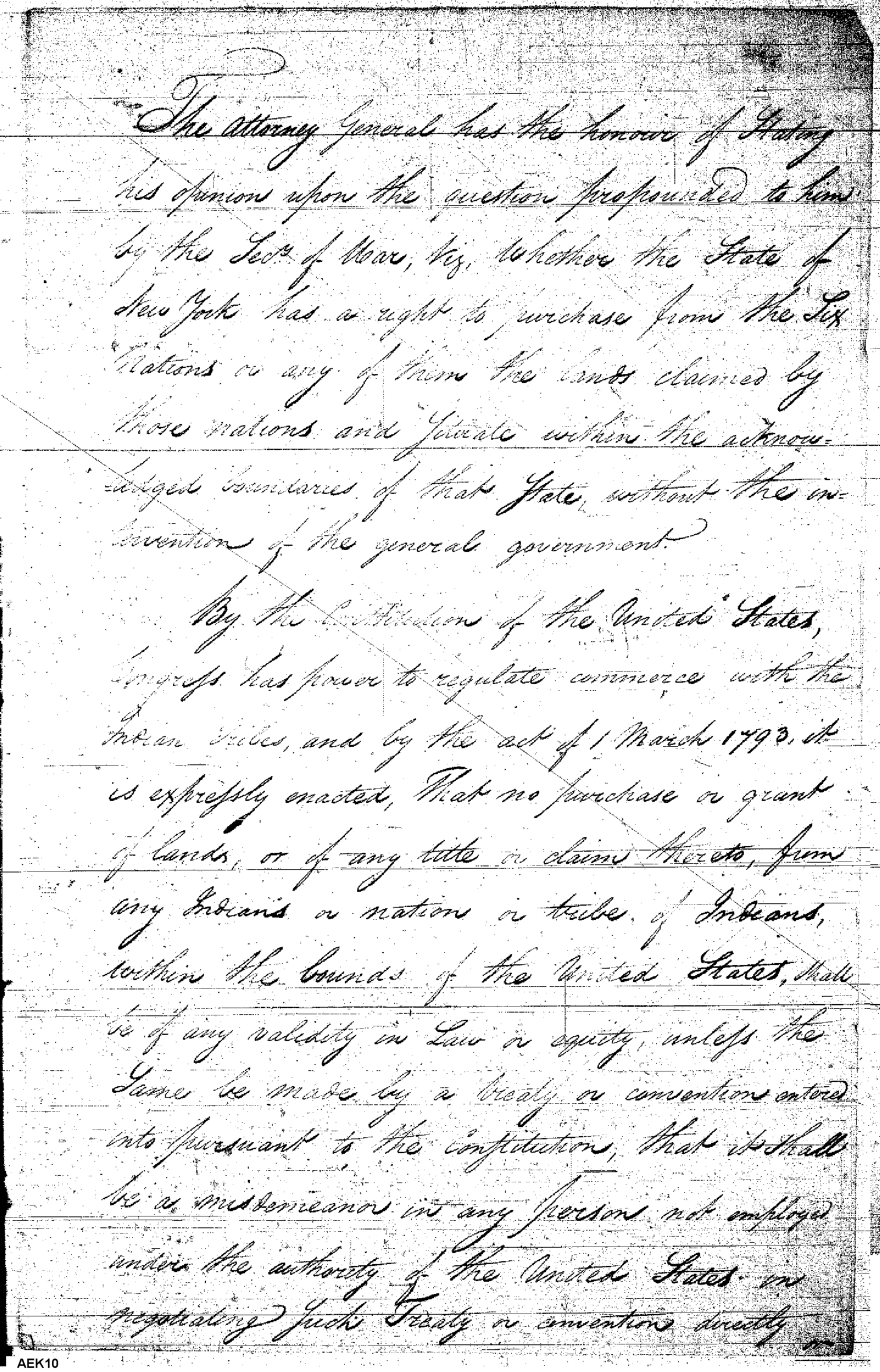
The Attorney General has the honour of stating his opinion upon the question propounded to him by the Secy of War, Viz, Whether the State of New York has a right to purchase from the Six Nations or any of them the lands claimed by those nations and situate within the acknowledged boundaries of that State, without the intervention of the general government.
By the Constitution of the United States, Congress has power to regulate commerce with the Indian Tribes, and by the act of 1 March 1793, it is expressly enacted, That no purchase or grant of lands, or of any title or claim thereto, from any Indians or nation or tribe of Indians, within the bounds of the United States, shall be of any validity in Law or equity, unless the same be made by a treaty or convention entered into pursuant to the institutions, that it shall be a misdemeanor in any person not employed under the authority of the United States in negotiating such Treaty or convention directly
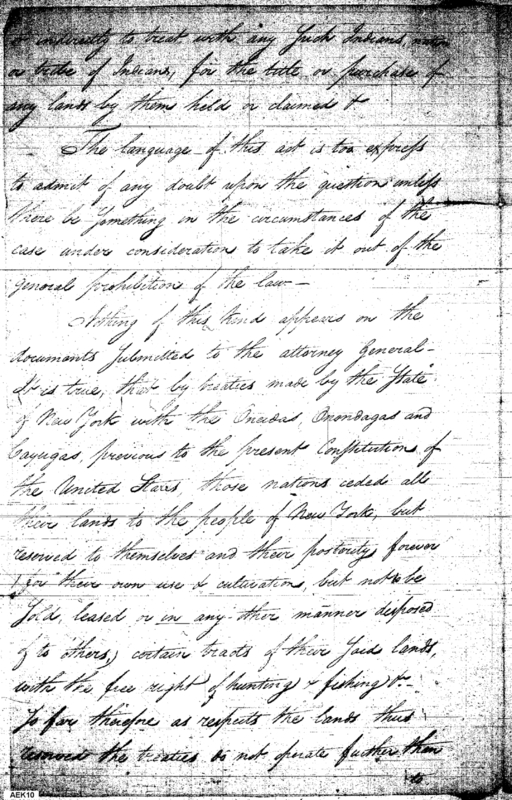
or indirectly to treat with any such Indians, nation, or tribe of Indians, for the title or purchase of any lands by them held or claimed &c.
The language of this act is too express to admit of any doubt upon the question unless there be something in the circumstances of the case under consideration to take it out of the general prohibition of the law.
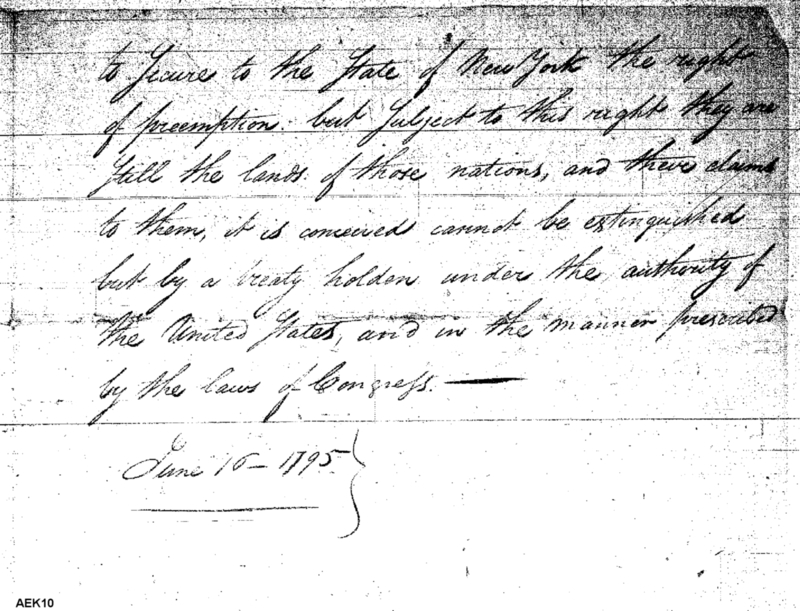
Nothing of this kind appears on the documents submitted to the Attorney General. It is true, that by treaties made by the State of New York with the Oneidas, Onondagas and Cayugas, previous to the present Constitution of the United States, those nations ceded all their lands to the people of New York, but reserved to themselves and their posterity forever for their own use & cultivations, but not to be sold, leased or in any other manner disposed of to others, certain tracts of their said lands with the free right of hunting & fishing &c. So far therefore as respects the lands thus reserved the treaties do not operate further than
to secure to the State of New York the right of preemption, but subject to this right they are still the lands of those nations, and their claims to them it is conceived cannot be extinguished but by a treaty holden under the authority of the United States, and in the manner prescribed by the laws of Congress.
June 16 - 1795}
This transcription was generated by machine using Anthropic's Claude Code (model sonnet 4.6). It may contain errors or inaccuracies. Please verify against the document image. Learn more about our generative AI methodology.