No human transcription currently available for this document.
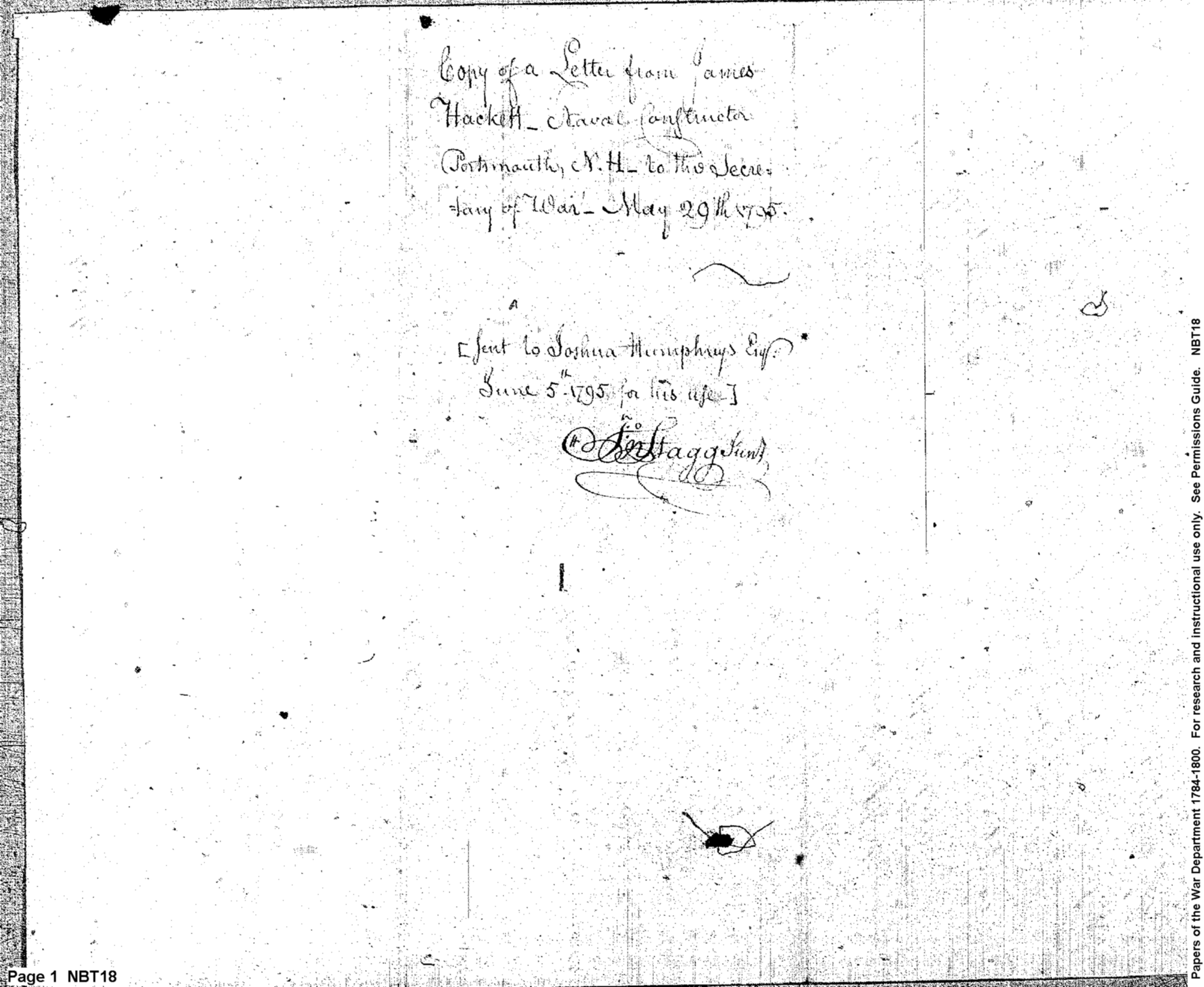
[Copy of a Letter from James Hackett Naval Constructor Portsmouth, N.H. to the Secretary of War — May 29th 1795.]
[Sent to Joshua Humphreys Esqr. June 5. 1795. for his use.]
[signature/initials]
Portsmouth N. Ho May 29 1795
Sir
I received your letter of the 13 instant, inclosing Mr Humphreys letter of 31st December 1794, & February 7. 1795, also yours of the 19 instant with Mr Humphreys letter of the 16 instant and his table of the timber of the Frigates, I have observed the contents. I have ever been of the opinion that the scantlings of the timber for the 36 Gun Frigates were to large, & am happy to find Mr Humphreys ideas in reducing them coincide with mine, also I think the transoms & fashion pieces are too heavy, and if reduced in the moulding, the upper fashion pieces sided two inches thinner, it would take off a weight from the Stern, which as it now is will be a strain to this thin part of the Ship. The main transom does not work to the dimensions, it being very veiny and somewhat defective, and will not moudle more than twenty inches, nor side more than nineteen. The second and third transoms are both breeched & small heart-streaks appear in the middle and on the backsides of them all. The first futtocks side to the dimensions, and part of the second also. The third futtocks will not side more than eleven inches to get them straight. The sternpost will not work to the dimensions at the head by an inch, so as to make it any way square. In my opinion the Gun deck beams sided and moulded according to the dimensions given for the Frigates of 36 Guns are too large in proportion to other ships of war. For an English Ship carrying 100 Guns, the lower deck beams are moulded eighteen inches and sided the same. For 90 Guns the beams are moulded sixteen & one quarter inches, & sided seventeen. For 70 Guns the beams are moulded sixteen & half inches and sided the same. For 60 Guns the beams are moulded 15¾ inches and
and sided fifteen inches.
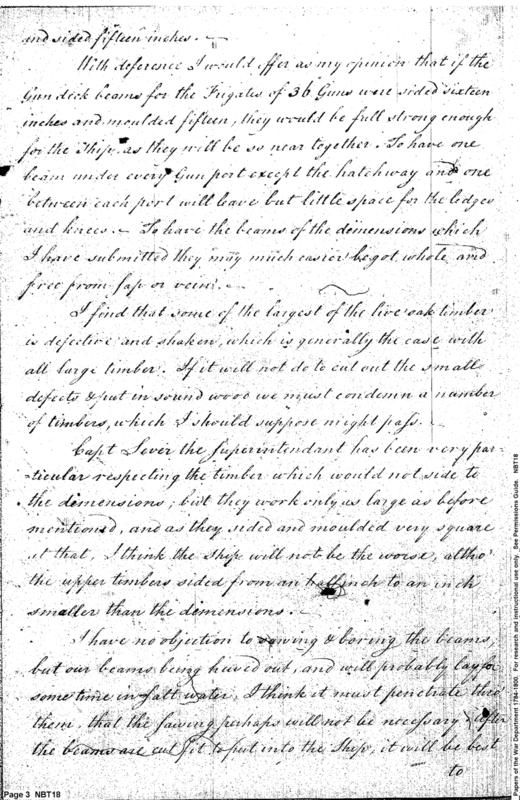
With deference I would offer as my opinion that if the Gun deck beams for the Frigates of 36 Guns were sided sixteen inches and moulded fifteen, they would be full strong enough for the Ships, as they will be so near together. To have one beam under every Gun port except the hatchway and one between each port will leave but little space for the ledges and knees. To have the beams of the dimensions which I have submitted they may much easier be got whole and free from sap or veins.
I find that some of the largest of the live oak timber is defective and shaken, which is generally the case with all large timber. If it will not do to cut out the small defects & put in sound wood we must condemn a number of timbers, which I should suppose might pass.
Capt Sevier the Superintendent has been very particular respecting the timber which would not side to the dimensions; but they work only as large as before mentioned, and as they sided and moulded very square at that, I think the Ship will not be the worse, altho' the upper timbers sided from an half inch to an inch smaller than the dimensions.
I have no objection to sawing & boring the beams, but our beams being hewed out, and will probably lay for some time in salt water, I think it must penetrate thro' them, that the sawing perhaps will not be necessary & if the beams are cut fit to put into the Ship, it will be best to
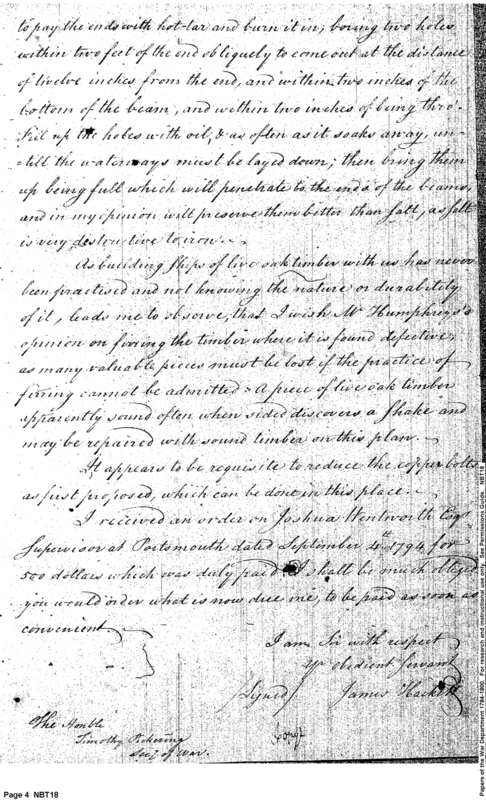
to pay the ends with hot tar and burn it in, boring two holes within two feet of the end obliquely to come out at the distance of twelve inches from the end, and within two inches of the bottom of the beam, and within two inches of being thr[ough], fill up the holes with oil, & as often as it soaks away, until the waterways must be laid down; then bring them up being full which will penetrate to the ends of the beams, and in my opinion will preserve them better than salt, as salt is very destructive to iron.
As building Ships of live oak timber with us has never been practised and not knowing the nature or durability of it, leads me to observe, that I wish Mr Humphreys opinion on feiring the timber where it is found defective, as many valuable pieces must be lost if the practice of feiring cannot be admitted. A piece of live oak timber apparently sound often when sided discovers a shake and may be repaired with some timber on this plan.
It appears to be requisite to reduce the copper bolts as first proposed, which can be done in this place.
I received an order on Joshua Wentworth Esqr Supervisor at Portsmouth dated September 4th 1794 for 500 dollars which was duly paid & shall be much obliged you would order what is now due me, to be paid as soon as convenient.
I am Sir with respect
Yr obedient Servant
Signed James Hackett
The Honble
Timothy Pickering
Secy of War