

Articles of Treaty Negotiations
Document 1795Timothy Pickering - interim Secretary of War - provides General Wayne with instructions relative to the approaching treaty with the Indians.
No human transcription currently available for this document.
This transcription was generated by machine using Anthropic's Claude Code (model sonnet 4.6). It may contain errors or inaccuracies. Please verify against the document image. Learn more about our generative AI methodology.
Now I have all 20 pages. Let me produce the full transcription.
[For]
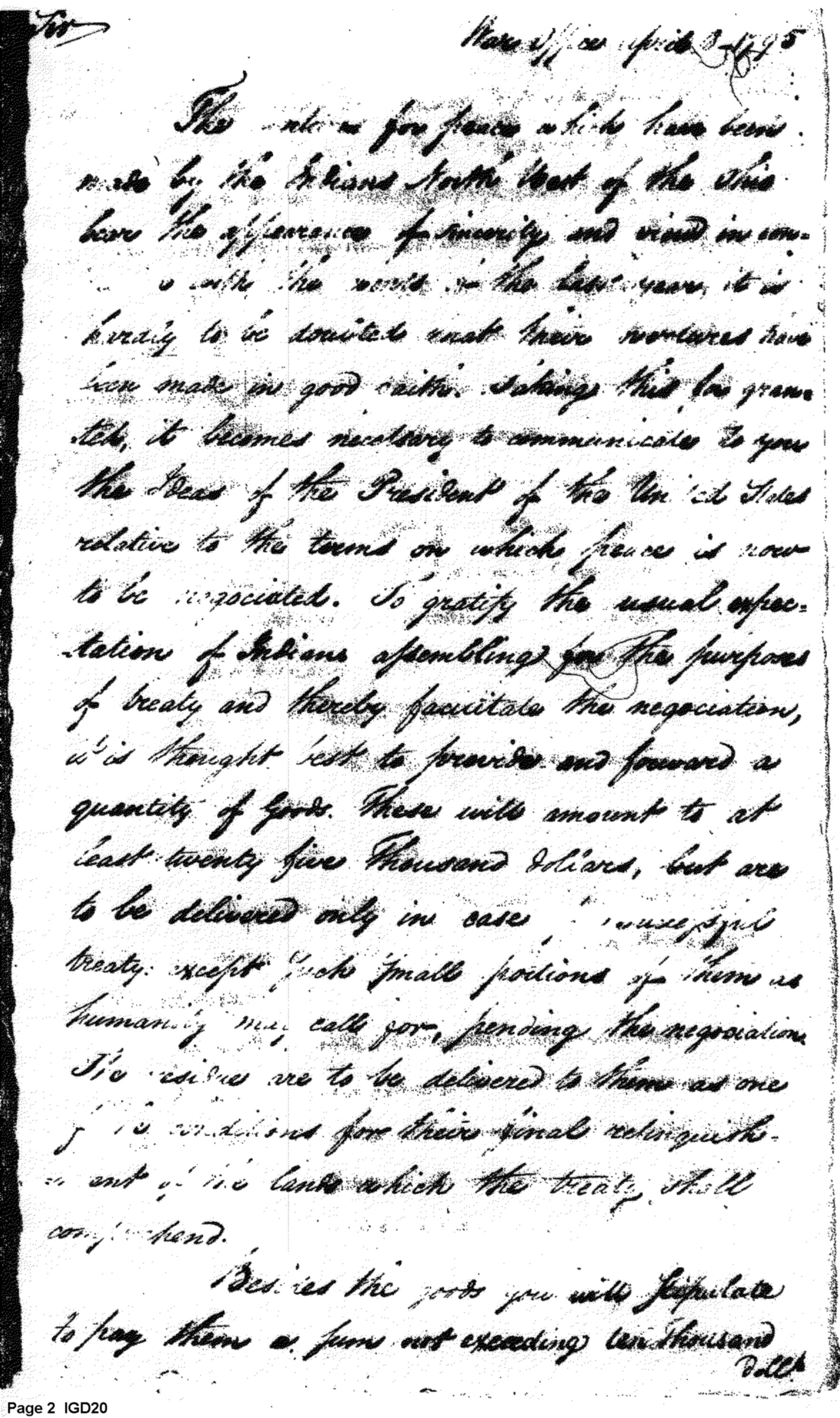
War Office April 8, 1795
The overtures for peace which have been made by the Indians North West of the Ohio have the appearance of sincerity and view'd in connexion with the events of the last year, it is hardly to be doubted that their overtures have been made in good faith. Taking this for granted, it becomes necessary to communicate to you the ideas of the President of the United States relative to the terms on which peace is now to be negotiated. To gratify the usual expectation of Indians assembling for the purposes of treaty and thereby facilitate the negociation, it is thought best to provide and forward a quantity of goods. These will amount to at least twenty five thousand dollars, but are to be delivered only in case [undecipherable] treaty: except such small portions of them as humanity may call for, pending the negociation. The residue are to be delivered to them as one of the conditions for their final relinquishment of the lands which the treaty shall comprehend.
Besides the goods you will stipulate to pay them a sums not exceeding ten thousand
Doll[ars]
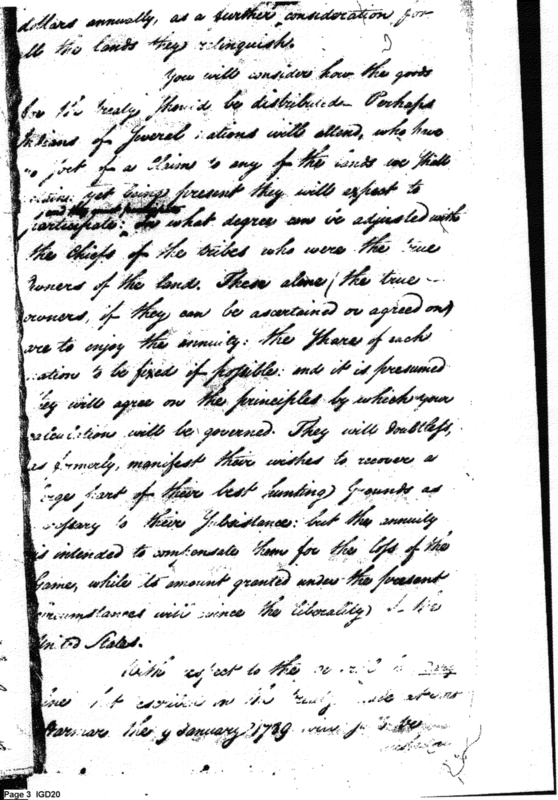
dollars annually, as a further consideration for all the lands they relinquish.
You will consider how the goods for the treaty should be distributed. Perhaps Indians of several nations will attend, who have no [object] as claims to any of the lands we shall obtain: yet being present they will expect to [and the goods] participate: On what degree are we adjusted with the chiefs of the tribes who were the true owners of the lands. These alone (the true owners, if they can be ascertained or agreed on) are to enjoy the annuity: the shares of each nation to be fixed if possible: and it is presumed they will agree on the principles by which your calculations will be governed. They will doubtless, as formerly, manifest their wishes to recover a large part of their best hunting grounds as necessary to their Subsistence: but the annuity is intended to compensate them for the loss of the game, while its amount granted under the present circumstances will evince the liberality of the United States.
With respect to the [undecipherable] [boundary] line [undecipherable] [the] [undecipherable] carries on the [treaty] [made at undecipherable] [the] 9th
[boundary] they [January] 1789 [undecipherable]
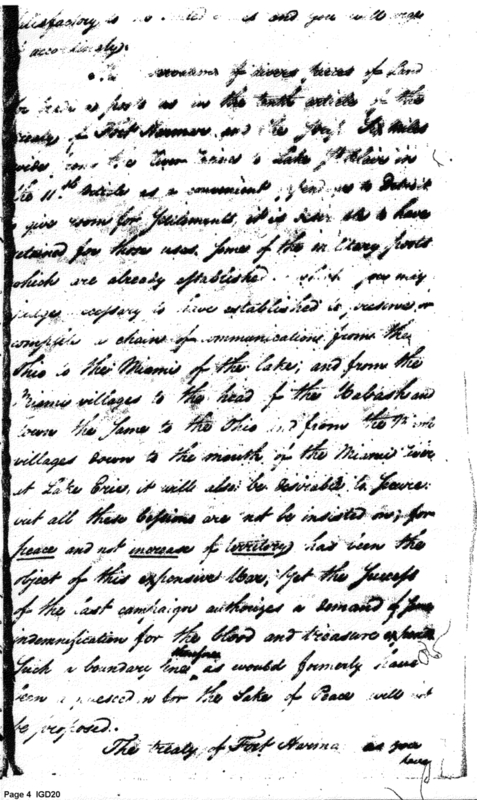
[undecipherable] is [undecipherable] and you will [to] [undecipherable]
[need] hastily.
The [measures] of rivers, pieces of land [to be] [seen] as far as in the tenth article of the treaty of Fort Harmar, and the great [six] miles wide from the upper lines to Lake St Clair in its 11th article as a convenient [place,] [here] as a distinct give room for Settlements, it is [seen] also to have retained for those uses some of the military posts which are already established [with] you may judge [also] necessary to have established to reserve or complete a chain of communications from the Ohio to the Miamis of the Lake; and from the Miamis villages to the head of the Wabash and thence the same to the Ohio [and] from the [Miami] villages down to the mouth of the Miami river at Lake Erie, it will also be desirable to [secure:] but all these [designs] are not be insisted on; for [underline: peace] and not [underline: increase of territory] has been the object of this expensive [war]; yet the [success] of the last campaign authorizes a demand of some indemnification for the blood and treasure expended. [Therefore:] Such a boundary line as would formerly have been [accepted] for the sake of Peace will not be proposed.
The treaty of Fort Harmar as you [have]
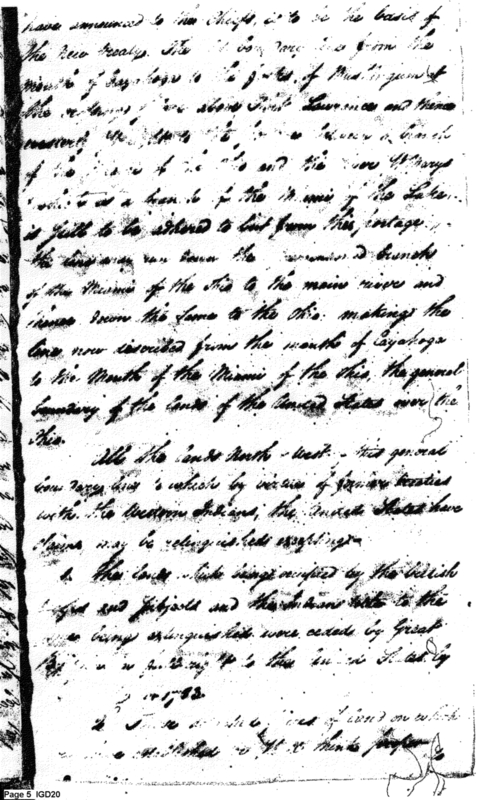
have announced to the Chiefs, is to be the basis of the new treaty. [The] boundary line from the [mouth] of [Cayahoga] to the [gates] of [Muskingum] [the nations] [was] above [Saint] Lawrence and thence [westerly] [up along] to [so as to] give [a branch] of [the land to the and] the [new] [Murray] [which] to as a [branch] of the Miamis of the Lake. [It] is [still] to be offered to last from this [portage.] The line may run down the [unnamed] branch of the Miamis of the Ohio to the main river and thence down the same to the Ohio, making the line now described from the mouth of Cayahoga to the Mouth of the Miamis of the Ohio, the general boundary of the lands of the United States over the Ohio.
All the lands North & West [of] this general boundary lines to which by [virtue] of former treaties with the Western Indians, the United States have claims may be relinquished excepting—
1. The lands which being occupied by the British [forts] and [subjects] and the Indians title to the [being] extinguished were ceded by Great [Britain] in [the] treaty [to the] United [States] [of] 1783.
2. [Some] of the other [tracts] of land on which [the undecipherable] [established] to [fit] [those] [purposes]
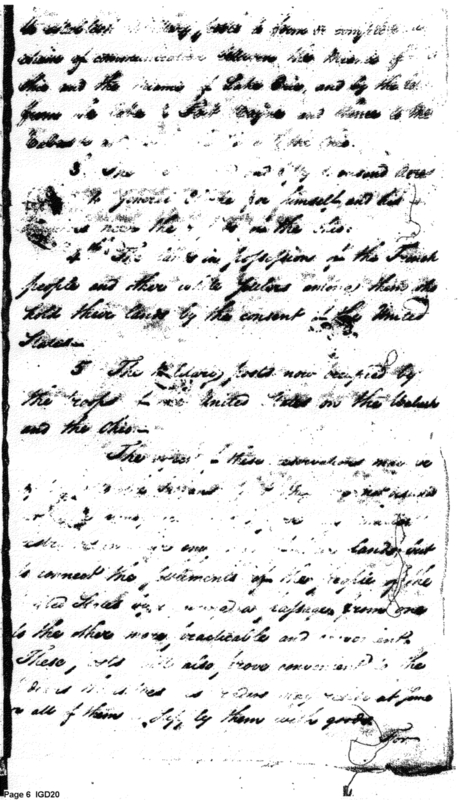
to [establish every,] tracts to form or complete the chain of communications [between] the Miamis of the Ohio and the [rivers] of Lake Erie, and by the [rivers] from the [lake] to Fort [Wayne] and thence to the Wabash [and] [the] [undecipherable] [the] [Ohio].
3. [The undecipherable] [the] [already owned by] [General Wayne] for himself and his [at] near [the] [mouth] on the [Ohio].
4th The lands in possession of the French people and others with [families among] them who hold their lands by the consent of the United States.
5 The Military posts now occupied by the troops of the United States on the Wabash and the Ohio.
The [result] of these [provisions] may [be] [undecipherable] [the] [general] [results] [undecipherable] [undecipherable] lands; but [to] correct the [testaments] of the [public of the] United States [in] [moved] as [passages] from one to the other more practicable and [more] [undecipherable]. These, [it] is also, [prove] convenient to the [derived undecipherable] [they could] at [some] to all of them. [Supply] by them with [goods.]
[undecipherable] [undecipherable] [undecipherable] [undecipherable] [the] [Word]
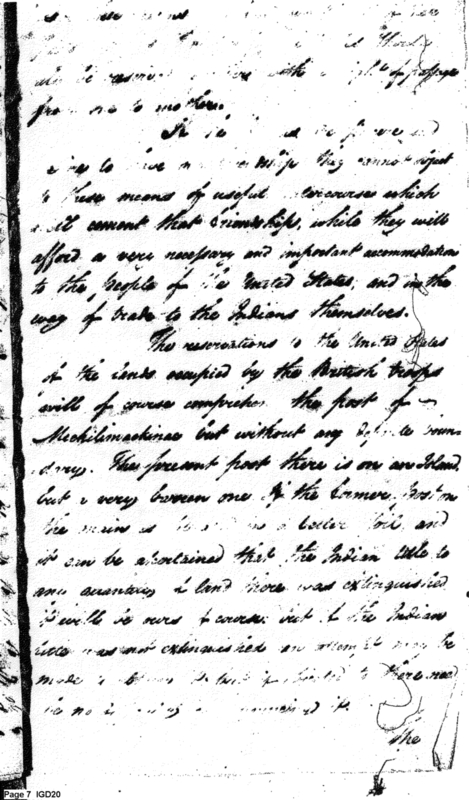
[and] to [reserve] [undecipherable] with [the] [help] of [passage] from one to another.
It is [undecipherable] of those they cannot [reject] to have means of useful [intercourse] which it cannot [but] create their [friendship,] while they will afford a very necessary and important accommodation to the people of the United States, and in the way of trade to the Indians themselves.
The reservations to the United States of the lands occupied by the British troops will of course comprehend the post [of] Mechilimackinac but without any definite boundaries. The present post there is on an island, but a very [barren] one. [If the Indians is forced] as [to have] a better [site,] and it can be ascertained that the Indian title to any quantity of land there was extinguished it will be ours of course: but if the Indians title was not extinguished an attempt may be made to purchase it [here;] [there is] no [necessity of commanding] it.
[The] [is] relinquished [and] [with] [the] [last] [terms,]
[But] [in] [case] [there] is any basis in the [undecipherable]
[and their utterances to sit on together.]
[It may be as it is the undecipherable]
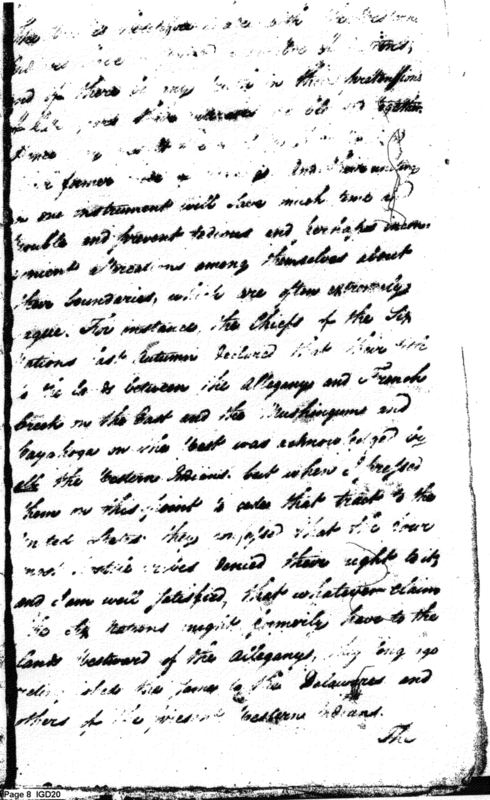
[a former was + is the undecipherable] in one instrument will [save] much time and trouble and prevent tedious and [perhaps] inconvenient [discussions] [among] themselves about their boundaries, which are often extremely vague. For instance, the Chiefs of the Six Nations last Autumn declared that their [territory undecipherable] to be between the Allegany and French Creek on the East and the [Muskingum] and Cayahoga on the [West] was acknowledged by all the Western Indians. But when I pressed them on this point to cede that track to the United States they [replied] that the [Congress] [had] [denied] their right to it, and I am well satisfied, that whatever claim the Six nations might formerly have to the lands westward of the Allegany, they long ago relinquished the same to the Delawares and others of the [present] [western] Indians.
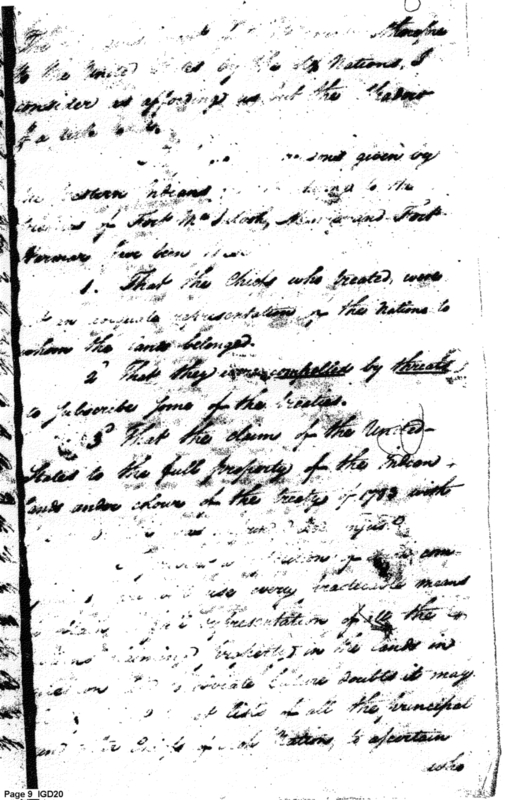
[strongly] to the United [States] by the Six Nations. I consider [us] as obtaining not [less] the [favour] of a [title] to.
[and more] given [by] the [eastern] Indians. [to as to] the boundary [at] Fort Mc[Intosh,] [Monroe,] and Fort [Harmar] have been [made].
1. That the Chiefs who treated, were not [adequate] representations of the Nations to whom the lands belonged.
2d That they were [underline: compelled] by [underline: threats] to subscribe some of the treaties.
3d That the claims of the United States to the full property of the Indians lands under colour of the treaty of 1783 with [Great Britain was unjust].
[undecipherable] [Indians] [they shall use every practicable means] [to] [display] [their] [representation of] all the [nations] [in their borders] in the lands [in] and [on an private claim] doubts it may [and of sale of] all the principal [men of the] chiefs of all Nations, to ascertain
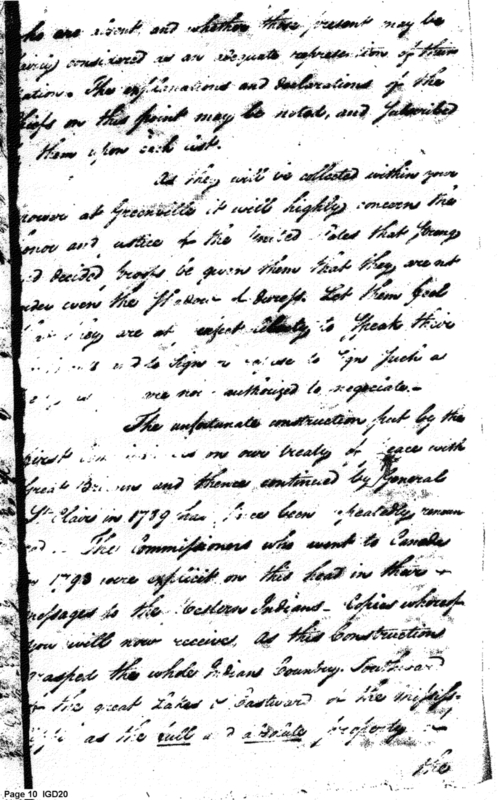
who
who are present, and whether those present may be fairly considered as an adequate representation of their nation. The explanations and declarations of the chiefs on this point may be noted, and submitted them upon each act.
As they will be collected within your power at Greenville it will highly concern the honor and justice of the United States that [strong] and decided proofs be given them that they are not under even the [shadow] of [duress]. Let them feel that they are at perfect liberty to speak their [minds] and to sign or refuse to sign such as they are not authorized to negotiate.
The unfortunate construction put by the [British undecipherable] on our treaty of peace with Great Britain and thence continued by General St Clair in 1789 has since been [materially] [removed]. The Commissioners who went to Canada in 1793 were explicit on this head in their messages to the Western Indians. Copies [whereof] you will now receive. As this construction [has] grasped the whole Indian Country [South] and to the great Lakes [Eastward] of the Mississippi, [undecipherable] as the [full] of a [private] [property] [undecipherable]
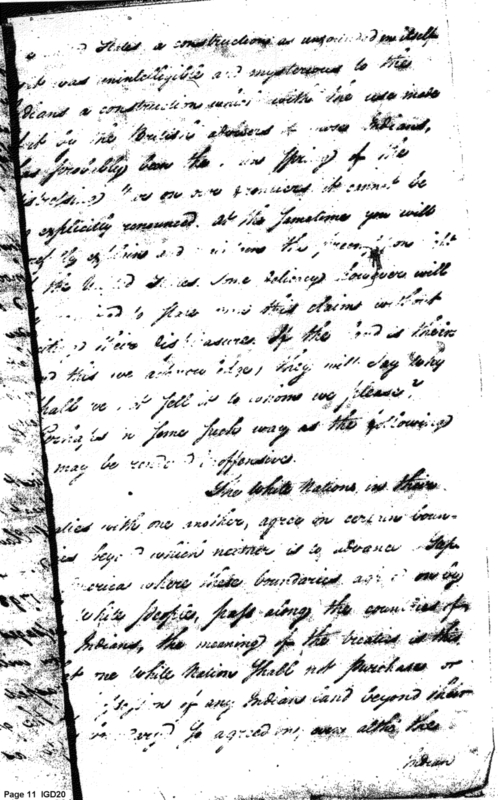
[United] States a construction as ungrounded in itself [it] was unintelligible and mysterious to the Indians a construction [united] within the [undecipherable] by the British advisers of [those] Indians, and [has] [forcibly] been [the undecipherable] spring of the [hostilities] [on our frontiers,] it cannot be explicitly [renounced]. At the same time you will [notify] the Indians and [urge] them [the] commissioners [with] the United States. Some delicacy [however] will [be required] to [place with] their claims in that [situation with] their [rightasures:] By the [land] is theirs and this we acknowledge; they will say why shall we not [sell] it to whom we please? [Propound] in some such way as the following may be [rendered] less offensive.
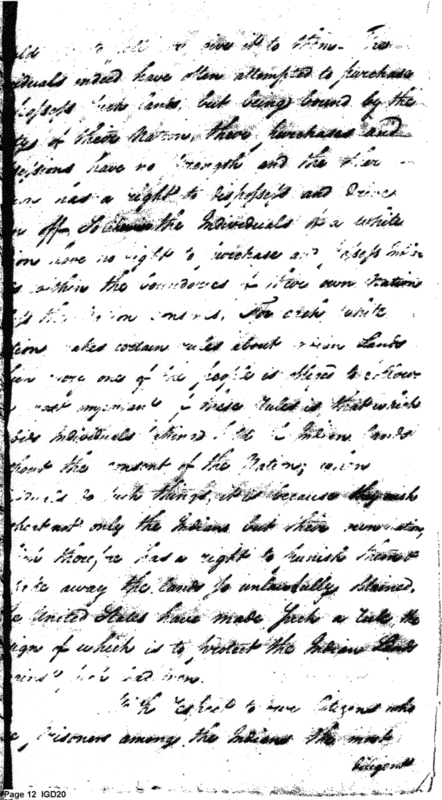
The White Nations in their dealings with one another, agree on certain boundaries beyond which neither is to advance. [Into] America where these boundaries are [to be run,] White Peoples [pass along] the countries of Indians, the meaning of the treaties is that no White Nations shall not purchase or [take] possession of any Indians land beyond their [boundaries to] agreed on, even [after] the Indians
[Indians] to sell or give it to them. [For] individuals indeed have often attempted to purchase [possessions from] those lands, but being bound by the [laws] of their nations, their purchases and possessions have no strength and the [nation] has a right to dispossess and drive [them] off. So likewise the individuals of a white nation have no right to purchase and possess [Indians land] within the boundaries [of] their own nations [as] their own [nations.] The great white [nations] makes certain rules about [their own] lands [for] more one of the [people] is [there] to [allow;] the most important [of] these Rules is that which bids individuals [retiring] to the Indians lands without the consent of the [Nations;] [which is] found to such things, it is because they wish to protect not only the Indians but their own nations; [in those] they has a right to punish them to take away the lands so unlawfully obtained. The United States have made such a [rule,] the signs of which is to protect the Indian lands [against their] aggressors.
With respect to our Citizens who [are] [prisoners] among the Indians [they must]
[diligent]
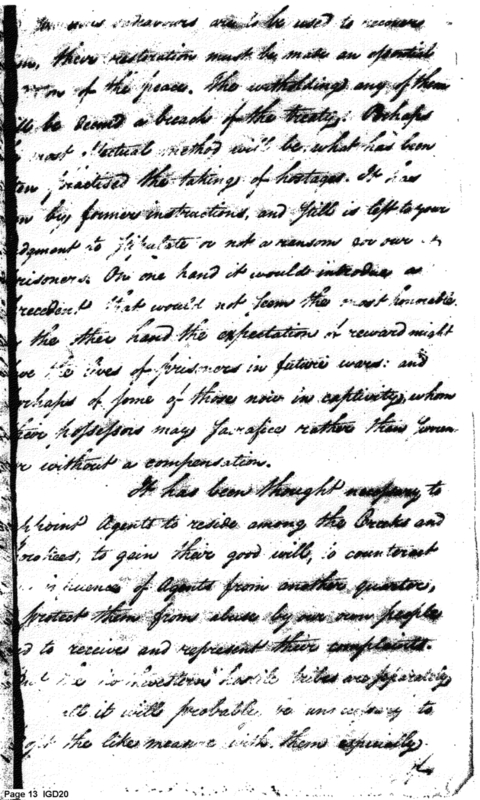
[their] various behaviours are to be [used] to recover [them.] Their restoration must be made an essential [term] of the peace. The withholding any of them will be deemed a breach of the treaty: Perhaps the most effectual method will be what has been [of] [practised] the takings of hostages. It is [covered] by former instructions, and still is left to your judgment to stipulate or not a ransom on our prisoners. On one hand it would introduce a precedent that would not seem the most laudable. On the other hand the expectations of reward might save the lives of prisoners in future wars: and perhaps of some of those now in captivity, whom their possessors may sacrifice rather than surrender without a compensation.
It has been thought necessary to appoint Agents to reside among the Creeks and [Cherokees,] to gain their good will, to counteract the influences of Agents from another quarter, protect them from abuses by our own people and to receive and represent their complaints. But the [Western] [hostile] tribes are [specially] all it will probable be unnecessary to get the like measures with them especially.
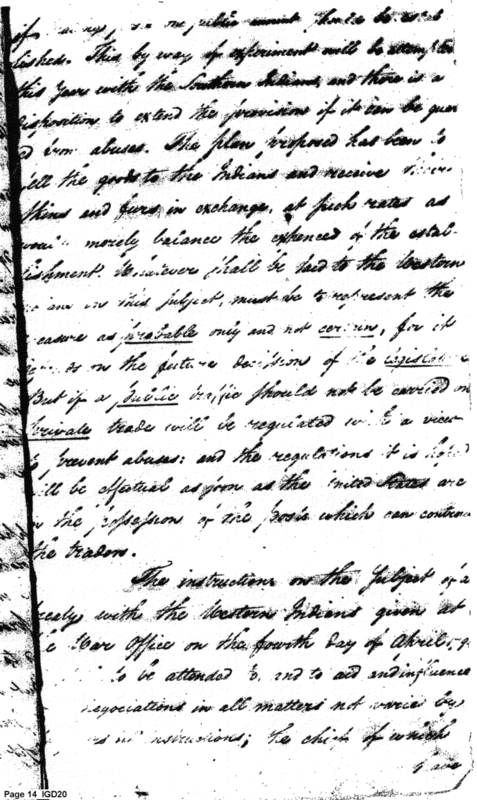
[for any on one, a suitable agent should be established.] This by way of experiment will be [attempted] this year with the Southern Indians, and there is a [disposition] to extend the [provisions] if it can be guarded from abuses. The plan [proposed] has been to sell the goods to the Indians and receive their skins and furs in exchange, at such rates as [would] nearly balance the expenses of the establishment. [Whatever] shall be said to the [Western] Indians on this subject, must be to represent the measure as [underline: probable] only and not [underline: certain,] for it [rests] on the future decisions of the [underline: [Legislature].] But if a [underline: public] [underline: [traffic]] should not be carried on, [underline: private] trade will be regulated with a view to prevent abuses: and the regulations it is [hoped] will be effectual as soon as the United States are in the possession of the posts which can control the traders.
The instructions on the subject of a treaty with the Western Indians given at the War Office on the fourth day of April, [1794] are to be attended to, and to aid and influence [the] negotiations in all matters not varied by [the present] instructions; the chief of which [was]
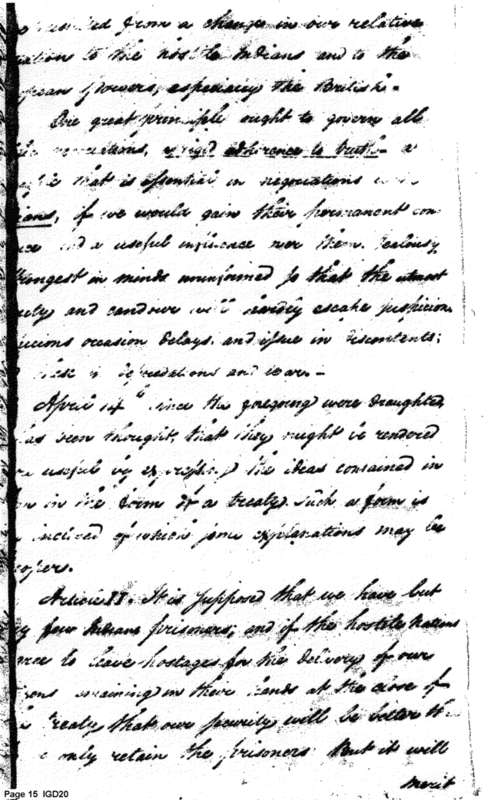
[resulted] from a change in our relative [position] to the hostile Indians and to the [European] [powers,] especially the British.
One great principle ought to govern all [the] negotiations, [underline: rigid adherence to truth—] a [principle] that is essential in negotiations with Indians, if we would gain their permanent confidence and a useful influence [over] them. [Jealousy] strongest in minds [unaccustomed to that] the utmost [nicety,] and candour will rarely escape [suspicion.] [Suspicion] occasion delays, and [rise] in [discontents;] These [are] [observations] and [caution—]
April 14th Since the foregoing were [draughted] [it] has been thought, that they ought to be rendered as useful as possible by expressing the ideas contained in [them] in the form of a treaty. Such a form is enclosed of which some explanations may be proper.
Article It It is supposed that we have but few Indians prisoners; and if the hostile nations agree to leave hostages for the delivery of our [citizens] remaining in their hands at the close of the treaty, that our security will be better [to] only retain the [prisoners] but it will
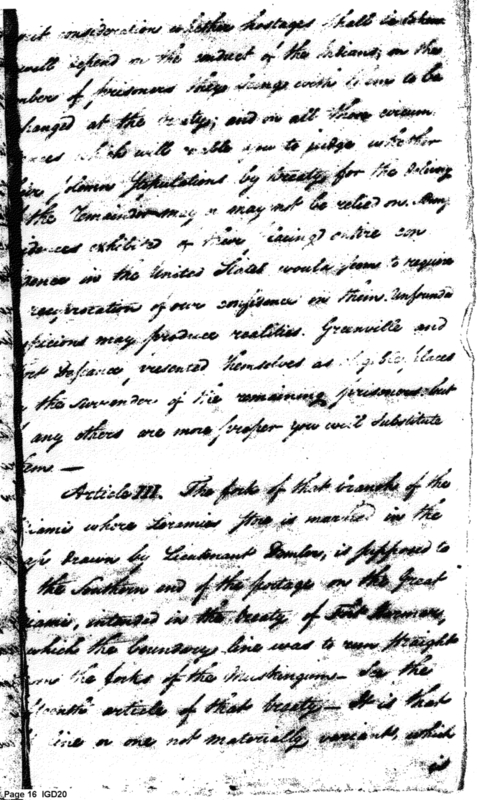
merit
[merit] consideration [whether] hostages shall [be taken] will depend on the conduct of the Indians; on the number of prisoners they [change with us] one to be exchanged at the treaty; and on all these circumstances [Acts] this will enable you to judge whether their [solemn] stipulations by treaty for the delivery of the remainder may or may not be relied on. Any [deficiencies] exhibited of their having entire confidence in the United States would seem to require [regeneration] of our confidence on them. Unfounded [suspicions] may produce realities. Greenville and [Fort] [Defiance,] [presented] themselves as [available] places [for] the surrender of the remaining [prisoners:] but any others are more [proper] you will substitute them.—
Article III. The fork of that branch of the [Miami] where [Loremia's store] is marked in the [line] drawn by Lieutenant [Damler,] is supposed to be the Southern end of the portage on the Great [Miami,] intended in the treaty of Fort Harmar, which the boundary line was to run straight from the forks of the Muskingum. For the [seventh] article of that treaty. It is that line or one not materially [variant,] which [is]
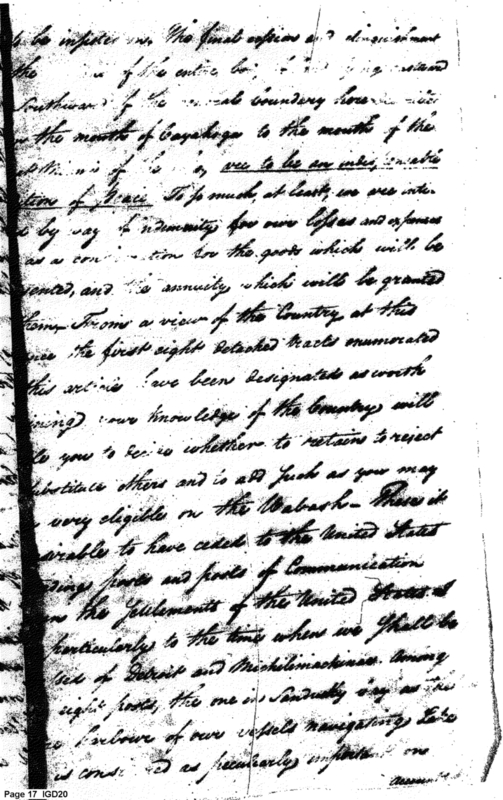
to be insisted on. The final action and [relinquishment] of the [line of] the entire [boundary] [long sustained southward] of the [movable] boundary [here undecipherable] the mouths of Cayahoga to the mouths of the [Miami of this] is [however over to be] our [indispensable] [condition] of [Peace.] So much, at least, we are [entitled] by way of [indemnity,] for our [losses] and expenses as a [consideration] for the goods which will be [given,] and the annuity, which will be granted to them. From a view of the Country at this time the first eight detached tracts enumerated [in] this [article] have been designated as worth [gaining;] your knowledge of the Country will enable you to decide whether to retain or reject [and] substitute others and to add such as you may [see] very eligible on the Wabash. [There it] is desirable to have ceded to the United States the [rivers,] [posts] and posts of Communication [serving] the Settlements of the United States and particularly to the time when we shall be [received] of Detroit and Michilimackinac. Among the eight posts, the one on Sandusky Bay as the [harbour] of our vessels navigating Lake [Erie] is considered as particularly important.
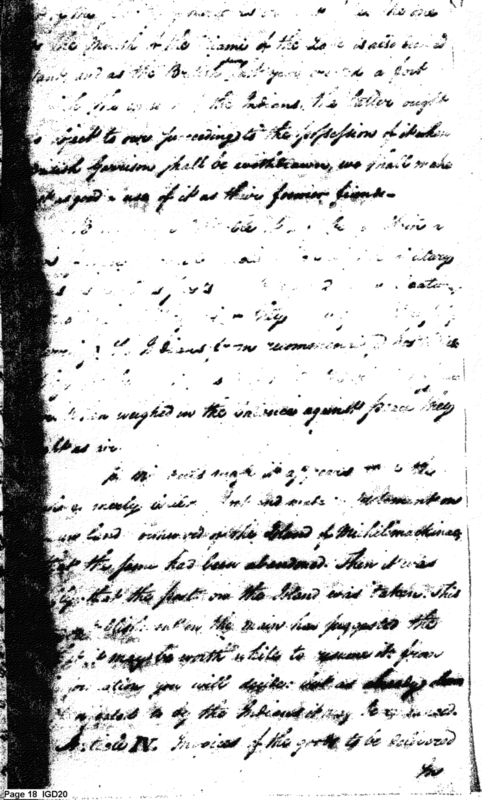
[the undecipherable and] in the one [of the mouth] of the [Miami] of the Lake is also [needed] and as the British last year [moved] a [fort] [towards] the Indians. The latter ought [to be] [attached] to our [proceeding] to the [possessions] of it when [such] garrison shall be [withdrawn;] we shall make [advantageous] use of it as their former [friend.]
3. [undecipherable] [the books of the undecipherable] [a] [undecipherable] [military] [and undecipherable undecipherable undecipherable undecipherable] [and undecipherable] [and] [there remains]
to be [weighed] on the [undecipherable] against [peace] they [were] as [we].
[In that posts made at Greenville in the town] is [merely] a list. [In and what a] settlement [on] land [renowned of] the Island of Michilimackinac, [says] the [same] has been abandoned. Then it was [suggested] that the [post] on the Island was taken. This [establishment] on the [ruins] has [suggested] the [plan] it may be worth while to [resume] it from [you] [ation,] you will desire it as [clearly then to] intend to do the Indians it may be [resumed.]
Article IV. [In] [voice] of the [goods] to be delivered [the]
in [case] of the [treaty] with it [undecipherable] [undecipherable].
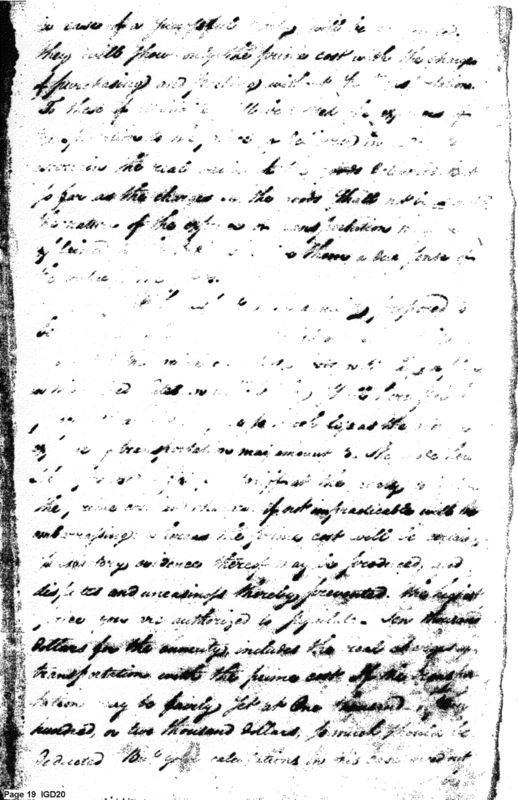
they will show only [the] [purchase] cost with the charges of purchasing and [he does with the first stations.] To [have] [a undecipherable] the [bill of sale,] [so as undecipherable undecipherable undecipherable] and [undecipherable undecipherable] with the [real] purchases and [undecipherable] so far as the charges on the roads shall [admit;] the nature of the [expenses] and [positions undecipherable] of [their undecipherable undecipherable. There] a [bill,] [hence from undecipherable how]
[undecipherable undecipherable undecipherable undecipherable undecipherable disposed of]
[undecipherable undecipherable undecipherable undecipherable]
[undecipherable] the [undecipherable] [such the like the]
[and undecipherable that we not the thing,] [finding that]
[undecipherable undecipherable established as the undecipherable]
[undecipherable] [transportation] may amount to [the whole sum]
[and undecipherable undecipherable] if not [impracticable] with no embarrassing. [In some the frames] cost will be [receiving,] it [customs] by [evidences thereof] may be [produced,] and disputes and uneasiness thereby prevented. The highest [annuity] you are authorized to stipulate. [How their annuity] dollars for the annuity, [includes] the real [charges] in transportation with the [prime] cost of the [foreign] [ations] may be fairly set at One [thousand] [five] hundred, or two thousand dollars, so much of which to be [deducted by] [their calculations] in his [course and not]
[as argument the question undecipherable undecipherable than Book]
[undecipherable undecipherable undecipherable undecipherable undecipherable undecipherable]
[to one of concerns this]
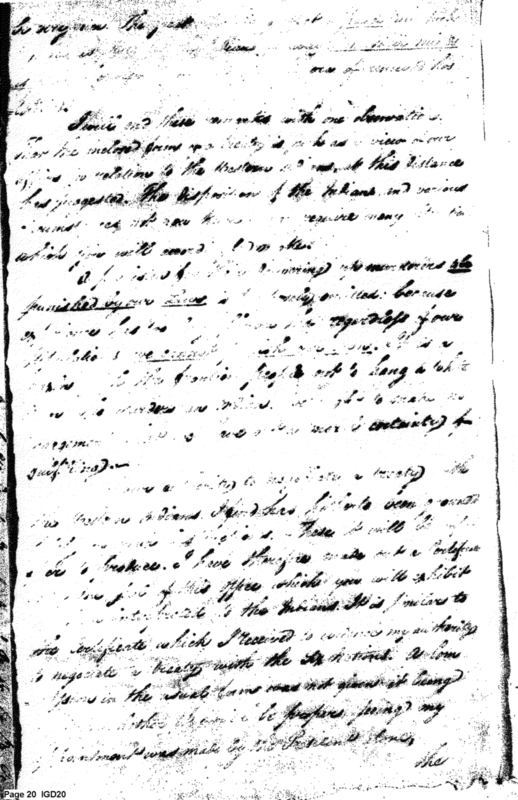
[Simil]arly these [monies] with one [observation.] For the enclosed form of a treaty it is to be as a view of our ideas in relation to the Western [Indians] at this distance [has proposed.] The disposition of the Indians and various [circumstances] [undecipherable] requires many [facts] in which you will record on the spot.
[On a matter of this,] [forming into remembrances the] [punished in your law it is truly omitted.] because [undecipherable those by the undecipherable] regardless of [our] [article] the [annuity:] [undecipherable is a of the frontier,] [ought not to hang a white on and murders or articles, are to make the undecipherable] there we [run more certainly to argument undecipherable undecipherable]
[undecipherable] to enter into a [treaty,] [the] the Western Indians. [I then has into two parts undecipherable undecipherable undecipherable undecipherable. There is will be undecipherable to its frontiers.] I have [things] made with a [certificate] from [the] office which you will exhibit [in undecipherable words] to the Indians. It is [intend] to [undecipherable which I Received is contains] my [authority] to negotiate a treaty with the [Six Nations.] As long as [it was] in the [usual] form [was] not given it being [undecipherable] I [thought] it best to [propose,] [joining] my [appointment] [and was made] by the President himself. [The]
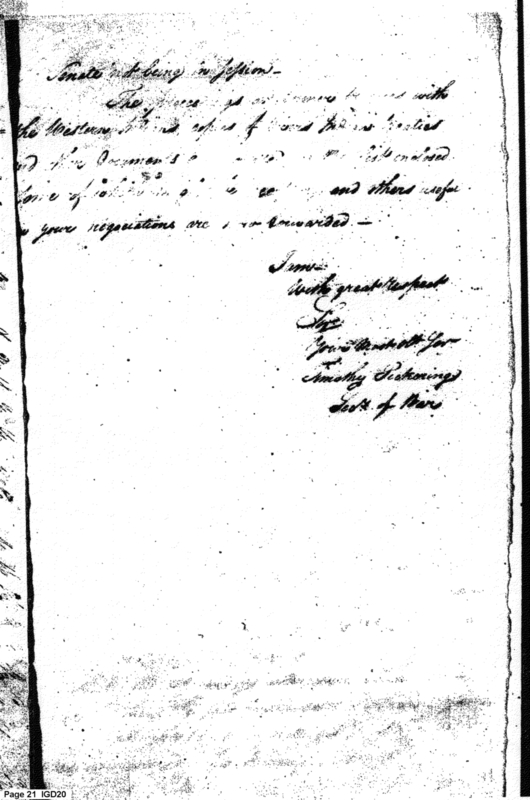
Senate not being in session.
The [press of undecipherable] to [carry with] the Western [Indians,] copies of [those previous] [treaties] and the Documents [and] are [enclosed.] [Some] of [what] is [continued] and others [useful] in your negotiations are [also forwarded.]—
I am—
With great respect
Sir
Your most obt Sert
Timothy Pickering
Sect of War
Type
Autograph Letter Signed
Description
Timothy Pickering - interim Secretary of War - provides General Wayne with instructions relative to the approaching treaty with the Indians.
Date
04/08/1795
Author
Recipient
Sent from
War Office
Repository
Collection
Document number
1795040800001
Page start
1
Note
Cited in Pickering to Wayne, 04/25/1795.
XL, 35
Notable persons
Anthony Wayne
Timothy Pickering
George Washington
Ohio
Miami
French
British
Six Nations
Western Indians
Delaware
Arthur St. Clair
White Nations
prisoners
Creek
Cherokee
Agents
Lieutenant Domler
Notable locations
War Office
Southwest Territory
Wabash River
Ohio River
Lake Erie
Fort Harmar
Cuyahoga
Northwest Territory
Fort Michilimackinac
Allegheny River
French Creek
Muskingum River
Greenville
Canada
Detroit
Sandusky River
Notable items
compensation
hunting grounds
Treaty of 1783
Treaty of Fort Harmar
property
threats
hostages
ransom
trading post