

[Criticism]
Document 1795Criticism of New Jersey Cavalry system. Stagg believed methods used in Europe should be adopted speedily if any success in war is to be gained. With detailed instructions on implementation.



No human transcription currently available for this document.
This transcription was generated by machine using Anthropic's Claude Code (model sonnet 4.6). It may contain errors or inaccuracies. Please verify against the document image. Learn more about our generative AI methodology.
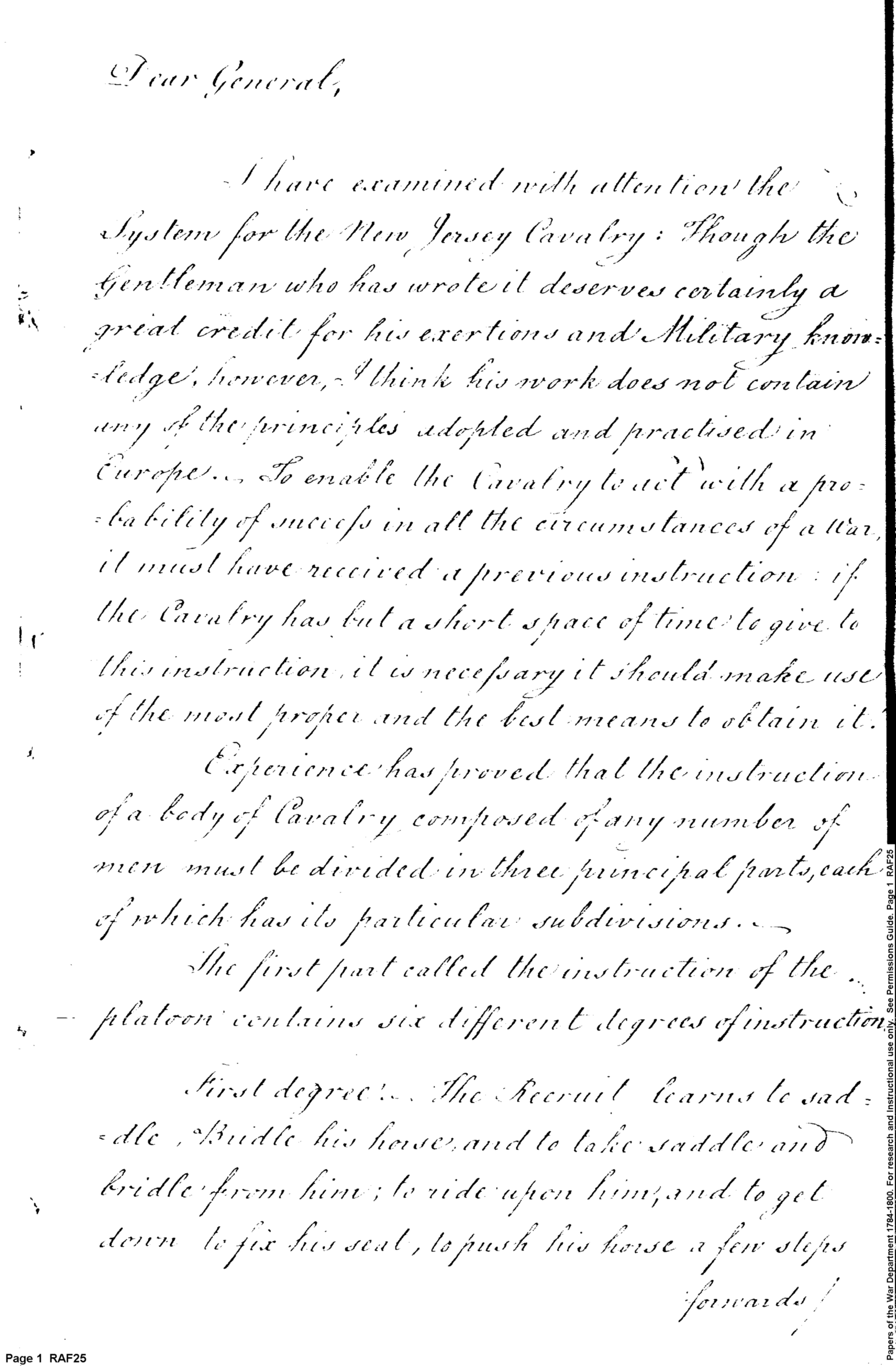
Dear General,
I have examined with attention the System for the New Jersey Cavalry: Though the Gentleman who has wrote it deserves certainly a great credit for his exertions and Military knowledge, however, I think his work does not contain any of the principles adopted and practised in Europe... To enable the Cavalry to act with a probability of success in all the circumstances of a War, it must have received a previous instruction: if the Cavalry has but a short space of time to give to this instruction, it is necessary it should make use of the most proper and the best means to obtain it.
Experience has proved that the instruction of a body of Cavalry composed of any number of men must be divided in three principal parts, each of which has its particular subdivisions...
The first part called the instruction of the platoon contains six different degrees of instruction
First degree. The Recruit learns to saddle, Bridle his horse, and to take saddle and bridle from him; to ride upon him; and to get down, to fix his seat, to push his horse a few steps forwards,
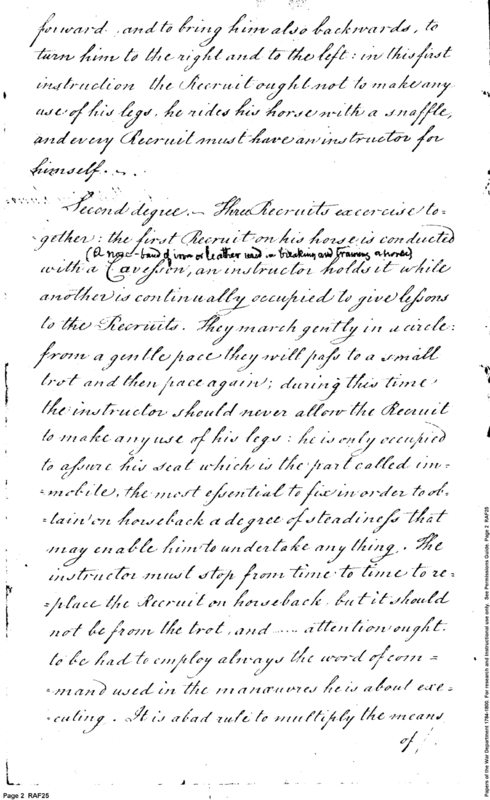
forward, and to bring him also backwards, to turn him to the right and to the left: in this first instruction the Recruit ought not to make any use of his legs, he rides his horse with a snaffle, and every Recruit must have an instructor for himself...
Second degree. — Three Recruits excercise together: the first Recruit on his horse is conducted
(A nose-band of iron or leather used in breaking and framing a horse)
with a Cavesson, an instructor holds it while another is continually occupied to give lessons to the Recruits. They march gently in a circle: from a gentle pace they will pass to a small trot and then pace again; during this time the instructor should never allow the Recruit to make any use of his legs: he is only occupied to assure his seat which is the part called immobile, the most essential to fix in order to obtain on horseback a degree of steadiness that may enable him to undertake any thing. The instructor must stop from time to time to replace the Recruit on horseback, but it should not be from the trot, and ...... attention ought to be had to employ always the word of command used in the manœuvres he is about executing. It is a bad rule to multiply the means of
of intelligence of men when they are collected in a great number: if one tells a Recruit stop, he must explain him what is stop and learn him after, that [underline: halt] is the same thing, what he might have done at once...
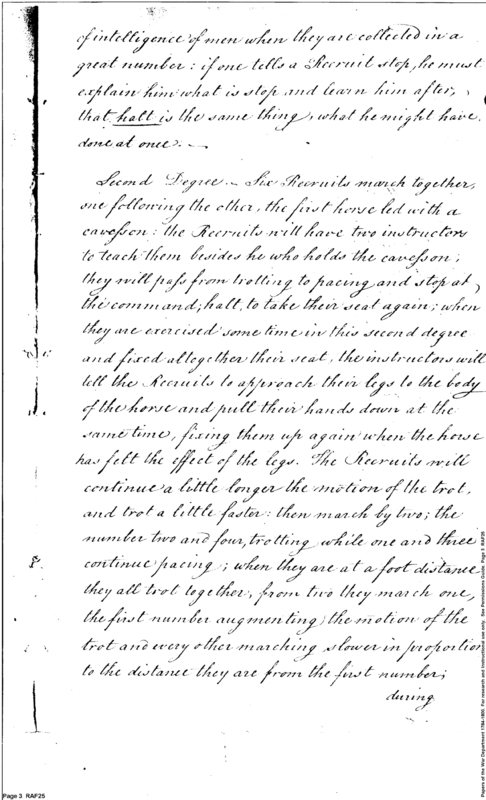
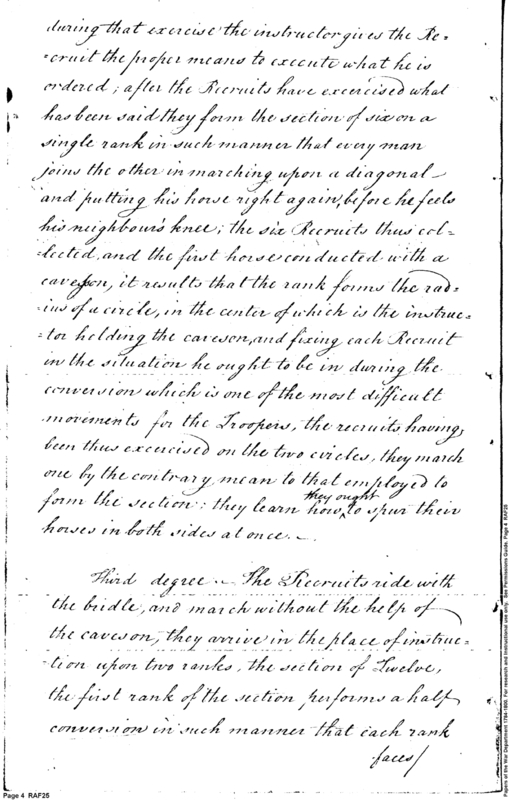
Second Degree. — Six Recruits march together, one following the other, the first horse led with a cavesson: the Recruits will have two instructors to teach them besides he who holds the cavesson; they will pass from trotting to pacing, and stop at the command; halt, to take their seat again; when they are exercised some time in this second degree and fixed altogether their seat, the instructors will tell the Recruits to approach their legs to the body of the horse and pull their hands down at the same time, fixing them up again when the horse has felt the effect of the legs. The Recruits will continue a little longer the motion of the trot, and trot a little faster: then march by two; the number two and four, trotting while one and three continue pacing; when they are at a foot distance they all trot together; from two they march one, the first number augmenting the motion of the trot and every other marching slower in proportion to the distance they are from the first number; during
during that exercise the instructor gives the Recruit the proper means to execute what he is ordered; after the Recruits have exercised what has been said they form the section of six on a single rank in such manner that every man joins the other in marching upon a diagonal and putting his horse right again, before he feels his neighbours knee; the six Recruits thus collected, and the first horse conducted with a cavesson, it results that the rank forms the radius of a circle, in the center of which is the instructor holding the cavesson, and fixing each Recruit in the situation he ought to be in during the conversion which is one of the most difficult movements for the Troopers, the recruits having been thus exercised on the two circles, they march one by the contrary mean to that employed to form the section: they learn [strikethrough: how] they ought to spur their horses in both sides at once.
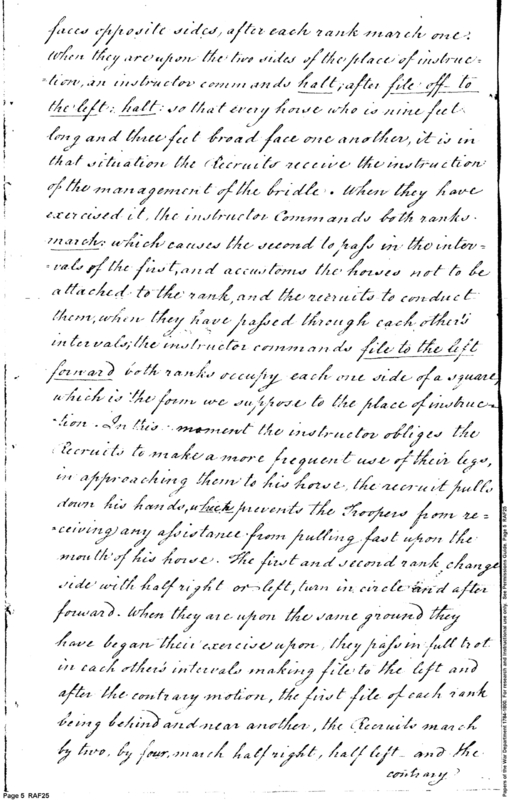
Third degree. — The Recruits ride with the bridle, and march without the help of the cavesson, they arrive in the place of instruction upon two ranks, the section of Twelve, the first rank of the section performs a half conversion in such manner that each rank faces
faces opposite sides, after each rank march one: when they are upon the two sides of the place of instruction, an instructor commands halt, after file off to the left: halt, so that every horse who is nine feet long and three feet broad face one another, it is in that situation the Recruits receive the instruction of the management of the bridle. When they have exercised it, the instructor commands both ranks march, which causes the second to pass in the intervals of the first, and accustoms the horses not to be attached to the rank, and the recruits to conduct them, when they have passed through each others intervals, the instructor commands file to the left forward, both ranks occupy each one side of a square, which is the form we suppose to the place of instruction. At this moment the instructor obliges the Recruits to make a more frequent use of their legs, in approaching them to his horse, the recruit pulls down his hands, which prevents the Troopers from receiving any assistance from pulling fast upon the mouth of his horse. The first and second rank change side with half right or left, turn in circle and after forward. When they are upon the same ground they have begun their exercises, upon they pass in full trot in each others intervals, making file to the left and after the contrary motion, the first file of each rank being behind and near another, the Recruits march by two, by four, march half right, half left, and the contrary
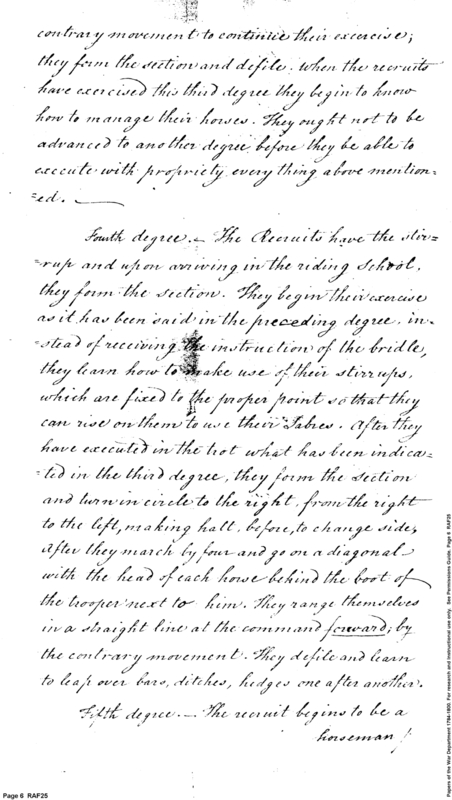
contrary movement to continue their excercise; they form the section and defile. When the recruits have exercised this third degree they begin to know how to manage their horses. They ought not to be advanced to another degree before they be able to execute with propriety every thing above mentioned.
Fourth degree. — The Recruits have the stirrup and upon arriving in the riding School, they form the section. They begin their exercise as it has been said in the preceding degree, instead of receiving the instruction of the bridle, they learn how to make use of their stirrups, which are fixed to the proper point so that they can rise on them to use their Sabres. After they have executed in the trot what has been indicated in the third degree, they form the section and turn in circle to the right, from the right to the left, making halt, before, to change sides, after they march by four and go on a diagonal with the head of each horse behind the boot of the trooper next to him. They range themselves in a straight line at the command [underline: forward]; by the contrary movement. They defile and learn to leap over bars, ditches, hedges one after another.
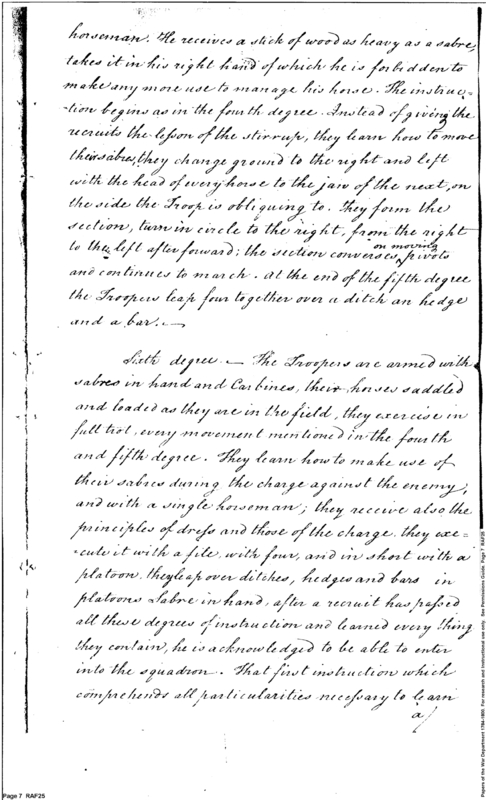
Fifth degree. — The recruit begins to be a horseman,
horseman. He receives a stick of wood as heavy as a sabre, takes it in his right hand of which he is forbidden to make any more use to manage his horse. The instruction begins as in the fourth degree. Instead of giving the recruits the lesson of the stirrup, they learn how to move themselves, they change ground to the right and left with the head of every horse to the jaw of the next, on the side the Troop is obliquing to. They form the section, turn in circle to the right, from the right to the left, after forward; the section converting, paces on manœuvres and continues to march. At the end of the fifth degree the Troopers leap four together over a ditch an hedge and a bar.
Sixth degree. — The Troopers are armed with sabres in hand and Carbines, their horses saddled and loaded as they are in the field, they exercise in full trot every movement mentioned in the fourth and fifth degree. They learn how to make use of their sabres during the charge against the enemy, and with a single horseman; they receive also the principles of drops and those of the charge, they execute with a file with four, and in short with a platoon, they leap over ditches, hedges and bars in platoon, Sabre in hand. After a recruit has passed all these degrees of instruction and learned every thing they contain, he is acknowledged to be able to enter into the squadron. That first instruction which comprehends all particularities necessary to learn a
a recruit how to manage his horse in the rank, requires a great deal of patience in those who teach him; a bad principle, an accident which happens to a recruit makes sometimes a bad horseman of him, who properly taught, might have been an excellent trooper.
During the time the Recruits are at rest the instructors learn them how they must behave when they are in a [underline: vedette], in a [underline: patrole], how they must [underline: reconnoitre] every Officer coming to visit a post.
The second instruction is called the work of the squadron, it consists of eight different degrees, the first is to obtain the horses to remain quiet in the rank, and the Troopers steady, to come to this end it is necessary to cause them to march by four upon a road, the horses distant one of the other of three feet and bring them closer gradually till they seem to be agitated, then the ranks must be made open again.
The second degree comprehends the individual alignement to the right, to the left, correcting the faults which may happen by a trooper being too much forward or backward, he must know how to correct this defect, and when he misses to do it, the subaltern Officer to the right or left of the platoon must tell him of it.
The
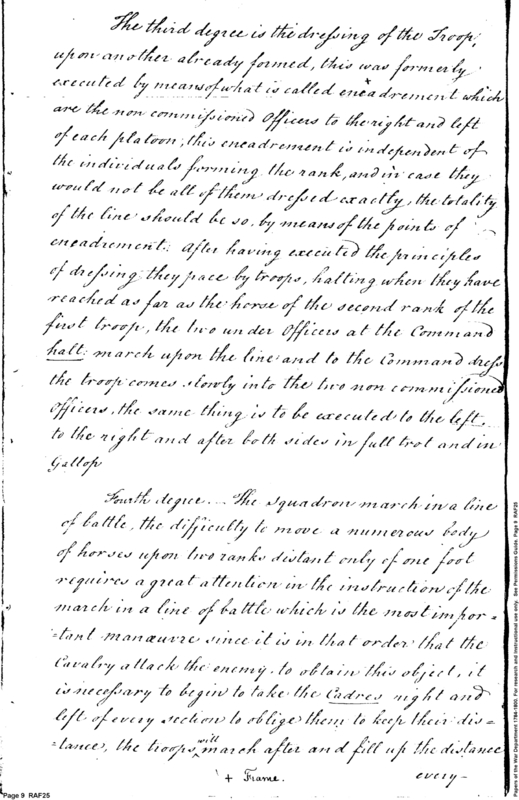
The third degree is the dressing of the Troop upon another already formed, this was formerly executed by means of what is called encadrement which are the non commissioned Officers to the right and left of each platoon; this encadrement is independent of the individuals forming the rank, and in case they would not be all of them dressed exactly, the totality of the line should be so, by means of the points of encadrement. After having executed the principles of dressing, they pace by troops, halting when they have reached as far as the horse of the second rank of the first troop, the two under Officers at the Command [underline: halt], march upon the line and to the Command dress, the troop comes slowly into the two non commissioned Officers, the same thing is to be executed to the left, to the right and after both sides in full trot and in Gallop.
Fourth degree. — The squadron march in a line of battle, the difficulty to move a numerous body of horses upon two ranks distant only of one foot requires a great attention in the instruction of the march in a line of battle which is the most important manœuvre since it is in that order that the Cavalry attack the enemy. To obtain this object, it is necessary to begin to take the [underline: Cadres] right and left of every section to oblige them to keep their distance, the troops will march after and fill up the distance every
* France.
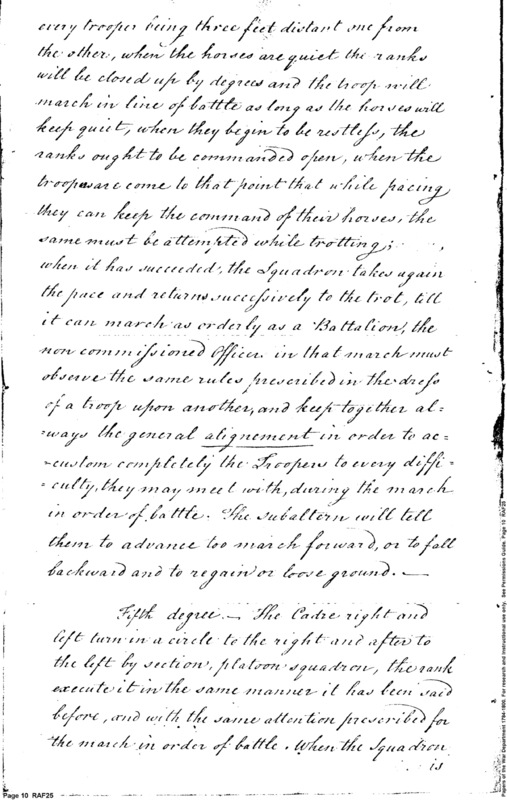
every trooper being three feet distant one from the other, when the horses are quiet the ranks will be closed up by degrees and the troop will march in line of battle as long as the horses will keep quiet, when they begin to be restless, the ranks ought to be commanded open, when the troopers are come to that point that while pacing they can keep the command of their horses, the same must be attempted while trotting; when it has succeeded, the Squadron takes again the pace and returns successively to the trot, till it can march as orderly as a Battalion, the non commissioned Officer in that march must observe the same rules prescribed in the dress of a troop upon another, and keep together always the general [underline: alignement] in order to accustom completely the Troopers to every difficulty they may meet with, during the march in order of battle. The subaltern will tell them to advance, to march forward, or to fall backward and to regain or loose ground.
Fifth degree. — The Cadre right and left turn in a circle to the right and after to the left by section, platoon, squadron, the rank execute it in the same manner it has been said before, and with the same attention prescribed for the march in order of battle. When the Squadron is
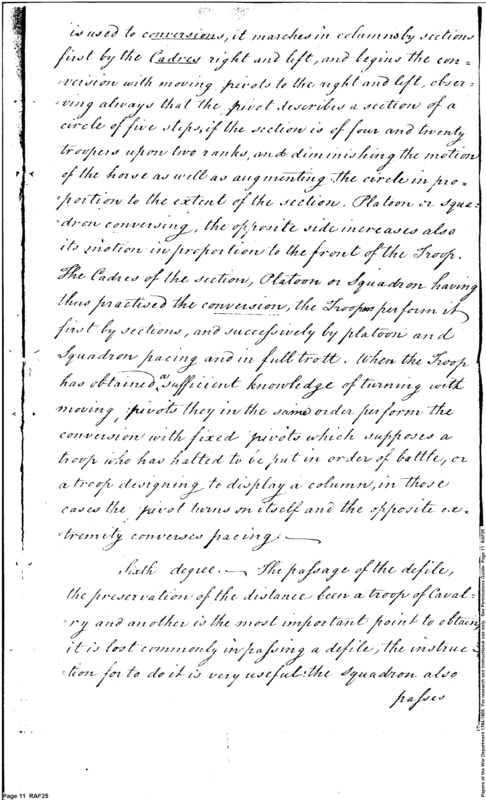
is used to conversions, it marches in column by section, first by the [underline: Cadres] right and left, and begins the conversion with moving pivots to the right and left, observing always that the pivot describes a section of a circle of five steps, if the section is of four and twenty troopers upon two ranks, and diminishing the motion of the horse as well as augmenting the circles in proportion to the extent of the section. Platoon or Squadron conversing, the opposite side increases also its motion in proportion to the front of the Troop. The Cadres of the section, Platoon or Squadron having thus practised the conversion, the Troop perform it first by sections, and successively by platoon and Squadron pacing and in full trot. When the Troop has obtained sufficient knowledge of turning with moving pivots, they in the same order perform the conversion with fixed pivots which supposes a troop who has halted to be put in order of battle, or a troop designing to display a column; in these cases the pivot turns on itself and the opposite extremely converses pacing.
Sixth degree. — The passage of the defile, the preservation of the distance, in a troop of cavalry and another is the most important point to obtain, it is lost commonly in passing a defile, the instruction for to do it is very useful, the Squadron also passes
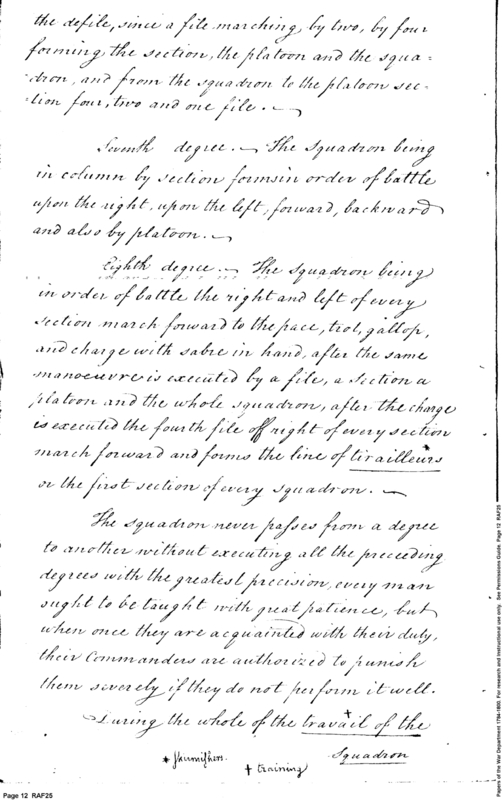
the defile, since a file marching, by two, by four, forming the section, the platoon and the squadron, and from the squadron to the platoon, section, four, two and one file.
Seventh degree. — The Squadron being in column by section, forms in order of battle upon the right, upon the left, forward, backward and also by platoon.
Eighth degree. — The Squadron being in order of battle, the right and left of every section march forward to the pace, trot, gallop, and charge with sabre in hand, after the same manœuvre is executed by a file, a section, a platoon and the whole squadron, after the charge is executed the fourth file of right of every section march forward and forms the line of [underline: Tirailleurs] or the first section of every squadron.
The squadron never passes from a degree to another without executing all the preceding degrees with the greatest precision, every man ought to be taught with great patience, but when once they are acquainted with their duty, their Commanders are authorized to punish them severely if they do not perform it well.
During the whole of the travail + of the * [underline: Squadron]
* Haumilhon. + Training.
Squadron every commissioned and non commissioned Officer or trooper ought to be informed of every fault that may eventually take place in a manœuvre and learn how to remedy each of them without interrupting the order of the Squadron, this is the only means to insure the precision of the manœuvre in general, and to prevent any particular accident influencing the whole line.
The third instruction consists of the execution of the manœuvres of the line.
The end of the [underline: manœuvres] of cavalry is to occupy any position or to form a Troop in any order required, as for example sake; if occupying any given position, a more advantageous one preferred, such that advancing the right, the left may be refused, or the contrary; and also to take a position forward or backward of a former one, to [underline: conceal] a column behind a body formed in a line of battle, to depass it and succeed by means of this manœuvre to act upon the enemy's flank. To attack an enemy in the field, to pursue an advantage, to cover a defeat, to pass a defile, form in line of battle and attack, in order to give the infantry the necessary time to occupy a position out of the defile; to pass from the line of battle to the order of Column, or being in column, to form in array an half of the force or the whole of it, upon one
one or upon two lines, to charge the cavalry or the infantry. — To execute the manœuvres of the line with exactness, it is necessary after performing in perfection the work of the squadron, to take the Cadre right and left of every section and command the manœuvres as if the line were formed together; every squadron in the manœuvre must from the column of manœuvre make by regimental form a particular column, to arrive in a line of battle when ordered to take it. Every commander of a squadron ought to form at one view his judgement so as to keep exactly in the Diagonal, he has to run over, and form his squadron at a proper distance of the line he is to occupy, to obtain that [underline: rectitude] in a full gallop and under the inconveniency of the dust, requires a great practice, the same difficulty comes again to display a column in mass, the march in a line of battle demands also a great activity and knowledge in the commanders of every squadron, and as his instruction would prove extremely fatiguing for the troopers and horses, it ought to form a separate object, independent of the manœuvres; it should be the same for what concerns the necessary dispositions to attack a post, to obtain intelligence of the enemy, to take prisoners, to fix a picket of Cavalry and infantry in night or day time, to protect a foraging party, to enter a village and occupy it, how to make an advance
advance guard, how to cover a flank, to lay an ambuscade or avoid it, all this requires a particular instruction, a body of cavalry which having received the first and second degree of instruction above mentioned, and executed with the cadres the manœuvres aforesaid, which is likewise acquainted with all what is to be executed in the several occurrences, we can offer, ought to be enabled to manœuvre with advantage, to march to the place of exercises and retire from it with the same cautions, as if there was a possibility of being attacked by an Enemy, it ought to have an advanced, a rear guard, flankers; the cavalry must manœuvre as if the enemy was of good to the Troop actually exercising, the evolutions should be continued as if directed against another body, equal, superior, or inferior in number, sometimes a small body will be sent to surprize the Troop, which another time will be more cautious in its march, every time a troop exercise, it must be with more perfection, unless the instruction has not been followed as it has been said, to render the instruction good, useful, agreeable to every body's liking, it must be directed towards the essential point of being able to attack any troop with advantage, when of equal number, and with certainty of success when inferior. The difference between a well disciplined troop and one which is not, may be compared to that between a fencing master and the man who never had a sword in hand, and we all know the chances of success are much less in favor of an ignorant body of men. [undecipherable: opposed to a]
a disciplined one, particularly in cavalry, which must be in continual activity.
The object of this already too long letter is to prove that the system of the New Jersey Cavalry is not sufficient to form a body of cavalry, and not the best that may be adopted by the Executive of the United States; should our Country be forced into a war, I would recommend to, in preference the instruction adopted in 1789 for the french cavalry, with the additions made in 1791. That instruction and its additions will furnish a general means to perform all the evolutions by marching the shortest distance, preserving the best order and passing with ease over every difficulty the ground may offer. I would also recommend the instruction destined to the troops serving in the advanced posts, redacted at the same time, and likewise the Ordinance of Campaigne; those three books have been found very useful and have made up for that experience which a long interruption of Warlike operations had prevented the French Troops from receiving. Should the principles contained in these works be adopted and reduced in practice, I think America will in a short time have a well disciplined army, which I look upon as the first instrument to obtain advantages over her enemy.
I have endeavoured to answer your confidence
(Dear)
Dear General, I wish I had more talent and more time; I wrote upon Cavalry in general and not upon that which I believe the United States should make use of in case of a war. I have presented some observations but had not the pretention to give an instruction. Such regularity as I think proper and [underline: indispensable] in a large body of cavalry, is not necessary in a small troop, the being possessed of it will, to any corps prove very advantageous. I wish my reflections might be communicated to Colo White, his sentiment of them will be very serviceable to me and altho no more occupied of military matters without the pretention to be employed any more in any army, I will receive his observations with that satisfaction a Military man will always feel in being taught by his companion of arms, in a science that opens daily a new field for study.
I am Dear General
with Sentiments of most
particular friendship
your most obedient
and humble Servant
Signed Gen: Noailles
Copy from the translation—
[signature]
25 March 1795
[Copy
Genl. Noailles
(Translation dated March 25. 1795)
On
Syst. of N.J. Cavalry which
is practised in Brunswick by
Shelby, [undecipherable], in 1793.
—
The Visconte Noailles is a
French Officer who Served in
America during the Revolutionary War.]
Type
Document Signed
Description
Criticism of New Jersey Cavalry system. Stagg believed methods used in Europe should be adopted speedily if any success in war is to be gained. With detailed instructions on implementation.
Date
03/25/1795
Author
Collection
Document number
1795032515001
Page start
1
Notable persons
John Stagg