

Indian Relations and Peace on Frontier
Document 1795Sections of letters from Gov. Blount were given to Congress for informative purpose. President awaits results of deliberations regarding trade with Indians. Defense of frontier financed. All offensive action stopped, policy of peace with Indians supported. Discussed Indian relations in detail, peace is paramount.
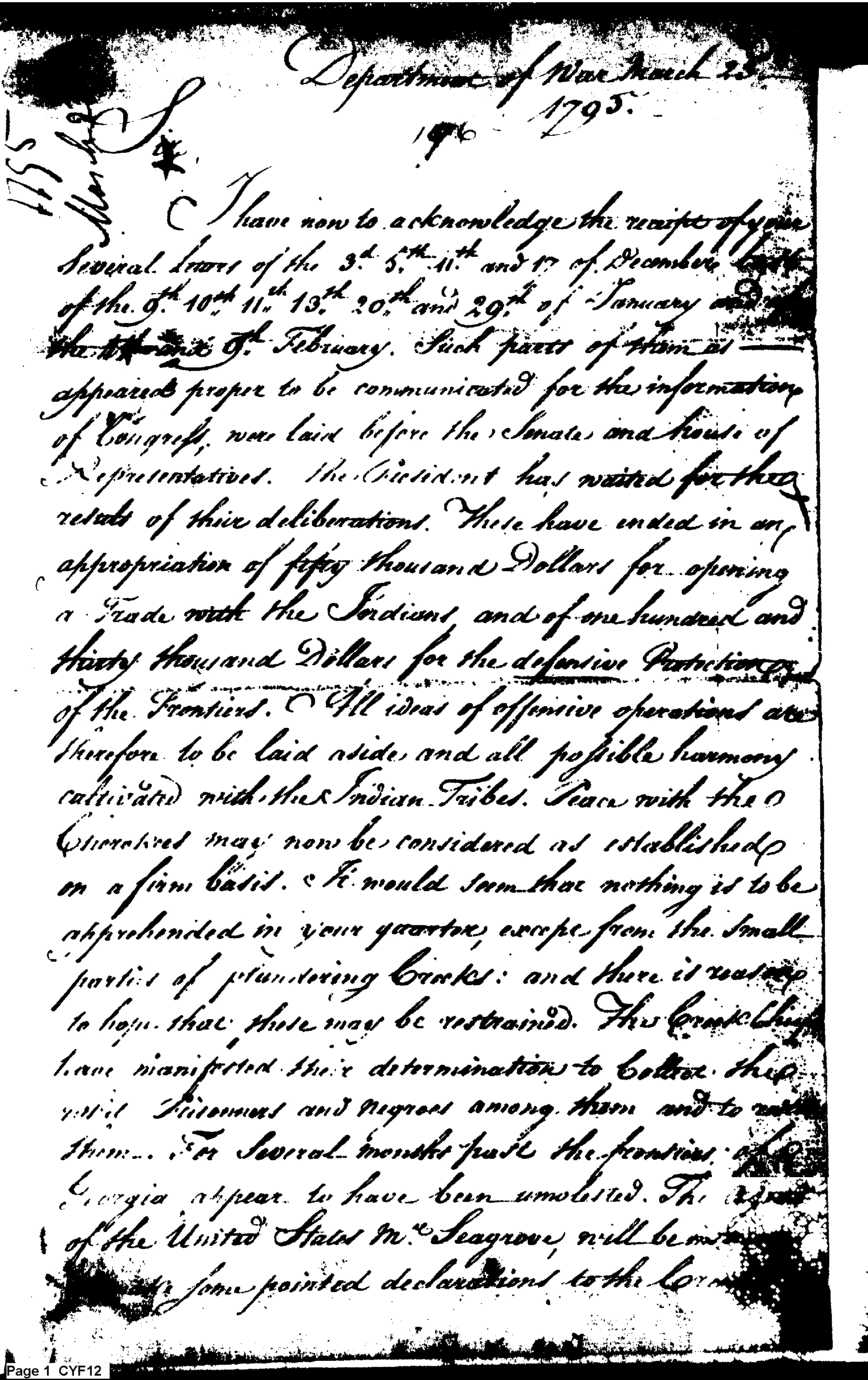
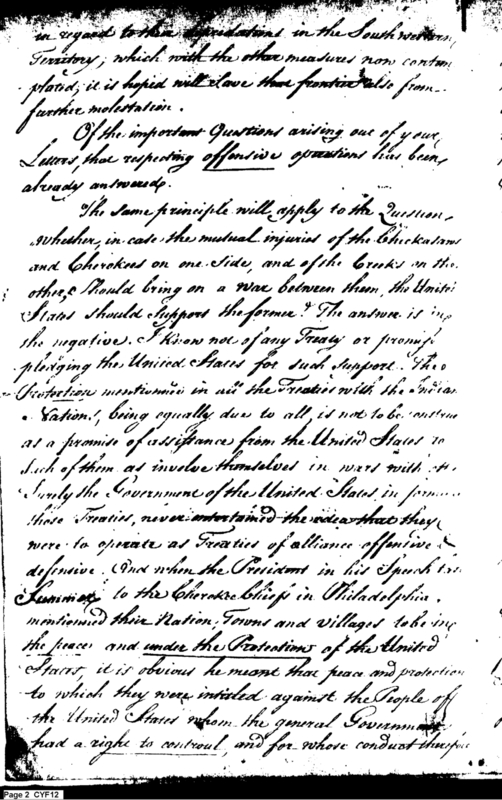
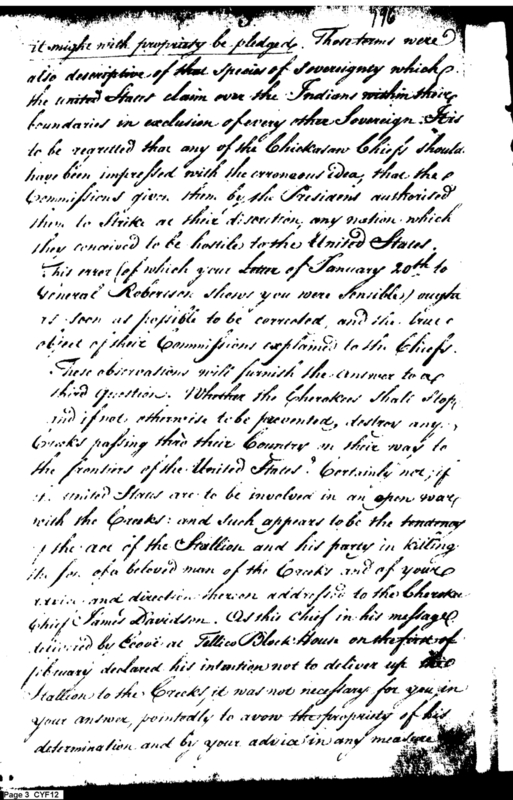
No human transcription currently available for this document.
This transcription was generated by machine using Anthropic's Claude Code (model sonnet 4.6). It may contain errors or inaccuracies. Please verify against the document image. Learn more about our generative AI methodology.
Department of War March 25
1795.
I have now to acknowledge the receipt of your several letters of the 3d 5th 11th and 17 of December last, of the 9th 10th 11th 13th 20th and 29th of January and the [strikethrough: 14th 24th] of February. Such parts of them as appeared proper to be communicated for the information of Congress, were laid before the Senate and House of Representatives. The President has waited for the results of their deliberations. These have ended in an appropriation of fifty thousand Dollars for opening a Trade with the Indians, and of one hundred and thirty thousand Dollars for the defensive Protection of the Frontiers. All ideas of offensive operations are therefore to be laid aside, and all possible harmony cultivated with the Indian Tribes. Peace with the Cherokees may now be considered as established on a firm basis. It would seem that nothing is to be apprehended in your quarter, except from the Small parties of plundering Creeks: and there is reason to hope that those may be restrained. This Creek [Chief?] have manifested their determination to deliver their [hostile?] Prisoners and Negroes among them and to [secure?] them... For Several months past the frontiers of Georgia appear to have been unmolested. The agent of the United States Mr. Seagrove will be making some pointed declarations to the [Creek?]
in regard to their [depredations?] in the South western Territory; which with the other measures now contemplated, it is hoped will save those frontiers also from further molestation.
Of the important Questions arising out of your Letters, that respecting offensive operations has been already answered.
The same principle will apply to the Question, whether, in case the mutual injuries of the Chickasaws and Cherokees on one Side, and of the Creeks on the other, should bring on a War between them, the United States should support the former? The answer is in the negative. I know not of any Treaty or promise pledging the United States for such support. The protection mentioned in all the Treaties with the Indian Nations, being equally due to all, is not to be construed as a promise of assistance from the United States to such of them as involve themselves in wars with others. Surely the Government of the United States in forming those Treaties, never [strikethrough: entertained the idea that] they were to operate as Treaties of alliance offensive and defensive. And when the President in his Speech [to?] [undecipherable] to the Cherokee Chiefs in Philadelphia, mentioned their Nation, Towns and villages to be [under?] the peace and [underline: under the Protections of the United States], it is obvious he meant that peace and protection to which they were intitled against the People of the United States whom the general Government had a right to controul, and for whose conduct therefore
it might with propriety be pledged. Those terms were also descriptive of that Species of Sovereignty which the United States claim over the Indians within their boundaries in exclusion of every other Sovereign. It is to be regretted that any of the Chickasaw Chiefs should have been impressed with the erroneous idea, that the Commissions given them by the President authorised them to Strike at their discretion any nation which they conceived to be hostiles to the United States.
This error (of which your Letter of January 20th to General Robertson shows you were Sensible) ought as soon as possible to be corrected, and the true object of their Commissions explained to the Chiefs.
These observations will furnish the answer to a third Question. Whether the Cherokees Shall Stop, and if not otherwise to be prevented, destroy any Creeks passing thro their Country in their way to the frontiers of the United States? Certainly not, if the United States are to be involved in an open war with the Creeks: and such appears to be the tendency of the act of the Stallion and his party in killing the [son?] of a beloved man of the Creeks and of your advice and direction thereon addressed to the Cherokee Chief James Davidson. As this Chief in his message delivered by Cooie at Tellico Block House on the first of February declared his intention not to deliver up the Stallion to the Creeks, it was not necessary for you in your answer, pointedly to avow the propriety of his determination and by your advice in any measure
[dismiss?] the United States.
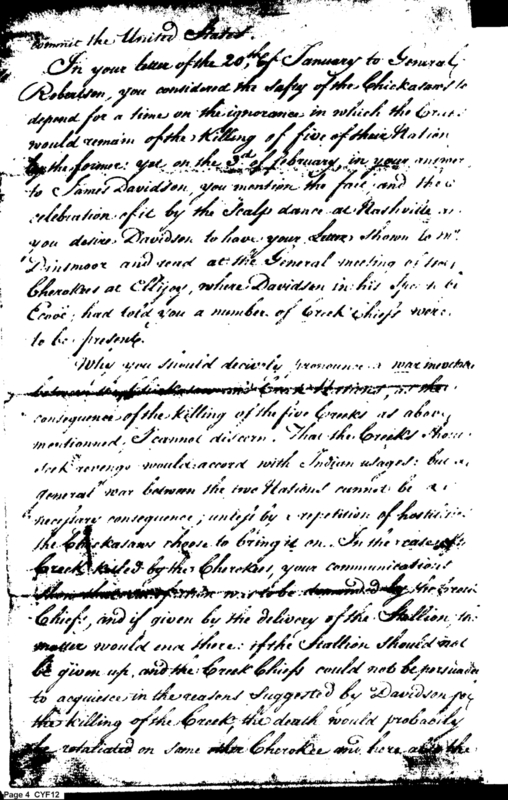
In your letter of the 20th of January to General Robertson, you considered the duty of the Chickasaws to depend for a time on the ignorance in which the Creek would remain of the killing of five of their Nation by the former: yet on the 3d of February, in your answer to James Davidson, you mention the fact, and the celebration of it by the Scalps dance at Nashville, as you desire Davidson to have your Letter shown to Mr. Dinsmore and send at the General meeting of the Cherokees at Eliijay, where Davidson in his Speech to Cooie, had told you a number of Creek Chiefs were to be present.
When you should decisively pronounce a war inevitable between [the Chickasaws] and Creek [Warriors?], not the consequence of the killing of the five Creeks as above mentioned, I cannot discern. That the Creeks [those?] such revenge would accord with Indian usages; but a general war between the two Nations cannot be a necessary consequence; unless by a repetition of hostility the Chickasaws chose to bring it on. In the case of the Creek [killed] by the Cherokees, your communications [then?] determined were to be demanded by the Creek Chiefs, and if given by the delivery of the Stallion, the matter would end there: if the Stallion should not be given up, and the Creek Chiefs could not be persuaded to acquiese in the reasons Suggested by Davidson for the killing of the Creek, the death would probably be retaliated on Some other Cherokee more, and the
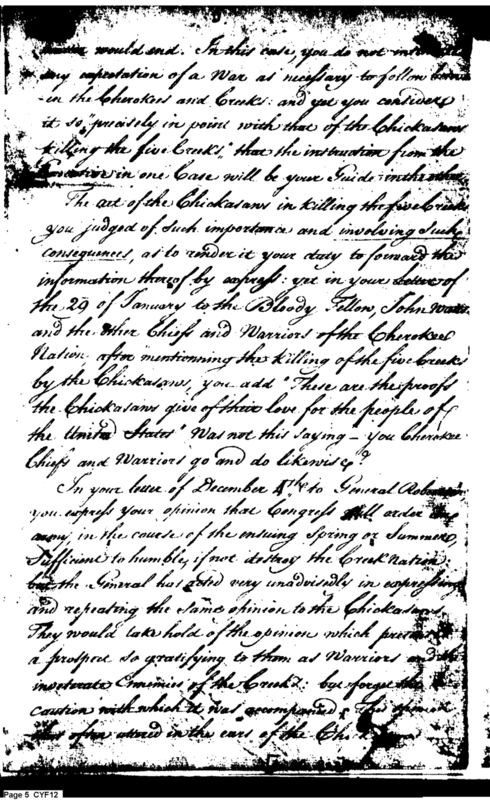
[matter?] would end. In this case you do not mention any expectation of a War as necessary to follow between the Chickasaws and Creeks: and yet you [consider?] it so precisely in point with that of the Chickasaws killing the five Creeks, that the instruction from the [President?] in one case will be your Guide in [the other?].
The act of the Chickasaws in killing the five Creeks you judged of such importance, and involving such consequences, as to render it your duty to forward this information [thereof] by express: yet in your letter of the 29 of January to the Bloody Fellow, John Watts, and the [War] Chief and Warriors of the Cherokee Nation, after mentioning the killing of five Creeks by the Chickasaws, you add "There are the proofs the Chickasaws give of their love for the people of the United States" Was not this saying — you Cherokee Chiefs and Warriors go and do likewise?
In your letter of December 11th to General Robertson, you express your opinion that Congress will order [the?] army in the course of the ensuing Spring or Summer, [if?] it is to humble, if not destroy the Creek Nation; but the General has acted very unadvisedly in [expressing?] and repeating the same opinion to the Chickasaws. They would take hold of the opinion which promises a prospect so gratifying to them as Warriors and to their inveterate Enemies of the Creeks: by forgetting the caution with which it was accompanied & the [expressions?] often uttered in the ears of the Che[rokees?]
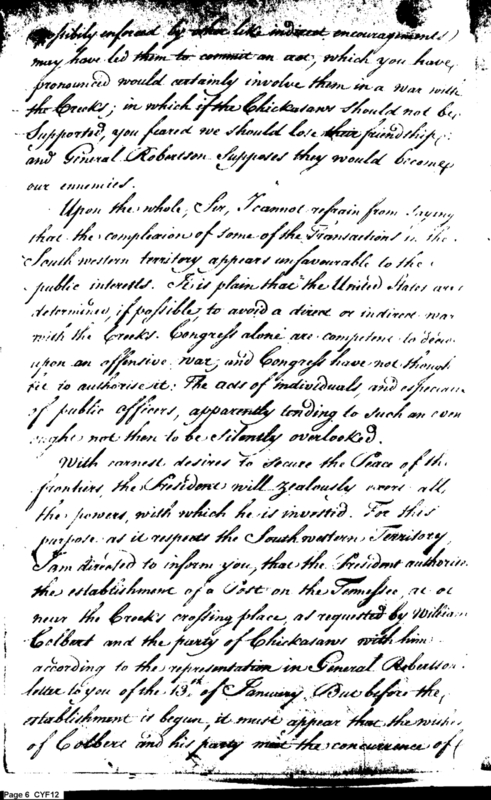
possibly enforced by other like indiscreet encouragements, may have led them to commit an act, which you have pronounced would certainly involve them in a war with the Creeks; in which if the Chickasaws should not be supported, you feared we should lose their friendship; and General Robertson supposes they would become our ennemies.
Upon the whole, Sir, I cannot refrain from saying that the complexion of some of the Transactions in the South western territory appears unfavourable to the public interests. It is plain that the United States are determined, if possible, to avoid a direct or indirect war with the Creeks. Congress alone are competent to decide upon an offensive war; and Congress have not thought fit to authorise it. The acts of individuals and especially of public officers, apparently tending to such an event, ought not then to be [underline: silently overlooked].
With earnest desires to secure the Peace of the frontiers, the President will zealously exert all his powers, with which he is invested. For this purpose, as it respects the South western Territory, I am directed to inform you, that the President authorises the establishment of a Post on the Tennissee, at or near the Creek's crossing place, as requested by William Colbert and the party of Chickasaws with him, according to the representation in General Robertson's letter to you of the 13. of January; But before the establishment is begun, it must appear that the wishes of Colbert and his party meet the concurrence of
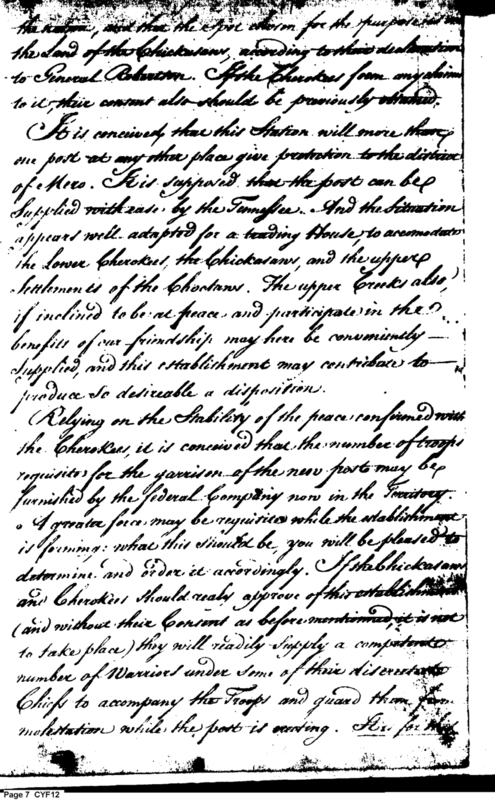
the [majority?] [undecipherable] who are the [first?] reason for the purpose [of?] the land of the Chickasaws, according to their destination to General Robertson. If the Cherokees from any claim to it, their consent also should be previously obtained.
It is conceived that this Station will more than one post at any other place give protection to the district of Mero. It is supposed that the post can be supplied with ease by the Tennessee. And the Situation appears well adapted for a trading House, to accomodate the lower Cherokees, the Chickasaws, and the upper Settlements of the Choctaws. The upper Creeks also, if inclined to be at peace, and participate in the benefits of our Friendships, may here be conveniently supplied, and this establishment may contribute to produce so desireable a disposition.
Relying on the Stability of the peace confirmed with the Cherokees, it is conceived that the number of troops requisite for the garrison of the new posts may be furnished by the Federal Companies now in the territory. A greater force may be requisite while the establishment is forming: what this should be, you will be pleased to determine, and order it accordingly. If the Chickasaws and Cherokees should really approve of this establishment, (and without their Consent as before mentioned, it is not to take place) they will readily supply a competent number of Warriors under Some of their discreet [undecipherable] Chiefs to accompany the Troops and guard them from molestation while the post is erecting. As for the
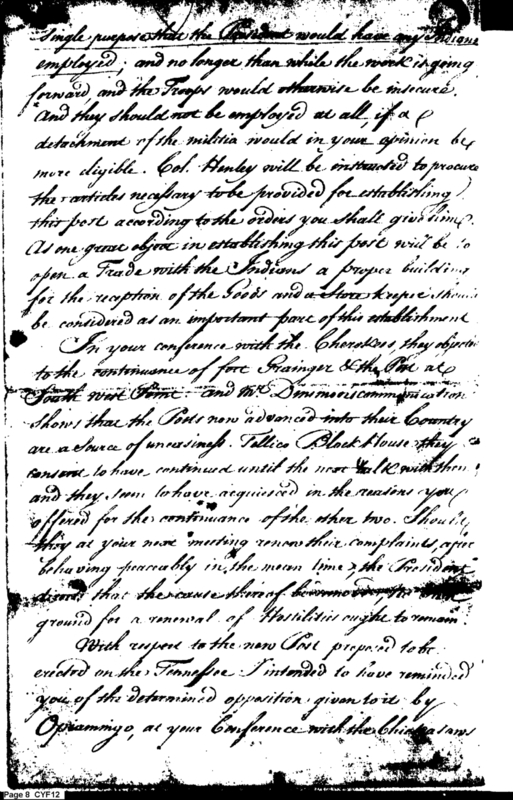
Single purpose that the President would have any Indians employed; and no longer than while the work is going forward; and the Troops would otherwise be incessant. And they should not be employed at all, if a detachment of the militia would in your opinion be more eligible. Col. Henley will be instructed to procure the articles necessary to be provided for establishing this post according to the orders you shall give him. As one great object in establishing this post will be to open a Trade with the Indians, a proper building for the reception of the Goods and a Store House should be considered as an important part of this establishment.
In your conference with the Cherokees, they objected to the continuance of Fort Grainger & the Post at South West Point. And Mr. Dinsmore's communication shows that the Posts now advanced into their Country are a source of uneasiness. Tellico Block House they conceive to have continued until the next Talk with them, and they seem to have acquiesced in the reasons you offered for the continuance of the other two. Should they [object?] at your next meeting renew their complaints, after behaving peacably in the mean time, the President desires that the cause of them be removed, any just ground for a renewal of Hostilities ought to remain.
With respect to the new Post proposed to be erected on the Tennissee, I intend to have reminded you of the determined opposition given to it by Opsammigo, at your conference with the Chickasaws
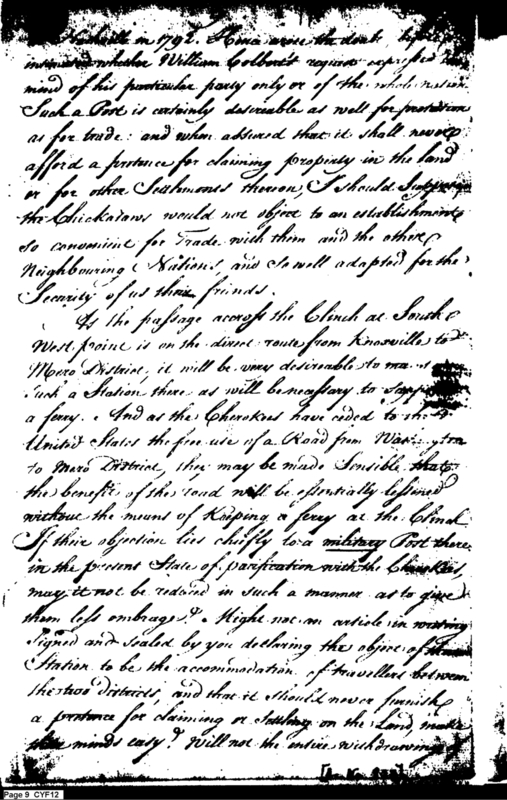
[established?] in 1795. There were doubts by [undecipherable] whether William Colbert's request [had?] mind of this particular party only or of the whole nation. Such a Post is certainly desireable as well for protection as for trade: and when assured that it shall never afford a pretence for claiming property in the land, the Chickasaws would not object to an establishment so convenient for trade with them and the other Neighbouring Nations, and so well adapted for the Security of all those friends.
As the passage across the Clinch at South [or?] West Point is on the direct route from Knoxville to Mero District, it will be some desireable to have such a Station there, as will be necessary to support a Ferry. And as the Cherokees have ceded to the United States the free use of a Road from Washington to Mero District, this may be made Sensible that the benefits of this road will be effectually lessened without the means of Keeping a Ferry at the Clinch. If their objection lies chiefly to a military Post there, in the present State of pacification with the Cherokees, may it not be varied in such a manner as to give them less [umbrage?]. Might not an article in writing signed and sealed by you declaring the above [referenced?] Station to be the accomodation of Travellers between the two Districts, and that it Should never furnish a pretence for claiming or [settling?] on the Land, make their minds easy? Will not the entire withdrawing
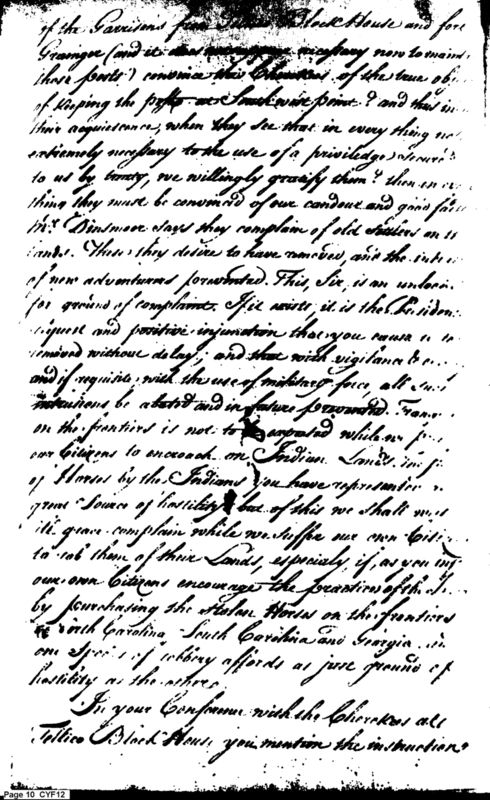
of the Garrisons from [the?] Tellico Block House and Fort Grainger (and it does not appear necessary now to maintain those posts) convince the Cherokees of the true object of keeping the posts on South west point? and that in their acquiescence, when they see that in every thing else entirely necessary to the use of a privileged [Service?] to us by treaty, we willingly gratify them? then one thing they must be convinced of our candour and good faith. Mr. Dinstmoor says they complain of old Settlers on the limits. This, they desire to have removed, and the introduction of new adventurers prevented. This, Sir, is an unquestionable ground of complaint. It is the President's request and positive injunction that you cause it to be removed without delay; and that with vigilance to end, and if requisite, with the use of military force, all such intrusions be abated and in future prevented. Transactions on the frontiers is not to be permitted while our [citizens?] to encroach on Indian Lands. Injury of Horses by the Indians, you have represented as grave Sources of hostility, but of this we shall not if the grave complain while we suffer our own Citizens to rob them of their Lands, especially if, as you suggest, our own citizens encourage the [practice?] of that in South Carolina, South Carolina and Georgia, in one species of robbery affords as just ground of hostility as the others.
In your Conference with the Cherokees all Tellico Block House, you mention the instructions
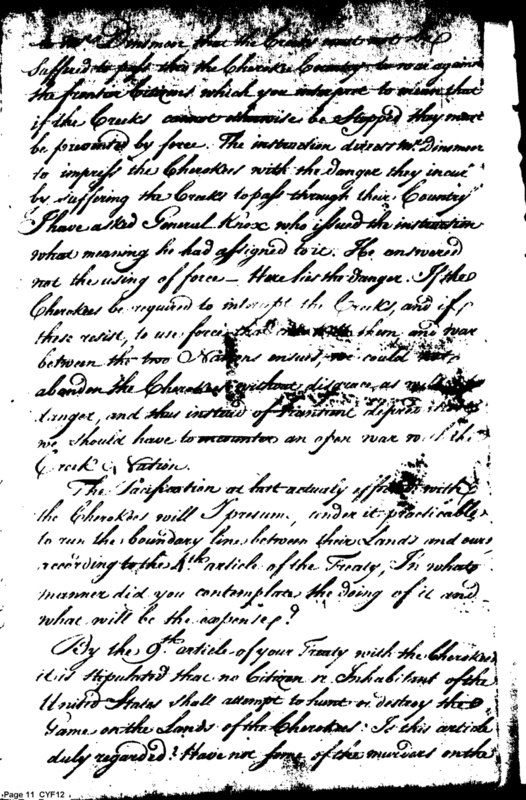
[addressed?] to [Dinsmore?] that [undecipherable] was to act against the [undecipherable] frontiers actions which you [interpreted?] to mean that if the Creeks cannot otherwise be stopped they must be prevented by force. The instruction desired Mr. Dinsmore to impress the Cherokees with the danger they incur'd by suffering the Creeks to pass through their Country. I have asked Samuel Knox who framed the instruction what meaning he had assigned to it. He answered not the using of force — Here lies the danger. If the Cherokees be required to intercept the Creeks, and if these refuse, to use force, that [undecipherable] them, a war between the two Nations ensued, we could not abandon the Cherokees without disgrace, at [undecipherable] danger, and thus instead of frustrating a dispute, we should have to encounter an open war [with?] the Creek Nation.
The Satisfaction at last actually offered [undecipherable] with the Cherokees will I presume, render it practicable to run the boundary line between their Lands and ours, according to the 8th article of the Treaty. In what manner did you contemplate the doing of it, and what will be the expenses?
By the 9th article of your Treaty with the Cherokees, it is stipulated that no Citizen or Inhabitant of the United States Shall attempt to hunt or destroy the Game on the lands of the Cherokees? Is this article duly regarded? Have not some of the murders & events
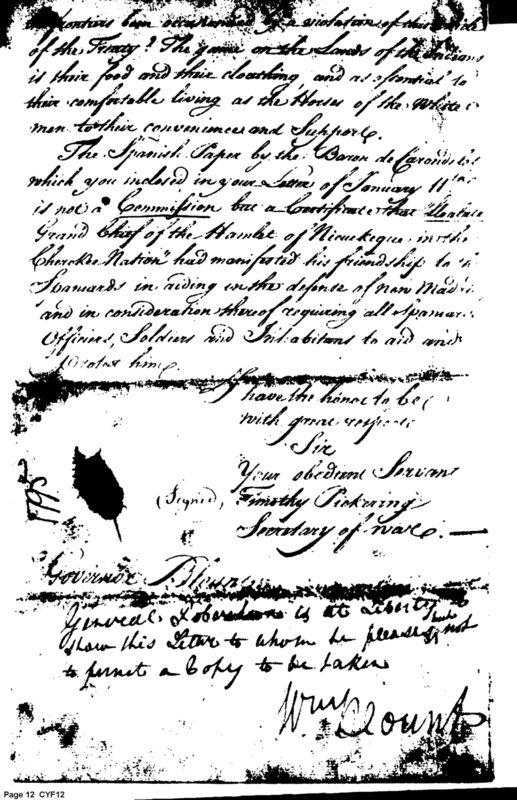
[violations?] have been [violations?] of this [article?] of the Treaty? The game on the Lands of the Indians is their food and their cloathing, and as essential to their comfortable living as the Houses of the White men to their conveniences and Support.
The Spanish Paper by the Baron de Carondelet which you inclosed in your Letter of January 11th is not a Commission but a Certificate that [undecipherable] Grand Chief of the Hamlet of Ninnekegue, in the Cherokee Nation had manifested his friendship to the Spaniards in aiding in the defense of New Madrid, and in consideration thereof requiring all Spanish Officers, Soldiers and Inhabitants to aid and [assist?] him.
I have the honor to be
with great respect
Sir
Your obedient Servant
(Signed) Timothy Pickering
Secretary of War —
Governor Blount
[General Robertson is at liberty to Show this letter to whom he pleases, and to permit a Copy to be taken
W. Blount]
Type
Autograph Letter Signed
Description
Sections of letters from Gov. Blount were given to Congress for informative purpose. President awaits results of deliberations regarding trade with Indians. Defense of frontier financed. All offensive action stopped, policy of peace with Indians supported. Discussed Indian relations in detail, peace is paramount.
Date
03/25/1795
Author
Recipient
Sent from
Department of War
Collection
Document number
1795032500102
Note
Cited in Pickering to Dandridge, 06/27/1795.
Notable persons
William Blount
Timothy Pickering
Congress
Senate
House of Representatives
President
George Washington
Indians
Indian Tribes
Cherokee
Creek
Creek Chiefs
prisoners
Negroes
Seagrove
Chickasaw
chiefs
commissioners
General Robertson
Stallion
Chief James Davidson
Dinsmoore
Dinsmor
Ecooe
Bloody Fellow
John Watts
chiefs and warriors
public officers
William Colbert
Colonel Henley
storekeeper
Opiamingo
General Knox
settlers
Baron de Carondelet
Spanish
Notable locations
Department of War
frontiers
Georgia
Southwestern territory
Philadelphia
towns and villages
Tellico
Tellico Block House
Nashville
Ellijoy
post
Tennessee River
Chickasaw land
Mero district
upper settlements
Fort Grainger
South West Point
Clinch
Knoxville
Cherokee land
Indian lands
South Carolina
Nicakegee
Notable items
trade
protection of the frontiers
offensive operations
scalp dance
transactions
post
trading house
garrison
goods
hostilities
ferry
article in writing
settlement
game
horses
Spanish paper
commission
certificate