

Letter from the Revenue Office concerning naval armament
Document 1794This letter notifies the Secretary at War that public advertisements have been issued for the procurement of naval armaments. The letter also outlines the contractual relationships for the construction of frigates in six port cities.

No human transcription currently available for this document.
This transcription was generated by machine using Anthropic's Claude Code (model sonnet 4.6). It may contain errors or inaccuracies. Please verify against the document image. Learn more about our generative AI methodology.
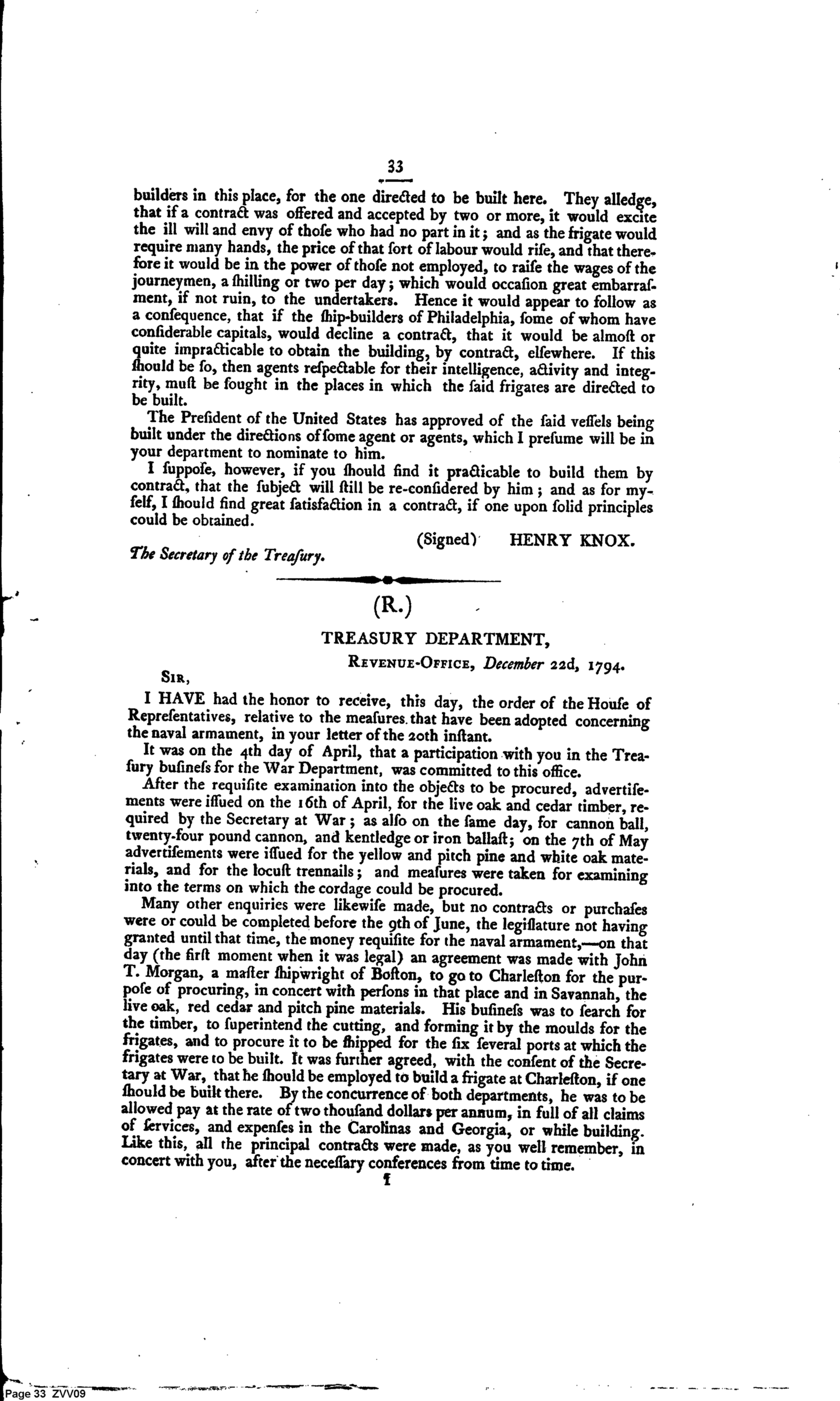
builders in this place, for the one directed to be built here. They alledge, that if a contract was offered and accepted by two or more, it would excite the ill will and envy of thoſe who had no part in it; and as the frigates would require many hands, the price of the ſort of labour would fall, and that therefore it would be in the power of thoſe not employed, to raiſe the wages of the journeymen, a ſhilling or two per day; which would occaſion great embarraſſments, if not ruin, to the undertakers. Hence it would appear to follow as a conſequence, that if the ſhip-builders of Philadelphia, ſome of whom have conſiderable capitals, would decline a contract, that it would be almoſt or quite impracticable to obtain the building, by contract, elſewhere. If this ſhould be ſo, then agents reſpectable for their intelligence, activity and integrity, muſt be ſought in the places in which the ſaid frigates are directed to be built.
The Preſident of the United States has approved of the ſaid veſſels being built under the directions of ſome agent or agents, which I preſume will be in your department, ſubjuniated to him.
I ſuppoſe, however, if you ſhould find it practicable to build them by contract, that the ſubject will ſtill be recommended by him; and as for myſelf, I ſhould find great ſatiſfaction in a contract, if one upon ſolid principles could be obtained.
(Signed) HENRY KNOX.
*The Secretary of the Treaſury.*
(R.)
TREASURY DEPARTMENT,
REVENUE-OFFICE, *December* 26*th*, 1794.
SIR,
I HAVE had the honor to receive, this day, the order of the Houſe of Repreſentatives, relative to the meaſures that have been adopted concerning the naval armament, in your letter of the 10th inſtant.
It was on the 4th of April, that the ſubject committed to you in the Treaſury buſineſs for the War Department, was committed to this office.
After the requiſite examination, the articles to be procured, advertiſements were iſſued on the 16th of April, for the live oak and cedar timber, received by the Secretary at War; as alſo on the ſame day, for cannon ball, twenty-four pound cannon, and kentledge (or iron ballaſt); on the 7th of May advertiſements were iſſued for the yellow and pitch pine and white oak materials, and for the locuſt trunnails; and meaſures were taken for inquiring into the terms on which the cordage could be procured.
Many other enquiries were likewiſe made, but no contracts or purchaſes were or could be completed before the 9th of June, the legiſlature not having granted until that time, ſufficient for that purpoſe; and of that day (the firſt moment when it was legal) an agreement was made with John T. Morgan, a timber [undecipherable], to pay further attention to [undecipherable] poſſibility of procuring, in concert with perſons in that place and in Savannah, the live oak, red cedar and pitch pine materials. His buſineſs was to ſearch for the timber, to ſuperintend the cutting, and forming it by the moulds for the frigates, and to procure it to be freighted thence, if any of the above mentioned articles appeared to require.
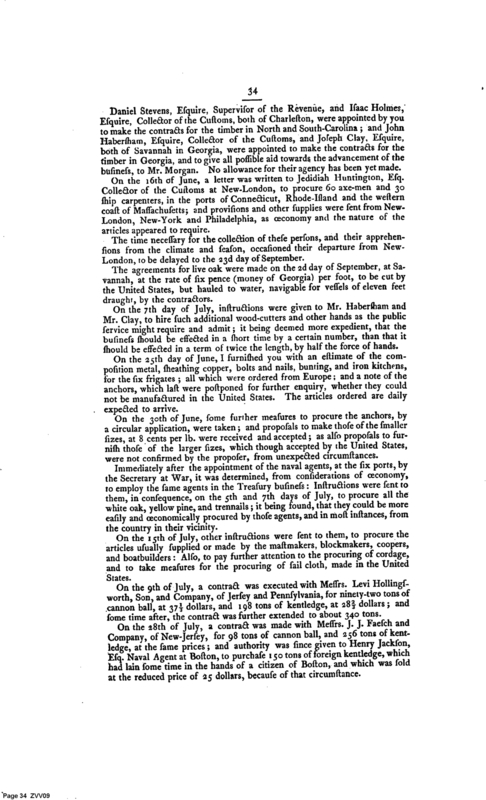
Daniel Stevens, Eſquire, Superviſor of the Revenue, and Iſaac Holmes, Eſquire, Collector of the Cuſtoms, both of Charleſton, were appointed by you to make the contracts for the timber in North and South-Carolina; and John Haberſham, Eſquire, Collector of the Cuſtoms, and Joſeph Clay, Eſquire, Collector of the Cuſtoms in Savannah, were appointed to make the contracts for the ballaſt, in Georgia, and all poſſible aid towards the advancement of the timber in Georgia. No allowance for their agency has been yet made. Ballaſts, to Mr. Morgan. No allowance for their agency has been yet made.
On the 16th of June, a letter was written to Jedidiah Huntington, Eſq, Collector of the Cuſtoms at New-London, to procure 60 axemen and 30 top carpenters, by [undecipherable] of Connecticut, to proceed on the eaſtern coaſt of Maſſachuſetts; and proviſions and other ſupplies were ſent from New-London, New-York and Philadelphia, as economy and the nature of the articles appeared to require.
The time required for the collection of their perſons, and their apprehenſions from the climate and ſeaſon, occaſioned their departure from New-London, to be delayed to the 25th of September.
The agreements for live oak were made on the [undecipherable] day of September, at Savannah, at the rate of 60 cents (money of the United States) per cubic foot, draught, by the perſons procured by Mr. Morgan.
On the 7th day of July, inſtructions were given to Mr. Haberſham and Mr. Clay, to hire ſuch additional veſſels, expending in their hands to the public Mr. Clay, to hire ſuch additional money as it being deemed more expedient, that the buſineſs might require and admit; it being deemed more expedient, that the buſineſs ſhould be effected in a ſhort time by a certain number, than that it ſhould be effected in a term of twice the longer time of the force of hands.
On the 25th day of June, I furniſhed you with an eſtimate of the compoſition metal, [undecipherable] copper, bolts and nails, heading, gudgeons, and rings, for the ſix frigates; all which were ordered from Europe; and a note of the articles, which laſt week the ſubject of further enquiry, whether they could not be manufactured in the United States. The articles ordered are daily expected to arrive.
On the 30th of June, ſome further meaſures to procure the anchors, by contract in Europe, were taken; and propoſals to furniſh them and to provide [undecipherable], at 6 cents per lb, were received and accepted; as alſo propoſals to furniſh part of the large anchors, which though accepted, by the United States, were not confirmed by the propoſer, from unexpected circumſtances.
Immediately after the appointment of the naval agent at the ſix ports, by the Secretary at War, it was determined, from conſiderations of economy, to employ the ſame agents in the Treaſury buſineſs; for that purpoſe [undecipherable] the 5th and 7th days of July, to procure all the white oak, yellow pine, and trunnails; it being found, that they could be more economically procured by the carpenters, boat builders, [undecipherable], and others of the country in their vicinity.
It remains only to notice the contract made in the month of September, with the [undecipherable] company, as it is the only ſufficient one [undecipherable]. [undecipherable] the price which I underſtand to have been ſettled, is from [undecipherable] to [undecipherable] dollars per bolt of 30 feet.
On the 5th day of July, a contract was made with the Cecil iron company, (Samuel Hughes, Eſq; and others, of Maryland) for three-fifth parts of the twenty-four pound cannon.
On the 8th of Auguſt, a contract was made with the owner of the furnace at Hope, (Meſſrs. Brown, Francis and Company, of Providence) for the ſame quantity of cannon ball. The prices were 106½ dollars and the difference of expence for boring for each from the mold.
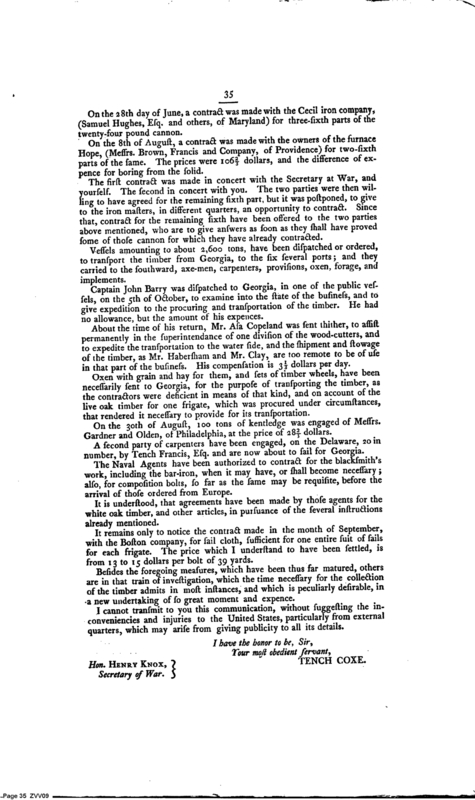
The laſt contract was made in concert with the Secretary at War, and yourſelf. The ſecond in concert with you. The two parties were then willing to have the iron mallers, in different quarters, an opportunity to contract. Since that, contract for the remaining ſuch has been offered to the two founderies above mentioned, who are to give anſwers as ſoon as they ſhall have proved thoſe of their cannon for which they have already undertaken.
Veſſels amounting to about 1,600 tons, have been diſpatched or ordered, to tranſport the timber from the ſouth; but ſix for ſeveral ports; and they carried to the ſouthward, axe-men, carpenters, proviſions, oxen, forage, and implements.
Captain John Barry was diſpatched to Georgia, in one of the public veſſels, on the 4th of July, to ſuperintend the flate of the buſineſs, and to give expedition to the procuring and tranſportation of the timber. He had no allowance, but at the rate of his pay.
At the time of his return, Mr. Als Copeland was firſt thither, to aſſiſt permanently in the ſuperintendence and expedition of the buſineſs, than that it ſhould be effected in a term of twice the longer time, and the ſhipment and ſtowage of the timber, as Mr. Haberſham and Mr. Clay were above mentioned.
Oxen with grain and hay for them, and ſets of timber wheels, have been neceſſarily ſent to Georgia, for the purpoſe of ſupporting the timber, as the contractors were deficient in means of that kind, and on account of the live oak timber for one frigate, which was procured under circumſtances, that rendered it neceſſary to provide for its tranſportation.
On the 3oth of June, 100 tons of kentledge of [undecipherable] agreed of Meſſrs. Gardiner and Olden, of Philadelphia, at the price of 2[undecipherable] dollars.
The ſecond party of carpenters have been engaged, on the way to Georgia, 70 in number, by Tench Francis, Eſq; and are now about to fail for Georgia.
The Naval Agents have been authorized to contract for the blackſmith's work, including the bar-iron, when it may have, or ſhall become neceſſary; alſo, for commodities, ſo far as the ſame may be requiſite, before the arrival of thoſe ordered from Europe.
Inſtructions have alſo been made by thoſe agents for the white oak timber, and other articles, in purſuance of the ſeveral inſtructions already mentioned.
It remains only to notice the contract made in the month of September, with the Cotton Company, as it is the only ſufficient one coming out of the ordinary. I figure the price which I underſtand to have been ſettled, is from 13 to 15 dollars per bolt of 30 feet.
Before the foregoing meaſures, which have been thus far matured, others are in that train of inveſtigation, which the time needful for the collection of the timber admits; for both departments, which is peculiarly deſirable, in a new undertaking of ſo great moment and expenſe.
I cannot transfer to you theſe foregoing facts without ſuggeſting the inconveniences and injuries to the United States, particularly from external quarters, which may ariſe from giving publicity to all its details.
*I have the honor to be, Sir,
Your moſt obedient ſervant,*
HENRY KNOX.
*Secretary of War.*
*Your moſt obedient ſervant,*
TENCH COXE.
Type
Letterbook Copy
Description
This letter notifies the Secretary at War that public advertisements have been issued for the procurement of naval armaments. The letter also outlines the contractual relationships for the construction of frigates in six port cities.
Date
12/22/1794
Author
Recipient
Sent from
Revenue Office
Document number
1794122240055
Page start
33
Notable persons
Henry Knox
Tench Coxe
John T. Morgan
shipwright
Henry Jackson
Naval Agent
Isaac Holmes
Daniel Stevens
commissioner revenue
collector of customs
Jedidiah Huntington
John Habersham
Joseph Clay
Levi Hollingsworth and son
Captain John Barry
Mr. Gardner
Mr. Olden
Tench Francis
naval agents
blacksmith
Notable locations
Revenue Office
Boston
New York
Philadelphia
Baltimore
Portsmouth New Hampshire
Charleston
Carolinas
Georgia
New London
woodcutters
mast makers
block makers
coopers
boat builders
New Jersey
Pennsylvania
Hope Furnace
Delaware
Notable items
live oak
cedar timber
cannon ball
kentledge
iron ballast
yellow pine
pitch pine
white oak
locust trennails
cordage
contracts
sheathing copper
bolts
nails
bunting
iron kitchens
anchors
sail cloth
bar iron