

Do Not Allow the Chain of Friendship to Grow Rusty
Document 1794Colonel Pickering's speech to the Six Nations assembled at a Council held at Canandagua in which he urges them not to allow the Chain of Friendship to grow more rusty and possibly to become rotten and break off.





No human transcription currently available for this document.
This transcription was generated by machine using Anthropic's Claude Code (model sonnet 4.6). It may contain errors or inaccuracies. Please verify against the document image. Learn more about our generative AI methodology.
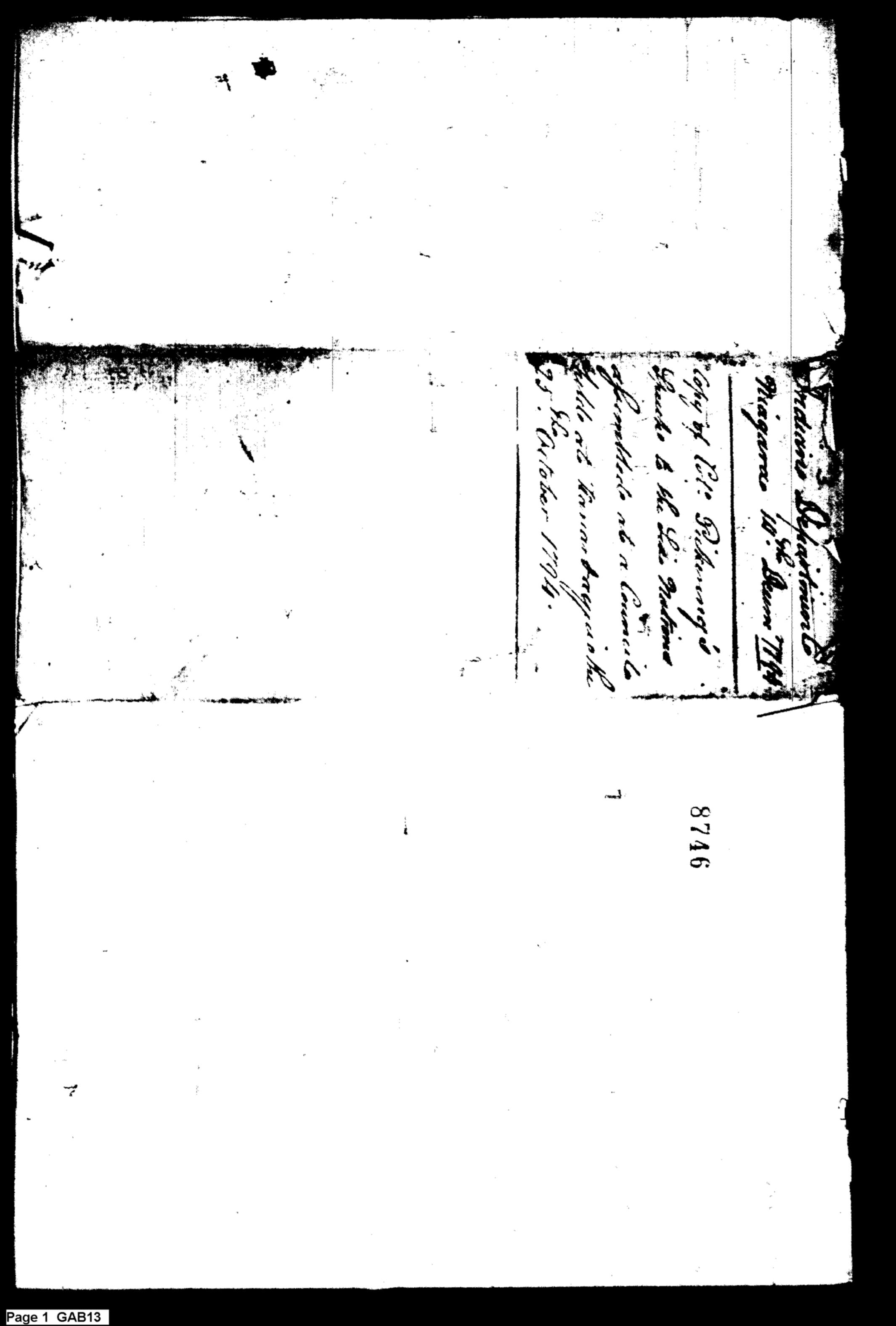
[Endorsement on cover wrapper:]
Preliminary Advertisement
Niagara [undecipherable] January 1794
[Center label:]
Copy of Col. Pickering's
Speech to the Six Nations
Assembled at a Council
at Kanadasagua, he
25 October 1794
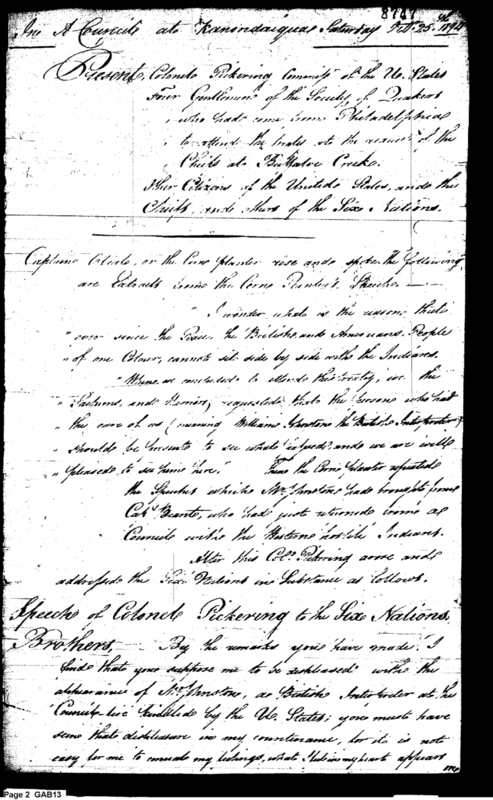
At a Council at Kanadasagua Saturday Nov. 25. 1794
Present, Colonels Pickering Commissr of the U. States
Four Gentlemen of the Society of Quakers
who had come from Philadelphia,
to attend the treaty at the request of the
Chiefs at Buffalo Creek.
Other Citizens of the United States, and the
Chiefs and Men of the Six Nations.
Captains Chiefs, or the Com[manders?] rose and spoke. The following
are Extracts from the Com[manders?] Speeches. —
"I wonder what is the reason that
"ever since the Peace, the British and American People
"of one Colour, cannot sit side by side with the Indians.
"We are requested to attend this treaty, by the
"Sachems and Princes, requested that the Persons who had
"the care of us [meaning Williams Johnston the British Superintendent]
"should be present, to see what [passed]; and we are well
"pleased to see him here." Then the Com[mander?] repeated
the Speeches which Mr. Johnston had brought from
Col. Brant, who had just returned from
Councils with the Western hostile Indians.
After this Col. Pickering arose and
addressed the Six Nations in Substance as follows.
Speech of Colonel Pickering to the Six Nations.
Brothers. By the remarks you have made, I
find that you suppose me to be displeased with the
appearance of Mr. Johnston, as British Intruder at this
Council; he is Invited by the U. States; you must have
seen that displeasure in my countenance; but it is not
easy for me to conceal my feelings, what lies in my heart appears
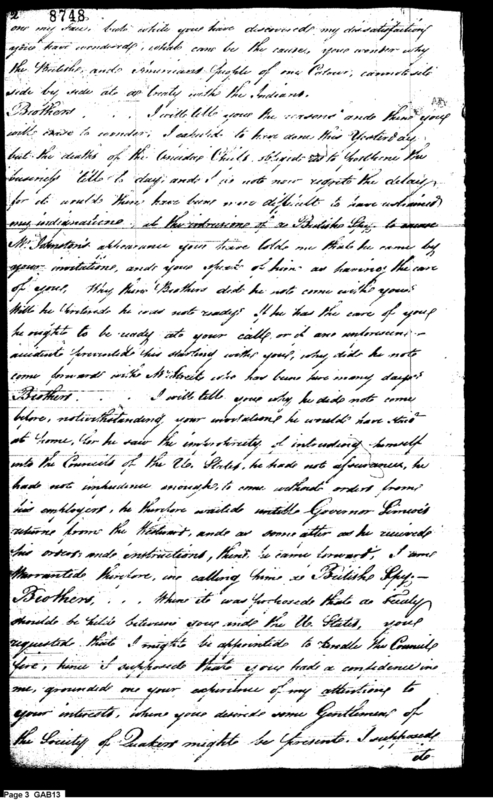
on my face: but while you have discovered my dissatisfaction,
you have wondered, what can be the cause, your wonder why
the British and American People of one Colour, cannot sit
side by side as we treat with the Indians.
Brothers. I will tell you the reasons: and then you
will cease to wonder. I wished to have seen this Yesterday,
but the deaths of the leading Chiefs [obliged] to [Postpone] the
business [till] to day; and I do not now regret the delay,
for it would have been more difficult to have addressed
my explanations at the admittance of a British Spy. To assure
Mr. Johnston's admittance you have told me that he came by
your invitation, and your report of him as having the care
of you. Why then Brothers did he not come with you?
[Was he the] Colonel, he was not ready? If he has the care of you,
he ought to be ready at your call; or if [any] unforeseen
accident [prevented] his coming with you, why did he not
come forward with Mr. [Arnold?] who has been here many days?
Brothers. I will tell you why he did not come
before, notwithstanding his invitations, he would have staid
at home; for he saw the impropriety of introducing himself
into the Councils of the U. States, he had not [forwardness], he
had not indolence enough to come without orders from
his employer; he therefore waited [until] Governor [Simcoe's]
returns from the Westward; and as soon as he received
his orders and instructions, then he came forward. I was
warranted therefore, in calling him a British Spy. —
Brothers. . . Where it was proposed that a treaty
should be held between you and the U. States, you
requested that I might be appointed to handle the Council
here; since I supposed that you had a confidence in
me, grounded on your experience of my attentions to
your interests. When you desired some Gentlemen of
the Society of Quakers might be present. I supposed,
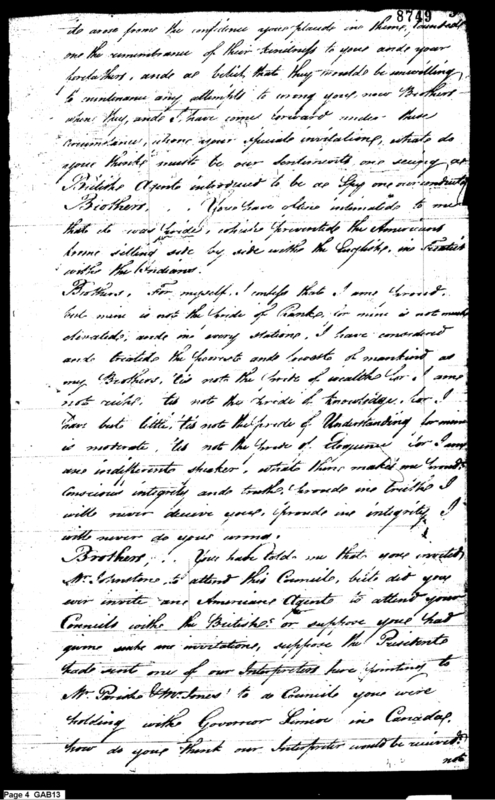
it arose from the confidence you placed in them, [and] not
the recommendations of their kindness to your noble Brothers,
and a belief that they would be unwilling
to [continue] any attempts to wrong you; nor Brothers
when; and I have come forward under these
circumstances, above your special invitations, what do
you think must be our [sentiment?] on seeing [a]
British Agents introduced to be as Spy on our conduct?
Brothers. . . You have also intimated to me
that it was [divided], which [prevented] the Americans
from sitting side by side with the English, as [treated]
with the Indians.
Brothers. For myself, I confess that I am [here]
[but mine is not the trade of Banks, mine is not much]
elevated, not in army stations. I have considered
and treated the [powers] and [hearts] of mankind as
my Brothers; it is not the trade of wealth for I am
not rich. It is not the trade of knowledge, for I
have but little; it is not the [trade] of Understanding to [in-
[is moderate]. It is not the trade of Eloquence for I am
[a very] indifferent speaker; these [have] made me [find]
conscious integrity and truth; [grounds] me to this, I
will never deceive you; [grounds] me integrity I
will never do you wrong.
Brothers. You have told me that you invited
Mr. Johnston to attend this Council; but did you
ever invite any American Agents to attend your
Councils with the British? or suppose you had
given such an invitation, suppose the President
had sent one of our Interpreters here [pointing]
to Mr. [Pierre?] Jones to a Council you were
holding with Governor Simcoe in Canada,
how do you think our Interpreter would be received?
[And now feeling myself the Height of British Spite.] I
cannot briefly describe to you his reception; if he were
only ordered instantly to quit the Council; and the [Governor]
and [people?] [to being] held in [Horne?], he might
think himself [lucky].
Brothers. . . This alone is a sufficient reason for
excluding [a] British Agent from the Councils here [handled]
by the U. States; but there are many other reasons some of
which I will mention; —
Brothers. We are or [are] Independent Nations;
treating with the Six Nations, who also profess to be
free, and independent; and whatever distinctions
arise between us, we can meet and confer on the
means of removing them, without the interference of
any other Nations whatsoever; but especially Brothers
the U. States have never [asked] the [Protection] of
the British; and we never shall [ask] it, [until] they
give some Proof of their sincerity. —
Brothers. Since we have been at War with the
Western Indians, the U. States have requested your assistance
to bring about a peace between us and the People
of your own Colour; we asked your Aid because we
believe you to be our friends; and that your words
[pass] with [sincerity]; you troubled us [in] our request
[and] for more than two years you have been [straining]
to [raise?] peace; we thank you for your exertions. [But]
they have been unsuccessful; and why were they
unsuccessful? What has prevented [a peace] between us
and the Western Nations? I answer without hesitation:
the British [commanded] it. —
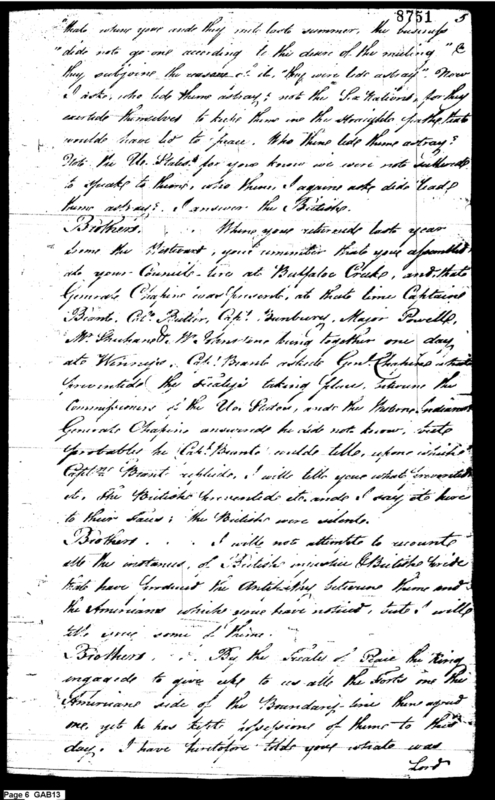
Brothers. . . And the Speeches from the Western
Indians sent you by Capt. Brant, and which
you have just returned to me, beg, say
"that where you and they will both look tomorrow, the business
"did not go on according to the desire of the meeting" [&]
they subjoined the reasons of it, they were led astray." Now
I ask, who led them astray; not the Six Nations, for they
exerted themselves to [keep] them on the straight path that
would have led to peace. Who then led them astray?
[It is] the U. States, for you know we were not [authorized]
to speak to them; so then, I [again] ask, who did [that];
[who] led them astray? I answer the British.
Brothers. When you returned last year
from the [West]; your committee made you [permitted?]
to your Council here at Buffaloe Creek, and that
General Chapin was [General?], at [that] time Captain
Brant, Col. Butler, Capt. Bunbury, Major [Paschall?],
Mr. [Blanchard?], Mr. [Glynn?] now being together one day,
at Wawayasio, Col. Brant [asked] Genl. Chapin what
[prevented] the [Treaty] taking place, between the
Commissioners of the U. States, and the Nations.
General Chapin answered he did not know; [that?]
[probably] it was Col. Brant's middle [title]; upon [which?]
Capt. Brant replied. I will tell you what [prevented]
it; the British [prevented] it; and I say it here
to their faces; the British were [asked?].
Brothers. . . I will not attempt to recount
all the instances of British insolence [&] British Tricks
that have produced the animosity between them and
the Americans which you have noticed; but I will
cite several of them. —
Brothers. . . By the Treaty of Paris the King
engaged to give up to us all the Forts on the
Americans side of the Boundary line. King agreed
[on]; yet he has [kept] possession of them to this
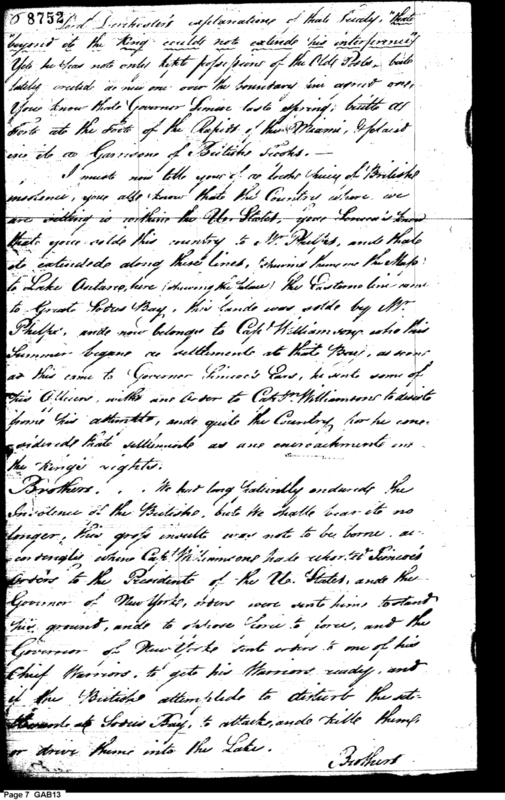
day. I have therefore told you [that?] your treaty was
[of] Lord Dorchester's explanations of [that] Treaty, "[the?]
[beyond] of the King could not [extend] his interference."
Yet he has not only kept possession of the Old Forts, but
lately created [a] new one over the boundary in [error? on?].
You know that Governor Simcoe has lately built it, at
[Forts] into the [heart] of the Rapids of the Miami; [stationed]
even it [as] Garrison [of] British [Troops]. —
I must now tell you of a noble [thing?] of British
[problems?]; you all know that the Councils where we
are [sitting] is within the U. States; your [Simcoe?] have
[that] you sold this country to Mr. Phelps, and that
it extended along these lines, [showing the Map] the
to Lake Ontario; here [showing the Map] the Eastern line [runs]
to Great Sodus Bay. This Lands was sold by Mr.
Phelps, and now belongs to Capt. Williamson who has
[a] Simcoe [began?] [a] settlement at that place; as soon
as this came to Governor Simcoe's ears, he sent some of
his Officers, with a letter to Capt. Williamson to desist
from his attempts, and quit the Country; for he considered
[himself] that settlement as one encroachment on
the King's rights.
Brothers. . . We had long patiently endured the
insolence of the British; but we [could] bear it no
longer; this gross insult was not to be borne. [A?]
[evenings?] where Capt. Williamson had to [raise? write?] to Simcoe's
[letters] to the President of the U. States, and the
Governor of New York; there were sent home to stand
[this] ground, and to [enforce?] force; and the
Governor of New York sent orders to one of his
Chief Warriors, to [get] his Warriors ready; and
if the British [attempt] to disturb the settlement
[below] at Sodus Bay, to [attack] and kill them
or drive them into the Lake. Brothers.
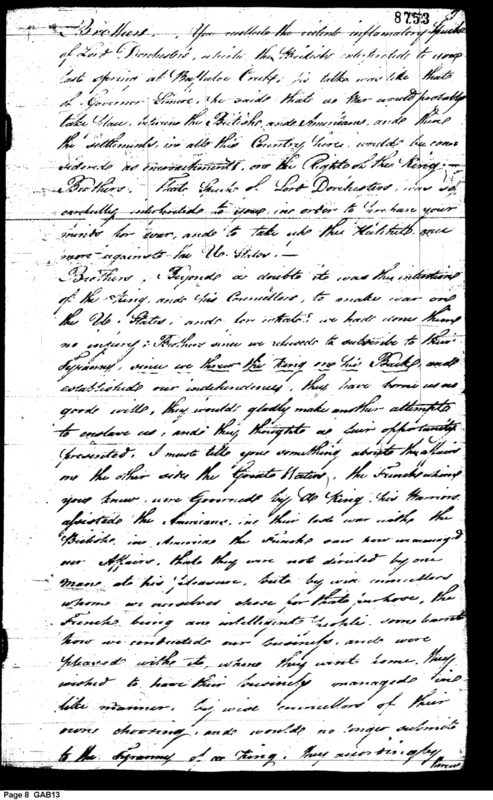
Brothers. You [recollect] the violent inflammatory Speech
of Lord Dorchester, which the British intended to [cause?]
late Spring at Bay Horse Creek; he talked more like that
of Governor Simcoe; he said that as War would probably
take place between the British and Americans, and that
the settlements in all this Country [here?] would be come
[declared?] as encroachments; on the Rights of the King. —
Brothers. That Speech of Lord Dorchester was so
carefully distributed to you; in order to [for have?] your
minds for war, and to take you this [to talk?] once
more against the U. States. —
Brothers. Regards it [should?] it was the intention
of the King, and his Councillors, to make war on
the U. States, and for what? as we have done them
no injury; Brothers since we refused to subscribe to their
tyranny, since we threw the King on his [back?] and
established our independence; they have been [at us?]
good will; they would gladly make another attempts
to enslave us; and they [thought?] so their opportunities
[presented]. I must tell you something about [the Nations]
on the other side the [Great] Water. The French who
you know, were Governed by the King; his Warriors
assisted the Americans in their last war with the
British; in America the French can have [managed?]
our Affairs, that they were not divided by one
man at his pleasure; but by wise Councillors,
whom we ourselves chose for that purpose; the
French being [an] intelligent People, some [have?]
how we conducted our business, and were
pleased with it; when they went home, they
wished to have their business managed [in] a
like manner, by wise Councillors of their
own choosing; and would no longer submit
to the tyranny of a King; they accordingly
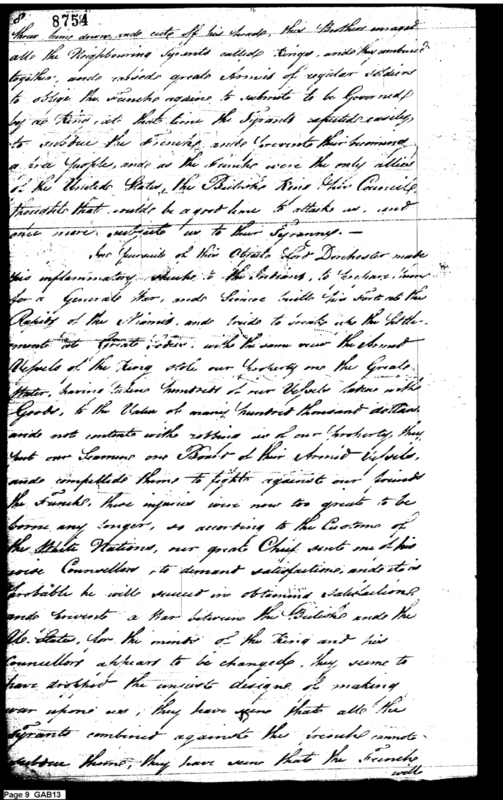
threw him down; and cut off his heads. This Brothers must [have?]
all the Neighbouring [tyrannical] Kings, and they combined
together, and raised great Armies of regular Soldiers
to oblige the French Nation to submit to be Governed
by a King; as [but] the [French] [expelled?] rapidly
to enslave the French, and [prevent] their becoming
a free People, and as the French were the only allied
[of] the United States, the British King [his] Councillors
[thought] that it could be a good time to attack us, and
once more, subjected us to their tyranny. —
And [General?] of [War?] Colonel Lord Dorchester made
his inflammatory [Attacks] to the [Nations], to [prepare] them
for a General War; and [Simcoe] builds his [Fort] at the
Rapids of the Miami; and [tried] to [keep] into the [settlement]
of the [great?] Irishmen; with the same once the [claimed]
Vessels of the King [stole?] our [Liberty?] on the [Great]
Water; having taken hundreds of our Vessels laden with
Goods; to the Value of many hundred thousand dollars;
and not content with [robbing] us of our property, they
took our Seamen and [poor?] at their Armed [Islands]
and compelled them to fight against our friends
the French. These injuries were now too great to be
borne any longer; so according to the Customs of
the White Nations; our great Chief sent out his
wise Councillors, to demand satisfaction; and it is
probable he will succeed in obtaining satisfactions
and [prevent] a War between the British and the
U. States. As the minds of the King and his
Councillors appeared to be changed; they seem to
have dropped the ungenerous designs of making
War against us; they have [agreed] that all the
[tyrannical?] combined against the [friendly?] minds
[of those?] them; they have seen that the French
will
remains upon their people; and that it will be no more [to?]
attempts to deprive us Americans of our liberty; the
French Brothers instead of being subdued are now
overrunning the Countries of the [tyrannies?] who attacked
them; the French are a very great People; and on this
[occasion?] they have adopted the Customs of the [nations?],
all their Young Men have become Warriors, and [marched]
against their Enemies, and beaten them on all sides. —
Brothers. I could [say?] by many instances of
British [Pride?] [Patriots?]; but I must mention a few.
You remember last year Col. Brant
and [a] large [Deputations] of Western Indians came
to Niagara, and desired to speak to the [American?]
Commissioners in presence of the Governor; they
asked, and we returned an Answer; in our
answer, we told them clearly, that in order to
make peace, something must be yielded on both
sides; that the U. States were willing to run as our
Line; [up?] to that it was impossible to make [this?]
the Mountains; that the United States [sitting?] on
the [Borough?] of [former?] [seated?], not [offered?] large
[quantities?] of Land over the Ohio, and that these
could not be given up. —
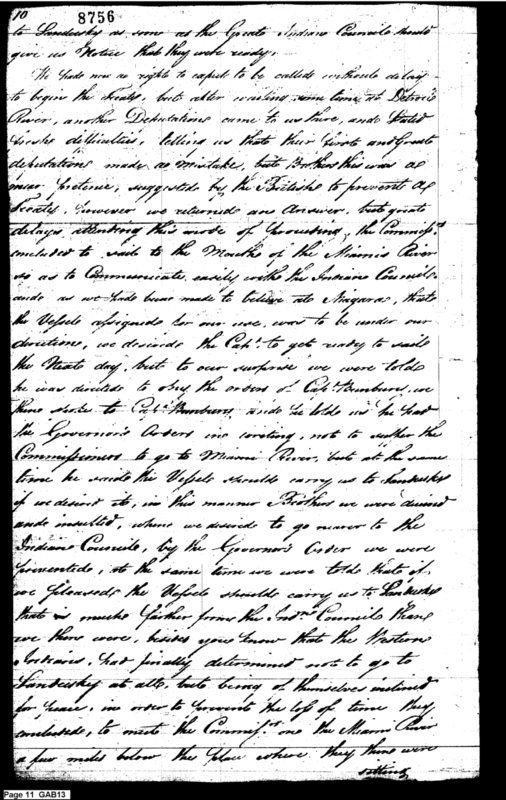
Brothers. . . Our Answer appeared satisfactory to
the Deputations, and they then look, as by the [hand?]
to lead us to [Sandusky], at this time Brothers the
People [noticed?] into the Conference, came the British;
[and?] the Great Difficulty was removed; and that
the Commissioners and the Indians would certainly
agree in making peace; this it is well known
was then the Common conversations at Niagara;
the Deputations then returned; the Commissioners
sailed to Detroit River to be at hand to [proceed]
to [Sandusky] as soon as the [great] Indian Councils would
give us Notice that they were ready.
We had now no right to expect to be called [without] delay
to begin the [treaty]; but after [waiting] some time at Detroit
River, another [Deputation] came to us [that]; and raised
[great] difficulties. Telling us that their Chiefs and [great?]
[Deputation] made no mistake; but Brothers this was all
[a] [pretence]; suggested by the British to prevent [a] Peace
[Treaty]; however we returned our Answer; but [great?]
delays attending this mode of [questioning]; the Commiss[ioners]
[resolved] to sail to the Mouths of the Miami River
as to Communicate easily with the Indian Councils;
and as we had been made to believe at Niagara, that
the Vessels [assigned?] for our use, were to be under our
direction; we [desired?] the Capt. to get ready to sail
the next day; but to our surprise we were told
he was directed to obey the orders of Col. [Turnbury?]; we
then spoke to Col. [Turnbury?]; and he told us he had
the Governor's Orders in writing, not to suffer the
Commissioners to go to Miami River; but at the same
time he would the Vessels should carry us to [Sandusky]
if we desired it; in this manner Brothers we were [denied?]
and insulted; when we desired to go nearer to the
Indian Councils, by the Governor's Order we were
[prevented]; at the same time we were told that if
we pleased, the Vessels should carry us to [Sandusky]
that is much farther from the [great?] Councils than
[we] were then were; besides you know that the Western
Indians had finally determined not to go to
[Sandusky] at all; but being as themselves [inclined]
for peace, in order to [prevent?] the loss of time they
[proceeded], to meet the Commiss. on the Miami River
a few miles below the place where they then were
sitting.
Sitting in Council; and you the Six Nations [were?]
informed [actually?] moved down to the [Exchange?] place
of meeting; you know whether or not this Commissioners
at [one?] (the Former Brother [said?] and said it was [done?])
Now then I once more ask, who [prevented?] our
[sealing?] in making peace with the Western Indians?
I answer the British, the very ones who had [especially]
wished it [as?] success. Yes Brothers, Governor Simcoe
twice took us by the [hand?], where I was [having]
Niagara to go to the Treaty with the Western
Indians, and twice [invited?] us to [carry?] us all [till?]
he had taken secret measures to [prevent] it. —
Brothers. I will mention but one more [fact?]
which the Western Indians sent removed to the [head?]
Warrior of our Army, with offers of Peace; the
Head Warrior answered that the U. States were [also?]
willing to make peace, but that if the [Great Indians?]
were now sincere in their proposals, they must give
evidence of it, by collecting, and bringing to his
quarters all the American Prisoners; the [next?]
then returned; and the hostile Indians were so
satisfied with the Answer that they actually
began to collect the Prisoners, in order to deliver
them to our Head Warrior; but as soon as the
British Agents heard this, they interfered, &
told the Indians they were [sold]; and that if
they proceeded they would be destroyed, and cut
off. Now Brothers I know the U. States were sincere
in consenting at [that?] time to make Peace; for I
had myself been desired to go to the Westward
as [a] Commissioner, to join our Head Warrior in
Negotiating the terms of the Treaty; and I had
consented to go. And you see Brothers that where
ever there was a prospect of making peace with the
Western Indians the British had not failed to
interfere and [prevent?] it. — Brothers.
Brothers. These are my reasons for
refusing to admit a British Agents into a Council
here [handled] by the U. States. I could mention more
but I am [convinced?] while speaking; as you must
be [so.] Knowing, and surely you must think the reasons
I have offered to be sufficient; the facts I have
mentioned, I believe to be [true], and the Observations
just; if there be any errors in any Statement
they have arisen from mistake or misinformation,
and not from designed. I have but one thing
more to [Mention], it is this: I am instructed
by the President, not to suffer a British Agent
to attend this Councils here. —
Brothers. You now have my reasons, and my
actions; if indeed I wished that the differences between
the United States and you should continue; if I
wished that the important business for which this
[present?] [treaty?] was [handled]; should be defeated; if
I wished no claims of friendship should grow more
[costly?]; if I wished it to become rotten and break
off; then I would advise to retain this British
[Spy?]
Brothers. It now remains with you to
determine, whether the Great business for which we
here meet, shall go on; or whether the Council
here, shall be extinguished; you are a free and
independent People; and as such, you will
determine this Question. ——
Niagara 10th Decemr 1794
A true Copy from the Original
Marks enclosed to Capt. Brant; one
Col. Pickering's letter to him of the 17th Nov. 1794
By [undecipherable] [from?] [Peter?] [undecipherable]
Type
Copy of document
Description
Colonel Pickering's speech to the Six Nations assembled at a Council held at Canandagua in which he urges them not to allow the Chain of Friendship to grow more rusty and possibly to become rotten and break off.
Date
10/25/1794
Author
Recipient
Sent from
In Council at Canandagua
Document number
1794102590002
Page start
1
Note
Partially illegible.
Notable persons
Timothy Pickering
Six Nations of Indians
Quakers
British spy
Notable locations
In council at Canandagua
Notable items
council fire