

Commutation for Exchanged Officers
Document 1794Upon examination of the facts stated on behalf of Capt. Peter Perrit, Howell finds that commutation has not been allowed officers who were exchanged in 1778-79 unless they were in service afterwards and continued to the 1st January 1781.




No human transcription currently available for this document.
This transcription was generated by machine using Anthropic's Claude Code (model sonnet 4.6). It may contain errors or inaccuracies. Please verify against the document image. Learn more about our generative AI methodology.
W.D Accountant's Office
Sir July 25th 1794
I have made an examination into the facts stated by Mr James Blanchard on behalf of Capt Alex Pratt, the result of which I beg leave to lay before you, it is as follows —
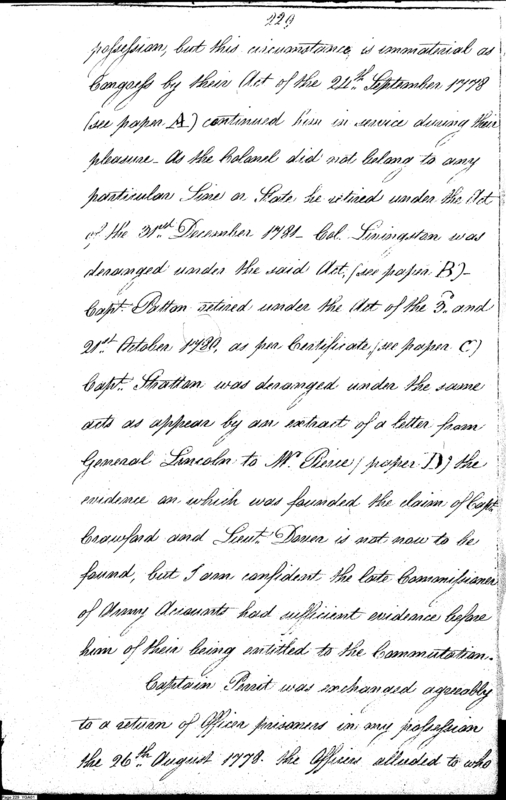
Mr Blanchard affirms that Capt Pratt's claim for Commutation is founded on the same principles which governed in the settlements and allowances made to Col Allen, Lt Col Livingston, Capt Patton, Stratton, Crawford and others, this merits particular enquiry — the time of Col Allen's exchange does not appear on the return in my possession, but this circumstance is immaterial as Congress by their Act of the 22d September 1779 (see paper A) continued him in service during their pleasure. As the Colonel did not belong to any particular Line or State he retired under the Act of the 28th December 1794. Col Livingston was deranged under the said Act (see paper B). Capt Patton retired under the Act of the 3d and 21st October 1790, as per Certificate (see paper C) Capt Stratton was deranged under the same acts as appears by an extract of a letter from General Lincoln to Mr Clerez (paper D) the evidence on which was founded the claim of Capt Crawford and Lieut Torer is not now to be found, but I am confident the late Commissioner of Army Accounts had sufficient evidence before him of their being entitled to the Commutation.
Captain Pratt was exchanged agreeably to a return of Officer prisoners in my possession the 26th August 1779, the Officers alluded to who received Commutation were exchanged between the 26th of October and the 21st December 1780 it being subsequent to the Act of the 22d May 1779 the similarity of the cases does not apply, for those officers who received the Commutation were considered by their States or by the Secretary of war as retiring from service under the Acts of the 3d and 21st October 1780 and probably by the act of Congress of the 1st January 1781. Those Officers who were exchanged previous to the 22 May 1779 and did not join their respective Regiments and who were not again in service, were considered under that act as Supernumerary, a few of which are mentioned in paper E and received the Years pay some in specie, others on the Old Emissions — a number of those Officers who were exchanged between the 25th October 80 and the 1st January 81 have only received the years pay paper F. it is therefore evident that commissioner of Accounts did not conceive himself authorized to grant the Commutation without the necessary Certificates from the State or Secretary of War, that these Officers were deranged under the Acts of 80 as mentioned. the many applications on this head induced the Commissioner to address himself on the Subject, and which produced the Resolve of February 1st 1792 and June 30th 1796.
Mr Blanchard quotes the 13th Article of section the 11th of the Articles of War. I am at a loss to know the purpose of bringing this forward as I conceive that Section operates against him — Congress being express in their declaration of dismissing Officers.
Captain Pratt in his Memorial to Congress of the 3d February last affirms that the act of Congress of the 11th of February 1782 entitles officers in his situation to half pay or the a commutation of half pray for life, on which resolution all the Officers who were in like circumstances with him have been settled with excepting himself and one more who was a Lieutenant in his Company at Fort Washington and was there "captured by the Enemy". I have before observed that those Officers who were exchanged previous to the 22d May 1779 and did not join the Army were considered under that Act as supernumerary. the assertion that all Officers in his situation were allowed the Commutation is not fact, so far from it, that I do not after a full investigation of the accounts settled by the late Commissioner of Army Accounts or by myself find one instance where an Officer has been allowed Commutation who was exchanged on 1778 & 1779 unless such Officer was afterwards in actual service and continued to the 1st Jany 1781 — This statement added to your two reports to Congress will I conceive fully show that Capt Pratt's claim is not founded either upon Law or custom —
The Secretary of War —
I am Sir &c
Joseph Howell
Type
Author's Letterbook Copy
Description
Upon examination of the facts stated on behalf of Capt. Peter Perrit, Howell finds that commutation has not been allowed officers who were exchanged in 1778-79 unless they were in service afterwards and continued to the 1st January 1781.
Date
07/24/1794
Author
Recipient
Sent from
Accountant's Office
Document number
1794072421155
Page start
228
Notable persons
Henry Knox
Joseph Howell
Notable locations
Accountant's Office