

Suspension of the Establishment at Presque Isle
Document 1794Govenor Mifflin makes his case against the suspension of the establishment of the town at Presque Isle, arguing that the land for the town is the property of his State and could not justifiably have been ceded to the Indians by the recent treaty.


No human transcription currently available for this document.
This transcription was generated by machine using Anthropic's Claude Code (model sonnet 4.6). It may contain errors or inaccuracies. Please verify against the document image. Learn more about our generative AI methodology.
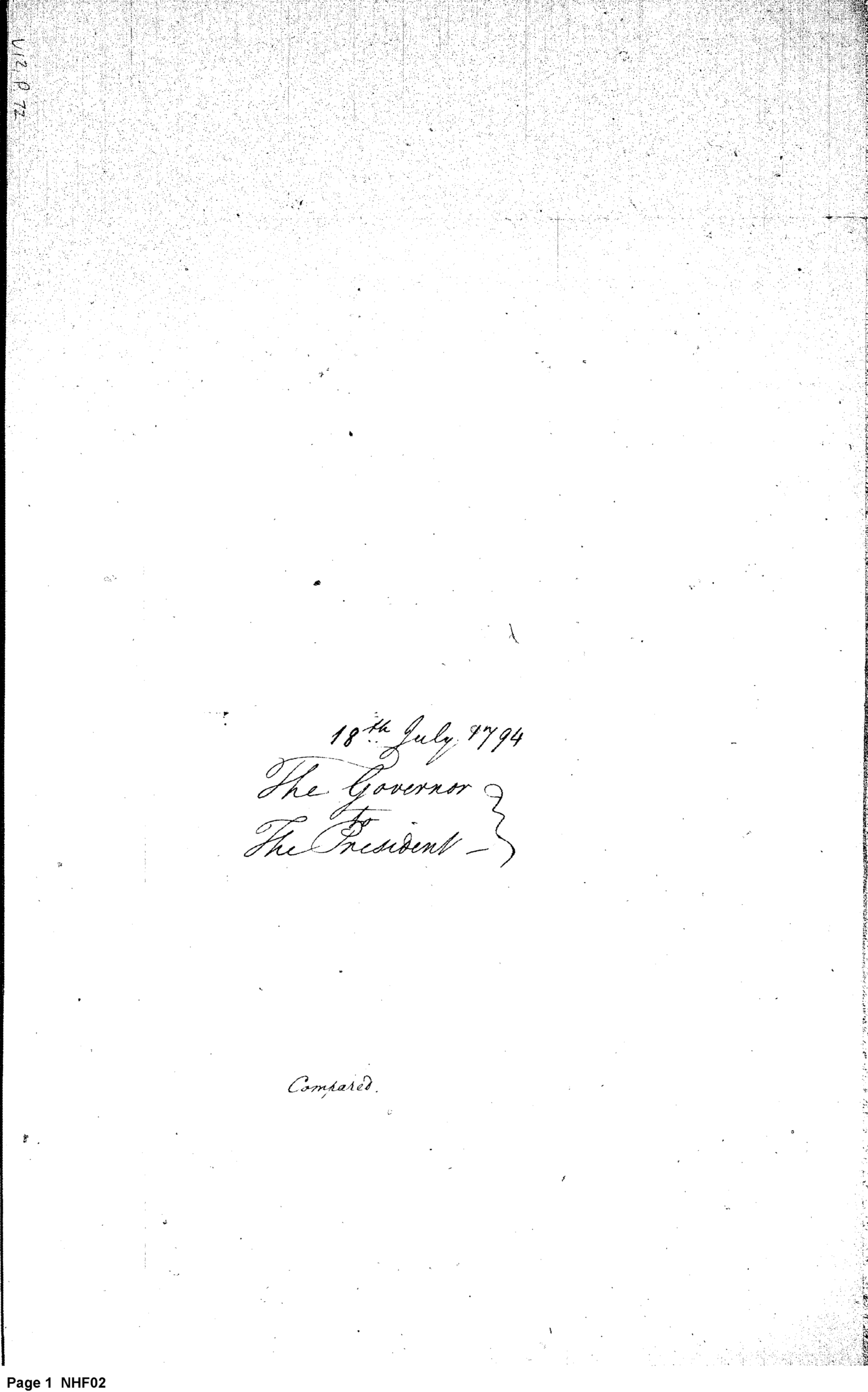
[V12 p 72]
[18th July 1794
The Governor
to
The President —]
[Compared.]
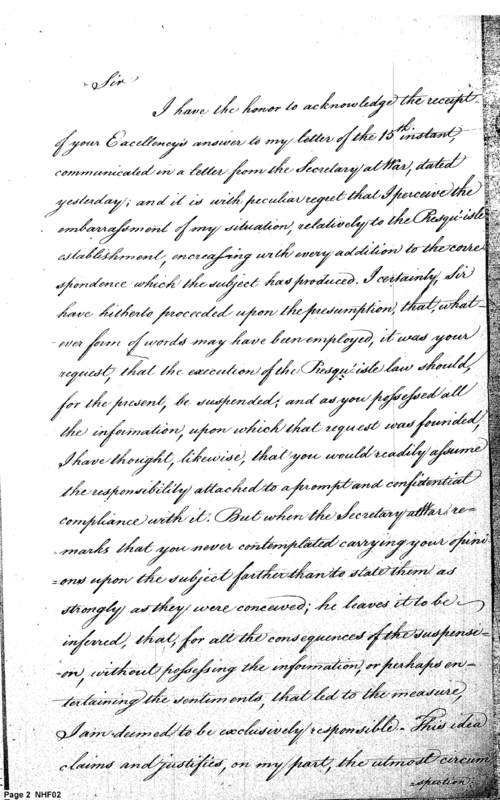
Sir
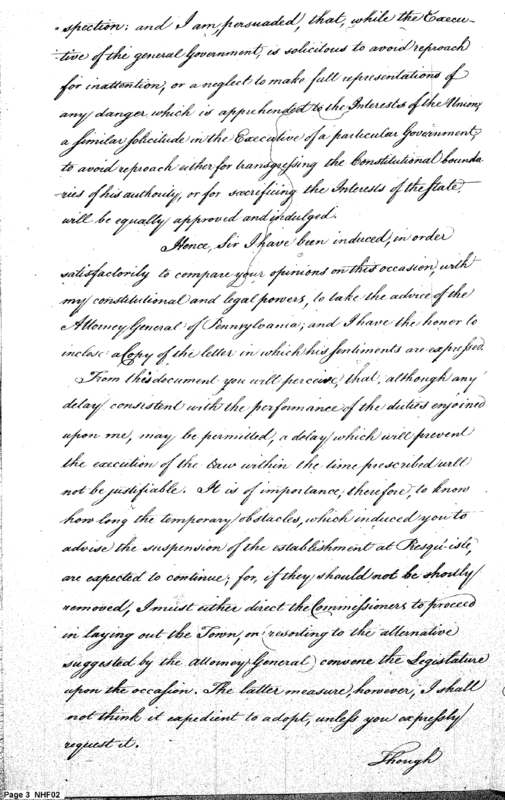
I have the honor to acknowledge the receipt of your Excellency's answer to my letter of the 15th instant, communicated in a letter from the Secretary at War, dated yesterday; and it is with peculiar regret that I perceive the embarrassment of my situation, relatively to the Presqu'isle establishment, encreasing with every addition to the correspondence which the subject has produced. I certainly, Sir have hitherto proceeded upon the presumption, that, whatever form of words may have been employed, it was your request, that the execution of the Presqu'isle law should, for the present, be suspended; and as you possesed all the information, upon which that request was founded, I have thought, likewise, that you would readily assume the responsibility attached to a prompt and confidential compliance with it. But when the Secretary at War remarks that you never contemplated carrying your opinions upon the subject farther than to state them as strongly as they were conceived; he leaves it to be inferred, that, for all the consequences of the suspension, without possesing the information, or perhaps entertaining the sentiments, that led to the measure, I am deemed to be exclusively responsible. This idea claims and justifies, on my part, the utmost circumspection; and I am persuaded, that, while the Executive of the general Government, is solicitous to avoid reproach for inattention, or a neglect to make full representations of any danger which is apprehended to the Interests of the Union, a similar solicitude in the Executive of a particular Government, to avoid reproach either for transgressing the Constitutional boundaries of his authority, or for sacrificing the Interests of the State, will be equally approved and indulged.
Hence, Sir I have been induced, in order satisfactorily to compare your opinions on this occasion, with my constitutional and legal powers, to take the advice of the Attorney General of Pennsylvania; and I have the honor to inclose a Copy of the letter in which his sentiments are expressed.
From this document you will perceive, that, although any delay consistent with the performance of the duties enjoined upon me, may be permitted, a delay which will prevent the execution of the law within the time prescribed will not be justifiable. It is of importance, therefore, to know how long the temporary obstacles, which induced you to advise the suspension of the establishment at Presqu-isle, are expected to continue; for, if they should not be shortly removed, I must either direct the Commissioners to proceed in laying out the Town, or (resorting to the alternative suggested by the Attorney General) convene the Legislature upon the occasion. The latter measure, however, I shall not think it expedient to adopt, unless you expressly request it.
Though the title of the State, to the jurisdiction and soil, of the territory, on which she proposes to form her settlements, can admit of no just controversy, I would cheerfully, as far as my power extends, co-operate in any amicable proceeding to conciliate the minds of the Six nations; but I have no authority to appoint a Commissioner to treat with them upon the subject; and indeed, the Secretary at War has misunderstood the purport of my conversation in that respect, since he ascribes to me an opinion, that, under the present circumstances, all differences may be accommodated by treaty. The truth is, that, if a sense of Justice influenced the conduct of those Indians, no opposition would have been made to our improving the lands, which we had fairly bought, and the sale of which they have repeatedly acknowledged; and if they act (as I believe [strikethrough: undecipherable] they do) under the direction and controul of British Agents, their opposition must be expected to last, as long as the policy, by which it is excited. If, however, Sir, you should be pleased, on the part of the United States, to authorise a treaty to be held, I shall think it my duty to furnish you with all the documents that relate to the title of Pennsylvania, and its repeated recognitions, by Corn planter and the other Indians who now presume to deny it.
I am, with perfect respect, Sir,
Philad.a 18.th July 1794
To The President
of the United States
Your Excellency's
most obedient servant
Thomas Mifflin
Type
Letter Signed
Description
Govenor Mifflin makes his case against the suspension of the establishment of the town at Presque Isle, arguing that the land for the town is the property of his State and could not justifiably have been ceded to the Indians by the recent treaty.
Date
07/18/1794
Author
Recipient
Sent from
Philadelphia
Collection
Document number
1794071800102
Page start
1
Notable persons
Thomas Mifflin
George Washington
Executive of the General Government
Commissioners
legislature [of Pennsylvania]
Six Nations
Governor
President
Secretary of War
attorney general
Cornplanter
commissioners
British agents
Notable locations
Pennsylvania
War Department
Presque Isle establishment
constitutional boundaries
Notable items
execution of the Presque Isle law
consequences of the suspension
interests of the Union
transgressing the Constitutional boundaries of his authority
interests of the State
my constitutional and legal powers
advice of the Attorney General of Pennsylvania
execution of the law within the law prescribed
suspension of the establishment at Presque Isle
settlements
treaty
sense of justice
lands which we had fairly bought
control of British agents
title of Pennsylvania
repeated recognitions by Cornplanter