

Interests of the Union vs. Those of the States
Document 1794Governor Mifflin lectures Knox on the discretionary powers of the President in relation to the State governments. He acknowledges that it is the duty of the President to act in the interests of the whole Union even if an action might be perceived as contrary to the interests of an individual State. However, it his duty as Executive Magistrate of Pennsylvania to act in its best interest unless an action is contrary to the interests of the whole Union.

No human transcription currently available for this document.
This transcription was generated by machine using Anthropic's Claude Code (model sonnet 4.6). It may contain errors or inaccuracies. Please verify against the document image. Learn more about our generative AI methodology.
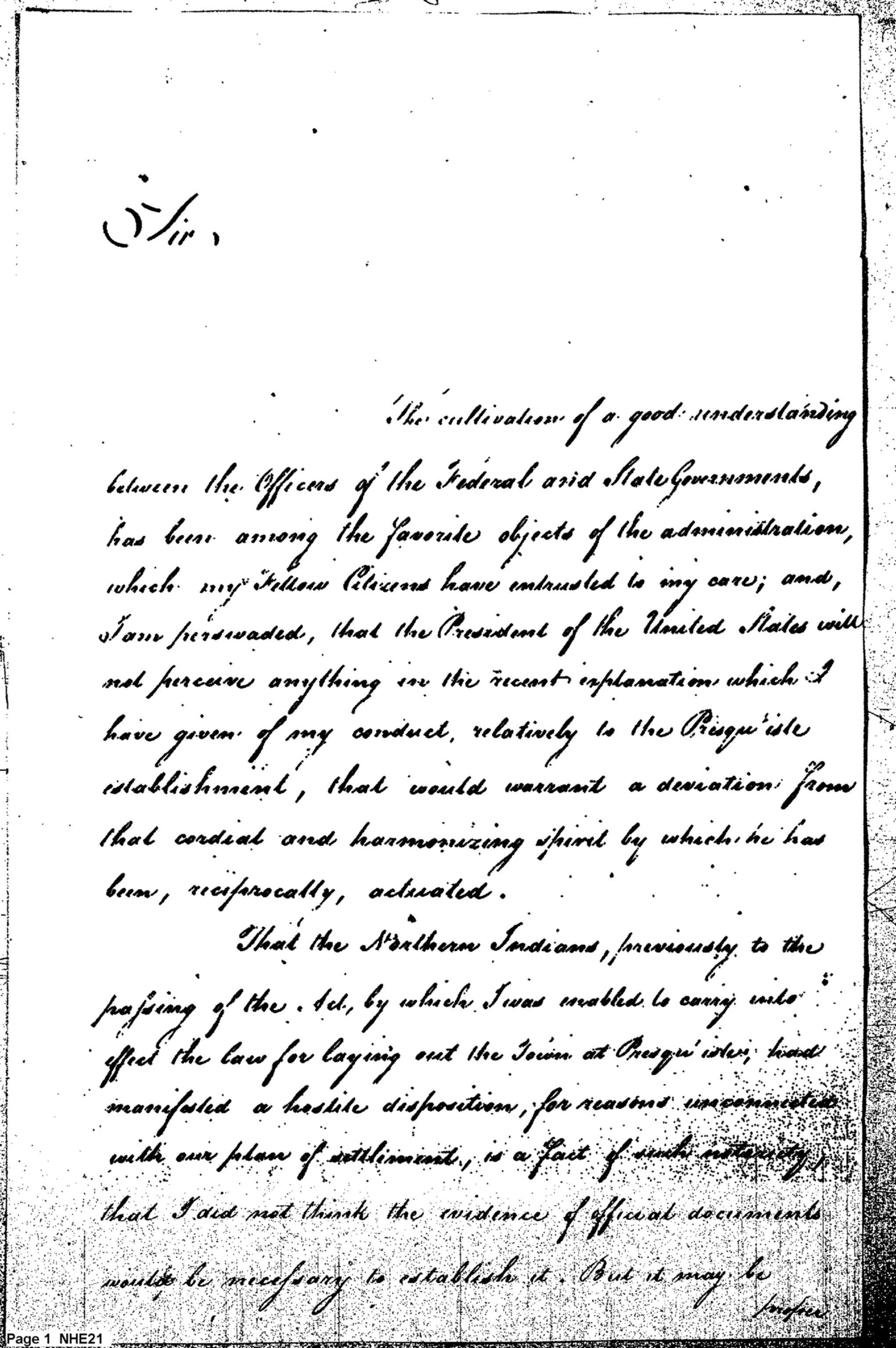
Sir,
The cultivation of a good understanding between the Officers of the Federal and State Governments, has been among the favorite objects of the administration, which my Fellow Citizens have intrusted to my care; and, I am persuaded, that the President of the United States will not perceive anything in the recent explanation which I have given of my conduct, relatively to the Presqu'isle establishment, that would warrant a deviation from that cordial and harmonizing spirit by which he has been, reciprocally, actuated.
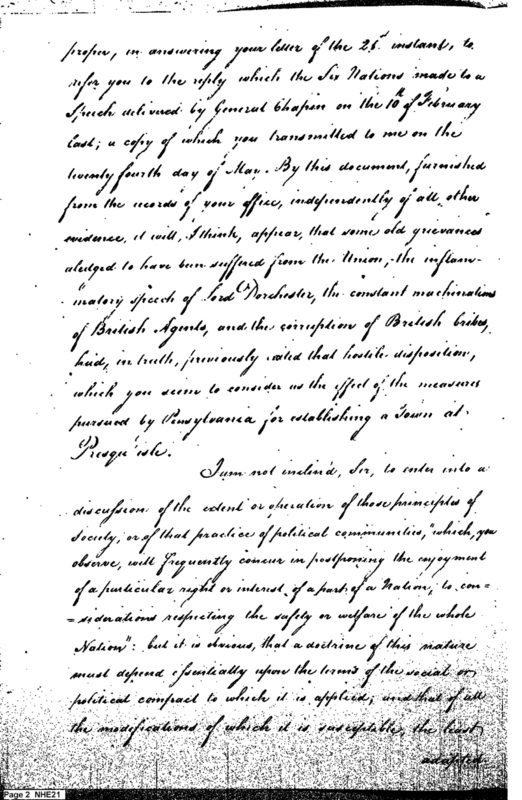
That the Northern Indians, previously to the passing of the Act, by which I was enabled to carry into effect the law for laying out the Town at Presqu'isle, had manifested a hostile disposition, for reasons unconnected with our plan of settlement, is a fact of such notoriety, that I did not think the evidence of official documents would be necessary to establish it. But it may be
proper, in answering your letter of the 25. instant, to refer you to the reply which the Six Nations made to a Speech delivered by General Chapin on the 10 of February last; a copy of which you transmitted to me on the twenty fourth day of May. By this document, furnished from the records of your office, independently of all other evidence, it will, I think, appear, that some old grievances alleged to have been suffered from the Union, the inflammatory speech of Lord Dorchester, the constant machinations of British Agents, and the corruption of British bribes, had, in truth, previously excited that hostile disposition, which you seem to consider as the effect of the measures pursued by Pennsylvania for establishing a Town at Presqu'isle.
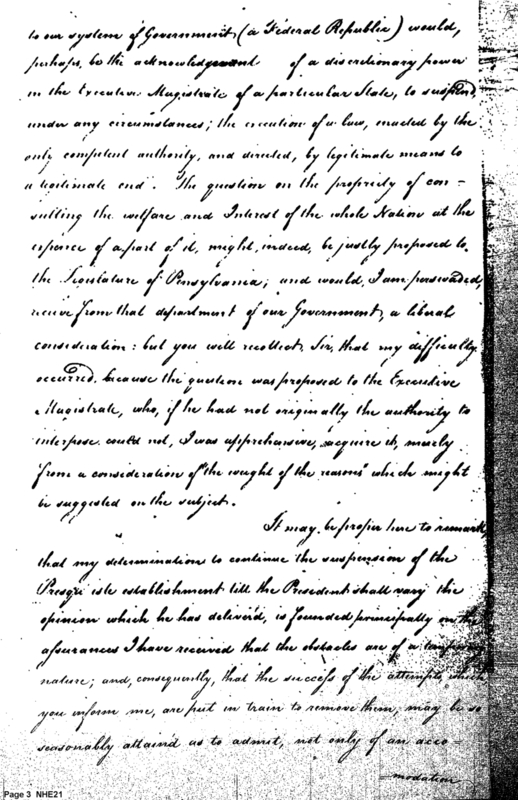
I am not inclined, Sir, to enter into a discussion of the extent or execution of those principles of Society, or of that practice of political communities, which, you observe, will frequently concur in postponing the enjoyment of a particular right or interest of a part of a Nation, to con=siderations respecting the safety or welfare of the whole Nation: but it is obvious, that a doctrine of this nature must depend especially upon the terms of the social or political compact to which it is applied; and that of all the modifications of which it is susceptible, the least
to our systems of Government (a Federal Republic) would, perhaps, be the acknowledgement of a discretionary power in the Executive Magistrate of a particular State, to suspend, under any circumstances, the execution of a law, enacted by the only competent authority, and directed, by legitimate means to a legitimate end. The question on the propriety of consulting the welfare and Interest of the whole Nation at the expense of a part of it, might, indeed, be justly proposed to the Legislature of Pennsylvania; and would, I am persuaded, receive from that department of our Government, a liberal consideration: but you will recollect, Sir, that my difficulty occurred, because the question was proposed to the Executive Magistrate, who, if he had not originally the authority to interpose could not, I was apprehensive, acquire it, merely from a consideration of the weight of the reasons which might be suggested on the subject.
It may be proper here to remark, that my determination to continue the suspension of the Presqu'isle establishment till the President shall vary this opinion which he has delivered, is founded principally on the assurances I have received that the obstacles are of a temporary nature; and, consequently, that the success of the attempts which you inform me, are put in train to remove them; may be so seasonably attained as to admit, not only of am acco=
mmodation of the views of the General Government; but also of the Execution of the law of Pennsylvania, within the period contemplated by the Legislature: for, although no arguments can be necessary to convince me of the patriotic attention of the President to the interests of the Union, it would be contrary to the ideas which I entertain of his justice, candor and wisdom, to suppose, that, in order to facilitate the duties of his station, he would advise me to pursue a measure inconsistent with the duties of mine; or that he would deliver an opinion to the Executive of any State, which it might be thought indecent to disregard, and illegal to adopt.
I am, with great respect,
To Henry Knox Eq.r Sir
Secretary at War [undecipherable] your most Obed. Serv.
[Signed:] Thomas Mifflin
[Examined: James Trimble [undecipherable] / [Attested]]
Philadelphia
24 June 1794
To Henry Knox, Esq.
Secretary at War
Type
Letter Signed
Description
Governor Mifflin lectures Knox on the discretionary powers of the President in relation to the State governments. He acknowledges that it is the duty of the President to act in the interests of the whole Union even if an action might be perceived as contrary to the interests of an individual State. However, it his duty as Executive Magistrate of Pennsylvania to act in its best interest unless an action is contrary to the interests of the whole Union.
Date
06/24/1794
Author
Recipient
Collection
Document number
1794062440201
Page start
1
Notable persons
Henry Knox
Thomas Mifflin
James Trimble
President [Washington]
Northern Indians
Six Nations
Notable locations
Presque Isle establishment
Pennsylvania
Notable items
good understanding between the Officers of the Federal and State governments
cordial and harmonizing spirit
law for laying out the town of Presque Isle
hostile disposition
plan of settlement
evidence of official documents
speech delivered by General Chapin
records of your office
old grievances
the Union
inflammatory speech of Lord Dorchester
constant machinations of British agents
corruption of British bribes
principles of society
practice of political communities
safety or welfare of the whole nation
social or political compact
Federal Republic
discretionary power of the Executive Magistrate
execution of a law
welfare and interest of the whole nation
legislature of Pennsylvania
suspension
General Government
interests of the Union
justice, candor, and wisdom