

Remarks on Masting of Frigates
Document 1794Letter, discusses masting of Frigates; encloses remarks on masting Frigates.




No human transcription currently available for this document.
This transcription was generated by machine using Anthropic's Claude Code (model sonnet 4.6). It may contain errors or inaccuracies. Please verify against the document image. Learn more about our generative AI methodology.
Now I have all pages. Let me produce the full transcription.
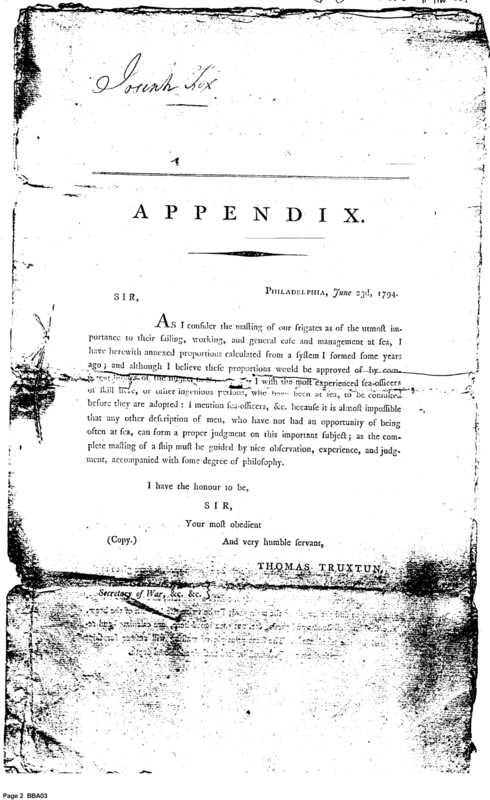
[handwritten: Joseph Fox]
APPENDIX.
SIR, Philadelphia, June 23d, 1794.
As I consider the masting of our frigates as of the utmost importance to their sailing, working, and general ease and management at sea, I have herewith annexed proportions calculated from a system I formed some years ago; and although I believe these proportions would be approved of by com[undecipherable] I wish the most experienced sea-officers of skill here, or other ingenious persons, who have been at sea, to be consulted before they are adopted: I mention sea-officers, &c. because it is almost impossible that any other description of men, who have not had an opportunity of being often at sea, can form a proper judgment on this important subject; as the complete masting of a ship must be guided by nice observation, experience, and judgment, accompanied with some degree of philosophy.
I have the honour to be,
SIR,
Your most obedient
(Copy.) And very humble servant,
THOMAS TRUXTUN.
Secretary of War, &c. &c.
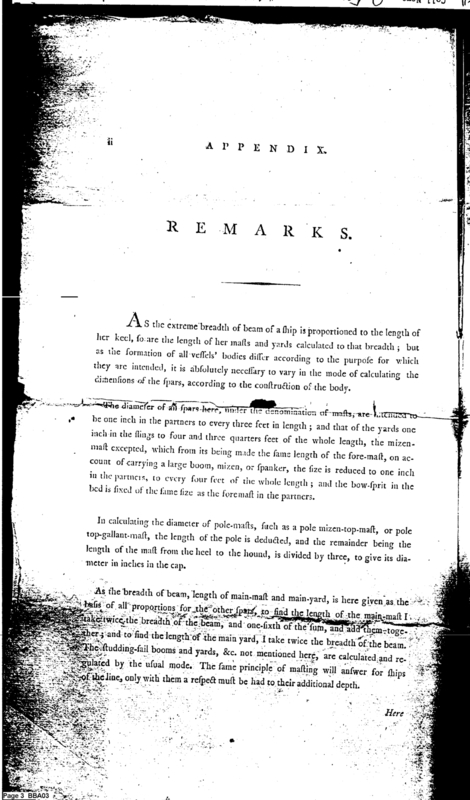
ii APPENDIX.
REMARKS.
As the extreme breadth of beam of a ship is proportioned to the length of her keel, so are the length of her masts and yards calculated to that breadth; but as the formation of all vessels' bodies differ according to the purpose for which they are intended, it is absolutely necessary to vary in the mode of calculating the dimensions of the spars, according to the construction of the body.
[undecipherable] The diameter of all spars here, under the denomination of masts, are intended to be one inch in the partners to every three feet in length; and that of the yards one inch in the slings to four and three quarters feet of the whole length, the mizen-mast excepted, which from its being made the same length of the fore-mast, on account of carrying a large boom, mizen, or spanker, the size is reduced to one inch in the partners, to every four feet of the whole length; and the bow-sprit in the bed is fixed of the same size as the foremast in the partners.
In calculating the diameter of pole-masts, such as a pole mizen-top-mast, or pole top-gallant-mast, the length of the pole is deducted, and the remainder being the length of the mast from the heel to the hound, is divided by three, to give its diameter in inches in the cap.
As the breadth of beam, length of main-mast and main-yard, is here given as the basis of all proportions for the other spars, to find the length of the main-mast I take twice the breadth of the beam, and one-sixth of the sum, and add them together; and to find the length of the main yard, I take twice the breadth of the beam. The studding-sail booms and yards, &c. not mentioned here, are calculated and regulated by the usual mode. The same principle of masting will answer for ships of the line, only with them a respect must be had to their additional depth.
Here
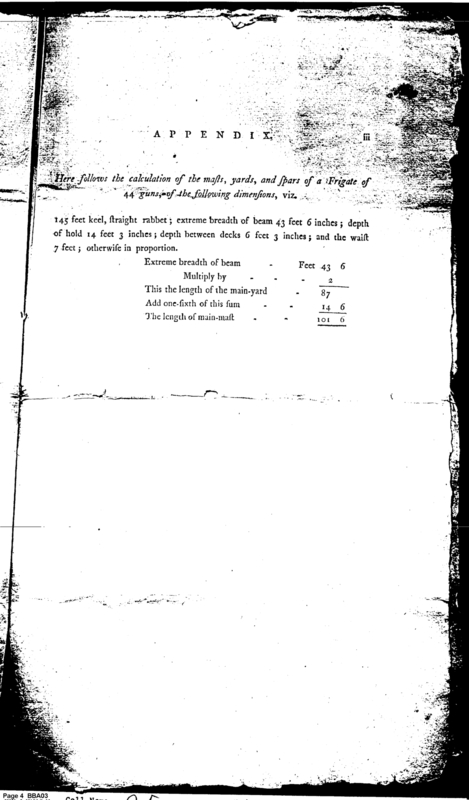
APPENDIX. iii
Here follows the calculation of the masts, yards, and spars of a Frigate of 44 guns, of the following dimensions, viz.
145 feet keel, straight rabbet; extreme breadth of beam 43 feet 6 inches; depth of hold 14 feet 3 inches; depth between decks 6 feet 3 inches; and the waist 7 feet; otherwise in proportion.
Extreme breadth of beam - Feet 43 6
Multiply by - - - 2
This the length of the main-yard - 87
Add one-sixth of this sum - - 14 6
The length of main-mast - - 101 6
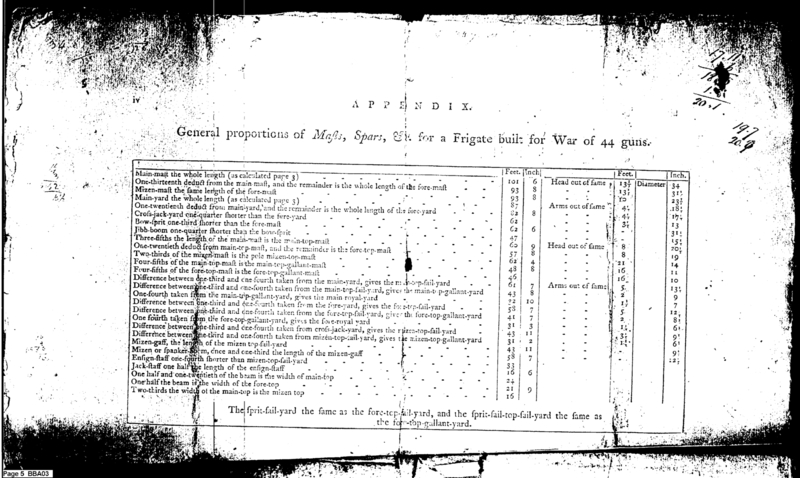
iv APPENDIX.
General proportions of Masts, Spars, &c. for a Frigate built for War of 44 guns.
Feet. Inch. Feet. Inch.
Main-mast the whole length (as calculated page 3) 101 6 Head out of same 13½ Diameter 34
One-thirteenth deduct from the main-mast, and the remainder is the
whole length of the fore-mast 93 8 13½ 31½
Mizen-mast the same length of the fore-mast 93 8 19 23½
Main-yard the whole length (as calculated page 5) 87 Arms out of same 4½ 18½
One-twentieth deduct from main-yard, and the remainder is the whole
length of the fore-yard 82 8 4½ 17½
Cross-jack-yard one-third shorter than the fore-yard 62 3½ 13
Bow-sprit one-third shorter than the fore-mast 62 6 - 31½
Jibb-boom one-quarter shorter than the bow-sprit 47 - 15½
Three-fifths the length of the main-mast is the main-top-mast 62 9 Head out of same 8 20½
One-twentieth deduct from main-top-mast, and the remainder is the
fore-top-mast 57 8 8 19
Two-thirds of the mizen-mast is the pole mizen-top-mast 62 4 21 14
Four-fifths of the main-top-mast is the main-top-gallant-mast 48 8 - 16
Four-fifths of the fore-top-mast is the fore-top-gallant-mast 46 - 11
Difference between one-third and one-fourth taken from the main-yard,
gives the main-top-sail-yard 61 7 Arms out of same 5½ 10
Difference between one-third and one-fourth taken from the main-top-sail-
yard, gives the main-top-gallant-yard 43 8 2 13½
One-fourth taken from the main-top-sail-yard, gives the main royal-yard 72 10 1½ 9
Difference between one-third and one-fourth taken from the fore-yard,
gives the fore-top-sail-yard 58 7 5 7
Difference between one-third and one-fourth taken from the fore-top-sail-
yard, gives the fore-top-gallant-yard 41 7 2 12
One-fourth taken from the fore-top-gallant-yard, gives the fore-royal yard 31 3 1½ 8½
Difference between one-third and one-fourth taken from cross-jack-yard,
gives the rizen-top-sail-yard 43 11 3½ 6½
Difference between one-third and one-fourth taken from mizen-top-sail-
yard, gives the mizen-top-gallant-yard 31 2 1½ 9½
Mizen-gaff, the length of the mizen top-sail-yard 43 11 - 6½
Mizen or spanker-boom, once and one-third the length of the mizen-gaff 58 7 - 9½
Ensign-staff one-fourth shorter than mizen-top-sail-yard 33 - 2½
Jack-staff one half the length of the ensign-staff 16 6
One half and one-twentieth of the beam is the width of main-top 24
One half the beam is the width of the fore-top 21 9
Two-thirds the width of the main-top is the mizen top 16
The sprit-sail-yard the same as the fore-top-sail-yard, and the sprit-sail-top-sail-yard the same as the fore-top-gallant-yard.
APPENDIX.
[handwritten calculations, partially legible: undecipherable]
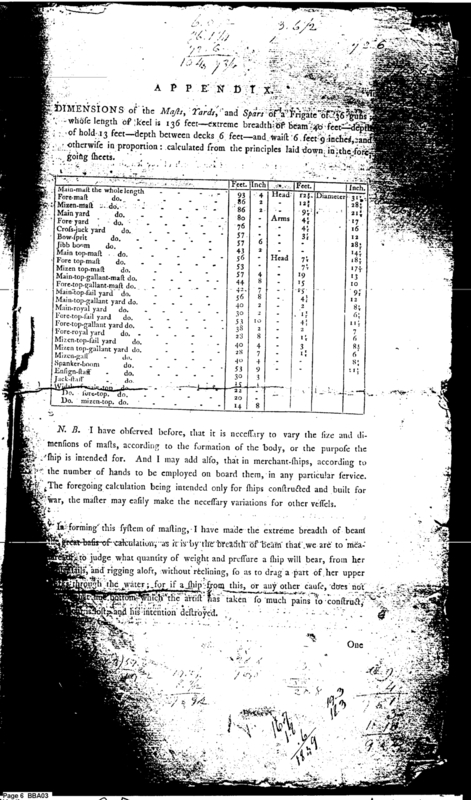
DIMENSIONS of the Masts, Yards, and Spars of a Frigate of 36 guns whose length of keel is 136 feet—extreme breadth of beam 40 feet—depth of hold 13 feet—depth between decks 6 feet—and waist 6 feet 9 inches, and otherwise in proportion: calculated from the principles laid down in the foregoing sheets.
Feet. Inch. Feet. Inch.
Main-mast the whole length 93 4 Head 12½ Diameter 31½
Fore-mast do. 86 2 12½ 28½
Mizen-mast do. 86 2 9½ 21½
Main yard do. 80 Arms 4½ 17
Fore yard do. 80 4½ 16
Cross-jack yard do. 76 3½ 12
Bow-sprit do. 57 6 - 28½
Jibb boom do. 57 2 - 14½
Main top-mast do. 43 Head 7½ 18½
Fore top-mast do. 56 7½ 17½
Mizen top-mast do. 53 - 13
Main-top-gallant-mast do. 47 4 19 10
Fore-top-gallant-mast do. 44 8 15 -
Main-top-sail yard do. 42 7 15 9½
Main-top-gallant yard do. 56 8 4½ 12
Main-royal yard do. 40 2 2 8½
Fore-top-sail yard do. 30 2 1½ 6½
Fore-top-gallant yard do. 53 10 4½ 11½
Fore-royal yard do. 38 2 2 7
Mizen-top-sail yard do. 23 8 1½ 6
Mizen top-gallant yard do. 40 4 3 8½
Mizen-gaff do. 28 7 1½ 6
Spanker-boom do. 40 4 - 8½
Ensign-staff do. 53 9 - 11½
Jack-staff do. 15 3
Width of main-top 22 ½ 1 —
Do. fore-top do. 20
Do. mizen-top do. 14 8
N. B. I have observed before, that it is necessary to vary the size and dimensions of masts, according to the formation of the body, or the purpose the ship is intended for. And I may add also, that in merchant-ships, according to the number of hands to be employed on board them, in any particular service. The foregoing calculation being intended only for ships constructed and built for war, the master may easily make the necessary variations for other vessels.
In forming this system of masting, I have made the extreme breadth of beam the great basis of calculation; as it is by the breadth of beam that we are to measure to judge what quantity of weight and pressure a ship will bear, from her sails, and rigging aloft, without reclining, so as to drag a part of her upper [undecipherable] through the water; for if a ship from this, or any other cause, does not [undecipherable] a bottom which the artist has taken so much pains to construct, [undecipherable] is lost, and his intention destroyed.
One
[handwritten calculations at bottom, partially legible: undecipherable]
viii APPENDIX.
One proportion (the breadth of beam) of the hull being taken to find the length of the main-mast and main-yard, as I have shown, another part may as properly be taken to proportion the mast-heads, &c. I have therefore brought forward the depth of waist, and the depth between decks for this purpose; which I think will answer as a better proportion than one-fourth of the length of the top-mast: for it must be observed, that there are inconveniences attending mast-heads, being too long as well as their being too short. However, if one-fourth of the whole length of the top-mast, as I have before mentioned, is taken for the lower masts heads, it will make but little difference from the first method; as per example. By the first method, the 44 gun ships' main and fore-mast heads are 13 feet 4 inches, (as the agitation of the fore-mast is greater than the main-mast, I have fixed the fore-mast head to be of the same length as the main-mast head), and by the second method, the main-mast head would be 15 feet 2 inches and a quarter; difference 22 inches and a quarter; and the fore-mast head 14 feet 5 inches; difference from the first method 13 inches.
The pole-mizen-top-mast the whole length is 62 feet 4 inches. I deduct the pole 21 feet therefrom, and the remainder being 41 feet 4 inches, is the length of the mizen-top mast, from heel to hound; one-fourth of which is 10 feet 4 inches, for the head of the mizen-mast; and by the first method, the head of the mizen-mast is 10 feet; difference 4 inches.
The pole main-top-gallant-mast the whole length is 48 feet 8 inches. I deduct the pole 16 feet, and the remainder being 32 feet 8 inches, is the length of the main-top-gallant-mast, from heel to hound; one-fourth of which is 8 feet 2 inches, for the head of the main-top-mast; and by the first method, the head of the main-top-mast is 8 feet; difference 2 inches only.
The fore-top-mast head calculated in the same way, would give but little difference also from the first method. In fact, either of these methods of finding the lengths of mast-heads will answer very well, as their difference is too trifling to be of any consequence.
The only true way of masting a ship, is by her own dimensions, and not at random, as merchantmen mostly are: and with respect to yards, I am clearly of opinion, that the ships of war of all nations carry too square yards; for the following reasons: 1st, Where a ship of this sort is going by the wind, and her yards braced up, you will find in general that the after part of her sails becomes a back sail; consequently instead
instead of increasing the velocity, as is intended, they cause a counter action. 2dly, By a ship having too square yards, the unnecessary and additional weight tends to make them crank, or lay down more than they otherwise would. 3dly, With yards too square, the stay-sails between the masts are rendered useless. Whereas ships with moderate yards, having their masts properly extended, [underline: in the manner I have stated], may not only carry their stay-sails to advantage, when close hauled, but they will hold up their sides to the breeze; by which means their velocity must naturally be increased. I have often noticed the disproportion of our former frigates' masts and yards, and lamented the want of some good general system of masting in this country, and of our never having got the proper rules by which the French and English mast their ships of war: but those nations are very tenacious of communicating any sort of improvements that they make in naval architecture, particularly such are approved of by the heads of their naval departments.
By many drawings which I have made at my leisure when at sea, I at last fixed on the principles now laid down, as the best I could devise; and if they should accord with the judgment of others, who are competent to an opinion on the subject, I shall be extremely happy.
T. T.
Type
Printed or published letter
Description
Letter, discusses masting of Frigates; encloses remarks on masting Frigates.
Date
06/23/1794
Author
Recipient
Sent from
Philadelphia
Repository
Collection
Document number
1794062340001
Page start
1
Notable persons
Thomas Truxtun
sea-officers
Notable locations
Philadelphia
at sea
Notable items
frigates
ship