

Harmony Between the General and Particular Governments
Document 1794Knox assures Governof Mifflin of the General Government's desire for harmony with the State Governments. He explains the suspension of the establishment of the town at Presque Isle as the means of maintaining harmony with the Six Nations following the murder of one of their Indians.

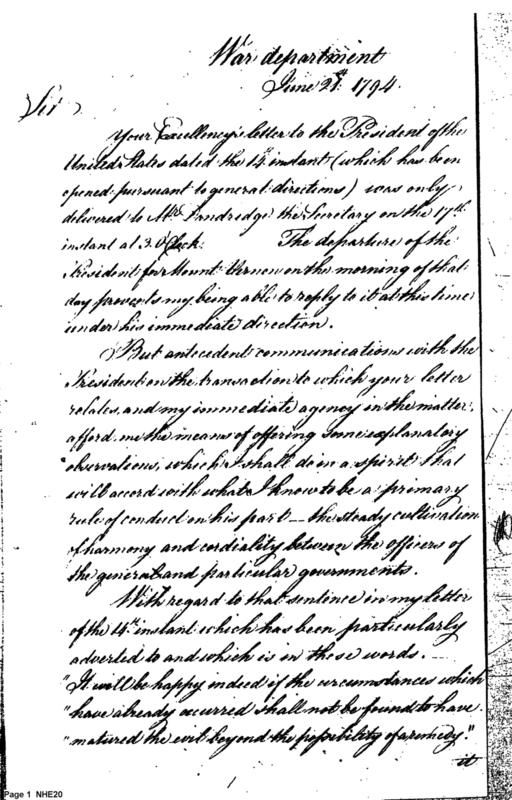


No human transcription currently available for this document.
This transcription was generated by machine using Anthropic's Claude Code (model sonnet 4.6). It may contain errors or inaccuracies. Please verify against the document image. Learn more about our generative AI methodology.
War department
June 27th 1794.
Sir,
Your Excellency's letter to the President of the United States dated the 14 instant (which has been opened pursuant to general directions) was only delivered to Mr Randolph the Secretary on the 17th instant at 3 OClock. The departure of the President for Mount Vernon on the morning of that day prevents my being able to reply to it at this time under his immediate direction.
But antecedent communications with the President on the transaction to which your letter relates, and my immediate agency in the matter; afford me the means of offering some explanatory observations, which I shall do in a spirit that will accord with what I know to be a primary rule of conduct on his part — the steady cultivation of harmony and cordiality between the officers of the general and particular governments.
With regard to that sentence in my letter of the 14th instant which has been particularly adverted to and which is in these words.
"It will be happy indeed if the circumstances which have already occurred shall not be found to have matured the evil beyond the possibility of a remedy"
it will, I hope, be sufficient to say that it was a mere general reflection on the probable or possible tendency of the circumstances which had occurred without intention of passing an opinion on the motives to, or reasons for, the measures which had been pursued by the Government of Pennsylvania either in a Legislative or executive capacity. Among the circumstances alluded to was the unfortunate coincidence of the murder of one of the Indians of the Six Nations, an ingredient which was mentioned in my letter of the 24th of May.
In order to avoid the inference of having acquiesced in the suggestion, I beg leave to add that there is no evidence in the papers of this office which establishes the fact of a previously hostile disposition of the Six Nations.
Your Excellency appears to lay stress on the lateness of the communication of the Presidents opinion as to the expediency of suspending the proposed establishment.
In proportion to the validity of the considerations, which support the right of the Commonwealth of Pennsylvania to project and make the establishment was the delicacy of the interference of the Executive of the United States. Whatever may have been the anticipations entertained of the effect of the measures; the situation seemed to require that an opinion should be deferred, till the progress of the experiment had produced some indication of probable consequences, when this happened the opinion was given. Had it been given sooner, it might perhaps have been deemed premature.
The rights of Pennsylvania in this case and the obligations which are urged to exist on the part of the United States in relation to them are not improperly made a question. But the fundamental principles of policy and the practice of all political communities is frequently to concur in postponing the enjoyment of a particular right or interest of a part of a nation to considerations respecting the safety or welfare of the whole Nation. The propriety then of a temporary suspension in the present instance must depend on the weight of the reasons which dictate it.
The question how far the requisition or advice of the Executive of the United States can justify such a suspension under the circumstances of the laws of Pennsylvania is rendered more absolutely useless by your Excellency's determination, that whatever may be the result, the establishment at Presque Isle will be suspended until the President shall have varied the opinion which has been delivered. No arguments I am persuaded can be necessary to satisfy you that when he saw, or thought he saw, in a measure of a particular state, consequences endangering important interests of the Union he discharged a duty in transmitting to the Executive of that State an opinion that it was adviseable to suspend the execution of that measure;
leaving that opinion to be appreciated as it deserved.
The President of the United States cannot fail to do justice to the disposition which has produced the determination you have announced to comply with his opinion.
No time will be lost after the arrival of the President in submitting to him your letter and this reply, and in the meantime the attempts for obviating the temporary obstacles are put in a train of execution.
With great respect
I have the honor to be
Your Excellency's
most obedient Servant
H. Knox
[endorsement notation, rotated: From Henry Knox Secy of War / [undecipherable lines]]
His Excellency
[the] Governor of the Commonwealth
of Pennsylvania
Type
Letter Signed
Description
Knox assures Governof Mifflin of the General Government's desire for harmony with the State Governments. He explains the suspension of the establishment of the town at Presque Isle as the means of maintaining harmony with the Six Nations following the murder of one of their Indians.
Date
06/21/1794
Author
Recipient
Sent from
Philadelphia
Collection
Document number
1794062100000
Note
The document is in the handwriting of Hamilton.
Notable persons
Thomas Mifflin, Governor of Pennsylvania
Henry Knox
President [Washington]
Mr. Dandridge
Executive of that State [Pennsylvania]
Six Nations of Indians
Notable locations
Philadelphia
Mount Vernon
Notable items
steady cultivation of harmony and cordiality
the evil
government of Pennsylvania
delicacy of the interference of the United States
murder of one of the Indians of the Six Nations
rights of Pennsylvania
fundamental principles of society
practice of all political communities
safety or welfare of the whole nation
establishment at Presque Isle
important interests of the Union