

Council Meeting at Vincennes
Document 1794First day of Council at Vincennes, speech by Captain Pasteur on the protective relationship between the United States and the Indian Nations. Several speeches by warriors who swore to never take up arms against their Father (George Washington).


No human transcription currently available for this document.
This transcription was generated by machine using Anthropic's Claude Code (model sonnet 4.6). It may contain errors or inaccuracies. Please verify against the document image. Learn more about our generative AI methodology.
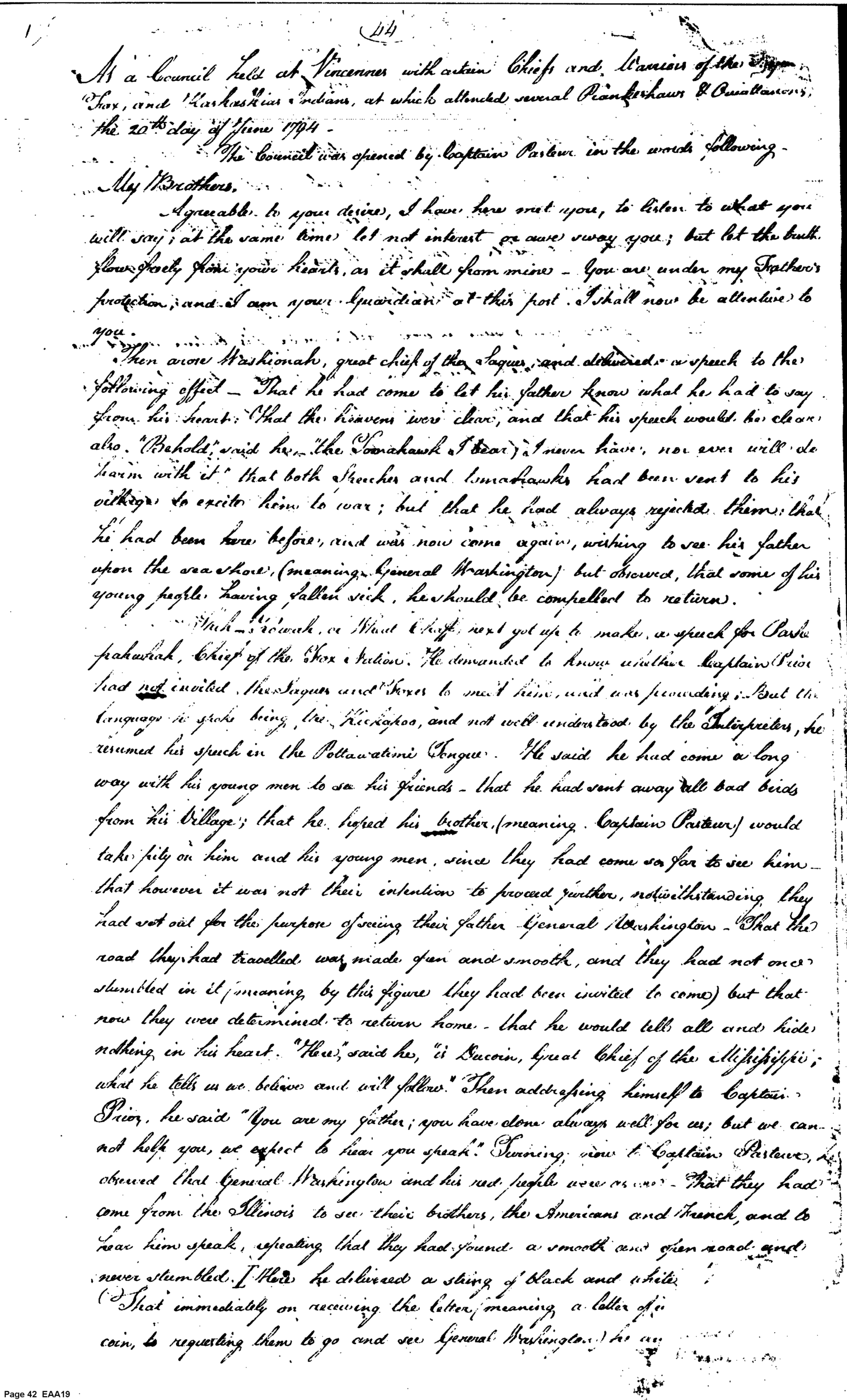
At a Council held at Vincennes with certain Chiefs and Warriors of the Sac, Fox, and Harkaskian Indians, at which attended several Piankeshaws & Buuallacons, the 20th day of June 1794 —
The Council was opened by Captain Pasteur in the words following —
My Brothers.
Agreeable to your desire, I have here met you, to listen to what you will say; at the same time, let not interest or awe sway you; but let the truth flow freely from your hearts, as it shall from mine — You are under my Father's protection; and I am your Guardian at this post. I shall now be attentive to you.
Then arose Washionah, great chief of the Sagues, and delivered a speech to the following effect — That he had come to let his father know what he had to say from his heart; That the heavens were clear, and that his speech would be clear also. "Behold," said he, "the Tomahawk I bear"; "I never have, nor ever will do harm with it" that both Speeches and tomahawks had been sent to his villages to excite him to war; but that he had always rejected them; that he had been here before, and was now come again, wishing to see his father upon the sea shore, (meaning General Washington) but observed, that some of his young people having fallen sick, he should be compelled to return.
Shck-kowah, or Flat Chief, next got up to make a speech for Pashepahwah, Chief of the Fox Indians. He demanded to know whether Captain Prior had not invited the Sagues and Foxes to meet him, and was [undecipherable]; But the language he spoke being the Kickapoo, and not well understood by the Interpreters, he resumed his speech in the Pottawatomi Tongue. He said he had come a long way with his young men to see his friends — that he had sent away all bad birds from his village; that he hoped his brother (meaning Captain Pasteur) would take pity on him and his young men, since they had come so far to see him — that however it was not their intention to proceed further, notwithstanding they had set out for the purpose of seeing their Father General Washington — That the road they had travelled was made open and smooth, and they had not once stumbled in it (meaning by this figure they had been invited to come) but that now they were determined to return home — that he would tell all and hide nothing in his heart. "Here," said he, "is Ducoin, great Chief of the Mississippi; what he tells us we believe and will follow." Then addressing himself to Captain Prior, he said "You are my father; you have done always well for us; but we cannot hold you, as expect to hear you speak." Turning now to Captain Pasteur, he observed that General Washington and his red people were as one — that they had come from the Illinois to see their brothers, the Americans and French, and to hear him speak, repeating that they had found a smooth and open road and never stumbled. [Here he delivered a string of black and white —
(That immediately on receiving the letter, meaning a letter of Ducoin, to requesting them to go and see General Washington,) he hast-
ate to come; that the Sagues set out first, and the Foxes, who live near, soon followed them — that they had always been peaceable (Here he shook hands with Captain Pasteur, and Judge Turner, who was present) that he hoped his brother would not take offence at his determination to return home. It was because some of his young men had fallen sick — that he trusted Captains Pasteur & Prior would take pity on him and his company when about to return, and also on the women and children in their towns. He hoped that guns would be given to his young men; for that they were fond of their brothers' guns, and that such of his young men's guns as were out of order, his brother would cause to be repaired — that he esteemed Ducoin as a good Chief — that he and his people were always on terms of friendship with Ducoin, and he with them; they were as one; that Ducoin invited them and they came accordingly; that now they wished to return, but in their absence any bad birds should fly through their towns — that his brother had told them to declare their minds from their hearts; and he had now unloaded his; that it was a very heavy load that as they were leaving their homes to come hither, several Nations admonished them against it, saying: "my brother, why do you go? some of your young men will be killed, where you are going." Shck-kowah concluded they by saying they were die for a dream. He then delivered another string of black and white Wampum.
Ducoin now harangued the Indians in a long speech, delivered with great fluency; and then shaking [strikethrough: every] by the hand every person in the room, addressed Captain Pasteur in words to the following effect —
"I desire all persons now present, both white and red, to listen with attention, for I am going to speak. My father General Washington, Congress, and Col. Jefferson, open your ears, and listen to what I shall say. I shall hide nothing from you. One half of your children on the Mississippi and Wabash are bad — General Washington sent us here to put the bad children in a good way." Here he shook hands with Captain Pasteur and proceeded:
He said that he, Ducoin, was not to desire General Washington, Captain Pasteur, or Captain Prior; nor would they desire his father's children. He hoped they would give with a liberal hand to their children whether of the Mississippi or Wabash, such goods as are suitable — and not to be stingy — That he was a Harkaskian, and his utmost efforts in assisting Congress to make the [undecipherable] his brother would, in turn, assist him — that General Washington, had sent Captain Pasteur & Prior on good affairs; and if there was any thing in the farmer's heart, he entreated him to speak it out — That the Sagues, Foxes, and others with him, had never taken up the Tomahawk to strike the Americans; though invited to it by the [strikethrough: Indians] English at Detroit, who had likewise invited several other nations — that perhaps the English would come upon his Lands, and on the lands of red people with him, and they might possibly kill him — but he would yield his lands to Congress to protect — that the Sagues &c are afraid to go to Congress, but that he would address a letter to Captain Pasteur and to inform Congress of the good intentions of those Indians, and hoped that he and Captain Prior would take pity on his people — that should they be hereafter invited by General Washington to go to see him, they would throw away their bodies to go — That the Spaniards and other white people are now fighting among themselves, and that the Tomahawk has been offered to him and various other nations, but that their answer has ever been "Let them fight their own battles, and we keep our lands in peace." — that he entreated Captains Pasteur and Prior to make their hearts glad on going home, by giving them presents of goods, guns and ammunition. (Here he presented Captain Pasteur with five short strings of white wampum, bound together at one end with green ribbons, and proceeded.)
He said that they had been demanded to come and see the Americans — that as they passed the Spaniards in the route hither, the Spaniards told them they were fools, they would get nothing from the Americans — not even a knife — but that notwithstanding, he trusted Captain Pasteur would take pity on them, and as to himself, he was very poor.
Ducoin now [strikethrough: accosted] the Indians in council with these words.
"Brothers!
I beseech you to behave well; build up your towns and live peaceably together; bring up your children in a good way; suffer them not to steal horses, nor drink whiskey — The latter is an enemy to their happiness, it excites them to quarrel and spills one another's blood — Aged Chiefs, remember the good conduct of your fathers now sleeping in their graves, I exhort you to follow the examples they have left you."
Ducoin now begged that Captain Pasteur would order a couple of cannon to be discharged in honor of General Washington,
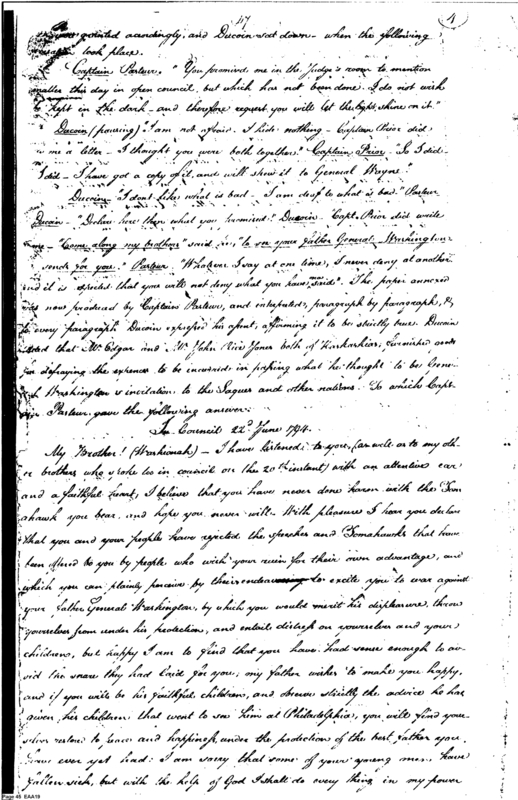
[undecipherable] granted accordingly, and Ducoin sat down — when the following [undecipherable] took place.
Captain Pasteur. "You promised me in the Judge's room to mention a matter this day in open council, but which has not been done. I do not wish to be kept in the dark — and therefore request you will let the light shine on it."
Ducoin (pausing) "I am not afraid. I hide nothing — Captain Prior did give me a letter — I thought you were both together." Captain Prior. "So I did — I did — I have got a copy of it, and will show it to General Wayne."
Ducoin. "I don't like what is bad — I am deaf to what is bad." Pasteur. Ducoin — "Deliver here then what you promised!" Ducoin. "Capt. Prior did write me — 'Come along my Brothers' said he, 'to see your father General Washington — send for you.'" Pasteur. "Whatever I say at one time, I never deny at another, and it is expected that you will not deny what you have said." The paper annexed was now produced by Captain Pasteur, and interpreted, paragraph by paragraph, & to every paragraph Ducoin expressed his assent, affirming it to be strictly true. Ducoin stated that Mr. Edgar and Mr. John (Rice) Jones both of Harkaskias; furnished goods in defraying the expences to be incurred in pushing what he thought to be General Washington's invitation to the Sagues and other nations. To which Captain Pasteur gave the following answer:
In Council 22d June 1794.
My Brother! (Washionah) — I have listened to you, (as well as to my other brothers who spoke too in council on the 20th instant) with an attentive ear and a faithful heart; I believe that you have never done harm with the Tomahawk you bear, and hope you never will. With pleasure I hear you declare that you and your people have rejected the speeches and Tomahawks that have been offered to you by people who wish your ruin for their own advantage, and which you can plainly perceive by their endeav[strikethrough: oring] to excite you to war against your father General Washington, by which you would merit his displeasure, throw yourselves from under his protection, and entail distress on yourselves and your children, but happy I am to find that you have had sense enough to avoid the snare they had laid for you; my father wishes to make you happy, and if you will be his faithful children, and observe strictly the advice he has given his children that went to see him at Philadelphia, you will find yourselves restored to peace and happiness under the protection of the best father you have ever yet had. I am sorry that some of your young men have fallen sick, but with the help of God I shall do every thing in my power
Type
Document
Description
First day of Council at Vincennes, speech by Captain Pasteur on the protective relationship between the United States and the Indian Nations. Several speeches by warriors who swore to never take up arms against their Father (George Washington).
Date
06/20/1794
Author
Repository
Collection
Document number
1794062090201
Page start
50
Notable persons
Captain Pasteur
Indian nations
George Washington
warriors
Notable locations
Council at Vincennes
Notable items
speeches by warriors