No human transcription currently available for this document.
[The Secretary of the Treasury]
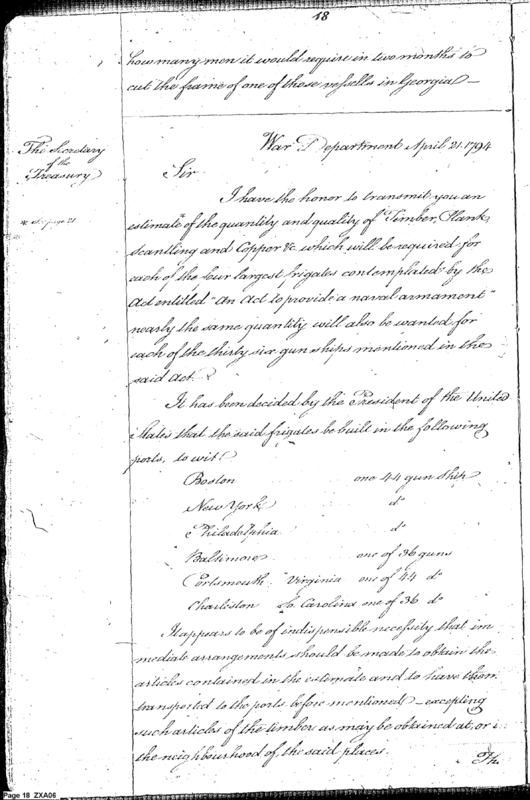
War Department April 21. 1794
Sir
I have the honor to transmit you an estimate of the quantity and quality of Timber, Plank, Scantling and Copper &c. which will be required for each of the four largest frigates contemplated by the Act entitled "An Act to provide a naval armament" nearly the same quantity will also be wanted for each of the thirty six gun ships mentioned in the said Act.
It has been decided by the President of the United States that the said frigates be built in the following ports, to wit:
Boston one 44 gun Ship
New York d°
Philadelphia d°
Baltimore one of 36 guns
Portsmouth Virginia one of 44 d°
Charleston So. Carolina one of 36 d°
It appears to be of indispensible necessity that immediate arrangements should be made to obtain the articles contained in the estimate and to have them transported to the ports before mentioned — excepting such articles of the timber as may be obtained at, or in the neighbourhood of, the said places.
The live oak and red cedar must principally be obtained from the islands on the coast of Georgia. Some parts however may be obtained in North Carolina, although it is alledged that the further South the live oak the better.
Different opinions are entertained as to the most certain, and the most oeconomical mode of obtaining the live oak and cedar from Georgia, and transporting the same to the ports where the ships are to be built.
Some persons recommend that one or more persons in whom due confidence may be placed, should repair to the Islands of Georgia, and contract with the proprietors of the timber as it stands for such parts as will serve the moulds, and that a sufficient number of axe men with their provisions be sent from the northward, in order to cut the same and transport it to the places where it is to be used. These persons assert that any contract made in Georgia or other parts to the Southward, will be executed by negroes, whose indolence and carelessness will inevitably produce disappointment or loss.
The moulds for the timbers of both sized ships are preparing and nearly finished. These must be transported to the places where the timber is to be cut, otherwise mistakes would arise and disappointment of course ensue.
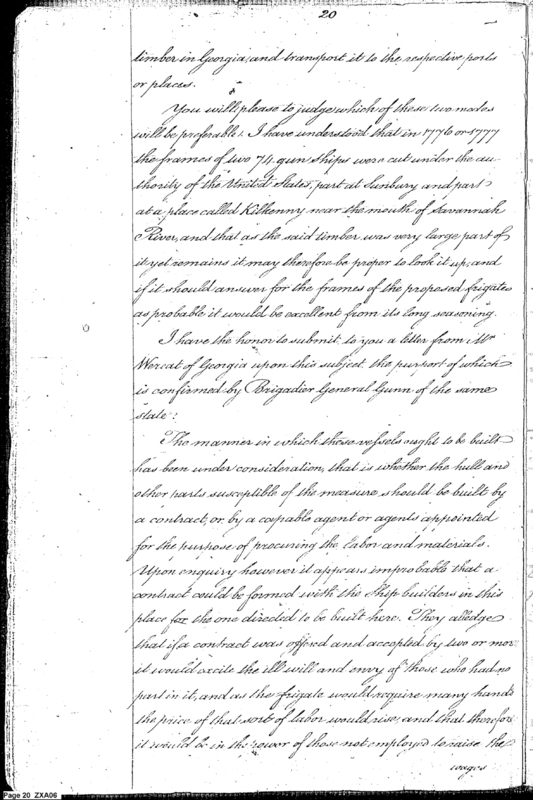
Besides the mode before mentioned, there are persons who recommend a contract with some persons, if such could be found, which is said to be the case to procure the timber in Georgia, and transport it to the respective ports or places.
You will please to judge which of those two modes will be preferable. I have understood that in 1776 or 1777 the frames of two 74 gun ships were cut under the authority of the United States, part at Sunbury and part at a place called Kilkenny, near the mouth of Savannah River, and that as the said timber was very large part of it yet remains it may therefore be proper to look it up, and if it should answer for the frames of the proposed frigates as probable it would be excellent from its long seasoning.
I have the honor to submit to you a letter from Mr Wervat of Georgia upon this subject, the purport of which is confirmed by Brigadier General Gunn of the same State:
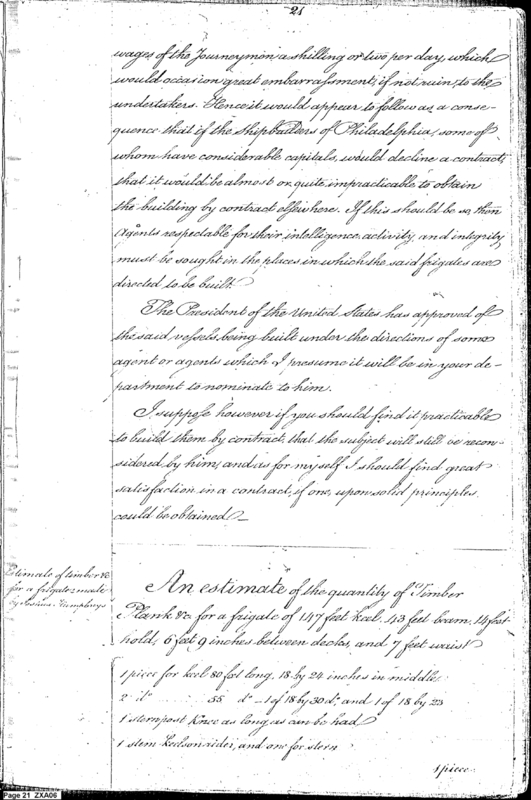
The manner in which those vessels ought to be built has been under consideration, that is whether the hull and other parts susceptible of the measure should be built by a contract, or by a capable agent or agents appointed for the purpose of procuring the labor and materials. Upon enquiry however it appears improbable that a contract could be formed with the Ship builders in this place for the one directed to be built here. They alledge that if a contract was offered and accepted by two or more it would excite the ill will and envy of those who had no part in it, and as the frigate would require many hands the price of that sort of labor would rise, and that therefore it would be in the power of those not employed to raise the wages of the Journeymen a shilling or two per day, which would occasion great embarrassment, if not ruin, to the undertakers. Hence it would appear to follow as a consequence that if the Shipbuilders of Philadelphia, some of whom have considerable capitals, would decline a contract, that it would be almost or quite impracticable to obtain the building by contract elsewhere. If this should be so then agents respectable for their intelligence, activity, and integrity, must be sought in the places in which the said frigates are directed to be built.
The President of the United States has approved of the said vessels being built under the directions of some agent or agents which I presume it will be in your department to nominate to him.
I suppose however if you should find it practicable to build them by contract that the subject will still be reconsidered by him, and as for myself I should find great satisfaction in a contract, if one, upon solid principles, could be obtained.
[Estimate of timber &c. for a frigate made by Joshua Humphreys]
An estimate of the quantity of Timber Plank &c. for a frigate of 147 feet Keel, 43 feet beam, 14 feet hold, 6 feet 9 inches between decks, and 7 feet waist
1 piece for keel 80 feet long, 18 by 24 inches in middle
2 d° 55 d° — 1 of 18 by 30 d°; and 1 of 18 by 23
1 sterpost knee as long as can be had
1 stem kelson sides, and one for stern
all the plank to be 1 piece dead wood forward
[as long as possible] d° d° 24 inches by 8, 100 feet, or 2 of 50 feet [or 70 feet if possible]
1 lower piece stem, and five pieces for kelson 310 ft. 18 in square
80 floor raising timbers and crotches.
[White Oak]
2000 feet of 6½ inch wales 9 inches wide running measure
200 d° 5 d° 9 d° d°
1200 d° [undecipherable] 6 by 9 for decks d°
2000 d° 4 inch plank for gun deck
1000 feet scantling for castings 6 by 6 reduced measure
1000 d° 6 by 9 d°
1 deck stem and 1 deck stern post knee to mizzen m[ast]. foremast
1400 feet of 5 inch plank 12 inches wide for clamps.
600 feet of 6 d° 10 inches wide for timber strake running measure
1000 d° 6 d° 14 d° inside bilge streaks d°
1500 d° scantling for castings for orlop deck
18000 feet of 4 inch plank for bottom and ceiling
200 good white oak logs
1000 feet running measure of 5 inch plank, 900 of 4½ inch, and 5000 feet 3 inch
[Pitchpine]
10000 feet of 3½ heart pine plank for lower deck
7000 d° 4 d° gun d°
8000 d° 3 d° quarter deck & forecastle
34 heart pitch pine beams for lower deck 14 by 14, 00 to 42 ft. long
10 d° d° gun deck 16 by 18, 00 to 40 ft. long
12 d° forecastle 10 by [undecipherable] 12 by 13, 22 to 38 feet long
34 d° for quarter deck 10 by 11 and 13 by 14, from 23 to 34 ft. long
50 d° orlop beams 10 by 12 30 to 38 feet long
6000 ft. Jersey pine two inch plank for orlop deck
[Live Oak and Red Cedar]
[The knees may be had in North Carolina, &c. &c., also in Georgia]
170 live oak lower futtocks
174 d° middle d°
178 d° upper d°
150 live oak }
50 red cedar } top timbers
[These timbers are calculated for four tiers, but it is doubtful whether they can be procured of that length, if not add 290]
200 cedar half timbers
2 live oak Knight heads
8 d° hausspiece
12 d° bow timbers
1 d° upper piece stem & 1 piece apron
40 d° stanchions
1 d° sternpost 30 feet long sided 17 inches
1 d° transom 30 d° 22 inches square & 10 smaller ones
2 d° corner counter timbers
5 d° middle d°
12 cedar half timbers d°
500 knees for lower and gun deck of live oak
130 d° quarter deck and forecastle d°
8 d° for transom d°
2 d° d° standard d°
8 live oak breast hooks from 18 to 20 feet long d°
6 pieces for partners for masts live oak