

Expenditures of Monies on Naval Armaments
Document 1798This letter contains an estimate of materials necessary to construct the frigates authorized by act of Congress. The Secretary at War also requests that the Secretary of the Treasury consider two modes for obtaining oak and cedar for building the frigates: by direct contract or by appointed agents. The Secretary at War mentions problems associated with utilizing slave labor.
100%
⇣

No human transcription currently available for this document.
This transcription was generated by machine using Anthropic's Claude Code (model sonnet 4.6). It may contain errors or inaccuracies. Please verify against the document image. Learn more about our generative AI methodology.
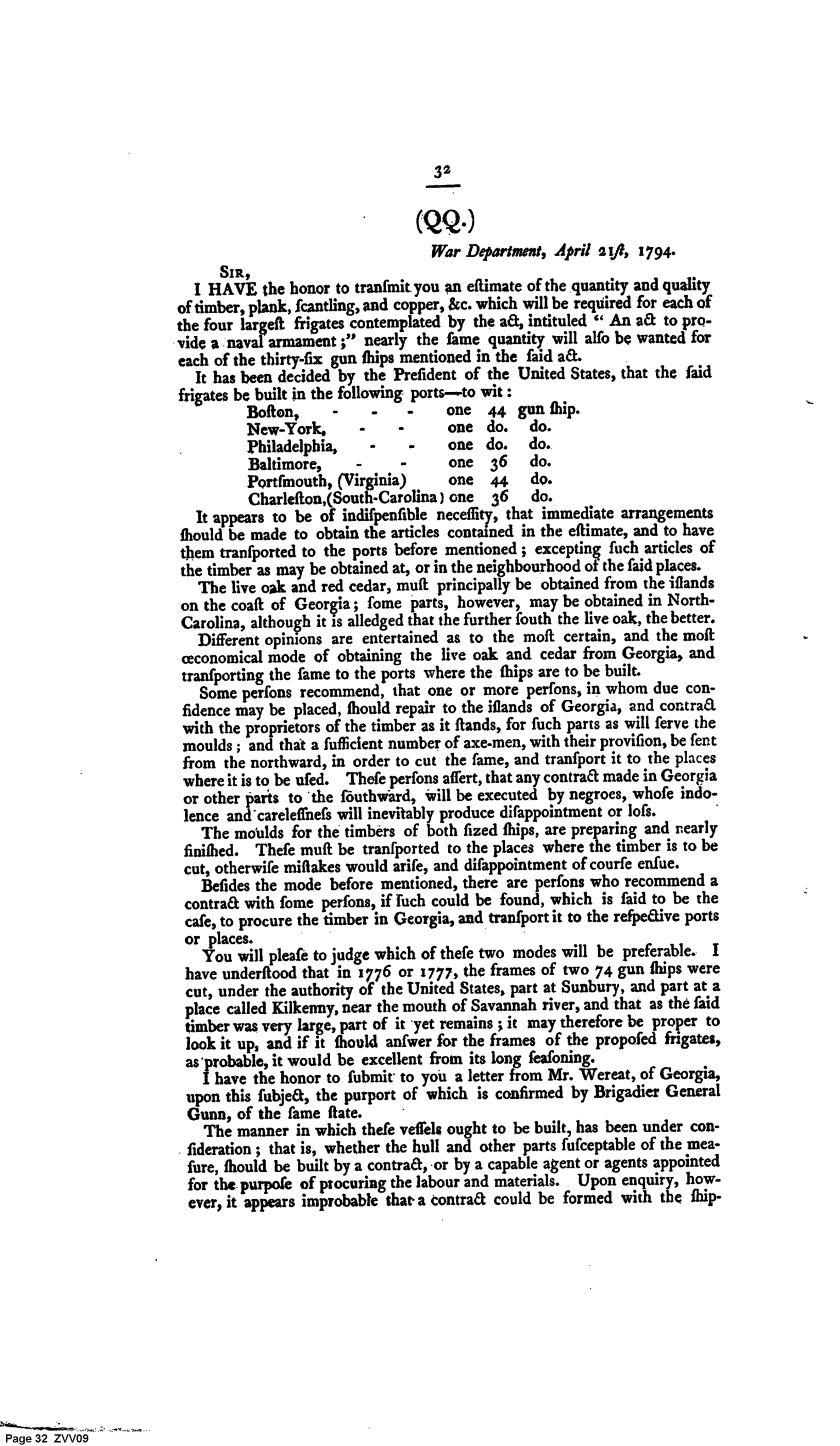
(QQ.)
War Department, April 21st, 1794.
Sir,
I HAVE the honor to transmit you an estimate of the quantity and quality of timber, plank, scantling, and copper, &c. which will be required for each of the four largest frigates contemplated by the act, intituled " An act to provide a naval armament;" nearly the same quantity will also be wanted for each of the thirty-six gun ships mentioned in the said act.
It has been decided by the President of the United States, that the said frigates be built in the following ports—viz.
Boston, - - one 44 gun ship.
New-York, - - one do. do.
Philadelphia, - - one do. do.
Baltimore, - - one 36 do.
Portsmouth, (Virginia,) one 44 do.
Charleston, (South-Carolina,) one 36 do.
It appears to be of indispensible necessity, that immediate arrangements should be made to obtain the articles contained in the estimate, and to have them transported to the ports before mentioned; excepting such articles of the timber as may be obtained at, or in the neighbourhood of the said places.
The live oak and red cedar, must principally be obtained from the Islands on the coast of Georgia; some part, however, may be obtained in North-Carolina, although it is alledged that the farther south the live oak, the better. Different opinions are entertained as to the most certain, and the most economical mode of obtaining the live oak and cedar from Georgia, and transporting the same to the ports where the ships are to be built.
Some persons recommend, that one or more persons, in whom due confidence may be placed, should repair to the Islands of Georgia, and contract with the proprietors of the timber as it stands, for such parts as will serve the moulds; and that a sufficient number of axe-men, sawyers, &c. be collected from the southwards, in order to cut the same, and transport it to the places where it is to be used. These persons affirm, that any quantity of made in Georgia, or other parts to the southward, will be executed by negroes, whose indolence and carelessness will inevitably produce disappointments and loss.
The moulds for the timber of both sized ships, are preparing, and nearly finished. These must be transported to the places where the timber is to be cut, otherwise mistakes would arise, and disappointments of course ensue.
Besides the mode before mentioned, there are persons who recommend a contract with four portions, if such could be found, which is said to be the case, to procure the timber in Georgia, and transport it to the respective ports or places.
You will please to judge which of these two modes will be preferable. I have understood that in 1776 or 1777, the frames of two 74 gun ships were cut, under the authority of the United States, part at Sudbury, and part at a place called Kilkenny, near the mouth of Savannah river, and that as the said timber was very large, part of it yet remains: it may therefore be proper to look it up, and if it should answer for the frames of the proposed frigates, as probable, it would be excellent from its long seasoning.
I have the honor to submit to you a letter from Mr. Wevet, of Georgia, upon this subject, the purport of which is confirmed by Brigadier General Gunn, of the same State.
The manner in which their vessels ought to be built, has been under consideration, viz. whether the hull and other parts (excepting of the masts, ture,) should be built by a contract, or by a capable agent or agents appointed for the purpose of procuring the labour and materials. Upon enquiry, however, it appears improbable that a contract could be formed with the ship-
Type
Printed or published document
Description
This letter contains an estimate of materials necessary to construct the frigates authorized by act of Congress. The Secretary at War also requests that the Secretary of the Treasury consider two modes for obtaining oak and cedar for building the frigates: by direct contract or by appointed agents. The Secretary at War mentions problems associated with utilizing slave labor.
Date
04/02/1798
Author
Recipient
Document number
1798040200055
Page start
32
Note
Enclosed is a 56 page document on "the expenditures of the monies heretofore appropriated for Naval Armaments and also the causes of the delay in competing the same."
Notable persons
James McHenry
Edward Livingstone
Mr. Wereat
Brigadier General Gunn
negroes
slaves
House of Representatives
Congress
agents
John Blagge
Nicholas Fish
Gurney and Smith
Gardner and Olden
John Habersham
Jedidiah Huntington
Henry Jackson
Samuel Meredith
William Pennock
Joseph Sterett
Jacob Sheafe
Solomon Townsend
Tenche Francis
Brown, Francis & Others
John Blagge
Joseph Copperthwaite
William A. Deas
Daniel Stevens
Josiah Fox
carpenters
caulkers
Treasury Department, revenue office
Capt. John Barry
Joshua Humphreys
Oliver Wolcott
George Claghorne
Notable locations
Boston
New York
Philadelphia
Baltimore
Portsmouth
Charleston
Norfolk
sail cloth manufactury at Bolton
New Hampshire
Mud Fort
the Mediterranean
Maryland
Notable items
Georgia wood
timber
ships of war
frigates
live oak timbers
price of labor and materials
cost of the armament
contracts for cannon
naval protection to their commerce
expenditures
anchors
furnace Hope
white oak
plank measure
the Constitution
cooking utensils
payrolls
wages
muzzle
cannon
furnace
nine pounders
six pounders
powder
draught
indenture
copper