

Instructions for Treaty with Northwest Indians
Document 1794Instructions to Major General Anthony Wayne for holding a treaty with the Northwestern Indians and form of the Treaty. Based on Wayne's communication of 18 January, Knox notes that a treaty may be possible if Indian overtures are sincere, and Wayne's conditions of delivering prisoners and recalling war parties can be met.

No human transcription currently available for this document.
This transcription was generated by machine using Anthropic's Claude Code (model sonnet 4.6). It may contain errors or inaccuracies. Please verify against the document image. Learn more about our generative AI methodology.
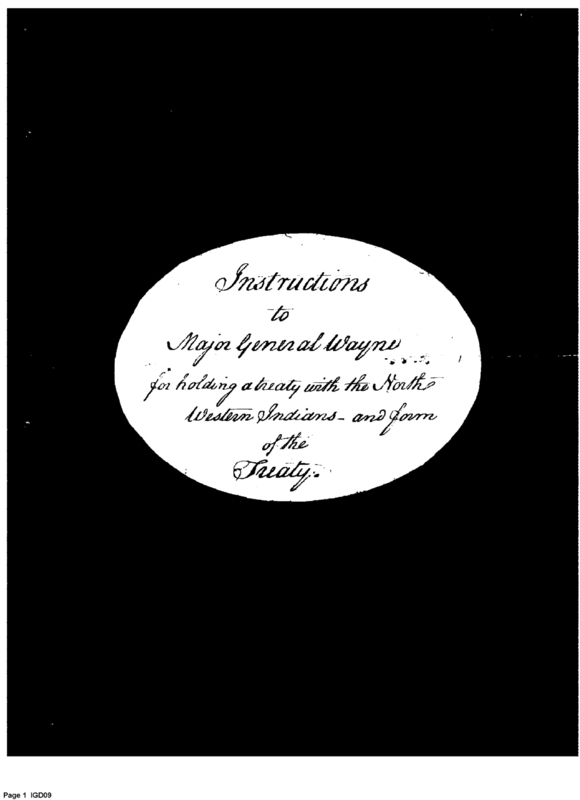
Instructions
to
Major General Wayne
for holding a treaty with the North
Western Indians - and form
of the
Treaty.
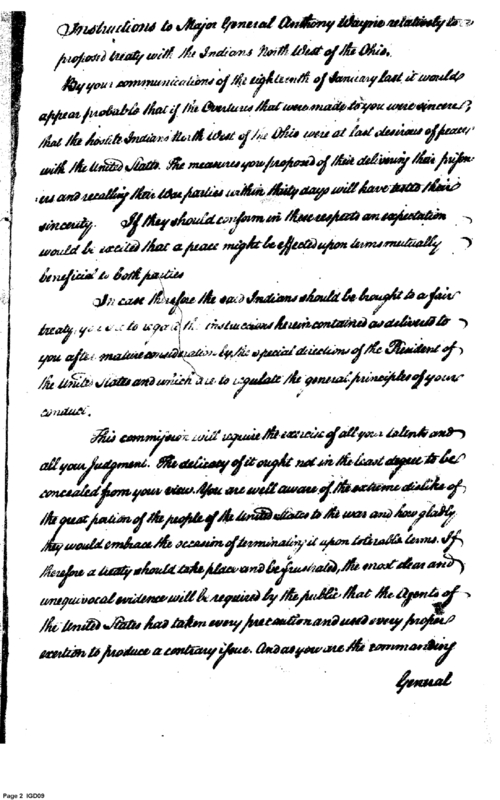
Instructions to Major General Anthony Wayne relatively to a proposed treaty with the Indians North West of the Ohio.
By your communications of the eighteenth of January last it would appear probable that if the Overtures that were made to you were sincere, that the hostile Indians North West of the Ohio were at last desirous of peace with the United States. The measures you proposed of their delivering their prisoners and recalling their two parties within thirty days will have more sincerity. If they should conform in these respects an expectation would be excited that a peace might be effected upon terms mutually beneficial to both parties.
In case therefore the said Indians should be brought to a fair treaty you are to sign it: the instructions herein contained are delivered to you after mature consideration by the special directions of the President of the United States and which are to regulate the general principles of your conduct.
This commission will require the exercise of all your talents and all your judgment. The delicacy of it ought not in the least degree to be concealed from your view. You are well aware of the extreme dislike of the great portion of the people of the United States to the war and how gladly they would embrace the occasion of terminating it upon tolerable terms off, therefore a treaty should take place and be frustrated, the most clear and unequivocal evidence will be required by the public that the Agents of the United States has taken every precaution and used every proper exertion to produce a contrary [issue?]. And as you are the commanding
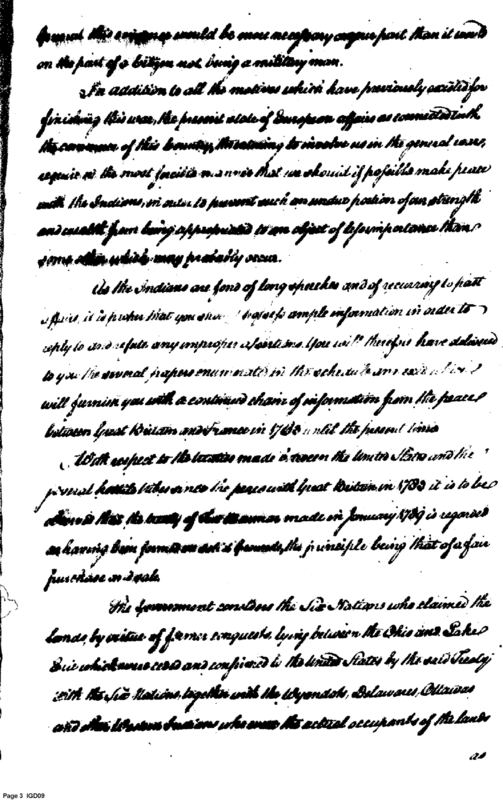
General demand this assignup would be more necessary congress part than it would on the part of a citizen not being a military man.
In addition to all the motives which have previously excited you to finishing this war, the present state of European affairs as connected with the commerce of this country, threatening to involve us in the general wars, require on the most positive manner that we should if possible make peace with the Indians, in order to prevent such an unfavourable impression of our strength and enable from being appropriated to any object of less importance than some other which may probably occur.
As the Indians are fond of long speeches and of receiving in part, after it is proper that you should thorough ample information in order to reply to and refute any improper assertions upon the [undecipherable] therefore have delivered to you the several [papers] enumerated in the schedule hereunto annexed which will furnish you with a continued chain of information from the peace between Great Britain and France in 1760 until the present time.
With respect to the treaties made between the United States and the several British tribes now in peace with Great Britain in 1789 it is to be observed that the treaty of Fort Harman made on January [undecipherable] is regarded as having been formed on just grounds, the principle being that of a fair purchase or [deal].
The government considers the Six Nations who claimed the lands by virtue of former conquests lying between the Ohio and [Lake?] Erie which were ceded and confirmed to the United States by the said Treaty with the Six Nations together with the [undecipherable] Delaware citizens and other Western Indians who were the actual occupants of the lands
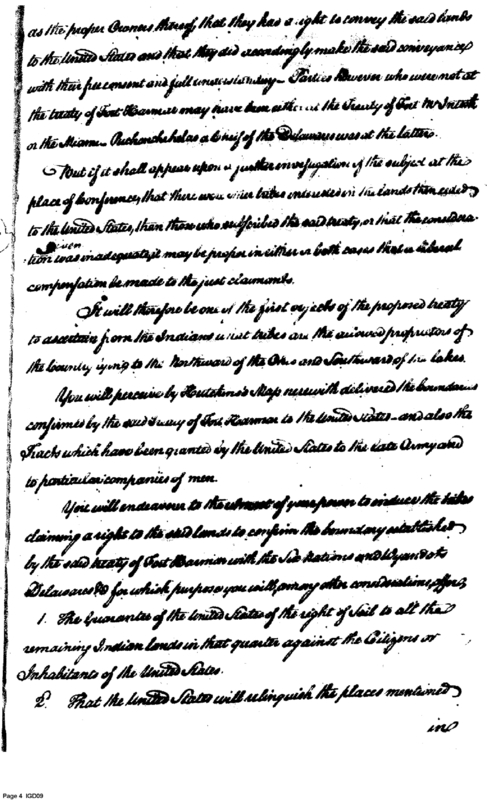
as the proper Owners thereof, that they had a right to convey the said lands to the United States and that they did accordingly make the said conveyances with their free consent and full consideration. Parties however who were not at the treaty of Fort Harman may have been either — the treaty of Fort McIntosh or in the Miami — perhaps also a part of the Delawares was at the latter.
That if it shall appear upon a just investigation of the subject at the place of conference that there were other titles outstanding in the lands than existed to the United States, then those who are [described in?] the said treaty, or [trust?] the considerations have been inadequate, may be regarded in either in both cases that a liberal compensation be made to the just claimants.
It will therefore be one of the first objects of the proposed treaty to ascertain from the Indians what tribes are the ancient proprietors of the country lying to the Northwest of the Ohio and Southward of the lakes.
You will perceive by [Hutchins's] Map herewith delivered the boundaries confirmed by the said [treaty?] of Fort Harman to the United States - and also the tracts which have been granted by the United States to the late Army and to particular companies of men.
You will endeavour to the utmost of your power to induce the tribes claiming a right to the said lands to confirm the boundary established by the said treaty of Fort Harman with the Said Nations and to [agree?] to the Delawares for which purpose you will convey other considerations, [viz?:]
1. The guarantee of the United States of the right of [title?] to all the remaining Indian lands in that quarter against the Citizens or Inhabitants of the United States.
2. That the United States will relinquish the places mentioned in
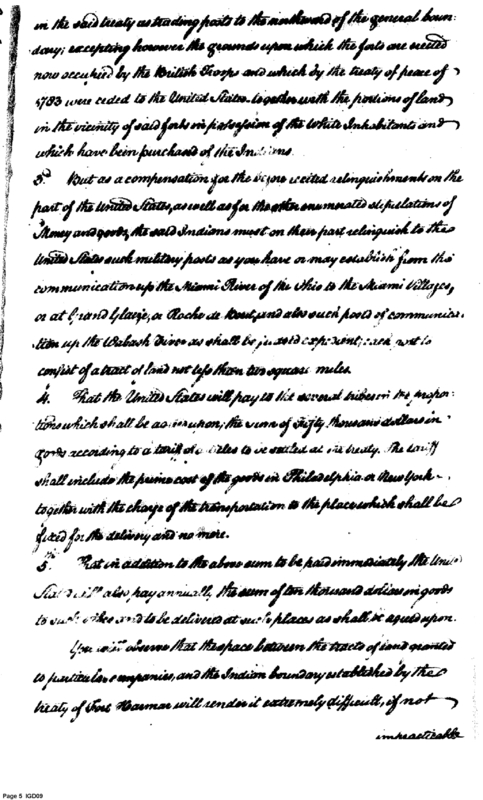
in the said treaty as starting points to the Southward of the general boundary, excepting however the grounds upon which the forts are erected now occupied by the [United?] troops and which by the treaty of peace of 1783 were ceded to the United States, together with the portions of land in the vicinity of said forts in proportion of the White Inhabitants and which have been purchased of the Indians.
3d. That as a compensation for the [above?] ceded relinquishments on the part of the United States, as well as for the other enumerated stipulations of [money and goods], the said Indians must on their part relinquish to the United States such military posts as you have or may establish from the communications up the Miami River of the Ohio to the Miami Villages, or at [Grand?] [Glaize?], or [Cache?] as [Rau?] and also such posts of communication up the Wabash [River?] as shall be [judged?] expedient — and also to consist of a tract of land not less than ten square miles.
4. That the United States will pay to the several tribes the proportions which shall be as [much as?], the sum of eighty thousand dollars in goods according to a bill of articles to be recited as [in?] the treaty. The tariff shall include the prime cost of the goods at Philadelphia or New York together with the charge of the transportation to the place which shall be fixed for the delivery and no more.
5. That in addition to the above sum to be paid immediately the United States will also pay annually. The sum of ten thousand dollars in goods to such tribes as is to be delivered at such places as shall be agreed upon.
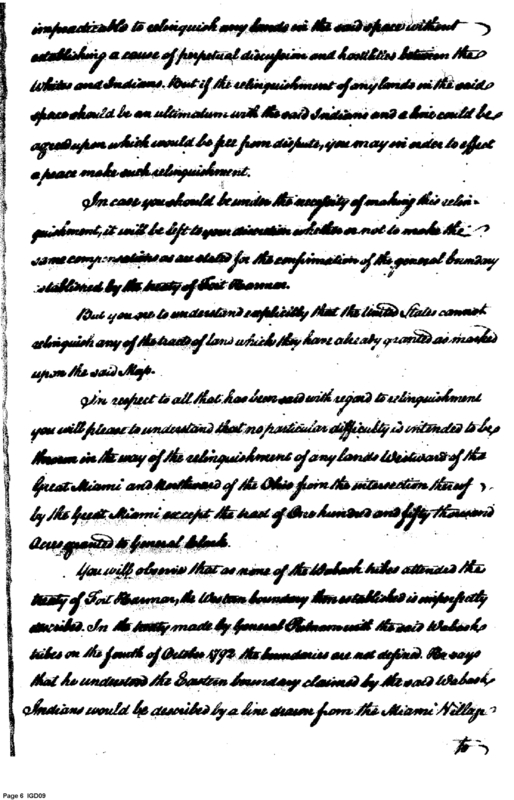
You will observe that the space between the tracts of land granted to particular companies, and the Indian boundary established by the treaty of Fort Harman will render it extremely difficult, of not impracticable
impracticable to relinquish any lands in the said space without establishing a cause of perpetual disruption and hostilities between the Whites and Indians. But if the relinquishment of any lands in the said space should be an ultimatum with the said Indians and a line could be agreed upon which could be free from dispute, you may in order to effect a peace make such relinquishment.
In case you should be under the necessity of making this relinquishment, it will be left to your discretion whether or not to make the same compensations as are stated for the confirmation of the general boundary established by the treaty of Fort Harman.
But you are to understand explicitly that the United States cannot relinquish any of the tracts of land which they have already granted as marked upon the said Map.
In respect to all that has been said with regard to relinquishment you will please to understand that no particular difficulty is intended to be thrown in the way of the relinquishment of any lands Westward of the Great Miami and Northward of the Ohio from the intersection thereof by the great Miami except the tract of One hundred and fifty thousand Acres granted to General [Cluck?].
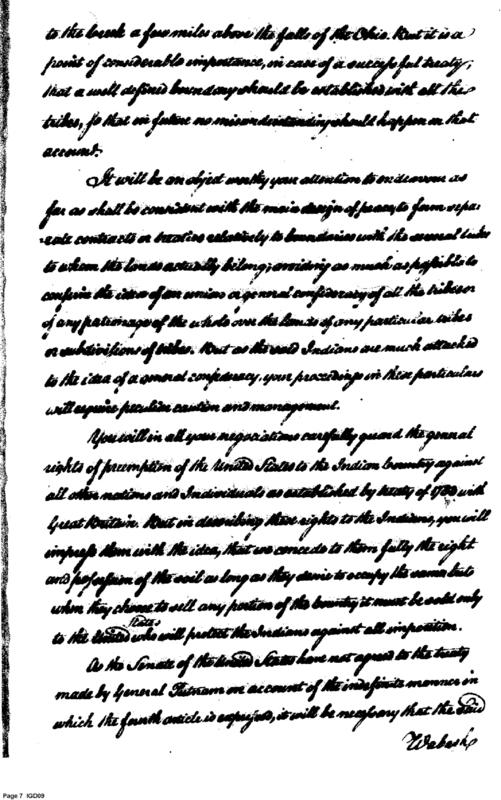
You will observe that none of the Wabash tribes attended the treaty of Fort Harman, the Western boundary then established is imperfectly described. In the treaty made by General [Putnam?] with the said Wabash tribes on the [fourth?] of October 1793 the boundaries are not defined. He says that he understood the Eastern boundary claimed by the said Wabash Indians would be described by a line drawn from the Miami Village
to the brook a few miles above the falls of the Ohio. But it is a point of considerable importance, in case of a successful treaty, that a well defined boundary should be established with all the tribes, so that in future no misunderstanding should happen on that account.
It will be an object worthy your attention to endeavour as far as shall be consistent with the main design of peace to form separate contracts or treaties separately to boundaries with the several tribes to whom the lands actually belong; resorting as much as possible to confirm the idea of or union in general confederacy of all the tribes or any patronage of the whole over the lands of any particular tribes or subdivisions of tribes. That as the said Indians are much attached to the idea of a general confederacy, your proceedings on this particulars will require particular caution and management.
You will in all your negotiations carefully guard the general rights of preemption of the United States to the Indian territory against all other nations and individuals as established by treaty of 1783 with Great Britain. And in describing those rights to the Indians you will impress them with the idea, that we concede to them fully the right and possession of the soil as long as they desire to occupy the same but when they choose to sell any portion of the territory it must be sold only to the [United?] who will protect the Indians against all impositions.
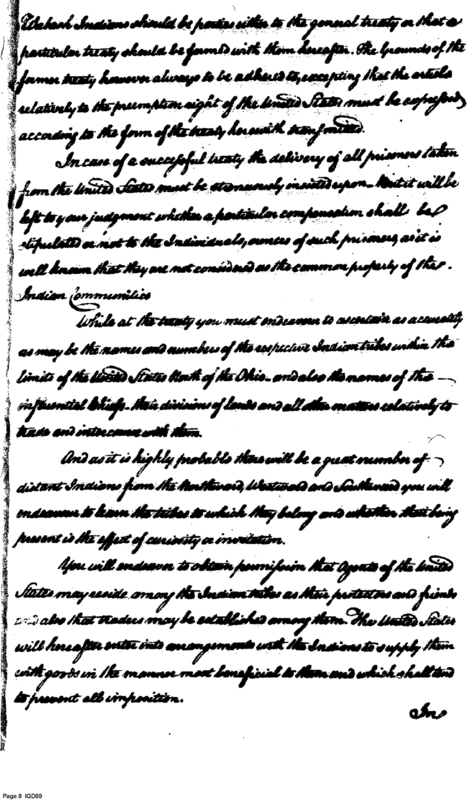
As the Senate of the United States have not agreed to the treaty made by General [Putnam?] on account of the indefinite manner in which the fourth article is expressed, it will be necessary that the [Wabash?]
Wabash Indians should be parties either to the general treaty or that a particular treaty should be formed with them hereafter. The [terms?] of the former treaty however always to be adhered to, excepting that the article relatively to the preemption right of the United States must be expressed according to the form of the treaty herewith [conformed?].
In case of a successful treaty the delivery of all prisoners taken from the United States must be strenuously insisted upon. Notice will be left to your discretion whether a particular compensation shall be stipulated or not to the individuals, owners of such prisoners as it is well known that they are not considered as the common property of the Indian communities.
While at the treaty you must endeavour to ascertain as accurately as may be the names and numbers of the respective Indian tribes within the limits of the United States North of the Ohio - and also the names of the influential chiefs, their divisions of lands and all other matters relatively to trade and intercourse with them.
And as it is highly probable there will be a great number of distant Indians from the Northwest, Westward and Southward you will endeavour to learn the tribes to which they belong and whether their being present is the effect of curiosity or invitation.
You will endeavour to obtain permission that Agents of the United States may reside among the Indian tribes as their protectors and friends and also that traders may be established among them. The United States will hereafter enter into arrangements with the Indians to supply them with goods in the manner most beneficial to them and which shall tend to prevent all impositions.
In
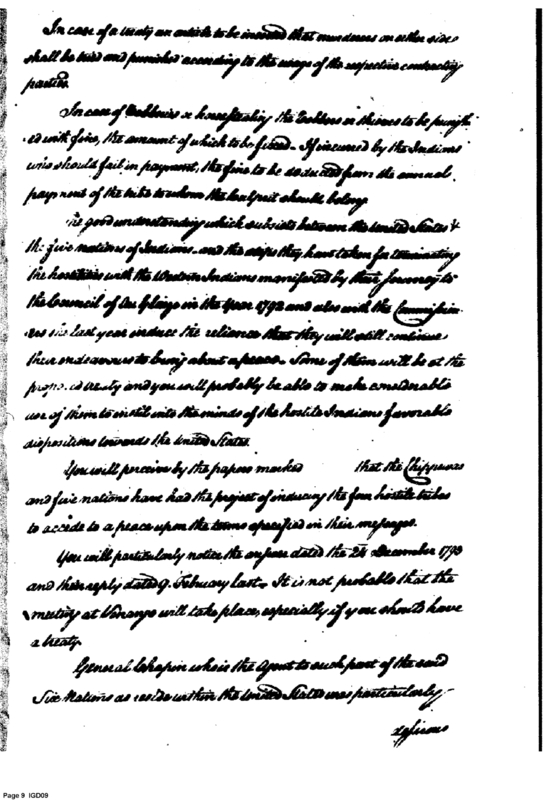
In case of a treaty an article to be inserted that murderers on either side shall be tried and punished according to the usages of the respective contracting parties.
In case of robberies or horse stealing, the Indians or thieves to be punished with fine, the amount of which to be fixed - if incurred by the Indians who should fail in payment, the fine to be deducted from the annual payments of the tribe to whom the culprit should belong.
The good understanding which subsists between the United States & the [Five?] Nations of Indians - and the steps they have taken for terminating the hostilities with the Western Indians manifested by their [January?] to the [Council?] of the [Glaize?] in the year 1793 and also with the [Commission?] [this?] last year induce the reliance that they will still continue their endeavours to bring about a peace. Some of them will be at the proposed treaty and you will probably be able to make considerable use of them to instill into the minds of the hostile Indians favorable dispositions towards the United States.
You will perceive by the papers marked that the [Chippewas?] and five nations have had the project of inducing the four hostile tribes to accede to a peace upon the terms specified in their [messages?].
You will particularly notice the papers dated the 24 December 1793 and their reply dated 9. February [last?]. It is not probable that the meeting at [Niagara?] will take place, especially if you should have a treaty.
General [Chapin?] who is the Agent to such part of the said Six Nations as reside within the United States was particularly
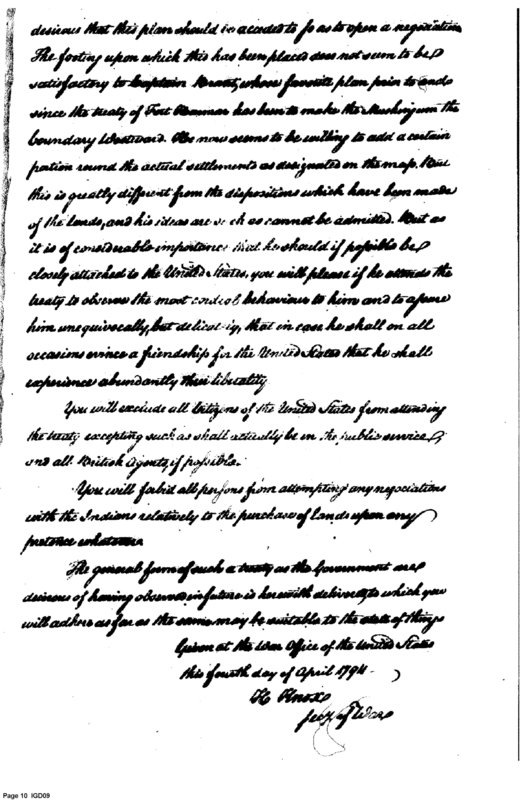
[efficious?]
desirous that this plan should be acceded to so as to open a negotiation. The footing upon which this has been placed does not seem to be satisfactory to [Captain?] [Brant?], whose favourite plan prior to and since the treaty of Fort Harman has been to make the [Muskingum?] the boundary [Westward?]. He now seems to be willing to add a certain portion round the actual settlements as designated on the map. Now this is greatly different from the dispositions which have been made of the lands, and his ideas are such as cannot be admitted. But as it is of considerable importance that he should if possible be closely attached to the United States, you will please if he attends the treaty to observe the most cordial behaviour to him and to assure him unequivocally but delicately, that in case he shall on all occasions evince a friendship for the United States that he shall experience abundantly their liberality.
You will exclude all Citizens of the United States from attending the treaty excepting such as shall actually be in the public service & and all British Agents if possible.
You will forbid all persons from attempting any negotiations with the Indians relatively to the purchase of lands upon any pretence whatsoever.
The general form of such a treaty as the Government are desirous of having observed in future is herewith delivered to which you will adhere as far as the same may be suitable to the state of things.
Given at the War Office of the United States this fourth day of April 1794.
Go: Knox
Secy of War
Type
Copy of Signed Document
Description
Instructions to Major General Anthony Wayne for holding a treaty with the Northwestern Indians and form of the Treaty. Based on Wayne's communication of 18 January, Knox notes that a treaty may be possible if Indian overtures are sincere, and Wayne's conditions of delivering prisoners and recalling war parties can be met.
Date
04/04/1794
Author
Recipient
Sent from
War Office
Repository
Collection
Document number
1794040400101
Page start
1
Notable persons
Henry Knox
Anthony Wayne
Indians
prisoners
George Washington
commission
agents
Six Nations
Wyandots
Delawares
Ottawas
Miami
British
troops
Israel Putnam
Chippewas
Notable locations
War Office
Northwest
Fort Haskett
Great Lakes
Ohio River
Miami River
Grand Glaize
Roche
Wabash River
Fort Barnan
Notable items
war
treaty
peace
speeches
boundary
bounty