

Letter from the Secretary of War regarding Perrault's duties as temporary engineer
Document 1794Instructions from Knox to Paul Hyacinthe Perrault regarding duties as temporary engineer for fortifications assigned to Charleston, South Carolina.


No human transcription currently available for this document.
This transcription was generated by machine using Anthropic's Claude Code (model sonnet 4.6). It may contain errors or inaccuracies. Please verify against the document image. Learn more about our generative AI methodology.
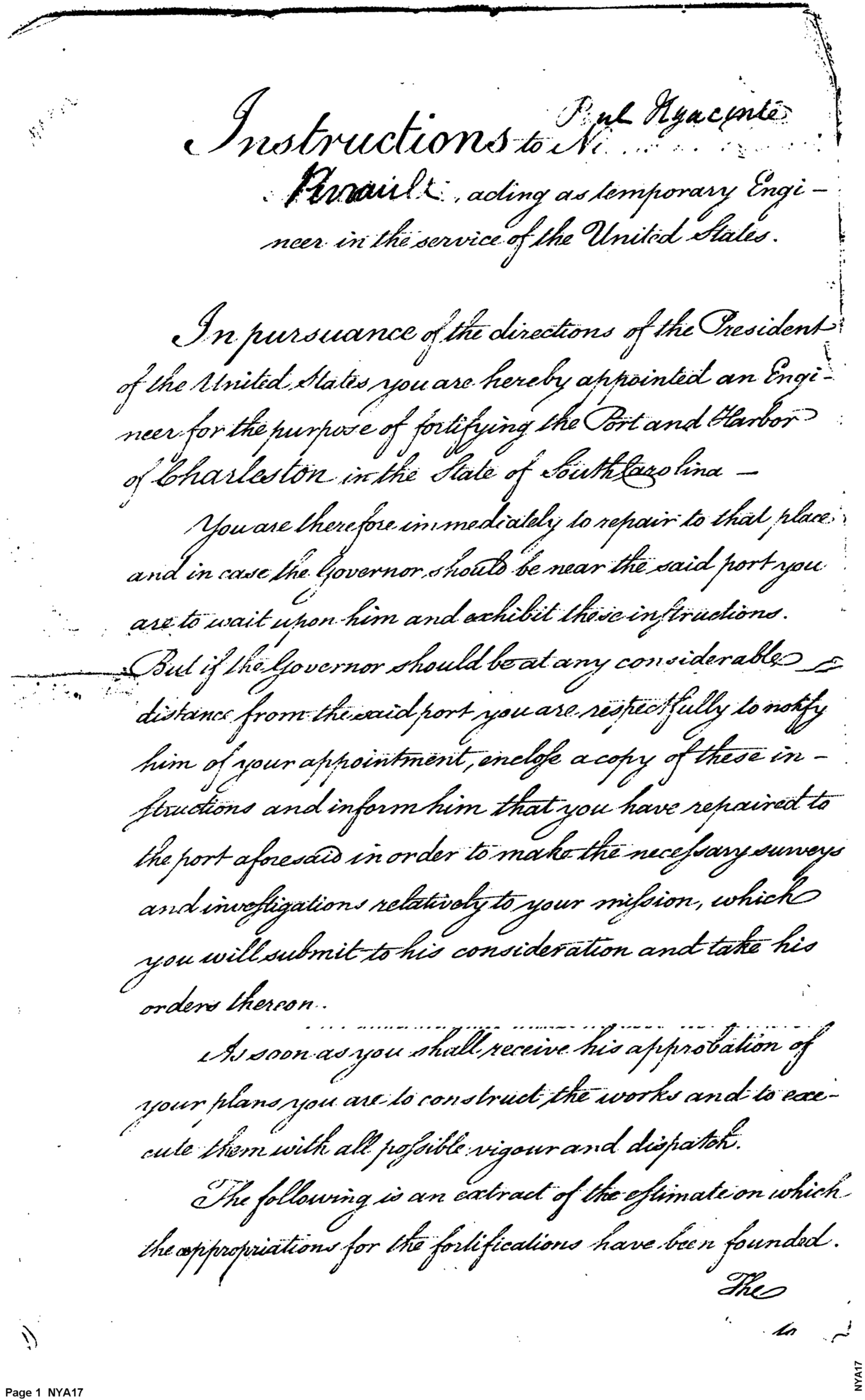
Instructions to Mr Paul Hyacinte
Perrault, acting as temporary Engineer in the service of the United States.
In pursuance of the directions of the President of the United States, you are hereby appointed an Engineer for the purpose of fortifying the Port and Harbor of Charleston in the State of South Carolina —
You are therefore immediately to repair to that place, and in case the Governor should be near the said port you are to wait upon him and exhibit these instructions. But if the Governor should be at any considerable distance from the said port, you are respectfully to notify him of your appointment, enclose a copy of these instructions and inform him that you have repaired to the port aforesaid in order to make the necessary surveys and investigations relatively to your mission, which you will submit to his consideration and take his orders thereon.
As soon as you shall receive his approbation of your plans you are to construct the works and to execute them with all possible vigour and dispatch.
The following is an extract of the estimate on which the appropriations for the fortifications have been founded.
The proportion of expence therefore herein stated for the port aforesaid must not be exceeded. viz
"Charleston
"To be fortified with 72 pieces, which may
" be divided into three setts of batteries Doll.s Ct
"and redoubts. . . . . . . . . . . . 11,212 ..32
It will be readily perceived by the lowness of the estimate that the parapets of the works intended to be erected are to be of earth, or where that cannot easily be obtained of an adhesive quality the parapets may be faced with strong timber and filled in with such earth [strikethrough: as can] as can be had.
It is however conceived that in most cases earth may be procured, and that a parapet made thereof will not only form a solid defence, but even be durable if the earth be tenacious and properly stored and sodded inside and out, and the seed of knot grass sown so as to bind the sods and earth together.
It is however apprehended that the embrasures made in this manner would suffer from the explosion of the powder from the cannon; and that therefore where the batteries are not en barbette that the embrasures ought to be framed with joist and faced with plank of two inches thick.
When the batteries are to be erected on points of land islands or other places at a distance from the towns intended to be defended they ought to be covered or secured by a redoubt or other enclosed work, in which the garrison should reside constantly either in a barrack or a strong block house as shall be judged most expedient. But in general as the garrisons will be weak in numbers a block house mounting one or two small pieces of cannon in its upper story will be more secure and therefore to be preferred. These however ought not to be much if any exposed to the fire of heavy cannon. A block house will not contain more than fifty men. If the garrison therefore should be enlarged tents must be used.
The redoubts in general ought to be of a size to contain five hundred men so as to resist a sudden enterprize of an enemy, and perhaps the idea ought to be embraced in the first instance that they should be of such extent as to admit timber casemates to be erected hereafter so as to enable the garrison to resist in some tolerable degree a bombardment.
But it is not proposed at present to erect such casemates excepting for a magazine, which must be formed of massy timber and be six feet thick on the roof exclusive of the earth and jointed and caulked in such a manner as to be perfectly tight. Care must be taken to have these magazines properly ventilated and free from dampness. They are to be of a size sufficient to hold one hundred and fifty rounds of powder for each piece of cannon intended to be served from it. The spot at which a magazine of this nature shall be fixed will require great judgment so as to combine security against an enemy either foreign or subtle or any danger from common accidents.
Your judgment will also direct what parts of your works shall be protected by fraizes and what by palisadoes or whether your redoubts shall have embrasures or fire en barbette with small cannon. As the redoubts are to cover the batteries they would certainly secure and resist better without embrasures. The batteries are to annoy.
The choice of the ground on which the batteries & works are to be erected whether to have embrasures or to fire en barbette with the new [undecipherable: Duamont] carriages, with all the combinations and effects depending on them, will rest with your judgment under the directions of the Governor. It has not been intended by any thing herein recited to point out the particular manner in which the works should be executed. Outlines only have been given to serve in regulating the expence which is limited by the sums before mentioned.
Some person in whose ingenuity and industry confidence can be placed will be appointed at the said port to superintend the actual execution of the works according to your directions. Arrangements will also be made by him or some other person to obtain the necessary workmen implements and materials which will be required in this business. But every thing must be previously calculated and estimated by you.
Although the business herein entrusted to your charge is in itself of an highly honourable nature and strongly evincive of the confidence of the President of the United States and which would probably enhance your reputation, yet it is explicitly to be understood by you that the employment is only temporary and not conferring or involving any military rank whatever.
For a compensation for your services and personal expences you will be allowed and paid at the rate of four dollars per day while you shall be employed. For all reasonable extra expences such as necessary out hire and persons to assist in your surveys you will be allowed but for these you must keep regular accounts and take receipts.
You are to deliver to the Governor copies of all your plans surveys soundings &c and also transmit copies of the same to this Office. You are also to make a weekly report to this Office of your proceedings.
I have issued my warrant in your favor for two hundred [undecipherable] dollars as an advance on account of your extra expences. For any [undecipherable] you may require on account of your compensation for personal expence you must apply to [undecipherable] at the [undecipherable] to be paid in Charleston.
[undecipherable]
An reverberatory furnace for red-hot balls must be erected for each battery.
All the plans must be accompanied with sections and elevations, so that a complete judgment may be formed thereof. An estimate of the expence must also be formed of each work, and the number and size of the cannon intended must be specified.
You will have under your immediate orders Jerome Murchie as a director of Artillery Artificers to mount the new Gun carriages, and John James Louis as Sub Engineer and Interpreter —
This Appointment to take place from the first of this Instant, April.
Given at the War Office of the United States this eleventh day of April
1794 —
[signed] Knox
[signed: undecipherable]
[These instructions were orig[undecipherable] designed for Mr H[undecipherable] but circumst[undecipherable] occasioned his [undecipherable] to North [undecipherable] and Mr Perrault [undecipherable] in Charleston.]
Type
Letterbook
Description
Instructions from Knox to Paul Hyacinthe Perrault regarding duties as temporary engineer for fortifications assigned to Charleston, South Carolina.
Date
04/11/1794
Author
Recipient
Sent from
War Office
Collection
Document number
1794041100005
Page start
1
Notable persons
Henry Knox
President of the United States
John James Learis
Jerome Murlhie
Artificers
engineers
Secretary of War
interpreter
artillery artificer
George Washington
Governor South Carolina
garrison
Notable locations
South Carolina
War Office
North Carolina
Charleston
Charleston Port
Charleston Harbor
Notable items
carriages
red hot balls
furnace
powder
cannon
embrasures
timber
earth
blockhouse
magazine
tents
fraizes
redoubts
instructions
fortifications
parapte
plank
joist
battery
works
warrant