No human transcription currently available for this document.
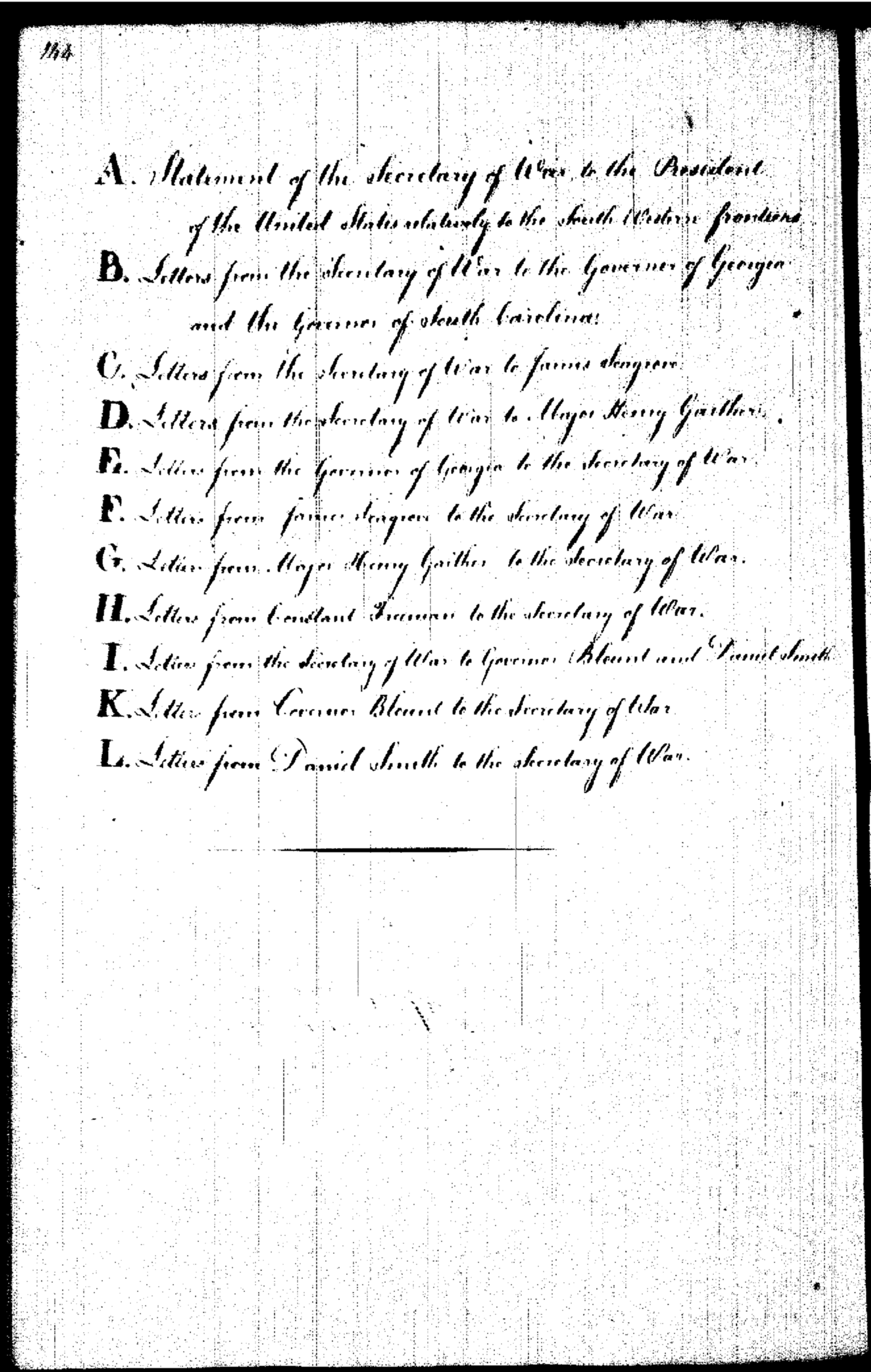
A
Statement of the Secretary of War, to the President of the United States, relatively to the South Western frontiers.
The Secretary of War respectfully submits to the President of the United States the following statement relatively to the South Western frontiers of the United States as connected with the State of Georgia and the Creek Indians, and the territory of the United States South of the Ohio and the Cherokee Indians.
That in the month of November 1792 James Seagrove a temporary agent held a conference with the lower Creeks, at which were present upwards of one thousand men, women, and children. That the objects of this conference were to confirm the treaty which had been made with them at New York and administering to their necessities they being greatly in want of Corn and Clothing to attach them more firmly to the interests of the United States.
That as the said Indians expressed themselves with great gratitude for the kindness they received, a hope was indulged that beneficial consequences would flow from the measure, especially as it was directed that the said agent should repair both to the lower and upper Creek towns in order to tranquillize their minds upon past and prevent any misconceptions respecting the future conduct of the United States.
But on the eleventh day of March then prospects were clouded by a party of about thirty of the Seminoles (some of their living to the Southward of the territory of the United States) who plundered a Store upon the St. Mary's River of a large quantity of goods and killed several persons.
This outrage being followed by some others excited vigorous alarm on the frontiers of Georgia. The Governor of that State called into service considerable bodies of Militia Horse and foot for the protection of the exposed inhabitants.
That upon the receiving information of the aforesaid event the President on the 30th of May directed that the Governor of Georgia should be informed that from considerations of policy at this critical period relative to foreign powers and during the preceding treaty with the Northern Indians it was deemed advisable for the present to avoid offensive expeditions into the Creek Country. But that from the circumstances of the recent depredations on the frontiers of Georgia, it was thought expedient to increase the force in that quarter for defensive purposes, and therefore the Governor was authorized to call into service in aid of the Continental Troops, One hundred horse and one hundred foot of the Militia of the said State.
That as it did not appear that the whole of the Creek nation were disposed for or engaged in hostility, it was considered that the above force was sufficient for the purposes designated.
That the case of a serious invasion of Georgia by large bodies of Indians must be referred to the provisions of the Constitution.
That on the 11th of June the Governor of South Carolina was requested to afford aid to Georgia in case that it should be seriously invaded by large bodies of Indians.
That a Magazine of two thousand Arms, and a proportionable quantity of ammunition and some other military stores have been established in Georgia as a provisional measure, in case the said state should be invaded, the said articles in that event to be subject to the order of the Governor.
That on the 12th of June the Governor transmitted information of an intended expedition into the Creek Country to consist of a body of about seven hundred volunteers, and on the 11th of the same month he transmitted the result thereof, by which it appeared that the said volunteers commanded by General Twiggs, proceeded to the Ockmulgee, about forty miles distant from the Oconee, and from circumstances of their provisions being nearly exhausted, many horses died and other adverse events they returned on the 11th of the month.
That on the 13th of August the Governor transmitted information that he had convened a Council of General Officers on the subject of reducing the five eminent towns in the Creek nation, the propositions to, with the answer of the Council he transmitted for the purpose of being laid before the President of the United States.
That in an answer to the said letter dated the 5th September the Governor was informed that as an offensive expedition against the Creeks of the nature and complicated importance to the United States, it had engaged the serious consideration of the President, and as the deliberate result thereof he utterly disapproved the measure at that time as being unauthorized by law— as contrary to the present state of affairs, and as contrary to the instructions heretofore given upon the subject.
That on the 7th of October the Governor transmitted the information of two officers who commanded an expedition against a Creek town which they surprized on the 4th of September and killed six warriors and took eight women and children prisoners.
That it appears from the representations of James Seagrove that the Indian town which was surprized as before mentioned on the 4th of September was situated on the Chattahoochie river and called "the little Oakfuskie" that the people belonging to it were among the most friendly of the Creeks, and no way concerned in stealing of Horses, they being under the direction of the White Lieutenant.
That it has been the opinion of James Seagrove, communicated in his various dispatches that notwithstanding the outrage of the 11th of March, and the subsequent conduct of some of the Banditti, that the main body of the Creek nation are desirous of remaining at peace with the United States. That in pursuance of his directions from the President of the United States and his own opinion he had been endeavouring for some months past to make arrangements to go into the Creek nation for the purposes of obtaining the punishment of the Banditti, & Laws who have committed the outrages aforesaid and of more closely attaching the Creeks to the United States.
That he had made an agreement to meet a number of friendly Indians on the Ockmulgee River about the 30th of September and with them to proceed into the Indian towns for the purposes aforesaid. But the expedition of the 4th of September and the violent threats of a number of lawless Whites on the frontiers of Georgia had prevented him. Some of these people appear to oppose every effort for peace and ardently desire a war.
That by his letter of the 21st October it appears that two parties were preparing to go to War with the Creeks, the result of which has not yet been known.
That the information of the Governor of Georgia to James Seagrove stated the 26th of August last, to wit "that under the laws of the United States as well as for the security of this State, the Government of Georgia cannot recognize the establishment of peace without having Commissioners at the treaty" is a matter which requires serious notice.
It is to be observed that the Governor of Georgia has not organized the hundred horse and hundred Militia foot which he was authorized to do by the President on the 30th May last, instead thereof he has kept up considerable bodies of mounted volunteers of the Militia of which no returns have been received, but which perhaps may be nearly or quite five hundred men. The payment of these troops will probably amount to a very large sum of money, and it may become a question of importance whether the United States are responsible for their payment, the circumstances of the case being duly considered.
It is suggested in the papers which accompany this statement that it is highly probable that it is owing to some of these troops that Mr Seagrove has been hitherto restrained from adjusting amicably the causes of difference with the Creek nation, and also probably that it was a part of them who surprized the Little Oakfuskie Town.
From a view of the representations contained in the letters of James Seagrove, Major Gaither (the Commanding Officer,) and Constant Freeman herewith submitted, it will appear that the Creeks are generally disposed for peace, but there is too much reason to apprehend that the unjustifiable conduct of certain lawless Whites on the frontiers of Georgia will prevent that desirable event from being realized.
The present State of this part of the frontier involves national considerations of great magnitude whether viewed as relative to the expense which has been incurred during the present summer, of which payment will most probably be demanded of the United States— whether with regard to the claims of the Governor of Georgia of a right of interference in any treaty with the Creeks, which is presumed to be contrary to the Constitution of the United States— or whether with regard to a War with the powerful tribes of the Creeks, with the long and indeed unlimited train of collateral and consequent evils attendant thereon— a measure may be avoided, if means could be devised to keep the bold and turbulent of both sides in order.
Of the Territory of the United States South West of the Ohio and the Cherokees
That it will appear from the papers relative to the Cherokees on the files of Congress that in the year 1792 a partial disposition for War existed among the Cherokees being chiefly confined to the five lower Towns so called embracing to the utmost one third of that nation or six hundred and fifty Warriors.
That however by the abilities and assiduity of Governor Blount this disposition in the commencement of the year was greatly changed, and the said five Towns were supposed to be desirous of an accommodation.
That while this business was negotiating a party of armed men under Captain John Beard, who had been called into service by Governor Blount, with a view of protecting the settlers, did on the 12th of June in defiance of their orders cross the Tenn[essee] and surprize and kill a number of our best friends, among the Indians at the moment Governor Blount's messengers were among them.
This violent outrage so disgraceful to the United States has been followed by several others and the South Western territory is involved in a War with the Cherokees which as it relates to the above event must be considered as highly unjust. It is to be apprehended and regretted that from the prejudice against the Indians on the frontiers, it is but too probable that the perpetrators of these violences will escape unpunished. Such measures as the laws authorize have been directed but as yet no result has been transmitted.
Great bodies of Militia have been brought into service on this occasion in order to guard against the effects of savage retaliation. Much expense has been already incurred nor is it yet terminated. However hostilities shall be restrained by the severity of the Winter yet they may be expected to break out with renewed violence in the Spring.
The evil seems to require a remedy. But no Indian peace will be permanent unless an effectual mode can be devised to punish the violators of it on both sides. It will be with an ill grace that the United States demand the punishment of Banditti Indians, when at the same time the guilty whites escape with impunity—
All which is respectfully submitted
H. Knox,
Secretary of War.
War Department
December 13th 1793