

Treaty between Spanish and Indians
Document 1793Head of a treaty between the King of Spain and the Creek, Chickasaw, and Cherokee Indians.
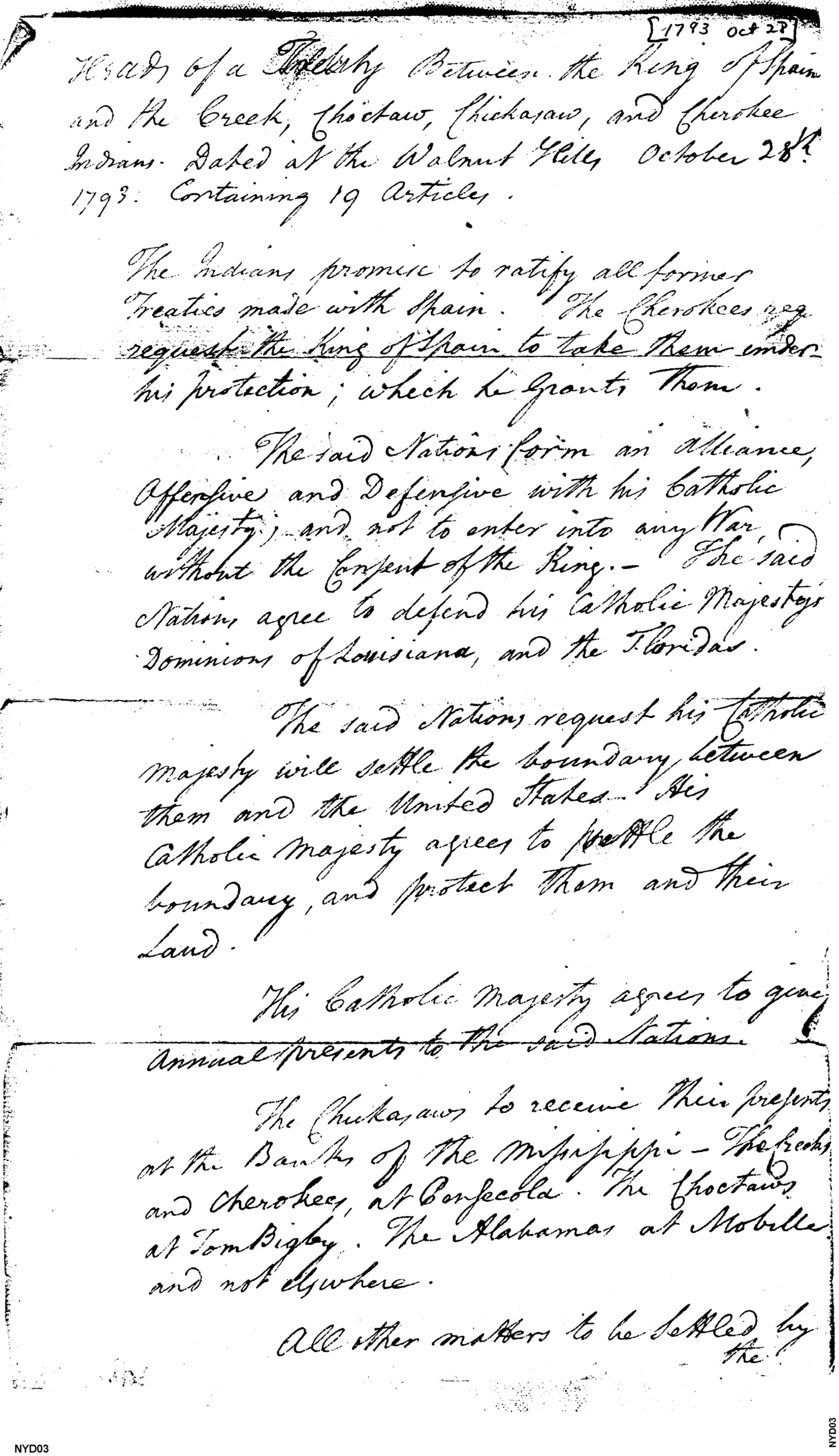
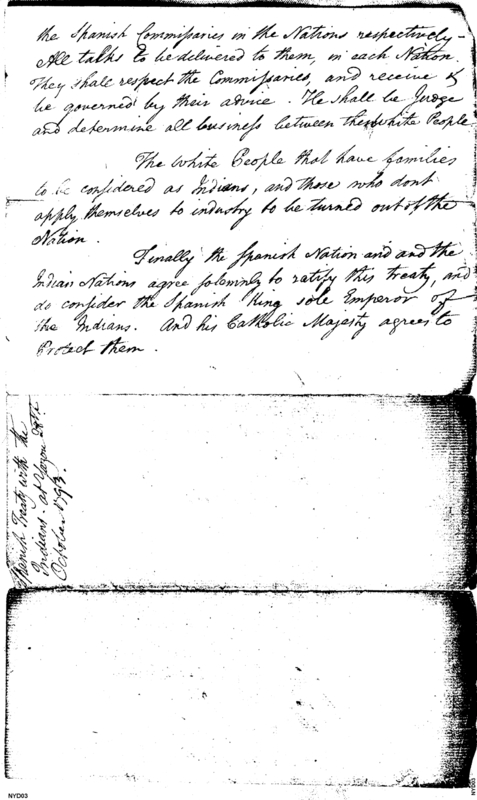
Head of a Treaty Between the King of Spain and the Creek, Choctaw, Chickasaw, and Cherokee Indians. Dated at the Walnut Hills October 28th 1793. Containing 19 Articles. The Indians promise to ratify all former Treaties made with Spain. The Cherokees req request the King of Spain to take them under his protection; which he grants them. The said nations form an alliance, Affective and Defensive with his Catholic Majesty, and not to enter into any War, without the consent of the king. - The said Natives agree to defend his catholic majestys Dominion of Louisiana and the Floridas. The said Nations request his Catholic Majesty will settle the boundary between them and the United States. His Catholic majesty agrees to settle the boundary, and protect them and their land. His Catholic majesty agrees to give annual presents to the said Nations. The Chickasaw to receive their presents on the Banks of the Missipippi - The Creek and Cherokee, at Consecold. The Choctaws at Tom Bigby. The Alabamas at Mobille and not elswhere. All other matters to be settled by the the Spanish Commisaries in the Nations respectively - All talks to be delivered to them, in each Nation. They shall respect the Commisaries, and receive it be governed by their advice. He shall be Judge and determine all business between the White People. The White People that have families to be considered as Indians, and those who don’t apply themselves to industry to be turned out of the Nation. Finally the Spanish Nation and and the Indian Nations agree solemnly to ratify this treaty, and do consider the Spanish King the sole Emperor of The Indians. And his Catholic Majesty agrees to protect them.
Spanish Treaty with the Indians. at Yazon 28th October 1793.
This transcription was generated by machine using Anthropic's Claude Code (model sonnet 4.6). It may contain errors or inaccuracies. Please verify against the document image. Learn more about our generative AI methodology.